
Guide
What is self-growth? Meaning, examples and how to start
Updated 11 October 2026 · 11 min read
Self-growth is the slow, ordinary work of understanding yourself better and living a little more by what matters to you. It isn't about fixing a broken self or chasing endless improvement. It means noticing your patterns, treating yourself fairly, knowing your values and building small habits, so your life feels more like your own.
By the Self Growth team · drawn from well-being research and self-determination theory · how we make these
If you've typed 'what is self-growth' into a search bar, there's a good chance something has shifted. Maybe life feels a bit stuck, or a bit not-quite-yours. Maybe you've noticed the same pattern turn up again, in a new job or a new relationship, and you'd like to understand it.
Self-growth can sound like a big, shiny project. It isn't. It's mostly small, quiet things: noticing, choosing, practising, and being fair with yourself when you slip. This guide explains what it means, what it isn't, the main areas it covers, and a simple way to begin. Each area links to a free worksheet, so you can do the thing as well as read about it.
What does self-growth mean?
Self-growth (also called personal growth, or self growth and development) means becoming more aware of who you are and more able to live in a way that fits it. It covers how you understand yourself, how you treat yourself, what you value, how you relate to other people, and the habits that shape an ordinary day.
Psychologists have a version of this idea too. In a 1989 paper in the Journal of Personality and Social Psychology, Carol Ryff set out six dimensions of psychological well-being, and 'personal growth' is one of them. In her model, it describes a sense of continuing to develop, seeing yourself as growing over time, and being open to new experiences. The point is that growth is treated as part of feeling well, not a bonus on top.
Self-growth isn't becoming someone else. It's becoming more fully, more comfortably, yourself.
Another useful lens comes from self-determination theory. Richard Ryan and Edward Deci describe three basic psychological needs: autonomy (feeling your choices are your own), competence (feeling able) and relatedness (feeling connected to others). Their work links meeting these needs with better motivation and well-being. You can read a lot of self-growth as simply looking after those three things.
What self-growth is not
A lot of what gets sold as self-growth makes people feel worse, so it's worth being clear about what it isn't.
- It isn't endless self-improvement. You don't have to optimise every hour or turn your life into a project with targets. Rest counts. Staying the same in some areas is fine.
- It isn't fixing a broken you. You're not starting from a fault. Growth starts from where you already are, with whatever you've got.
- It isn't hype. No morning routine, book or mindset will change everything in a weekend. Real change is usually small and a bit boring.
- It isn't a race or a comparison. Someone else's pace, or what they post, tells you nothing about yours.
- It isn't therapy. Self-reflection can help a lot, but it doesn't replace real support when things are hard.
Examples of self-growth
Self-growth rarely looks dramatic from the outside. Some everyday examples:
- Noticing you snap when you're tired, and starting to say 'I need ten minutes' instead.
- Catching the voice that calls you an idiot after a mistake, and answering it the way you'd answer a friend.
- Working out that freedom matters more to you than status, and letting that guide a job decision.
- Saying no to an extra favour without a long apology.
- Going for a ten-minute walk three times a week, and keeping it up for a month.
- Being able to name a feeling ('I'm disappointed', not just 'I'm fine') before reacting to it.
- Trying something you'd usually avoid because you might be bad at it.
- Apologising properly after an argument, without defending yourself first.
None of these would make a headline. All of them change how a life feels to live.
The main areas of self-growth
There's no official list, but most self-growth falls into a handful of areas. You don't need to work on all of them. Pick the one that sounds most like where you are now.
Self-awareness. Understanding your own patterns, triggers and strengths, and how you come across to others. It's the base the other areas rest on. Start with the self-awareness worksheet or the guide to becoming more self-aware. If you'd rather begin with the bigger question of who you are, try the Who am I? worksheet.
Self-esteem and self-worth. How you judge yourself, and whether you feel you're worth something regardless of how today went. The two overlap but aren't the same, which the guide on self-worth vs self-esteem explains. For practice, there are self-esteem worksheets and a self-worth worksheet.
Self-compassion. Treating yourself with the kindness you'd give a friend, especially when things go wrong. It's often what keeps self-growth from turning harsh. The self-compassion worksheet and the guide to practising self-compassion are good places to start, and the negative self-talk worksheet helps when the inner critic is loud.
Values. Knowing what actually matters to you, so your choices have something to point at. Use the core values worksheet or read how to find your core values.
Boundaries. Being clear about what you will and won't do, give or accept. For many people this is where growth first shows up in real life. See the boundaries worksheet and the guide to setting boundaries. If saying yes comes out before you can stop it, the people-pleasing worksheet helps too.
Habits and goals. Turning what you care about into small, repeatable actions. The goal-setting worksheet and the guide on how to set goals cover the basics, and self-growth goals has ideas aimed at this kind of inner work. The growth mindset worksheet helps when you're stuck on 'I'm just not good at this'.
Emotional skills. Noticing, naming and handling feelings without being run by them. The feelings wheel helps you find the right word, and a gratitude journal is a gentle way to notice what's going well. Looking after yourself on a basic level belongs here too, and the self-care worksheet helps you plan it.
If you're not sure which area to start with, the wheel of life worksheet gives you a quick picture of how each part of your life feels right now, so you can see where a bit of attention would help most.
Why is self-growth important?
Self-growth matters less because it makes you 'better' and more because it makes your life feel more like yours. When you understand your patterns, you're less likely to repeat the painful ones on autopilot. When you know your values, decisions get a little easier. When you treat yourself fairly, setbacks sting without flattening you.
It also tends to help the people around you. Someone who can name their feelings, say no kindly and apologise properly is easier to be close to. Psychologist Carol Ryff's model of psychological well-being puts personal growth alongside self-acceptance, positive relations with others, autonomy, environmental mastery and purpose in life, which fits what you may notice yourself: these areas tend to move together.
How to start self-growth, step by step
You don't need a plan for your whole life. You need a starting point, one small action and a way to notice how it's going.
- 1Take stock. Rate how each area of your life feels right now, from work and health to friendships and fun. A wheel of life is a quick way to do this.
- 2Pick one area. Choose the one that would make the biggest difference if it felt a little better, not the one you think you should fix.
- 3Get curious before you change anything. Spend a week noticing what happens in that area: when it goes well, when it doesn't, and what you feel.
- 4Choose one small action. Make it so small you could do it on a bad day, like a ten-minute walk, one honest no, or writing three lines before bed.
- 5Write it down. Note the area, the action and why it matters to you, so you have something to come back to.
- 6Check in after a few weeks. Ask what's changed, what's been hard and what you'd adjust. Then keep going, change the action, or pick a new area.
- 7Be fair with yourself when you slip. Missing a day is part of it. Start again without the lecture.
The free self-growth plan worksheet walks you through these steps on one page, so you finish with one area, one action and a date to check in.
Open the Self-Growth PlanSelf-growth questions to ask yourself
Good questions do more than tips. Pick two or three of these and write your answers down, rather than just thinking them. Writing slows you down enough to notice what you actually believe.
- What do I want more of in my life, and what do I want less of?
- When did I last feel most like myself? What was I doing?
- What pattern keeps showing up for me, in different places or with different people?
- What am I tolerating that I don't need to?
- How do I talk to myself when I make a mistake? Would I talk to a friend that way?
- What three things matter most to me, and does my week reflect them?
- Where do I say yes when I mean no?
- What am I avoiding because I might not be good at it?
- What do I need right now that I'm not giving myself?
- Who do I feel most at ease with, and why?
- What would a slightly kinder version of today look like?
- What have I already grown through that I don't give myself credit for?
If you'd like more prompts like these, the self-discovery journal prompts go deeper, and best self-growth books has reading if you want it.
Self-growth tips that actually help
- Go small and specific. 'Be more confident' is a wish. 'Speak once in Monday's meeting' is a step.
- Work on one area at a time. Trying to change everything at once usually means changing nothing.
- Write things down. Reflection on paper is easier to look back on and harder to argue with.
- Notice progress, not just gaps. Keep a short note of what's gone better.
- Let rest count. Growth needs recovery, the same way muscles do.
- Pair challenge with kindness. Push where it helps, and go easy where you're already stretched.
- Talk to someone you trust. Other people often see your patterns before you do.
Signs self-growth is helping, and signs it's tipped into harshness
Self-growth should feel like you're on your own side. Some signs it's working:
- You notice your patterns sooner, even if you don't always stop them.
- You recover from setbacks a little faster.
- Your choices feel more like your own.
- You can say what you feel and need more clearly.
- You feel a bit more at ease with yourself, not just busier.
And some signs it has turned into something harsher:
- You feel you're never doing enough, however much you do.
- Every flaw feels like a project that has to be fixed now.
- You compare your progress with other people's and come away feeling worse.
- Rest or a missed day makes you feel guilty or like a failure.
- The inner voice pushing you sounds more like a critic than a coach.
If the second list sounds familiar, that's useful to know, not a reason to give up. Slow down, shrink the goal, and spend some time on self-compassion before anything else. The guide to quieting your inner critic may help.
When to get more support
Self-growth tools are for reflection, not treatment. If low mood, anxiety, old hurts or difficult relationships keep getting in the way, or if working on yourself brings up more than you can hold, that's a sign to talk to someone, not to try harder alone.
A GP is a good first step and can point you towards talking therapies or other support. If you ever have thoughts of harming yourself, please reach out straight away: in the UK you can call Samaritans on 116 123, in the US you can call or text 988, and findahelpline.com lists free helplines in other countries. You deserve real support, not just a worksheet.
How we put this together
This guide is written in plain language. 'Self-growth' is an everyday phrase rather than a single research term, so it draws on the nearest evidence: Carol Ryff's model of psychological well-being, which names personal growth as one dimension, and self-determination theory's work on basic psychological needs. The examples, steps and questions are practical suggestions, not findings from a study. It's an educational self-reflection resource, not therapy or medical advice, see our editorial standards.
If you want to go deeper
- Carol D. Ryff — Happiness is everything, or is it? Explorations on the meaning of psychological well-being, Journal of Personality and Social Psychology, 57(6), 1069-1081, 1989 (doi:10.1037/0022-3514.57.6.1069).
- Richard M. Ryan & Edward L. Deci — Self-determination theory and the facilitation of intrinsic motivation, social development, and well-being, American Psychologist, 55(1), 68-78, 2000 (doi:10.1037/0003-066X.55.1.68).
Your questions, answered
- What is the meaning of self-growth?
- Self-growth means becoming more aware of who you are and more able to live in a way that fits it. It covers self-awareness, how you treat yourself, your values, your boundaries, your habits and how you handle feelings. It's usually slow and ordinary rather than dramatic, and it starts from where you already are.
- What are some examples of self-growth?
- Everyday examples include noticing you get short-tempered when tired and asking for a break, answering your inner critic more fairly, working out your values and using them in a decision, saying no without over-apologising, naming a feeling before reacting, and keeping up a small habit like a short walk for a few weeks.
- Why is self-growth important?
- Self-growth helps your life feel more like your own. Understanding your patterns makes you less likely to repeat painful ones, knowing your values makes decisions easier, and treating yourself fairly helps you recover from setbacks. In Carol Ryff's model of psychological well-being, personal growth is one of six core dimensions of feeling well.
- Is self-growth the same as self-improvement?
- They overlap, but not quite. Self-improvement often means fixing faults or hitting targets. Self-growth is wider and gentler: understanding yourself, living by your values and treating yourself fairly, including in the areas you choose not to change. If 'improving' leaves you feeling never good enough, it has probably tipped into harshness.
- How do I start with self-growth?
- Take stock of how each area of your life feels, pick one area, notice what happens in it for a week, then choose one small action you could do even on a bad day. Write it down and check in after a few weeks. A wheel of life and a simple self-growth plan make this easier.
- Is this free, and is it therapy?
- Everything here is free, with no payment and no email needed, and the worksheets work online or printed. They're self-reflection tools, not therapy. If things feel heavy, a GP or therapist can help. If you ever have thoughts of harming yourself, contact Samaritans on 116 123 (UK), 988 (US) or a helpline at findahelpline.com.
Worksheets to do the work
Free to fill in online or print. No email needed.
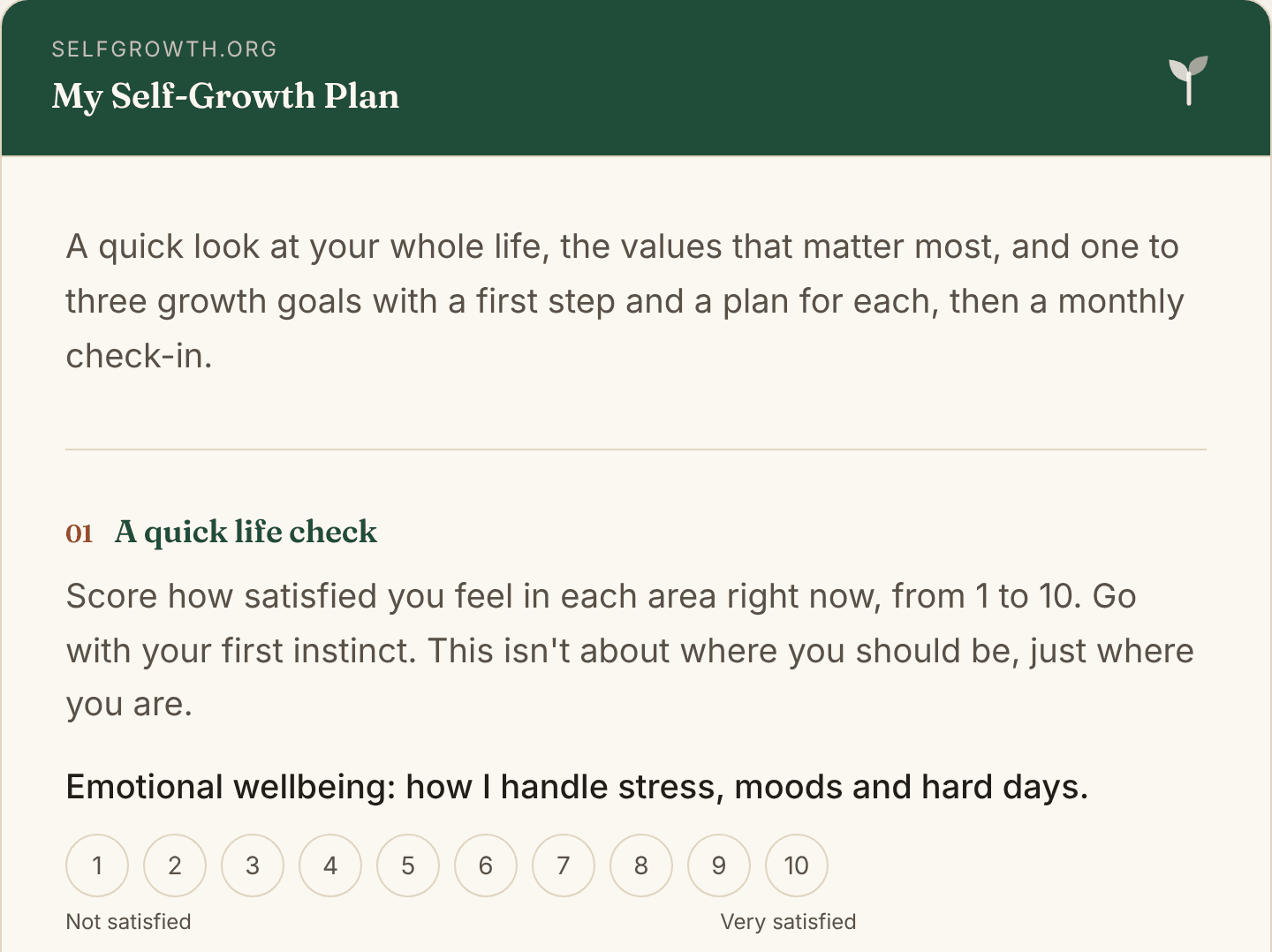
Self-Growth Plan
A free, printable self-growth plan template: check in on six areas of life, pick three values, choose one to three goals, plan a first step and review monthly.
Open worksheet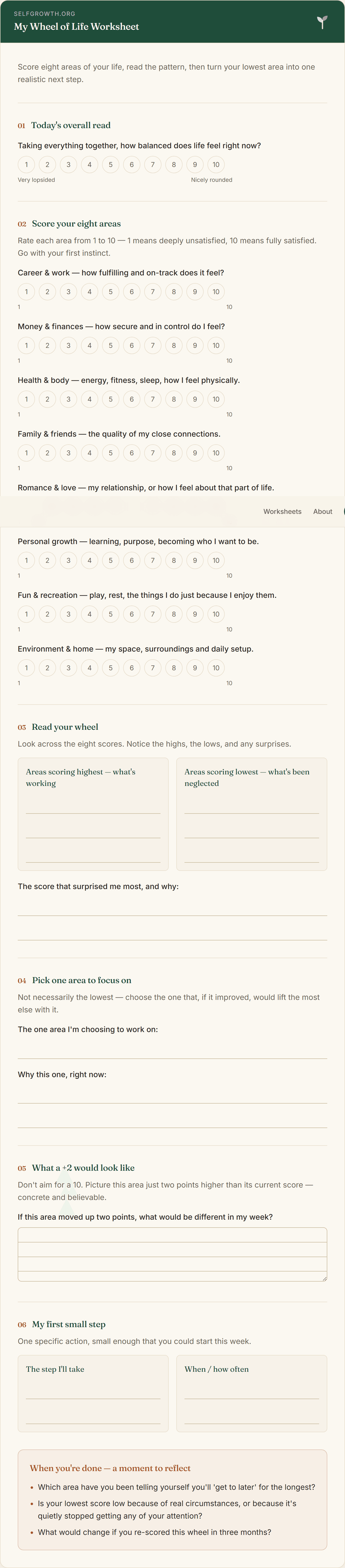
Wheel of Life Worksheet
A free, printable Wheel of Life worksheet. Score eight areas of your life out of ten, see where you're out of balance, and pick one to work on next.
Open worksheet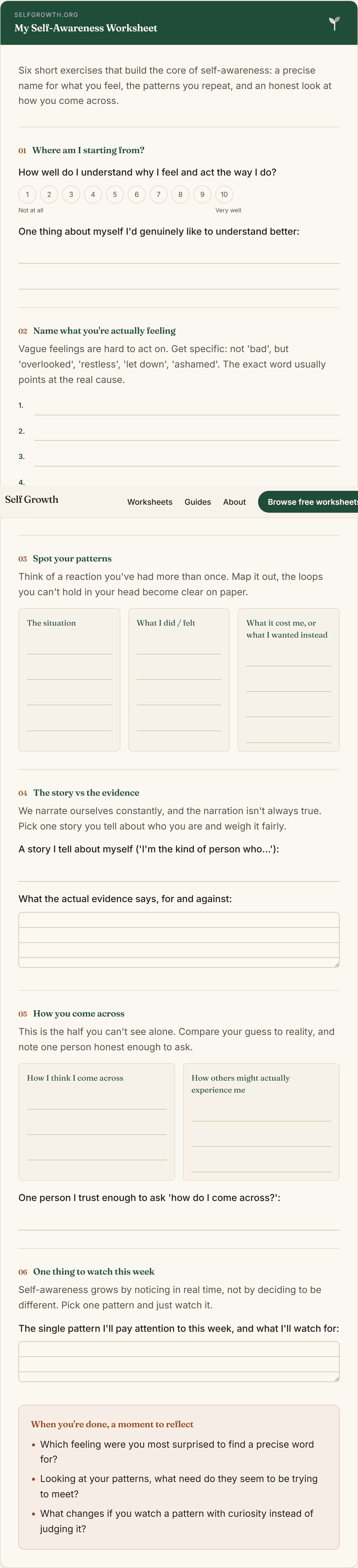
Self-Awareness Worksheet
A free, printable self-awareness worksheet with guided exercises to name your feelings, spot your patterns, and see how you come across, so you understand yourself better.
Open worksheet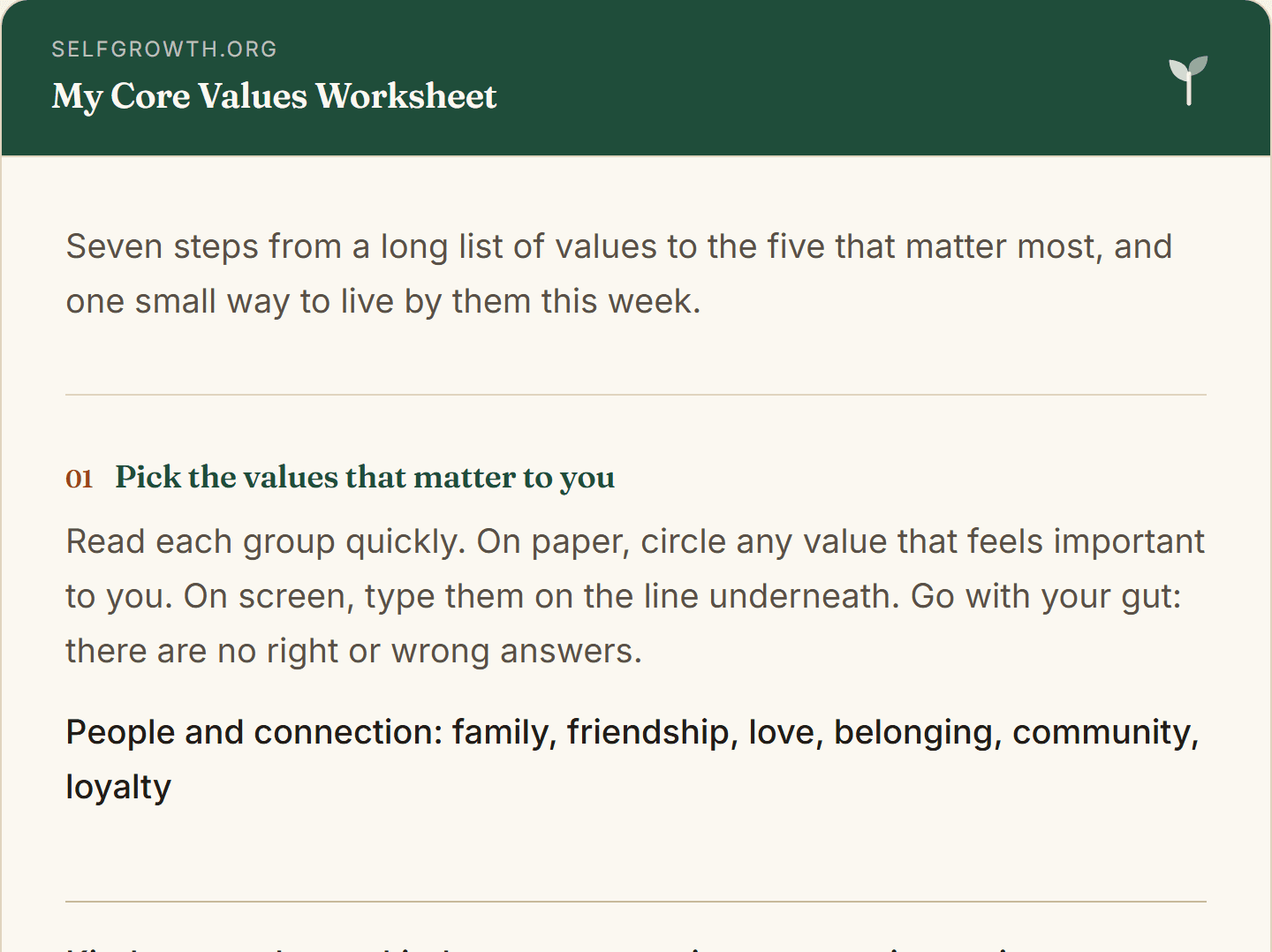
Core Values Worksheet
A free, printable core values worksheet: pick values from a list, narrow them to your top five, put them in your own words and plan one step to live by them.
Open worksheet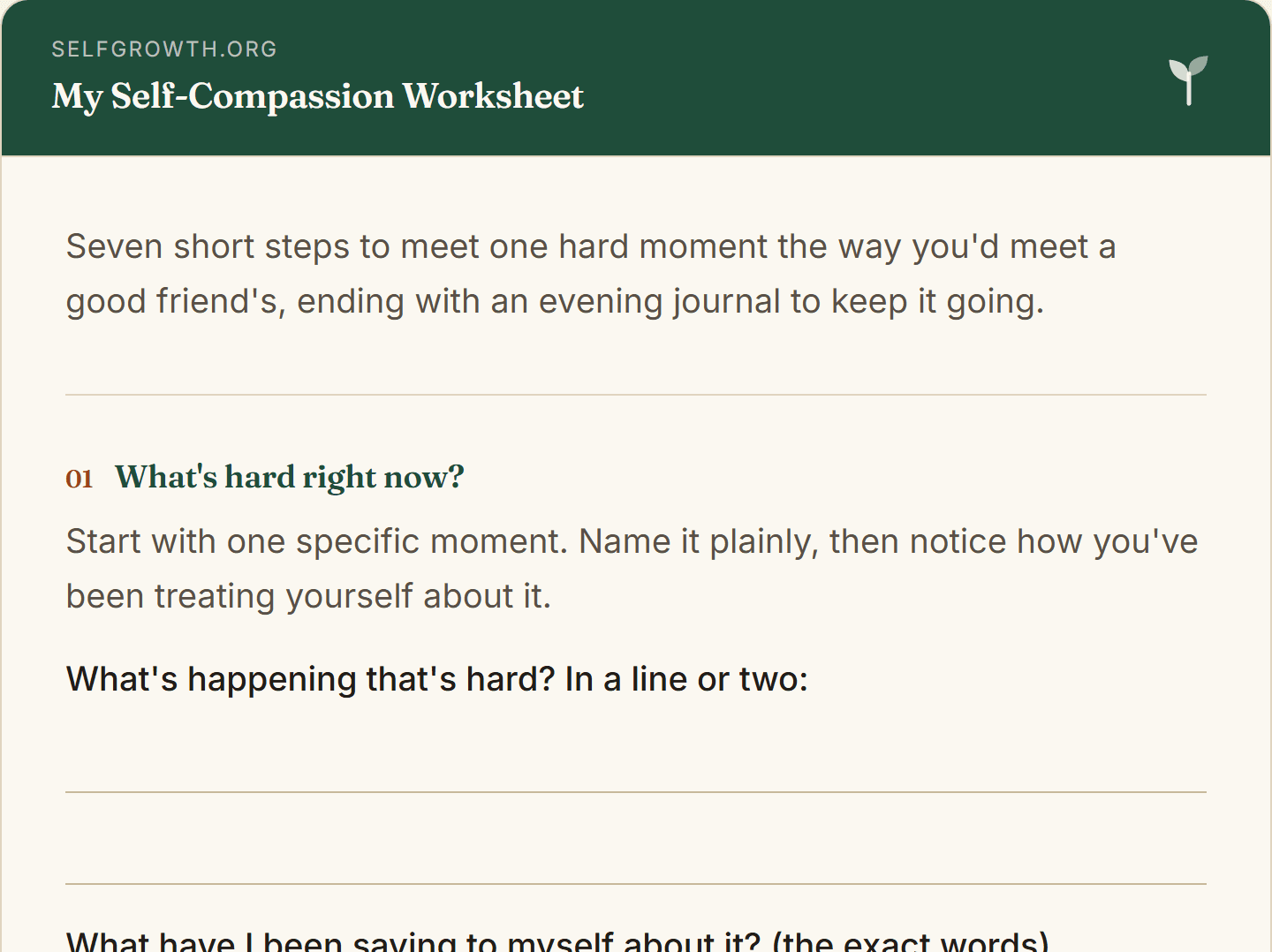
Self-Compassion Worksheet
A free, printable self-compassion worksheet: the self-compassion break, the friend test, a kind letter and journal prompts, based on Kristin Neff's research.
Open worksheet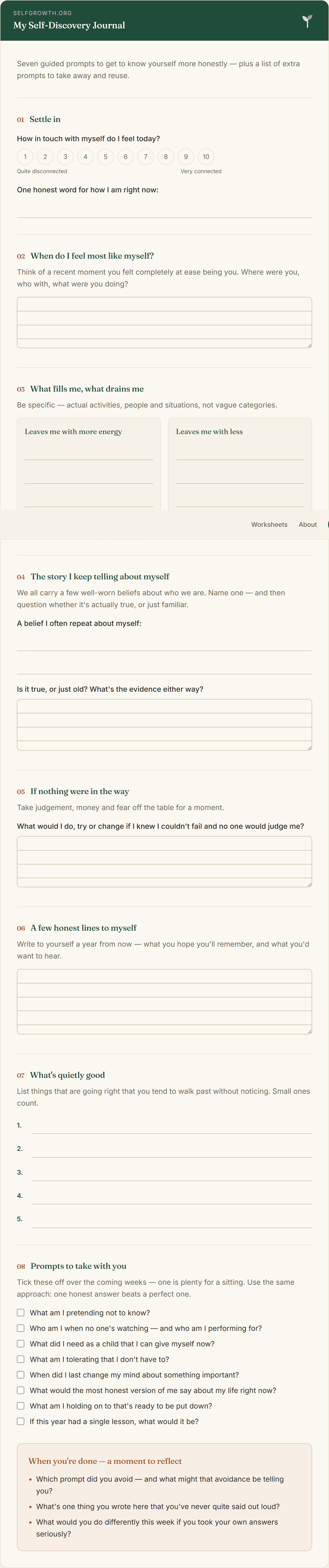
Self-Discovery Journal Prompts
Free, printable self-discovery journal prompts, guided questions with space to write, to explore your values, patterns and what you really want.
Open worksheetRelated guides
New worksheets, straight to your inbox
An occasional new worksheet or tool, sent only when there's something genuinely worth your time. No spam, no pressure, unsubscribe any time.