
Guide
The best self-growth books, and who each one is for
Updated 11 October 2026 · 12 min read
The best self-growth books are honest about what they rest on, and most come from qualified people drawing on real research. Good places to start: Self-Compassion by Kristin Neff if you're hard on yourself, Feeling Good by David Burns for negative thinking, The Happiness Trap by Russ Harris for overthinking, and Atomic Habits by James Clear for building habits.
By the Self Growth team · a reading guide to well-respected books on CBT, ACT, self-compassion and habits · how we make these
There are thousands of self-help books, and it's hard to tell which one fits you. This one is shorter. It groups 14 well-known, widely respected books by what you might be going through, so you can find the one that fits your life right now rather than the one with the loudest cover.
For each book you'll find what it's about in plain words, what it actually rests on (including when a book is popular but thinly evidenced), who it tends to suit, and a free worksheet on this site that turns the idea into something you can do tonight. There are no affiliate links and no ratings. Your local library will have most of these, often as free ebooks or audiobooks too.
A book can be a real help, but it isn't therapy. If you're struggling more than a book can carry, the last section is for you.
The best self-growth books at a glance
If you only want the shortlist, here it is, grouped by need. The sections below say more about each one.
- If you're too hard on yourself: Self-Compassion (Kristin Neff), Radical Acceptance (Tara Brach), The Gifts of Imperfection (Brené Brown).
- If your self-esteem is low: Overcoming Low Self-Esteem (Melanie Fennell).
- If your thoughts run away with you: Feeling Good (David Burns), Chatter (Ethan Kross).
- If you want better habits and goals: Atomic Habits (James Clear), Mindset (Carol Dweck).
- If you're looking for meaning and direction: Man's Search for Meaning (Viktor Frankl), The Happiness Trap (Russ Harris), Thanks! (Robert Emmons).
- If you struggle to say no: Set Boundaries, Find Peace (Nedra Glover Tawwab).
- If you want to understand yourself more deeply: Owning Your Own Shadow (Robert Johnson), Maybe You Should Talk to Someone (Lori Gottlieb).
Best books if you're too hard on yourself
If the voice in your head is harsher than anything you'd say to a friend, start here. These three books come at the same problem from different angles: research, meditation and storytelling.
Self-Compassion: The Proven Power of Being Kind to Yourself, by Kristin Neff (William Morrow, 2011).
- What it's about: how to treat yourself with the same kindness you'd offer a struggling friend, and why that works better than self-criticism for keeping you going.
- What it rests on: Neff is a psychologist at the University of Texas at Austin who has spent years researching self-compassion, and she co-developed the Mindful Self-Compassion programme. It's one of the better-evidenced ideas in this list, though the book itself hasn't been tested as a treatment.
- Suits you if: you're a perfectionist, you beat yourself up after mistakes, or you worry that being kinder to yourself would make you lazy.
- Try it with: the self-compassion worksheet, built on Neff's own exercises.
Radical Acceptance, by Tara Brach (Bantam, 2003). A 20th anniversary edition, with a new introduction and an extra chapter, was published in 2023.
- What it's about: what Brach calls the 'trance of unworthiness', the quiet sense that something is wrong with you, and how to meet it with acceptance instead of a fight.
- What it rests on: Buddhist meditation teaching, mixed with Brach's work as a clinical psychologist and stories from her own life. Mindfulness has a real research base, but the book is a teaching, not a tested method.
- Suits you if: you feel not good enough in a way that's hard to name, and you're open to a gentle, spiritual tone.
- Try it with: the self-love worksheets.
The Gifts of Imperfection, by Brené Brown (Hazelden, 2010). A 10th anniversary edition followed.
- What it's about: letting go of who you think you're supposed to be, and living with more courage, compassion and connection, mess and all.
- What it rests on: Brown's qualitative research, meaning interviews and the patterns she drew from them, on shame and what she calls 'wholehearted' living. It's thoughtful and widely loved, but it's descriptive research, not a tested programme.
- Suits you if: perfectionism and fear of what people think are running your life, and you like warm, personal writing.
- Try it with: the self-worth worksheets.
Best self-esteem books
Overcoming Low Self-Esteem, by Melanie Fennell (Robinson, 1999). The second edition, from 2016, is the one in print.
- What it's about: how low self-esteem forms, the 'bottom line' belief about yourself that keeps it going, and step-by-step ways to question that belief and act against it.
- What it rests on: cognitive behavioural therapy (CBT). Fennell is a clinical psychologist and one of the early CBT practitioners in the UK. The book has appeared on Reading Well, the Books on Prescription scheme run by The Reading Agency with health partners in England.
- Suits you if: you want a practical, structured workbook rather than inspiration, and you're willing to do the exercises.
- Try it with: the self-esteem worksheets for adults, or the shorter self-esteem worksheets.
If you're not sure whether your struggle is self-esteem or self-worth, the guide to self-worth vs self-esteem can help you tell them apart.
Best books for negative thinking and overthinking
Feeling Good: The New Mood Therapy, by David D. Burns (William Morrow, 1980). A revised edition followed in 1999.
- What it's about: how distorted thoughts, like all-or-nothing thinking and jumping to conclusions, drive low mood, and how to catch and answer them on paper.
- What it rests on: CBT. Burns is a psychiatrist, and the first edition carries a preface by Aaron Beck, who founded cognitive therapy. Unusually for a self-help book, it has been tested directly: in a 1995 study by C. Jamison and Forrest Scogin, adults with depression who worked through it with minimal contact improved more than a group on a waiting list, and kept their gains three months later. The studies are small and older, so treat it as a promising support, not a replacement for care.
- Suits you if: your mood follows your thoughts, and you like lists, examples and exercises. It's long, so dip in rather than read it cover to cover.
- Try it with: the negative self-talk worksheet.
Chatter: The Voice in Our Head, Why It Matters, and How to Harness It, by Ethan Kross (Crown, 2021).
- What it's about: why we get stuck in loops of worry and rumination, and small, practical ways to step back, such as coaching yourself through a problem as if you were talking to someone else.
- What it rests on: Kross is a psychology professor at the University of Michigan who runs a lab studying emotion and self-control, and the book draws heavily on his lab's experiments and others'. It's well grounded, though many of the studies are lab-based and short-term.
- Suits you if: you overthink, replay conversations, or talk yourself into a spiral, and you like science explained clearly.
- Try it with: the positive self-talk worksheet.
For more on the harsh inner voice specifically, the guide to quieting your inner critic goes deeper.
Best books for building better habits
Atomic Habits, by James Clear (Avery, 2018).
- What it's about: building habits by making them small, obvious and easy, shaping your surroundings so the good choice is the easy one, and tying habits to the person you want to be.
- What it rests on: Clear is a writer, not a psychologist or researcher. He pulls together ideas from habit research and behaviour change in a very readable way. The core advice fits what's known about habits, but the book isn't a source of new evidence, and some of its stories are illustrations rather than findings.
- Suits you if: you keep starting things and stopping, and you want a practical system more than a deep look at why.
- Try it with: the self-growth plan or the goal-setting worksheet.
Mindset: The New Psychology of Success, by Carol S. Dweck (Random House, 2006). An updated edition adds her later thinking, including the idea of a 'false growth mindset'.
- What it's about: the difference between a fixed mindset (believing your abilities are set) and a growth mindset (believing they can be developed), and how that belief shapes how you handle challenge and failure.
- What it rests on: Dweck is a Stanford psychologist, and the book rests on decades of her research. It's worth knowing the evidence is more mixed than the book's fame suggests: two large 2018 meta-analyses led by Victoria Sisk found the overall links between mindset and school results, and the effects of mindset programmes, were weak, with possible benefits for some struggling students.
- Suits you if: fear of failure stops you trying, or you tend to decide you're 'just not a ... person'. Read it as a useful way of thinking, not a guarantee.
- Try it with: the growth mindset worksheet.
If you want to turn either book into a real plan, the guide to setting goals walks through it step by step.
Best books for finding meaning and what matters to you
Man's Search for Meaning, by Viktor E. Frankl (first published in German in 1946; first English edition, Beacon Press, 1959, as From Death-Camp to Existentialism, retitled in 1962).
- What it's about: Frankl's account of surviving Nazi concentration camps, followed by a short introduction to his idea that the search for meaning is what keeps people going, even in terrible circumstances.
- What it rests on: Frankl was a psychiatrist, and the book rests on his own experience and the approach he founded, logotherapy. It's a profound memoir more than an evidence-based method, and logotherapy itself has been studied far less than CBT.
- Suits you if: you feel adrift, or you're facing something hard and want perspective. It's short, but it's heavy in places, so be gentle with yourself while you read.
- Try it with: the core values worksheet.
The Happiness Trap, by Russ Harris (Exisle, 2007). A heavily revised second edition was published in 2022.
- What it's about: why chasing good feelings and fighting bad ones often makes things worse, and how to make room for hard thoughts while doing what matters to you.
- What it rests on: acceptance and commitment therapy (ACT), which has a large and growing research base. Harris is a doctor and a well-known ACT trainer. It's one of the most practical ACT books written for the general reader.
- Suits you if: you're anxious, stuck in your head, or tired of trying to think your way to feeling better.
- Try it with: the core values worksheet, since ACT leans on knowing your values.
Thanks! How the New Science of Gratitude Can Make You Happier, by Robert A. Emmons (Houghton Mifflin, 2007).
- What it's about: what gratitude is, why it can be hard, and simple ways to practise it, such as keeping a gratitude journal.
- What it rests on: Emmons is a psychologist and one of the best-known gratitude researchers, and the book draws on his experiments. The research is real, but expect a gentle lift rather than a transformation, and be wary of any big percentage quoted for how much happier gratitude makes you.
- Suits you if: you want a small daily practice with some science behind it.
- Try it with: the gratitude journal prompts.
Best books for setting boundaries
Set Boundaries, Find Peace: A Guide to Reclaiming Yourself, by Nedra Glover Tawwab (TarcherPerigee, 2021).
- What it's about: what boundaries are, why they're hard, and how to set them with family, partners, friends and at work, with plenty of example wording.
- What it rests on: Tawwab is a licensed therapist, and the book comes mainly from her years of relationship therapy, drawing on CBT ideas. It's practice wisdom, not a tested programme, which is true of most books on boundaries.
- Suits you if: you say yes when you mean no, feel resentful and drained, or keep the peace at your own expense.
- Try it with: the boundaries worksheet or the people-pleasing worksheet.
The guide to setting boundaries covers the same ground with scripts you can adapt.
Best books for self-awareness and shadow work
Owning Your Own Shadow: Understanding the Dark Side of the Psyche, by Robert A. Johnson (HarperSanFrancisco, 1991).
- What it's about: Carl Jung's idea of the 'shadow', the parts of yourself you've pushed out of sight, and why making peace with them can make you more whole.
- What it rests on: Johnson was a Jungian analyst, and the book is Jungian psychology, a rich way of thinking about the mind that hasn't been tested the way CBT or ACT have. It's short and readable, a good first book on the subject.
- Suits you if: you're curious about shadow work and want the idea from its roots, without the hype that surrounds it online.
- Try it with: the shadow work worksheet, and the guide to what shadow work is.
Maybe You Should Talk to Someone, by Lori Gottlieb (Houghton Mifflin Harcourt, 2019).
- What it's about: a psychotherapist's story of her own life falling apart and going to therapy herself, woven with the stories of four of her clients.
- What it rests on: it's a memoir, not a method, so there's nothing to test. Its value is that it shows, honestly and often funnily, what therapy is actually like and how people change.
- Suits you if: you're curious about yourself, or you've wondered about therapy but don't know what happens in the room.
- Try it with: the self-awareness worksheet.
What are good self-growth books for women?
Every book here is for anyone, but if you'd like to read women writers, half of this list is by women: Kristin Neff, Tara Brach, Brené Brown, Melanie Fennell, Carol Dweck, Nedra Glover Tawwab and Lori Gottlieb. If the pressure to be perfect, to please and to look after everyone else first sounds familiar, Self-Compassion, The Gifts of Imperfection and Set Boundaries, Find Peace speak to it directly.
Be wary of books that tell you the problem is that you're not confident enough, not trying hard enough or not 'manifesting' properly. The better books help you understand yourself, not blame yourself.
How to pick a self-help book that's worth your time
Self-help is a huge, mostly unregulated market. A few quick checks will help you skip the ones that waste your time, or worse.
- 1Check who wrote it. Look for an author with relevant training, such as a psychologist, psychiatrist or therapist, or a writer who is open about where their ideas come from.
- 2Look for the method. Good books name what they rest on, such as CBT, ACT or a body of research, and have notes or references at the back.
- 3Notice the promises. Be wary of guarantees, quick fixes, 'secrets' and claims to change your life in days. Real change is usually slower and less dramatic.
- 4Check it's honest about limits. A trustworthy book says when you might need more help than a book can give.
- 5Read a sample first. Borrow it from the library or read the first chapter. If the voice makes you feel worse about yourself, it isn't the right book for you right now.
- 6Do one exercise, not the whole book. Pick one idea and practise it for a week. A book you use beats three you finish.
It's also fine to read a book that's popular but thinly evidenced, as long as you know that's what it is. A good story can be the nudge you need, even when the science behind it is still catching up.
When a book isn't enough
Books are a good start, and some have even been tested as a form of help. But a book can't notice when you're getting worse, and it can't tailor itself to you. If your mood, anxiety or self-worth has been low for weeks, if it's getting in the way of work, sleep or relationships, or if you've tried the exercises and nothing is shifting, you deserve real support, not just a book.
A GP is a good first step and can talk you through options, including talking therapies. In the UK you can also refer yourself to NHS Talking Therapies in England. If you're in crisis or having thoughts of harming yourself, please contact a crisis line now: Samaritans on 116 123 in the UK and Ireland, 988 in the US, or find a free helpline in your country at findahelpline.com. If you're in immediate danger, call your local emergency number.
Everything on this site, including the worksheets linked above, is for self-reflection. It isn't therapy, and it isn't a replacement for it.
How we put this together
This is a reading guide, not a review site. We don't take affiliate fees, give ratings or claim to rank books. Each title, author, year and publisher was checked against the publisher or a library catalogue, and each book's evidence is described as honestly as we can, including when it's popular but thinly tested. It's an educational self-reflection resource, not therapy or medical advice, see our editorial standards.
If you want to go deeper
- Kristin Neff — Self-Compassion: The Proven Power of Being Kind to Yourself (William Morrow, 2011).
- Tara Brach — Radical Acceptance: Embracing Your Life with the Heart of a Buddha (Bantam, 2003; 20th anniversary edition 2023).
- Brené Brown — The Gifts of Imperfection (Hazelden, 2010).
- Melanie Fennell — Overcoming Low Self-Esteem: A Self-Help Guide Using Cognitive Behavioural Techniques (Robinson, 1999; 2nd ed., 2016).
- David D. Burns — Feeling Good: The New Mood Therapy (William Morrow, 1980; revised ed., 1999).
- Ethan Kross — Chatter: The Voice in Our Head, Why It Matters, and How to Harness It (Crown, 2021).
- James Clear — Atomic Habits (Avery, 2018).
- Carol S. Dweck — Mindset: The New Psychology of Success (Random House, 2006; updated edition 2016).
- Viktor E. Frankl — Man's Search for Meaning (first published in German, 1946; first English edition Beacon Press, 1959, as From Death-Camp to Existentialism; retitled 1962).
- Russ Harris — The Happiness Trap (Exisle, 2007; 2nd ed., 2022).
- Robert A. Emmons — Thanks! How the New Science of Gratitude Can Make You Happier (Houghton Mifflin, 2007).
- Nedra Glover Tawwab — Set Boundaries, Find Peace: A Guide to Reclaiming Yourself (TarcherPerigee, 2021).
- Robert A. Johnson — Owning Your Own Shadow: Understanding the Dark Side of the Psyche (HarperSanFrancisco, 1991).
- Lori Gottlieb — Maybe You Should Talk to Someone (Houghton Mifflin Harcourt, 2019).
- C. Jamison & F. Scogin — The outcome of cognitive bibliotherapy with depressed adults, Journal of Consulting and Clinical Psychology, 63(4), 644-650, 1995 (doi:10.1037/0022-006X.63.4.644).
- Victoria F. Sisk, Alexander P. Burgoyne, Jingze Sun, Jennifer L. Butler & Brooke N. Macnamara — To what extent and under which circumstances are growth mind-sets important to academic achievement? Two meta-analyses, Psychological Science, 29(4), 549-571, 2018.
Your questions, answered
- What is the best book for self-growth?
- There isn't one best book for everyone. It depends on what you need. If you're hard on yourself, start with Self-Compassion by Kristin Neff. For negative thinking, Feeling Good by David Burns. For anxious overthinking, The Happiness Trap by Russ Harris. For habits, Atomic Habits by James Clear. Pick the one that matches the problem you'd most like to change.
- What are the top 10 self-growth books?
- A strong top ten, grouped by need: Self-Compassion (Neff), The Gifts of Imperfection (Brown), Overcoming Low Self-Esteem (Fennell), Feeling Good (Burns), Chatter (Kross), Atomic Habits (Clear), Mindset (Dweck), Man's Search for Meaning (Frankl), The Happiness Trap (Harris) and Set Boundaries, Find Peace (Tawwab). Any list like this is a starting point, not a ranking.
- Do self-help books actually work?
- Some can. A few, like Feeling Good, have been tested in studies and helped some readers with mild to moderate low mood, and the Reading Well scheme in England recommends a list of self-help books chosen with health experts. Many others are popular but untested. Books seem to work best when you actually do the exercises, and they're not a replacement for professional help if you're really struggling.
- What should I read first for self-improvement?
- Start with the area that's hurting most, not the most famous book. If you're not sure, Self-Compassion or The Happiness Trap are gentle, practical places to begin, because being kinder to yourself and making room for hard feelings make every other change easier. Pair it with one free worksheet so the ideas turn into action.
- Are there good self-growth books for women?
- Yes. Every book on this list is for anyone, and half are written by women, including Kristin Neff, Brené Brown, Tara Brach, Melanie Fennell, Carol Dweck, Nedra Glover Tawwab and Lori Gottlieb. Many women find Self-Compassion, The Gifts of Imperfection and Set Boundaries, Find Peace especially helpful for perfectionism and people-pleasing.
- Can a self-help book replace therapy?
- No. A good book can teach you useful skills, and for some people it's enough, but it can't respond to you, notice when things are getting worse, or help with trauma or a serious mental health problem. If you're struggling, talk to a GP. If you have thoughts of harming yourself, contact Samaritans on 116 123 (UK), 988 (US) or a helpline at findahelpline.com.
Worksheets to do the work
Free to fill in online or print. No email needed.
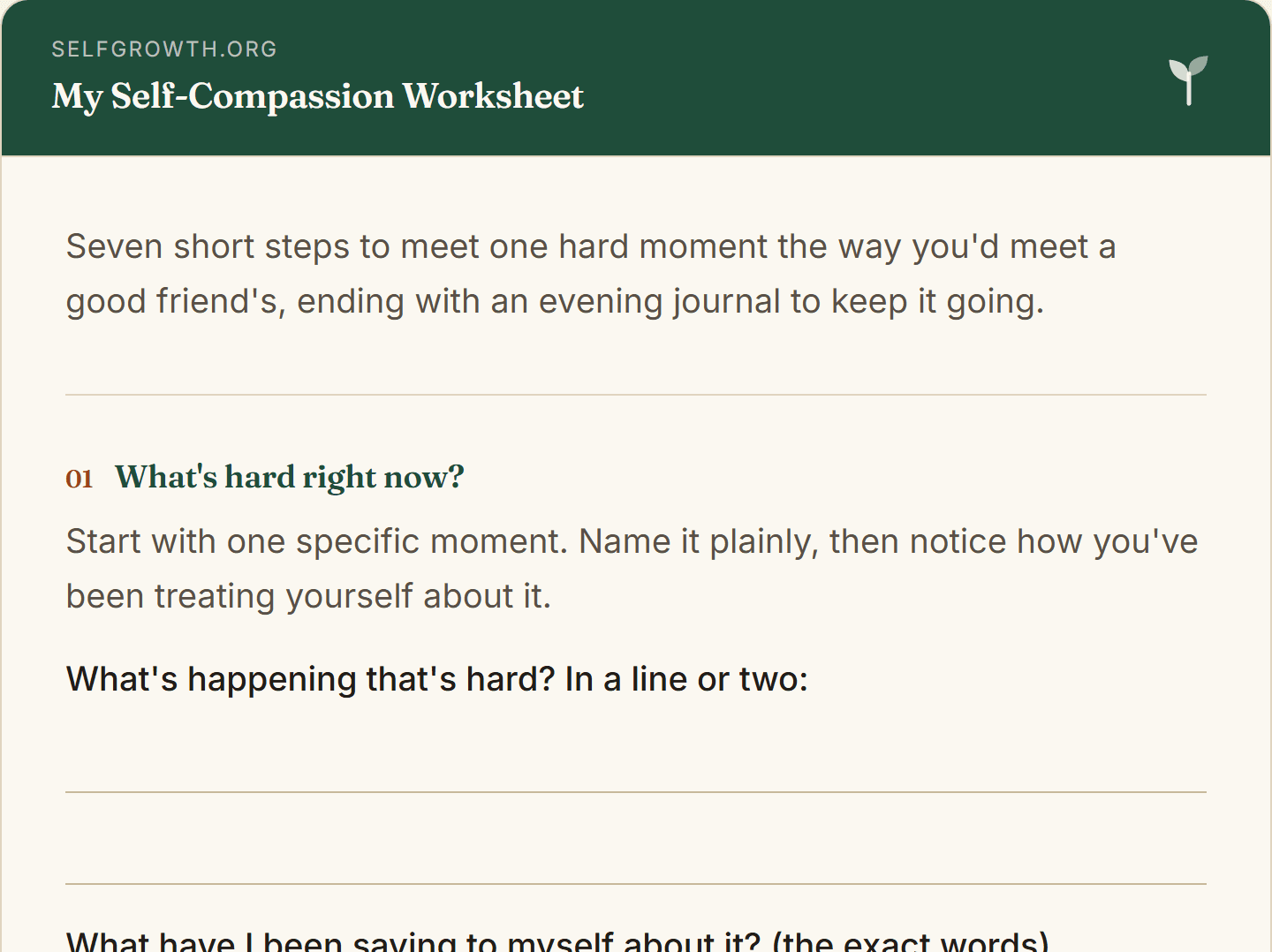
Self-Compassion Worksheet
A free, printable self-compassion worksheet: the self-compassion break, the friend test, a kind letter and journal prompts, based on Kristin Neff's research.
Open worksheet
Negative Self-Talk Worksheet
A free, printable negative self-talk worksheet: catch a harsh inner-critic thought, check whether it's fair, and answer it with something true and kinder.
Open worksheet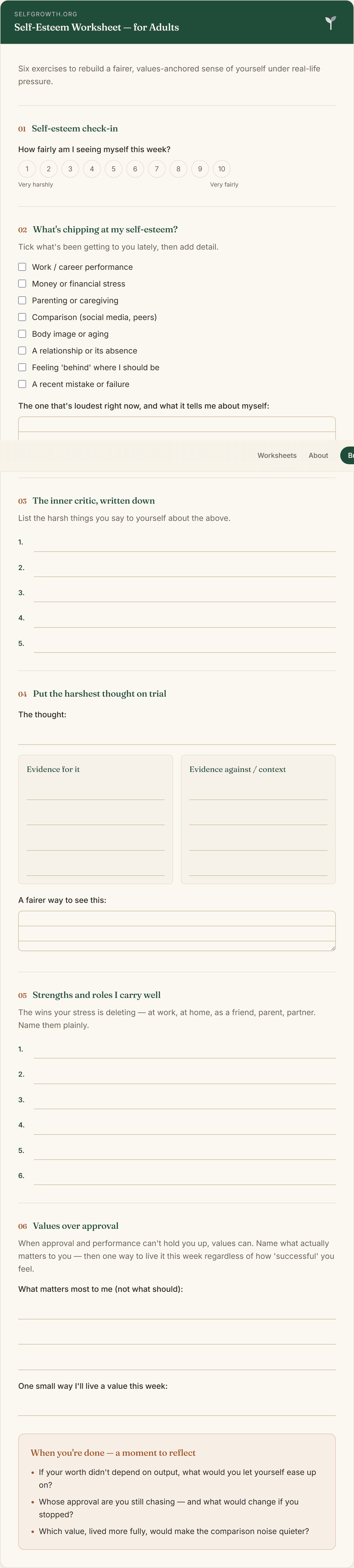
Self-Esteem (Adults)
Free printable self-esteem worksheet for adults: name the pressures wearing you down, question the 'shoulds' you judge yourself by, and credit what you carry.
Open worksheet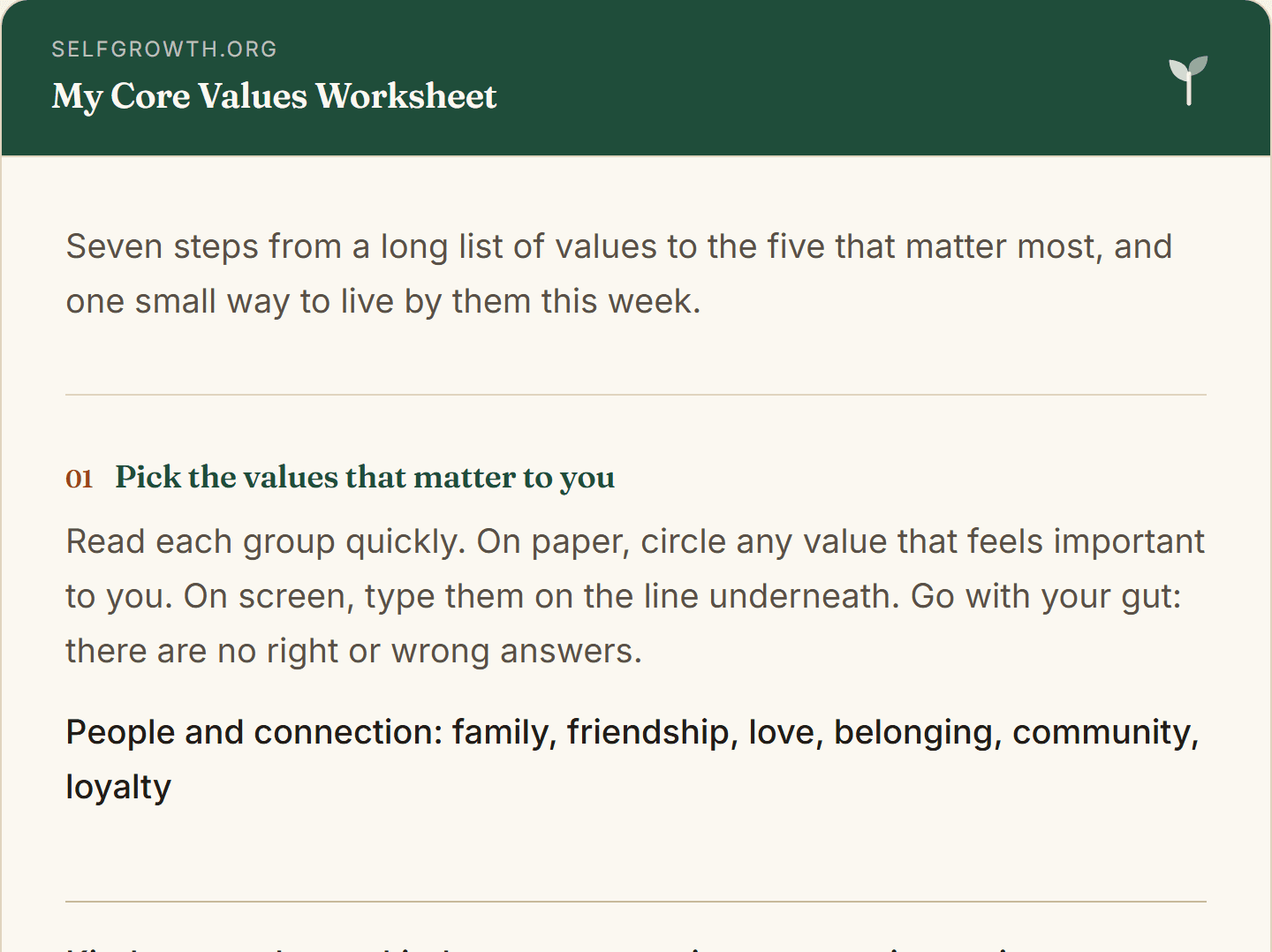
Core Values Worksheet
A free, printable core values worksheet: pick values from a list, narrow them to your top five, put them in your own words and plan one step to live by them.
Open worksheet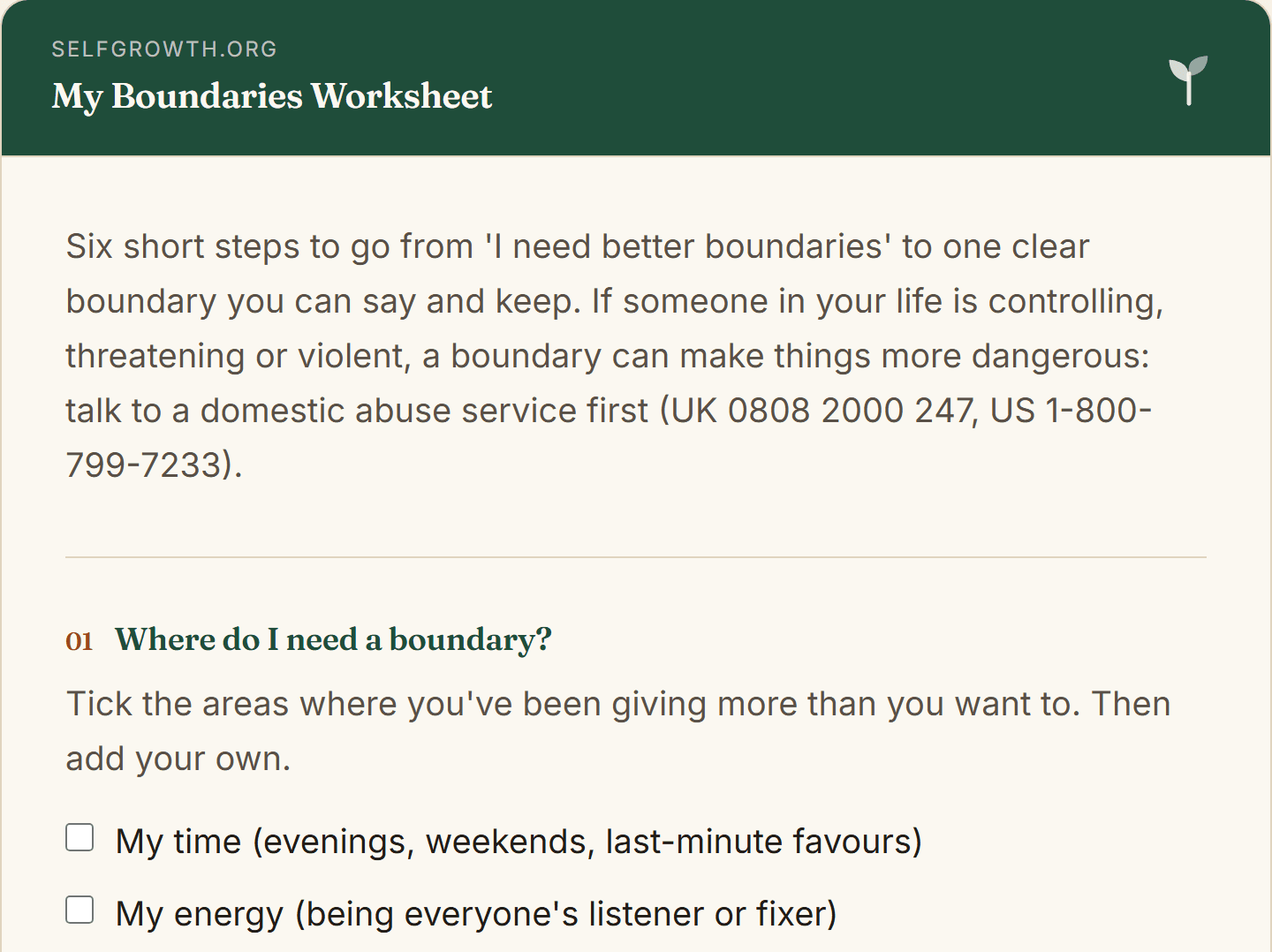
Boundaries Worksheet
A free, printable boundaries worksheet: spot where you need a limit, write it as something you'll do, plan the exact words, and decide what you'll do if it's crossed.
Open worksheet
Goal-Setting Worksheet
A free, printable goal-setting worksheet that turns a vague wish into a specific goal, a when-and-where plan, and a first step you'll actually take this week.
Open worksheetRelated guides
New worksheets, straight to your inbox
An occasional new worksheet or tool, sent only when there's something genuinely worth your time. No spam, no pressure, unsubscribe any time.