
Guide
How to build self-esteem
Updated June 25, 2026 · 10 min read
You build self-esteem less by trying to think positively and more by changing what you do and how you treat yourself. Notice the harsh voice in your head and answer it more fairly, act in line with what you value even when you don't feel like it, and let small, kept promises to yourself stack up over time.
By the Self Growth team · drawn from cognitive behavioural therapy and self-compassion research · how we make these
Most advice about self-esteem tells you to love yourself, as if that were a switch you could simply find and flick. If it were that easy you'd have done it already. Self-esteem isn't a feeling you talk yourself into, it's the quiet sense, built up over time, that you're basically alright and that your own opinion of you counts.
The good news is that it's built, not given. That means it can be rebuilt, in small pieces, at any age, whatever shape it's in right now. You'll see what self-esteem actually is, why it drops, and the handful of things that genuinely move it, and there's a free worksheet for each step so you're not just reading about it.
What self-esteem actually is (and isn't)
Self-esteem is how you rate your own worth. Healthy self-esteem isn't thinking you're better than other people, and it isn't feeling great all the time. It's steadier than that: a basic, fairly stable belief that you matter and that you can handle things, that doesn't collapse every time you make a mistake or someone disapproves.
It helps to separate two things that often get lumped together:
- Self-worth is the quiet belief that you have value as a person, regardless of what you achieve or how you look. It's the foundation.
- Self-confidence is the belief that you can do a particular thing: speak up, drive, handle the meeting. It's specific, and it grows with practice.
You can be confident in your job and still feel low in self-worth. You can have shaky confidence and still know, underneath, that you're a worthwhile person. Knowing which one is wobbling tells you where to start.
Signs of low self-esteem
Low self-esteem doesn't always look like obvious self-hatred. More often it's quieter, woven into everyday habits you might not connect to it at all. You might recognise some of these in yourself:
- A harsh inner voice that's quick to call you stupid, useless or a failure over small things.
- Finding it hard to accept a compliment, while criticism lands instantly and stays.
- Saying sorry constantly, or feeling you have to earn your place in a room.
- Putting everyone else first and treating your own needs as an imposition.
- Holding back from things you want, jobs, conversations, relationships, because you assume you'll fail or be rejected.
- Blaming yourself when things go wrong, and putting it down to luck when they go right.
- A nagging sense of being not quite good enough that no achievement seems to settle.
Recognising a few of these isn't a diagnosis, and it isn't a problem with you as a person. It's just a sign that the way you relate to yourself has tilted unfairly, which is exactly the thing that can be changed.
What causes low self-esteem?
Low self-esteem is usually learned, not a fact about you. It often traces back to early messages (a critical parent, bullying, never quite measuring up), to a hard stretch (loss, illness, a relationship that chipped away at you), or simply to years of an unkind inner voice going unchallenged.
Whatever started it, it's kept alive in the present by a few habits of mind:
- A harsh inner critic that narrates your day, far more cruelly than you'd ever speak to a friend.
- All-or-nothing rules: one mistake means you've failed, one rejection means you're unlovable.
- Discounting the good: praise bounces off, criticism sticks.
- Comparing your insides to other people's outsides, usually on a screen.
There's a hopeful pattern in the research here. Psychologists who have tracked self-esteem across the lifespan, such as Ulrich Orth and Richard Robins, find that it tends to dip in adolescence and then climb steadily through adulthood. In other words, low self-esteem is rarely a fixed trait, and it's genuinely not too late to change it.
Illustrative shape only, not exact figures. Based on Orth & Robins (2014), who tracked self-esteem across the lifespan: low in adolescence, rising through adulthood, peaking in the 50s to 60s, then easing in later life.
You can't undo the past, but these present-day habits are where the leverage is, because they're things you can actually catch and change.
What actually builds it
Self-esteem follows action more than it leads it.
Four things move self-esteem more than anything else. None of them is dramatic. All of them work by repetition.
- 1Answer the inner critic more fairly. When you catch a harsh thought ("I'm useless"), don't argue it into fake positivity. Just ask what you'd say to a friend in the same spot, and write that down. Over time the fairer voice gets louder.
- 2Act on your values, not your mood. Self-esteem follows action more than it leads it. Do one small thing that matters to you, even when you don't feel like it, and let the evidence pile up that you're someone who shows up.
- 3Keep small promises to yourself. Confidence is built from a stack of kept commitments. Make them tiny enough that you'll actually do them, then do them, so your word to yourself starts to mean something again.
- 4Treat yourself with the fairness you give others. Self-compassion isn't soft, it's accurate. You stop adding a second layer of cruelty on top of every hard moment, which is what keeps people stuck.
All four work by repetition, over time
That last one carries more weight than it sounds. Kristin Neff's research on self-compassion finds that treating yourself as fairly as you'd treat a friend tends to support wellbeing more reliably than chasing high self-esteem, partly because it doesn't rise and fall with how well you're doing.
Notice what's not on the list: affirmations you don't believe, and waiting until you feel confident before you act. Both tend to backfire. The work is smaller and more practical than that.
Where to start, depending on what's wobbling
You don't need to do all of this at once. Pick the one that sounds most like you and begin there. Each links to a free worksheet you can fill in online or print.
If the harsh inner voice is the loudest problem, start with the core self-esteem worksheet, it's built around catching and rebalancing those automatic thoughts.
Open the Self-Esteem WorksheetIf you feel like you have to earn the right to take up space, the issue is more likely self-worth than confidence. Start there.
Open the Self-Worth WorksheetIf underneath it all you find it hard to be kind to yourself at all, the self-love worksheet is the gentlest place to begin.
Open the Self-Love WorksheetAnd if specific situations are the sticking point, speaking up, being seen, trying something new, the self-confidence worksheet works on exactly that.
Open the Self-Confidence WorksheetWhen to get more support
Worksheets and self-help can do a lot, but they have limits, and it's worth being honest about where they end. If low self-esteem comes with lasting low mood, anxiety that won't shift, an eating problem, or you find yourself avoiding life in a way that's shrinking it, that's a sign to bring someone professional in alongside this.
A GP is a good first step and can point you to talking therapies. If you ever have thoughts of harming yourself, please don't sit with that alone, reach out to your doctor or a crisis line today. These guides and worksheets are educational self-reflection tools, not therapy, and you deserve real support, not just a worksheet, when things are heavy.
How we put this together
This guide is written in plain language from established, evidence-based ideas, not personal opinion. It's an educational self-reflection resource, not therapy or medical advice, see our editorial standards.
If you want to go deeper
- Melanie Fennell — Overcoming Low Self-Esteem, a CBT-based self-help guide.
- Kristin Neff — Self-Compassion: The Proven Power of Being Kind to Yourself (2011).
- Orth, U. & Robins, R. W. (2014). The development of self-esteem. Current Directions in Psychological Science.
Questions people ask
- What are the signs of low self-esteem?
- Common signs include a harsh inner voice, struggling to accept compliments while criticism sticks, apologising constantly, putting everyone else first, holding back from things you want for fear of failing, and a sense of not being good enough that no achievement settles. Recognising a few isn't a diagnosis, it's a sign your relationship with yourself has tilted unfairly.
- What causes low self-esteem?
- Low self-esteem is usually learned rather than a fact about you. It often traces back to early experiences such as a critical parent, bullying or never quite measuring up, to hard stretches like loss or a difficult relationship, or simply to years of an unchallenged inner critic. It's kept alive in the present by habits of harsh self-talk and all-or-nothing thinking.
- Can you really build self-esteem as an adult?
- Yes. Self-esteem is learned, which means it can be relearned at any age. Research that tracks self-esteem across life finds it often rises through adulthood, so it's genuinely not too late. It tends to shift through changed habits and small repeated actions rather than insight alone, so it's slower than you'd like, but it moves.
- Do affirmations build self-esteem?
- For people who already feel fairly good about themselves, positive affirmations can help a little. For people with low self-esteem, repeating statements you don't believe can actually make you feel worse, because the gap between the words and your real feeling stands out. Fairer, more believable self-talk works better than forced positivity.
- What's the difference between self-esteem, self-worth and self-confidence?
- Self-worth is the underlying belief that you matter as a person. Self-confidence is the belief that you can do a specific thing. Self-esteem is the overall sense of your own value that sits across both. Low self-worth is usually the deeper issue to address.
- Where should I start if I have low self-esteem?
- Pick the single thing that's wobbling most. If it's a harsh inner voice, start with the self-esteem worksheet. If it's feeling you have to earn your place, start with self-worth. If it's being kind to yourself at all, start with self-love. You don't have to do everything at once.
- Can low self-esteem be fixed?
- "Fixed" isn't quite the right word, because self-esteem isn't a switch that's on or off. But it can genuinely be rebuilt. Most people don't reach a point of feeling great every day, they reach a point where the floor is higher, so bad days don't take them as far down. If it comes with lasting low mood or anxiety, working alongside a GP or therapist helps.
Worksheets to do the work
Free to fill in online or print. No email needed.
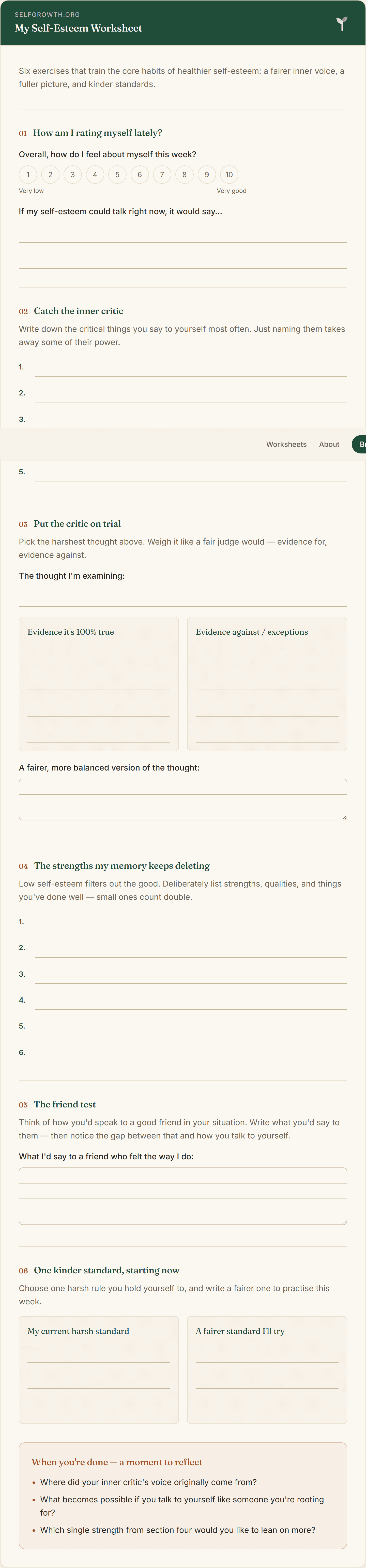
Self-Esteem Worksheet
Free, printable self-esteem worksheets with guided exercises to challenge your inner critic, recognise your strengths, and build steadier, healthier self-esteem.
Open worksheet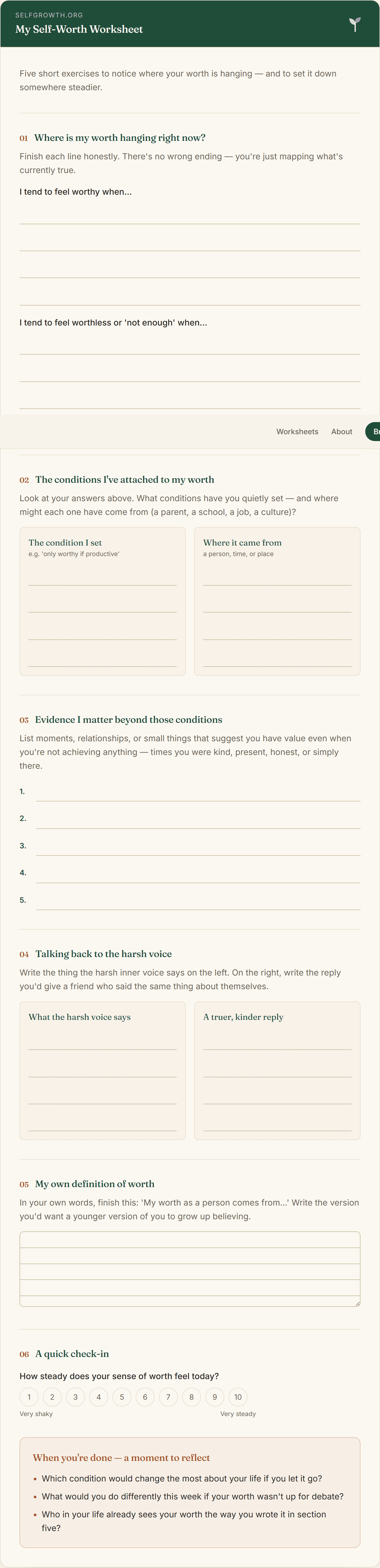
Self-Worth Worksheet
A free, printable self-worth worksheet with five short exercises to separate your value from your achievements and rebuild a steadier sense of worth.
Open worksheet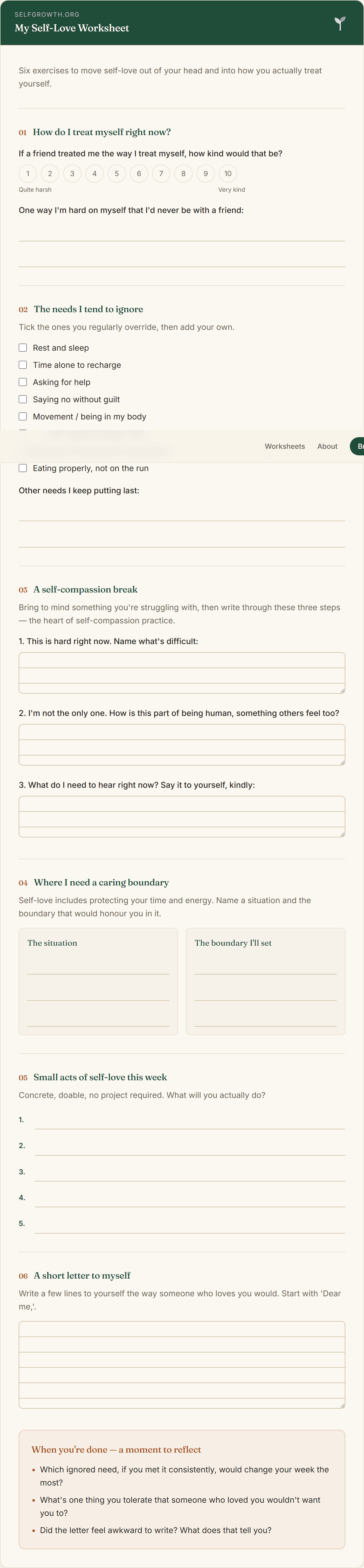
Self-Love Worksheet
A free, printable self-love worksheet that turns self-love from a vague idea into specific actions, meeting your needs, setting boundaries, and treating yourself with care.
Open worksheet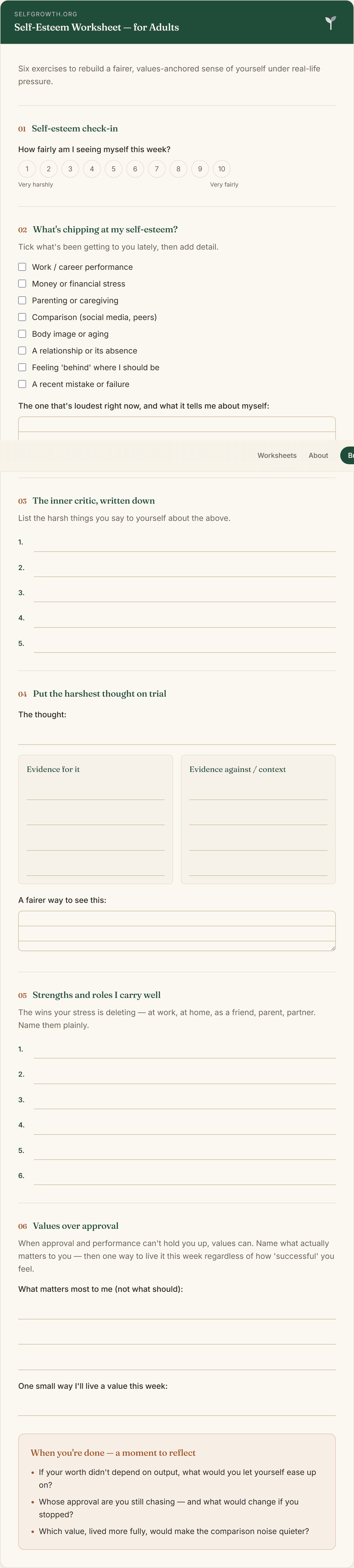
Self-Esteem (Adults)
Free, printable self-esteem worksheets for adults, handle the work, money, parenting and comparison pressures that chip away at self-esteem, and rebuild a fairer view of yourself.
Open worksheet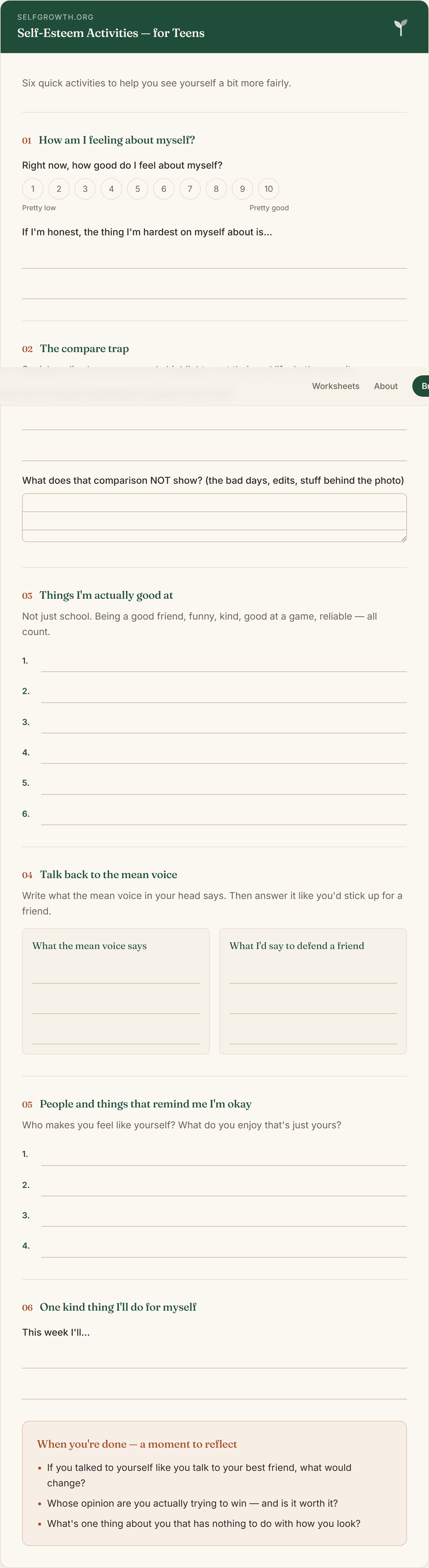
Self-Esteem (Teens)
Free, printable self-esteem worksheets and activities for teens, beat the compare trap, spot real strengths, and quiet the mean inner voice. No jargon.
Open worksheetNew worksheets, straight to your inbox
An occasional new worksheet or tool, sent only when there's something genuinely worth your time. No spam, no pressure, unsubscribe any time.