
Self-esteem
Self-Esteem Worksheets for Adults: Free Printable PDF Exercises
Updated June 27, 2026 · 7 min read · Free to print
Self-esteem worksheets for adults help you rebuild a fair, steady view of yourself amid the specific pressures of adult life, work, money, parenting, comparison, and other people's approval. This free, printable worksheet helps you spot what's chipping at your esteem, challenge the inner critic with evidence, and anchor your sense of self in your values rather than approval.
By the Self Growth team · drawn from cognitive behavioural therapy and self-compassion research · how we make these
A clean, print-ready PDF, properly formatted, free, no email needed.
Adult self-esteem gets squeezed from angles teenagers don't face: performance reviews, finances, parenting, aging, and a quiet running comparison with everyone else's careers and lives. It's easy to tie your worth to how productive, successful, or 'together' you appear, and then feel like you're failing whenever life is hard.
Healthy adult self-esteem isn't bravado. It's seeing yourself fairly: owning real strengths, accepting flaws without contempt, and resting your sense of self on what you value rather than on constant approval or achievement. That's steadier, and it survives a bad quarter or a hard season.
This worksheet is built for adult realities. You'll identify exactly what's eroding your esteem, put the harshest self-talk on trial against evidence, and reconnect with the values that can anchor you when approval and performance can't.
How to use this worksheet
- 1Give it around 20–25 minutes. Printing it and writing by hand tends to produce more honest answers.
- 2Be concrete about the pressures, the specifics are what make the reframes work.
- 3You can do one section per sitting; this isn't a race.
- 4Save it and revisit it each month, or before stressful periods, to keep recalibrating.
The worksheet
selfgrowth.org
Self-Esteem Worksheet, for Adults
Six exercises to rebuild a fairer, values-anchored sense of yourself under real-life pressure.
01Self-esteem check-in
How fairly am I seeing myself this week?
02What's chipping at my self-esteem?
Tick what's been getting to you lately, then add detail.
The one that's loudest right now, and what it tells me about myself:
03The inner critic, written down
List the harsh things you say to yourself about the above.
- 1.
- 2.
- 3.
- 4.
- 5.
04Put the harshest thought on trial
The thought:
Evidence for it
Evidence against / context
A fairer way to see this:
05Strengths and roles I carry well
The wins your stress is deleting, at work, at home, as a friend, parent, partner. Name them plainly.
- 1.
- 2.
- 3.
- 4.
- 5.
- 6.
06Values over approval
When approval and performance can't hold you up, values can. Name what actually matters to you, then one way to live it this week regardless of how 'successful' you feel.
What matters most to me (not what should):
One small way I'll live a value this week:
When you're done, a moment to reflect
- If your worth didn't depend on output, what would you let yourself ease up on?
- Whose approval are you still chasing, and what would change if you stopped?
- Which value, lived more fully, would make the comparison noise quieter?
The approach behind this worksheet
By adulthood, low self-esteem usually has a particular shape: it gets tangled up with work, money, parenting, and the constant background comparison of other people's lives. This worksheet keeps the core method decades of research support, the cognitive behavioural move of catching a harsh automatic judgement and weighing it against the evidence, but applies it to the pressures adults actually carry. Melanie Fennell's clinical model of low self-esteem (a 'bottom line' belief fed by biased thinking) is the backbone of the inner-critic work.
Alongside that sits self-compassion, because adults are often far harder on themselves than they would ever be on a friend in the same situation. Kristin Neff's research suggests treating yourself fairly does more for lasting self-worth than chasing achievement or comparison. These are educational self-reflection tools, not therapy.
These are educational self-reflection tools, not therapy, see our editorial standards.
If you want to go deeper
- Melanie Fennell — Overcoming Low Self-Esteem (Robinson, 1999): the CBT self-help model this worksheet is based on.
- Nathaniel Branden — The Six Pillars of Self-Esteem (Bantam, 1994): a classic framework for adult self-esteem.
- Kristin Neff — Self-Compassion: The Proven Power of Being Kind to Yourself (William Morrow, 2011).
Questions people ask
- What are the signs of low self-esteem in adults?
- In adults it often hides behind competence, so the signs are more internal: a relentless inner critic, difficulty accepting praise, tying your mood to your latest performance, over-apologising or people-pleasing, and a quiet sense of being 'behind' or not enough however much you do. Comparison and perfectionism are common too. Recognising a few of these is the cue to start putting that self-talk on trial, which is what this worksheet walks you through.
- What causes low self-esteem in adults?
- It's usually a mix: early experiences and self-talk habits, plus ongoing adult pressures like work performance, money, parenting, health, and constant comparison. Often the root issue is tying your worth to achievement or approval, so esteem rises and falls with circumstances. This worksheet targets both the harsh self-talk and that fragile foundation.
- What's the best worksheet exercise for adult self-esteem?
- Two stand out: putting your harshest self-talk 'on trial' against real evidence (a core cognitive technique), and anchoring your sense of self in your values rather than approval or output. The first stops the critic running unchecked; the second gives your esteem a foundation that doesn't collapse during a hard season.
- Can self-esteem improve in adulthood?
- Yes. Self-esteem isn't fixed at any age, it rests on habits of thinking and on what you base your worth on, both of which adults can deliberately change. Progress is usually gradual, so regular practice and revisiting your worksheets over time matters more than any single session.
- How long does it take to rebuild self-esteem?
- There's no fixed timeline, because self-esteem rests on habits of thinking built up over years. Many people notice small shifts within a few weeks of regularly catching and reframing harsh self-talk, with steadier change over months. That's why coming back to the worksheet, rather than doing it once, is where most of the progress comes from.
- Is this free and is it therapy?
- It's completely free to fill in or print, no payment, no email. It is not therapy or medical advice, though; it's an educational self-reflection tool. If low self-esteem is bound up with depression, anxiety, or thoughts of self-harm, please speak with a qualified professional or a local support line.
Keep going, related worksheets
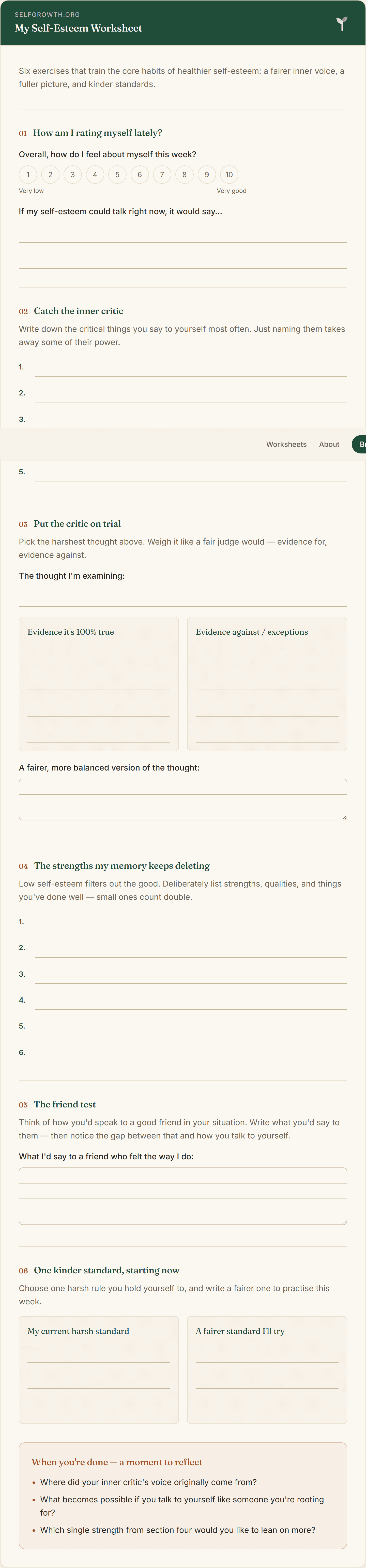
Self-Esteem Worksheet
Free, printable self-esteem worksheets with guided exercises to challenge your inner critic, recognise your strengths, and build steadier, healthier self-esteem.
Open worksheet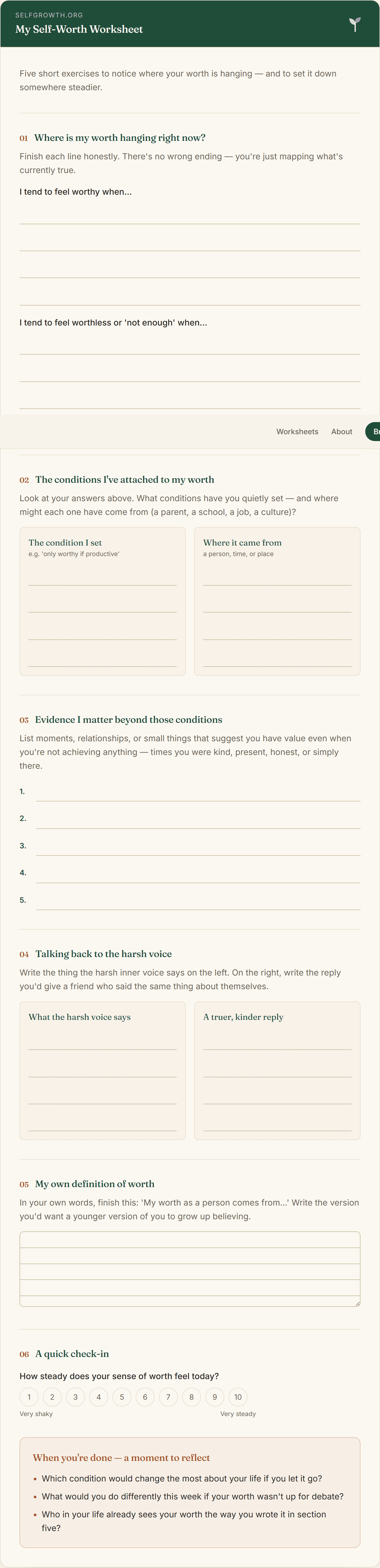
Self-Worth Worksheet
A free, printable self-worth worksheet with five short exercises to separate your value from your achievements and rebuild a steadier sense of worth.
Open worksheet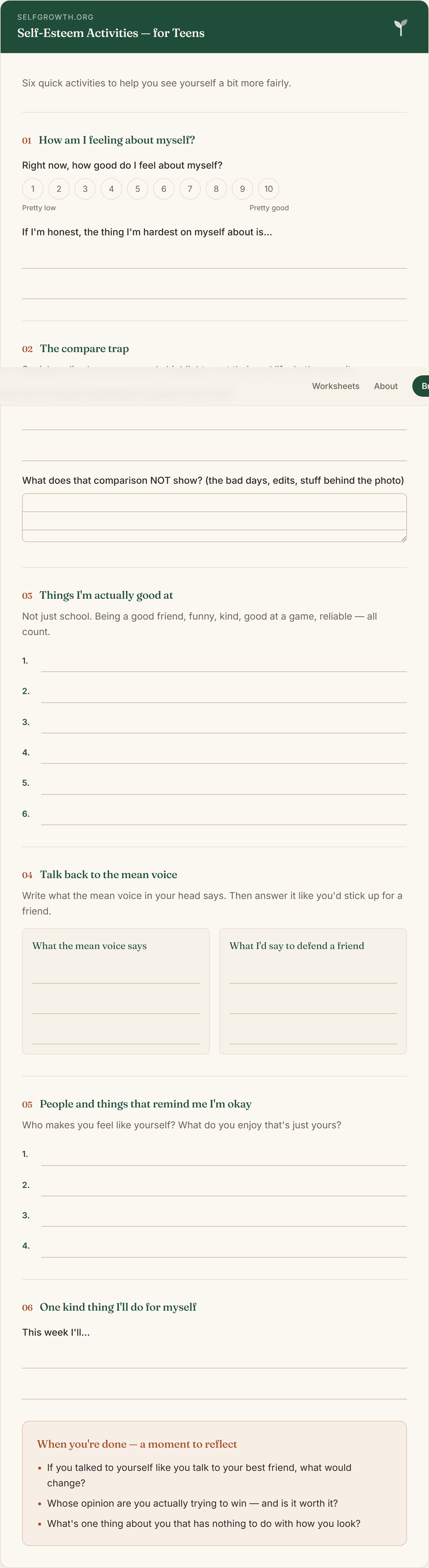
Self-Esteem (Teens)
Free, printable self-esteem worksheets and activities for teens, beat the compare trap, spot real strengths, and quiet the mean inner voice. No jargon.
Open worksheetNew worksheets, straight to your inbox
An occasional new worksheet or tool, sent only when there's something genuinely worth your time. No spam, no pressure, unsubscribe any time.