
Self-worth
Self-Worth Worksheet: Steady Your Sense of Your Own Value
Updated June 27, 2026 · 6 min read · Free to print
A self-worth worksheet helps you separate your value as a person from your achievements, mistakes, and what other people think. This free, printable worksheet walks you through five short exercises: naming the conditions you've quietly attached to your worth, questioning where they came from, and writing a steadier definition you actually believe.
By the Self Growth team · drawn from self-compassion research and unconditional self-acceptance · how we make these
A clean, print-ready PDF, properly formatted, free, no email needed.
Self-worth is the quiet sense that you matter, that you have value simply as a person, not because of what you produce, how you look, or whether you're getting everything right. When it's steady, criticism stings but doesn't capsize you. When it's shaky, a single bad day can feel like proof you're not enough.
Most of us learn, without ever deciding to, that our worth is conditional: worthy if I achieve, worthy if I'm useful, worthy if people approve. This worksheet helps you find those hidden conditions and gently take them apart, so your sense of value rests on something steadier than your last win or loss.
There are no right answers here, and nobody else needs to see it. The point isn't to feel great in twenty minutes, it's to notice the story you've been telling about your own value, and start writing a truer one.
How to use this worksheet
- 1Set aside about 20 quiet minutes. Fill it in on screen, or print it and write by hand, handwriting tends to slow your thinking down in a useful way.
- 2Answer honestly, not impressively. The harsh stuff is exactly what this is for.
- 3If a question feels heavy, write one sentence and move on. You can come back.
- 4Keep what you write. Revisit it in a month and notice what has shifted.
The worksheet
selfgrowth.org
My Self-Worth Worksheet
Five short exercises to notice where your worth is hanging, and to set it down somewhere steadier.
01Where is my worth hanging right now?
Finish each line honestly. There's no wrong ending, you're just mapping what's currently true.
I tend to feel worthy when…
I tend to feel worthless or 'not enough' when…
02The conditions I've attached to my worth
Look at your answers above. What conditions have you quietly set, and where might each one have come from (a parent, a school, a job, a culture)?
The condition I set
e.g. 'only worthy if productive'
Where it came from
a person, time, or place
03Evidence I matter beyond those conditions
List moments, relationships, or small things that suggest you have value even when you're not achieving anything, times you were kind, present, honest, or simply there.
- 1.
- 2.
- 3.
- 4.
- 5.
04Talking back to the harsh voice
Write the thing the harsh inner voice says on the left. On the right, write the reply you'd give a friend who said the same thing about themselves.
What the harsh voice says
A truer, kinder reply
05My own definition of worth
In your own words, finish this: 'My worth as a person comes from…' Write the version you'd want a younger version of you to grow up believing.
06A quick check-in
How steady does your sense of worth feel today?
When you're done, a moment to reflect
- Which condition would change the most about your life if you let it go?
- What would you do differently this week if your worth wasn't up for debate?
- Who in your life already sees your worth the way you wrote it in section five?
The approach behind this worksheet
Self-worth is the quiet belief that you matter as a person, not as a performance. That makes it different from self-esteem, which often rises and falls with how well you're doing. This worksheet works on the deeper layer: the hidden conditions you've attached to your own worth (when I'm productive, when I'm liked, when I don't mess up), and the practice of letting them go. It draws on Albert Ellis's idea of unconditional self-acceptance, that your value as a person isn't something you have to keep earning.
The second thread is self-compassion. Kristin Neff's research suggests that meeting your own struggles with kindness builds a steadier sense of worth than chasing approval or achievement ever does, which is why the worksheet asks you to speak to yourself the way you would to someone you love. These are educational self-reflection tools, not therapy.
These are educational self-reflection tools, not therapy, see our editorial standards.
If you want to go deeper
- Kristin Neff — Self-Compassion: The Proven Power of Being Kind to Yourself (William Morrow, 2011).
- Brené Brown — The Gifts of Imperfection (Hazelden, 2010): on worthiness that isn't conditional on achievement.
- Albert Ellis — The Myth of Self-Esteem (Prometheus, 2005): the case for unconditional self-acceptance over earned self-esteem.
Questions people ask
- What are the signs of low self-worth?
- Low self-worth often shows up as feeling you have to earn the right to take up space: over-apologising, struggling to say no, brushing off praise, and a sense that you're only as good as your last achievement. Criticism can feel devastating rather than just uncomfortable, and you may quietly believe that if people really knew you, they'd think less of you. If several of these ring true, the exercises here are built for exactly that.
- What causes low self-worth?
- Most of us absorb, without ever deciding to, the idea that our worth is conditional, worthy if we achieve, if we're useful, if people approve. That usually traces back to early messages from family, school, or culture about when we 'counted', and gets reinforced by later experiences. Because it's learned rather than true, it can be examined and gently rewritten, which is what this worksheet is for.
- What's the difference between self-worth and self-esteem?
- Self-esteem is usually about how good you feel at things, competence, confidence, performance. Self-worth is deeper and steadier: the sense that you have value as a person regardless of how well you're doing. You can have high self-esteem in one area and still struggle with self-worth, which is why this worksheet focuses on value rather than ability.
- Can you actually rebuild self-worth?
- Yes, though it's gradual. Self-worth is largely a set of learned beliefs about when you 'count', and beliefs can be examined and rewritten. Worksheets like this help by making those hidden beliefs visible so you can question them, and repeating that, over weeks and months, is what shifts the baseline.
- How often should I do this worksheet?
- Once is useful; revisiting it every few weeks is better. Your answers will change as your circumstances do, and comparing an old sheet with a new one is one of the clearest ways to see that your sense of worth is actually moving.
- Is this the same as therapy?
- No. This is an educational self-reflection tool, not therapy or medical advice. It can sit alongside therapy nicely, but if low self-worth is tied to depression, trauma, or thoughts of harming yourself, please reach out to a qualified professional or a local support line.
Keep going, related worksheets
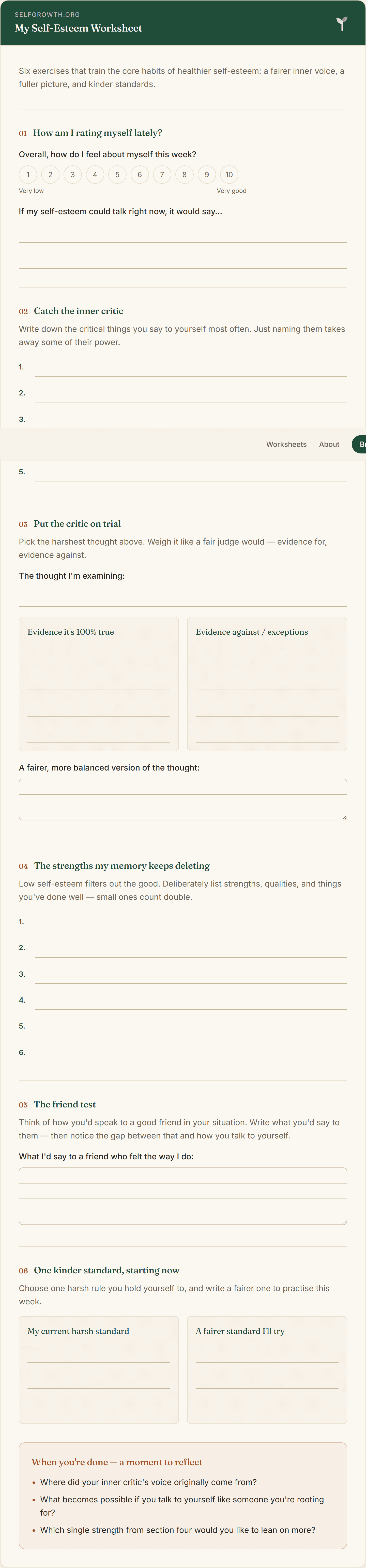
Self-Esteem Worksheet
Free, printable self-esteem worksheets with guided exercises to challenge your inner critic, recognise your strengths, and build steadier, healthier self-esteem.
Open worksheet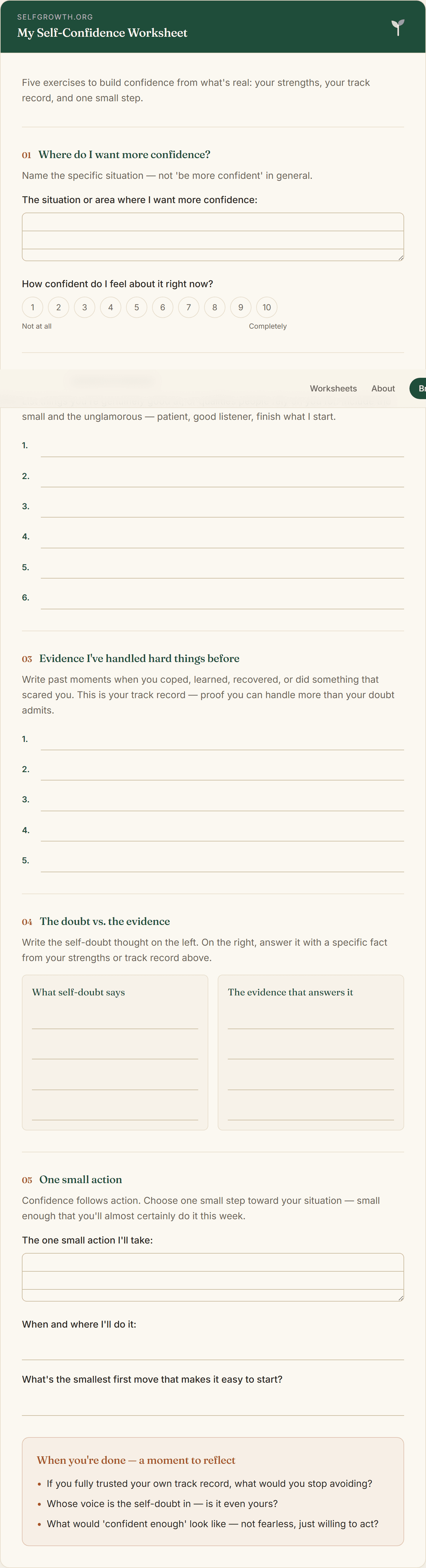
Self-Confidence Worksheet
A free, printable self-confidence worksheet that builds confidence from real evidence (your strengths, past wins, and one small action), instead of empty hype.
Open worksheet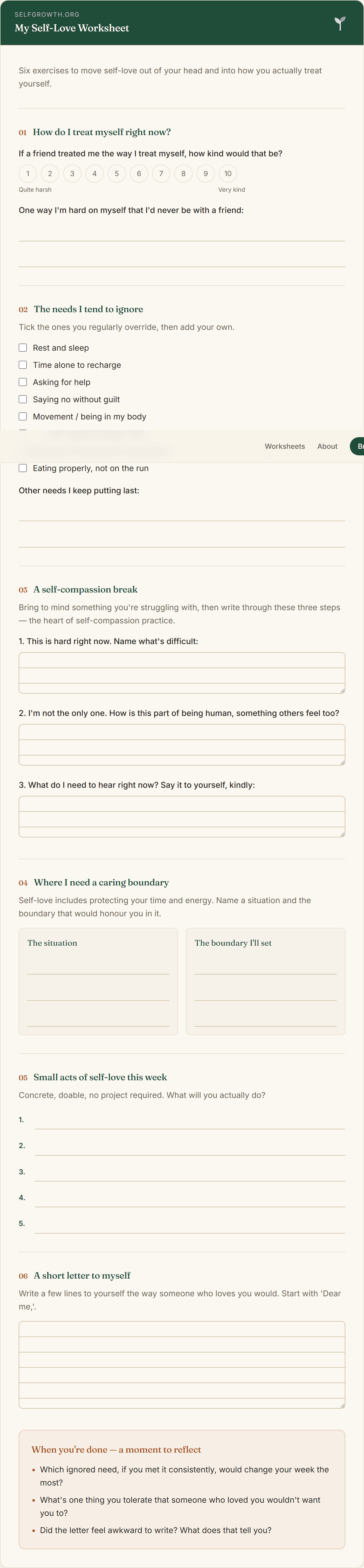
Self-Love Worksheet
A free, printable self-love worksheet that turns self-love from a vague idea into specific actions, meeting your needs, setting boundaries, and treating yourself with care.
Open worksheetNew worksheets, straight to your inbox
An occasional new worksheet or tool, sent only when there's something genuinely worth your time. No spam, no pressure, unsubscribe any time.