
Self-esteem
Self-Esteem Worksheets: A Free, Printable Set to Build Healthier Self-Esteem
Updated June 27, 2026 · 7 min read · Free to print
Self-esteem worksheets are guided exercises that help you build a fairer, steadier view of yourself. This free, printable worksheet takes you through the core moves that healthy self-esteem rests on: catching the inner critic, weighing it against real evidence, recognising your strengths, and treating yourself with the same fairness you'd give a friend.
By the Self Growth team · drawn from cognitive behavioural therapy & self-compassion research · how we make these
A clean, print-ready PDF, properly formatted, free, no email needed.
Self-esteem is how you rate yourself, whether, deep down, you treat yourself as basically okay or basically not. Healthy self-esteem isn't thinking you're better than everyone; it's seeing yourself clearly and fairly, strengths and flaws included, without the constant background hum of 'not good enough'.
Low self-esteem usually runs on a few habits of mind: a loud inner critic, a memory that keeps the failures and discards the wins, and a double standard where you're far harsher with yourself than you'd ever be with someone you love. The good news is that these are habits, and habits can be retrained.
This worksheet walks you through the moves that decades of psychology (especially cognitive and self-compassion approaches) point to: notice the critic, test it against evidence, build back a fair picture of your strengths, and practise treating yourself decently. Do it once for a reset, or keep it as a regular practice.
How to use this worksheet
- 1Allow about 20–25 minutes. Print it for a calmer, handwritten session, or fill it in on screen.
- 2Be specific rather than sweeping. 'I snapped at my partner on Tuesday' is workable; 'I'm a bad person' is just the critic talking.
- 3You don't have to finish in one sitting. Even one section moves the needle.
- 4Save it and repeat monthly, the comparison over time is where you'll see your self-esteem steadying.
The worksheet
selfgrowth.org
My Self-Esteem Worksheet
Six exercises that train the core habits of healthier self-esteem: a fairer inner voice, a fuller picture, and kinder standards.
01How am I rating myself lately?
Overall, how do I feel about myself this week?
If my self-esteem could talk right now, it would say…
02Catch the inner critic
Write down the critical things you say to yourself most often. Just naming them takes away some of their power.
- 1.
- 2.
- 3.
- 4.
- 5.
03Put the critic on trial
Pick the harshest thought above. Weigh it like a fair judge would, evidence for, evidence against.
The thought I'm examining:
Evidence it's 100% true
Evidence against / exceptions
A fairer, more balanced version of the thought:
04The strengths my memory keeps deleting
Low self-esteem filters out the good. Deliberately list strengths, qualities, and things you've done well, small ones count double.
- 1.
- 2.
- 3.
- 4.
- 5.
- 6.
05The friend test
Think of how you'd speak to a good friend in your situation. Write what you'd say to them, then notice the gap between that and how you talk to yourself.
What I'd say to a friend who felt the way I do:
06One kinder standard, starting now
Choose one harsh rule you hold yourself to, and write a fairer one to practise this week.
My current harsh standard
A fairer standard I'll try
When you're done, a moment to reflect
- Where did your inner critic's voice originally come from?
- What becomes possible if you talk to yourself like someone you're rooting for?
- Which single strength from section four would you like to lean on more?
The approach behind this worksheet
Healthy self-esteem isn't built by repeating affirmations you don't believe. It's built by changing the way you reason about yourself. The exercises here come from cognitive behavioural therapy (CBT), where the core move is cognitive restructuring: catching a harsh automatic thought ('I always mess this up'), holding it up against the actual evidence, and replacing it with a fairer, more accurate version. Melanie Fennell's clinical model of low self-esteem (the 'bottom line' belief that gets fed by biased thinking and avoidance) is the backbone of the inner-critic and 'put the critic on trial' sections.
The second thread is self-compassion. Kristin Neff's research shows that treating yourself with the fairness you'd offer a friend does more for lasting self-worth than chasing high self-esteem through comparison or achievement, which is why the 'friend test' and 'one kinder standard' sections matter as much as the thought-challenging ones. These are educational self-reflection tools, written to be done alone or alongside therapy, not a replacement for it.
These are educational self-reflection tools, not therapy, see our editorial standards.
If you want to go deeper
- Melanie Fennell — Overcoming Low Self-Esteem (Robinson, 1999): the CBT self-help model this worksheet's inner-critic exercises are based on.
- Kristin Neff — Self-Compassion: The Proven Power of Being Kind to Yourself (William Morrow, 2011).
- David D. Burns — Feeling Good: The New Mood Therapy (1980): the classic CBT guide to spotting and rebalancing cognitive distortions.
- Orth, U. & Robins, R. W. (2014). The development of self-esteem. Current Directions in Psychological Science, 23(5).
Questions people ask
- What are the signs of low self-esteem?
- Common signs include a harsh inner critic, struggling to accept compliments, comparing yourself unfavourably to others, putting yourself down or over-apologising, and a memory that keeps your failures and quietly deletes your wins. People with low self-esteem often feel 'not good enough' however well things are going, and take criticism harder than it warrants. Recognising a few of these is the cue to start the exercises here.
- What causes low self-esteem?
- It's usually built up over time rather than caused by one thing. Early experiences, harsh or critical voices, comparison, and repeated knocks all feed a 'bottom line' belief that you're not enough, which then gets reinforced by biased thinking that notices the misses and skips the hits. Because it's largely a set of learned habits of mind, it can be examined and gradually rebuilt, which is what this worksheet is for.
- Do self-esteem worksheets really work?
- They help most when used as practice rather than a one-off. The exercises here are based on cognitive techniques (examining and rebalancing harsh thoughts) and self-compassion (treating yourself fairly), both of which have research support for improving how people relate to themselves. The key is repetition, self-esteem is a set of mental habits, and habits change with reps.
- What are the best exercises for low self-esteem?
- Three do most of the work: catching and rebalancing your inner critic, deliberately recording your strengths and wins (because low self-esteem filters them out), and the 'friend test', speaking to yourself as kindly as you would to someone you love. This worksheet includes all three.
- How long does it take to improve self-esteem?
- There's no fixed timeline, but most people notice small shifts within a few weeks of regular practice and steadier change over a few months. It tends to move gradually rather than all at once, which is why saving your worksheets and comparing them over time is so useful.
- Are these worksheets free to print?
- Yes. Everything on selfgrowth.org is free to fill in online or print, no payment and no email required. Use the Download PDF button for a clean copy, or Print for a paper version.
- Is this a substitute for therapy?
- No. These are educational self-reflection tools, not therapy or medical advice. If low self-esteem is linked to depression, anxiety, trauma, or thoughts of self-harm, please talk to a qualified professional or a local support line.
Keep going, related worksheets
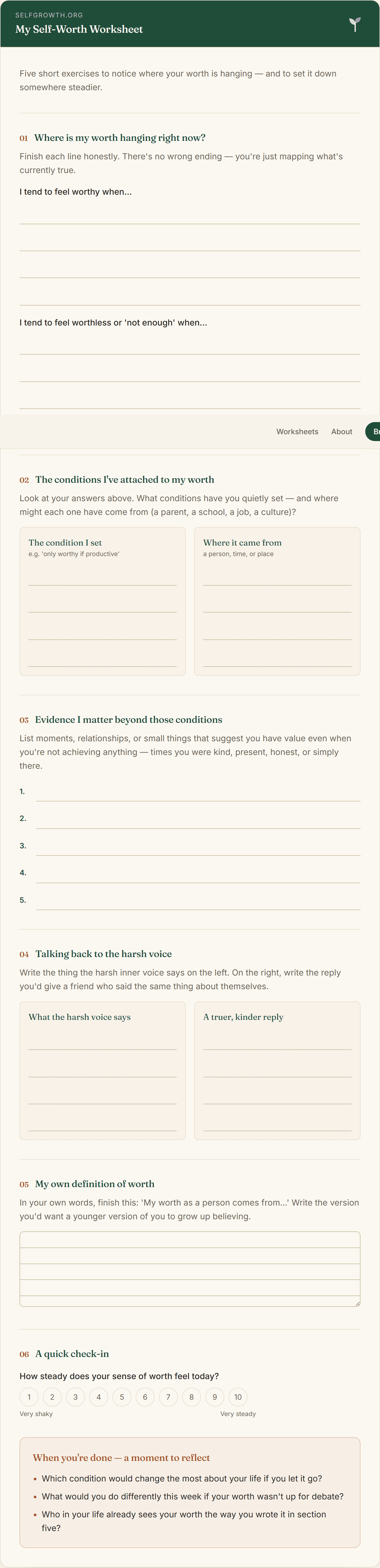
Self-Worth Worksheet
A free, printable self-worth worksheet with five short exercises to separate your value from your achievements and rebuild a steadier sense of worth.
Open worksheet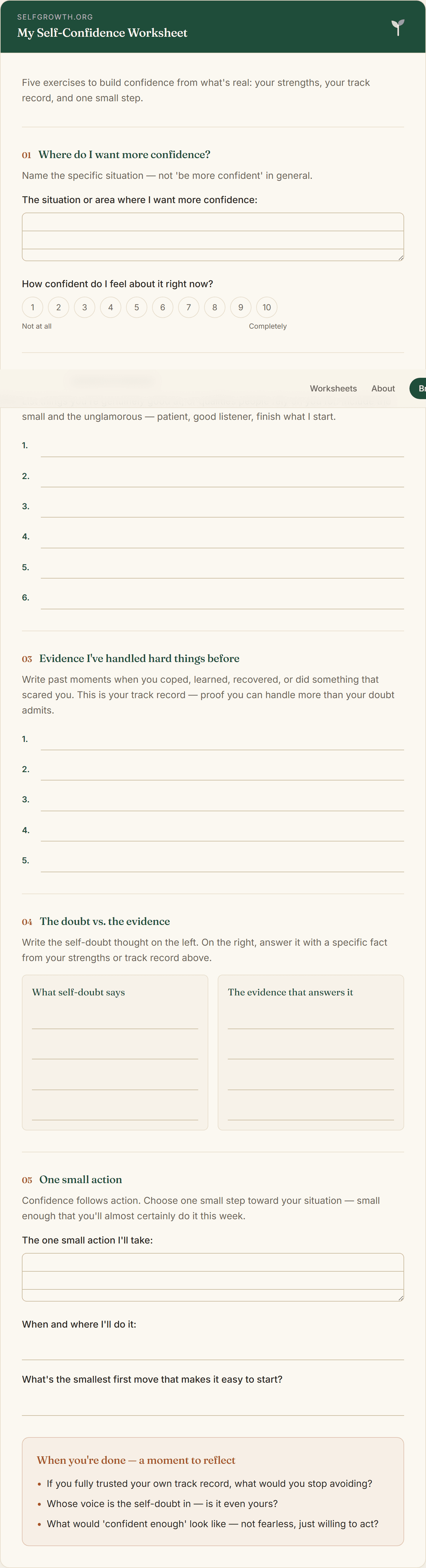
Self-Confidence Worksheet
A free, printable self-confidence worksheet that builds confidence from real evidence (your strengths, past wins, and one small action), instead of empty hype.
Open worksheet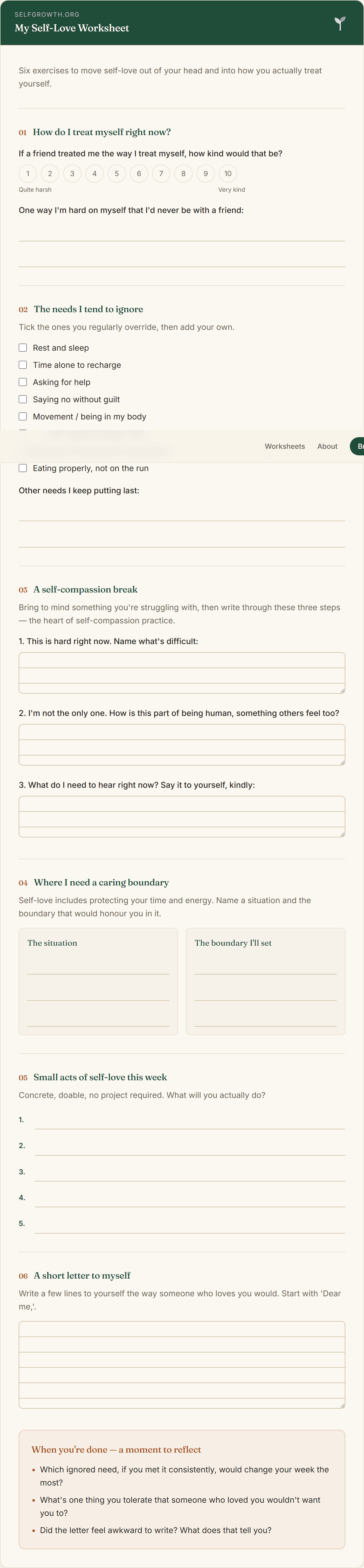
Self-Love Worksheet
A free, printable self-love worksheet that turns self-love from a vague idea into specific actions, meeting your needs, setting boundaries, and treating yourself with care.
Open worksheetNew worksheets, straight to your inbox
An occasional new worksheet or tool, sent only when there's something genuinely worth your time. No spam, no pressure, unsubscribe any time.