
Self-confidence
Self-Confidence Worksheet: Build Confidence From Evidence, Not Hype
Updated June 24, 2026 · 6 min read · Free to print
A self-confidence worksheet builds confidence the way it actually grows: from evidence and action, not affirmations alone. This free, printable worksheet helps you inventory your real strengths and past wins, challenge the self-doubt that talks over them, and commit to one small, doable action, because confidence follows doing far more than it follows positive thinking.
By the Self Growth team · drawn from self-efficacy research and action-based (ACT) approaches · how we make these
A clean, print-ready PDF, properly formatted, free, no email needed.
Confidence isn't a personality you're born with, it's the trust that you can handle things, and that trust is built. It grows mostly from evidence (proof you've coped before) and from action (small reps of doing the scary thing). Affirmations can help a little, but telling yourself you're amazing rarely sticks if part of you doesn't believe it.
This worksheet works with that reality. Instead of trying to feel confident on demand, you'll gather the evidence you already have, name the self-doubt that drowns it out, and pick one small action, because doing the thing, even badly, is what teaches your brain that you're capable.
Think of it as building a case for yourself, the way a good friend would: honestly, generously, and with proof.
How to use this worksheet
- 1Give it about 15–20 minutes. Fill it in online or print it and write by hand.
- 2When you list strengths and wins, count the small and ordinary ones, they're real evidence too.
- 3Pick an action small enough that you're 80% sure you'll actually do it. Tiny and done beats ambitious and skipped.
- 4Come back after you've taken the action and note what happened, that's where confidence compounds.
The worksheet
selfgrowth.org
My Self-Confidence Worksheet
Five exercises to build confidence from what's real: your strengths, your track record, and one small step.
01Where do I want more confidence?
Name the specific situation, not 'be more confident' in general.
The situation or area where I want more confidence:
How confident do I feel about it right now?
02My strengths inventory
List things you're genuinely good at, or qualities people rely on you for. Include the small and the unglamorous, patient, good listener, finish what I start.
- 1.
- 2.
- 3.
- 4.
- 5.
- 6.
03Evidence I've handled hard things before
Write past moments when you coped, learned, recovered, or did something that scared you. This is your track record, proof you can handle more than your doubt admits.
- 1.
- 2.
- 3.
- 4.
- 5.
04The doubt vs. the evidence
Write the self-doubt thought on the left. On the right, answer it with a specific fact from your strengths or track record above.
What self-doubt says
The evidence that answers it
05One small action
Confidence follows action. Choose one small step toward your situation, small enough that you'll almost certainly do it this week.
The one small action I'll take:
When and where I'll do it:
What's the smallest first move that makes it easy to start?
When you're done, a moment to reflect
- If you fully trusted your own track record, what would you stop avoiding?
- Whose voice is the self-doubt in, is it even yours?
- What would 'confident enough' look like, not fearless, just willing to act?
The approach behind this worksheet
Confidence isn't a feeling you wait to arrive; it's a belief in your own ability that you build from evidence. This worksheet is grounded in Albert Bandura's research on self-efficacy, which found that the strongest source of confidence is a track record of small successes, what he called mastery experiences. So instead of leading with affirmations, it asks you to gather real proof of what you've handled before, then add to that proof with one small action.
It also borrows from acceptance and commitment approaches, where the move is to act alongside the nerves rather than waiting for them to disappear, because confidence usually follows action, not the other way round. These are educational self-reflection tools, not therapy.
These are educational self-reflection tools, not therapy, see our editorial standards.
If you want to go deeper
- Albert Bandura — Self-Efficacy: The Exercise of Control (W. H. Freeman, 1997): the foundational research on building confidence from mastery experiences.
- Russ Harris — The Confidence Gap (Robinson, 2011): the ACT-based case for action before confidence.
- Melanie Fennell — Overcoming Low Self-Esteem (Robinson, 1999): the CBT model behind examining and rebalancing self-doubt.
Questions people ask
- How do worksheets actually build confidence?
- They make your evidence visible. Most people underestimate their own track record because doubt is loud and memory is selective. Writing down concrete strengths and past wins gives your brain proof to draw on, and pairing that with one small action turns the proof into experience, which is what genuinely raises confidence over time.
- Do affirmations work for confidence?
- A little, and mainly when they're believable. Telling yourself something you don't buy can backfire. That's why this worksheet leads with evidence and action rather than affirmations, confidence built on proof and reps tends to hold up under pressure, whereas confidence built on hype tends to wobble.
- What if I can't think of any strengths or wins?
- That's common when confidence is low, the filter is set to dismiss them. Lower the bar: think of an ordinary day you got through, a time someone thanked you, a small thing you finished. They count. If you're truly stuck, ask one person who knows you what they'd put on the list.
- Is this worksheet suitable for social anxiety?
- It can be a helpful supplement, because building a small-action habit is central to facing social fears. But it isn't treatment. If social anxiety is significantly affecting your life, consider speaking to a qualified professional, approaches like CBT are well-evidenced for it.
- Are these confidence worksheets free?
- Yes. Everything on selfgrowth.org is free to fill in online or print, with no payment and no email required. Use the Download PDF button for a clean copy, or Print for a paper version.
- Is this a substitute for therapy?
- No. This is an educational self-reflection tool, not therapy or medical advice. If low confidence is tied to anxiety, depression or past experiences that still weigh on you, please talk to a qualified professional or a local support line.
Keep going, related worksheets
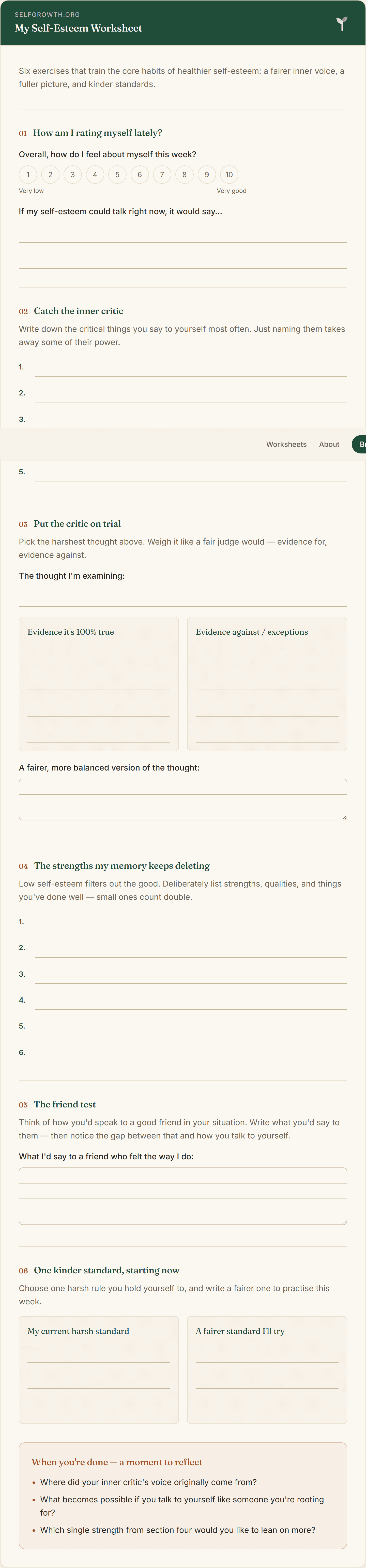
Self-Esteem Worksheet
Free, printable self-esteem worksheets with guided exercises to challenge your inner critic, recognise your strengths, and build steadier, healthier self-esteem.
Open worksheet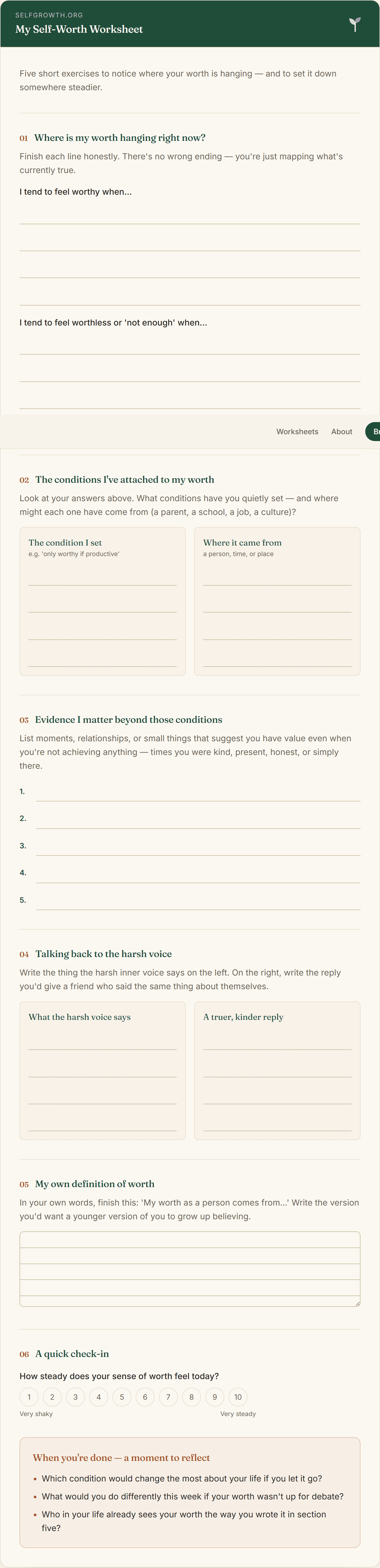
Self-Worth Worksheet
A free, printable self-worth worksheet with five short exercises to separate your value from your achievements and rebuild a steadier sense of worth.
Open worksheet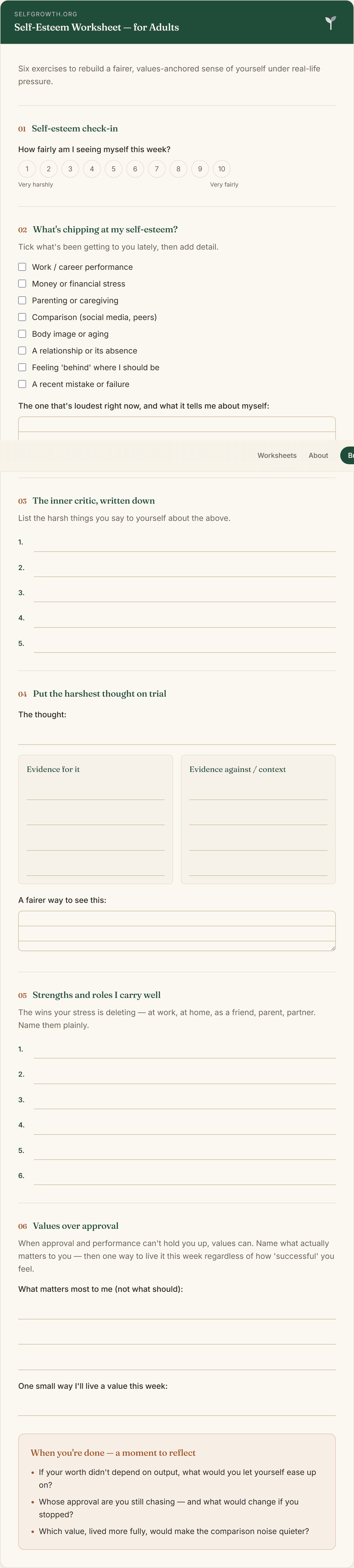
Self-Esteem (Adults)
Free, printable self-esteem worksheets for adults, handle the work, money, parenting and comparison pressures that chip away at self-esteem, and rebuild a fairer view of yourself.
Open worksheetNew worksheets, straight to your inbox
An occasional new worksheet or tool, sent only when there's something genuinely worth your time. No spam, no pressure, unsubscribe any time.