
Guide
How to build self-confidence
Updated 6 October 2026 · 12 min read
Build self-confidence from evidence and action, not affirmations. Gather concrete proof of things you've already handled, then take one small step towards the thing you're avoiding, small enough that you'll actually do it. Confidence is the trust that you can cope, and that trust grows from doing far more than from positive thinking.
By the Self Growth team · drawn from self-efficacy research and acceptance and commitment (ACT) approaches · how we make these
Confidence gets talked about as if some people are simply born with it, striding into rooms while the rest of us hang back. That's only part of the story. Temperament plays a part, but much of confidence is the trust that you can handle what's in front of you, and that trust is built from what you actually do. Even the most self-assured people you know built much of it by gathering evidence.
You can build that trust on purpose. Collect proof of what you've coped with, take one small action, and learn to act alongside the nerves instead of waiting for them to leave. There's a free worksheet at the end that walks you through it on a real situation.
What is self-confidence?
Confidence is a prediction. When you feel confident about something, what's really happening is that you expect you can handle it, based on some mix of past experience and readiness. That's why confidence is nearly always specific, not across the board: you can be quietly sure of yourself cooking dinner and a bundle of nerves before a presentation. 'I have no confidence' is almost never true across the board; it's usually 'I don't yet trust myself in this particular situation'.
It helps to separate confidence from self-esteem, because they're often muddled. Self-esteem is your overall rating of yourself as a person. Confidence is narrower and more practical: your belief in your ability to do a given thing. That distinction helps, because confidence is very trainable. You don't have to fix your whole self-image before you can get better at speaking up in meetings. You just have to build evidence in that one area.
- 1
Take one small action
Not the whole leap, just the first small step: ask one question, send one message, speak up first once.
- 2
Come through it
It goes okay, or okay enough. The nerves show up and don't stop you.
- 3
Your brain updates
'Noted, we can survive that.' A real experience, not an affirmation, so it actually lands.
- 4
You trust yourself a little more
One more piece of evidence in the account, harder for the doubt to delete.
- 5
The next step feels doable
So you take it, and the loop turns again. Each turn adds a little more confidence.
Action comes first, the confident feeling is its reward
Signs of low self-confidence
Low confidence doesn't always feel like fear. Often it shows up as habits that look sensible from the outside. You might recognise some of these:
- You avoid things you'd quite like to do because you assume you'll get them wrong.
- You wait to feel ready before you start, and the ready feeling never comes.
- You put your successes down to luck, timing or other people.
- You over-prepare, or check with someone else before making even small decisions.
- You stay quiet in meetings or groups even when you have something useful to say.
- You say "I can't" before you've tried.
Notice that most of these are about avoiding or discounting. That's useful to know, because both are habits, and habits can be changed one small action at a time.
What causes low self-confidence?
Albert Bandura's research on self-efficacy (the belief that you can handle a particular task) points to four things that build or drain it. Low confidence usually traces back to one or more of them working against you:
- Too little experience of doing the thing. Bandura saw this as the most powerful of the four. If you've avoided something for years, you have no recent evidence that you can do it, so your mind assumes you can't.
- Too few examples of people like you managing it. Bandura found that seeing someone similar to you succeed builds the belief that you could too. When you rarely see that, this source of confidence stays thin.
- Discouraging voices. Being put down growing up, a critical boss, or a harsh inner critic all chip away at it.
- Reading nerves as a verdict. A racing heart or a dry mouth gets taken as proof you're not up to it, rather than a normal sign that something matters to you.
That's why small actions matter so much. Each one adds the kind of evidence confidence is actually made from.
Why 'just think positive' doesn't work
The most common confidence advice is to pump yourself up: repeat affirmations, tell yourself you're amazing, fake it till you make it. There's a grain of truth in it, but for a lot of people it backfires. In a 2009 study by Joanne Wood and colleagues, people with low self-esteem who repeated 'I'm a lovable person' felt worse than people who didn't repeat it. If part of you doesn't believe 'I'm brilliant at this', saying it just draws attention to the gap between the words and how you actually feel. Your mind quietly argues back. Confidence built on hype tends to wobble the moment it's tested.
The deeper problem is that positive thinking tries to install the feeling first and hope the ability follows. Real confidence runs the other way. You will almost never feel ready before you act. If you wait for the nerves to disappear before you start, you may wait a long time, because nerves tend to ease by doing the thing. You act, it goes okay (or okay enough), and your sense of what you can handle shifts a little. So the aim of everything below isn't to talk yourself into feeling confident. It's to give yourself experiences that make confidence the honest conclusion.
Albert Bandura called this a mastery experience: the plain fact of having done something and come through it. That's why small actions matter so much: each one adds evidence you can trust.
Open the Self-Confidence WorksheetBuild your evidence base
Low confidence comes with a broken filter: it dismisses your wins as luck or 'anyone could have done that', and replays your stumbles on a loop. So the first practical move is to make your real track record visible, on paper, where the filter can't quietly delete it.
Write down two lists. First, your strengths: the things you're genuinely good at, or that people rely on you for. Include the small and unglamorous ones (patient, thorough, good in a crisis, finishes what they start). Second, your evidence of coping: specific past moments when you handled something hard, recovered from a setback, or did something that scared you and survived it. Keep them concrete. 'I ran the team meeting when my manager was off' beats 'I'm quite organised'. This isn't about making yourself feel good. It's writing down the case a fair observer would make for you.
Start ridiculously small
Once you can see your evidence, add to it, deliberately. Pick the situation you want more confidence in, then choose one action towards it that is small enough that you're about 80% sure you'll actually do it this week. Not the whole terrifying leap, just the first manageable rung of the ladder. If public speaking is the fear, the action isn't 'give a keynote', it's 'ask one question in a meeting' or 'speak up first on one call'.
The reason to go this small is that a tiny action you complete beats an ambitious one you avoid, because only the completed one adds to your evidence. Each small step helps in two ways. It wears down the avoidance that keeps fear going, and it adds to your proof. Do that repeatedly and confidence stops being something you're chasing and becomes something you're accumulating.
Open the Self-Confidence WorksheetAnswer the self-doubt that talks over the evidence
Even with the evidence written down, a doubting voice will pipe up: 'that was a fluke', 'this time's different', 'you'll be found out'. You don't have to win an argument with it. You just have to stop it from having the only say. The move is to put the doubt and the evidence side by side. Write the doubt as it actually sounds, then answer it with one specific fact from your strengths or track record.
- 'I'll freeze and say something stupid' meets 'I've spoken up in three meetings this month and the roof didn't fall in'.
- 'Everyone's more capable than me' meets 'two people asked me for help with this exact thing last week'.
- 'I got lucky last time' meets 'I prepared, showed up, and handled the questions, that's a skill, not luck'.
Notice the answers aren't cheerful slogans. They're fair, specific, and believable, which is exactly why they hold up where affirmations don't. You're not trying to feel invincible; you're refusing to let the doubt overwrite the record.
Act alongside the nerves
There's a quiet trap in confidence-building: assuming the goal is to reach a state where you feel no fear. Confident people feel nerves too, before the interview, the pitch, the hard conversation. What's different is that they've learned the nerves aren't a stop sign. Being willing to act while the nerves are still there is what confidence looks like from the inside. Waiting to feel fearless can quietly keep you stuck.
So change the target. 'Confident enough' doesn't mean fearless. It means willing to act. A racing heart before something that matters isn't a sign you're not ready. It's a sign it matters. Let it come along for the ride. The more often you act with the nerves rather than in spite of them, the more your brain learns that fear and capability can sit in the same room, and that kind of confidence tends to last.
What actually works, in order
Here are the five moves together. They draw on Bandura's research on mastery experiences, the cognitive behavioural therapy (CBT) approach to self-doubt (Fennell) and acting before you feel ready (Harris). The order is our suggestion, not a tested programme.
- 1Name the specific area: not 'be more confident', but the exact situation you want to trust yourself in.
- 2Gather the evidence: write down your real strengths and concrete times you've coped before.
- 3Pick one small action: tiny enough that you're 80% sure you'll do it this week.
- 4Answer the doubt: put each doubting thought beside a specific fact that argues against it.
- 5Act alongside the nerves: then come back and note what happened, because that's how your evidence builds up.
Where to go next
Pick what fits where you are. Each links to a free worksheet you can fill in online or print.
To work your own situation through the whole evidence-and-action process right now, use the self-confidence worksheet.
Open the Self-Confidence WorksheetIf the shaky confidence sits on top of a harsher problem (feeling you're not good enough as a person), the self-esteem worksheets rebuild that fairer view underneath it.
Open the Self-Esteem WorksheetAnd if you sense the self-doubt is really about feeling you have to earn your worth, the self-worth worksheets go to that root.
Open the Self-Worth WorksheetWhen low confidence is something more
Building confidence from evidence and action is a skill, and like any skill it helps with the ordinary version of the problem. But it has limits worth naming. Your lack of confidence might really be an intense fear of judgement that stops you living your life. It might come with lasting low mood, or be tied up with past experiences that still weigh heavily. If so, that's more than a worksheet is built for, and it isn't a sign you've failed at this.
If that's closer to your experience, please treat it as seriously as you'd want a friend to, and consider talking to a GP or a qualified professional. Approaches like CBT (cognitive behavioural therapy, a common talking therapy) are well-evidenced for social anxiety and low self-worth.
How we put this together
This guide is written in plain language and draws on the sources listed below. Where the research is thin or mixed, we say so. It's an educational self-reflection resource, not therapy or medical advice, see our editorial standards.
If you want to go deeper
- Bandura, A. (1997). Self-Efficacy: The Exercise of Control. W. H. Freeman, the foundational research on building confidence from mastery experiences.
- Harris, R. (2011). The Confidence Gap: A Guide to Overcoming Fear and Self-Doubt. Trumpeter, the ACT-based case for acting before the confidence arrives.
- Wood, J. V., Perunovic, W. Q. & Lee, J. W. (2009). Positive self-statements: Power for some, peril for others. Psychological Science, 20(7), 860-866.
- Fennell, M. (1999). Overcoming Low Self-Esteem. Robinson, the CBT model behind examining and rebalancing self-doubt.
Your questions, answered
- How do I build self-confidence?
- Build it from evidence and action rather than positive thinking. Make your real track record visible by writing down your strengths and specific times you've coped before, then take one small action towards the thing you're avoiding, small enough that you'll actually do it. Each completed rep adds proof that you can handle more than your doubt admits, and that accumulated proof is what confidence really is.
- What's the difference between confidence and self-esteem?
- Self-esteem is your overall rating of yourself as a person. Confidence is narrower and more practical: your belief that you can do a specific thing. You can have solid self-esteem and still feel nervous about public speaking, or feel capable at work while your deeper self-worth is shaky. The upside of the distinction is that confidence is very trainable in one area at a time, without having to fix your whole self-image first.
- Do affirmations actually build confidence?
- Only a little, and mainly when they're believable. Telling yourself something you don't buy tends to backfire, because it highlights the gap between the words and how you feel, and your mind argues back. Confidence built on hype tends to wobble when it's tested. Confidence built on evidence and real practice at doing the thing holds up far better under pressure, which is why the reliable methods lead with action, not slogans.
- How long does it take to become more confident?
- There's no fixed timeline, because confidence is specific and grows with reps rather than on a clock. The pace depends on how often you act, so smaller, more frequent steps beat rare big ones. A few small actions, completed regularly, often shift how you feel about a particular situation more than months of thinking about it.
- Can you build confidence at any age?
- Yes. Confidence can grow at any age. It's built from experiences of doing the thing and coming through it, and you can gather those at any stage of life. The loop is the same wherever you're starting: act, get through it, learn from it.
- Is this a substitute for therapy?
- No. This is an educational self-reflection guide, not therapy or medical advice. If low confidence is tied to intense social anxiety, lasting low mood, or past experiences that still weigh on you, that's beyond what a guide or worksheet is for, and it's worth speaking to a qualified professional. Approaches like CBT are well-evidenced for exactly these problems.
- Is this guide and the worksheet free?
- Yes. This guide and the self-confidence worksheet it links to are both free, with no payment and no email required. Fill the worksheet in online, or use the Download PDF button for a clean, printable copy.
Worksheets to do the work
Free to fill in online or print. No email needed.
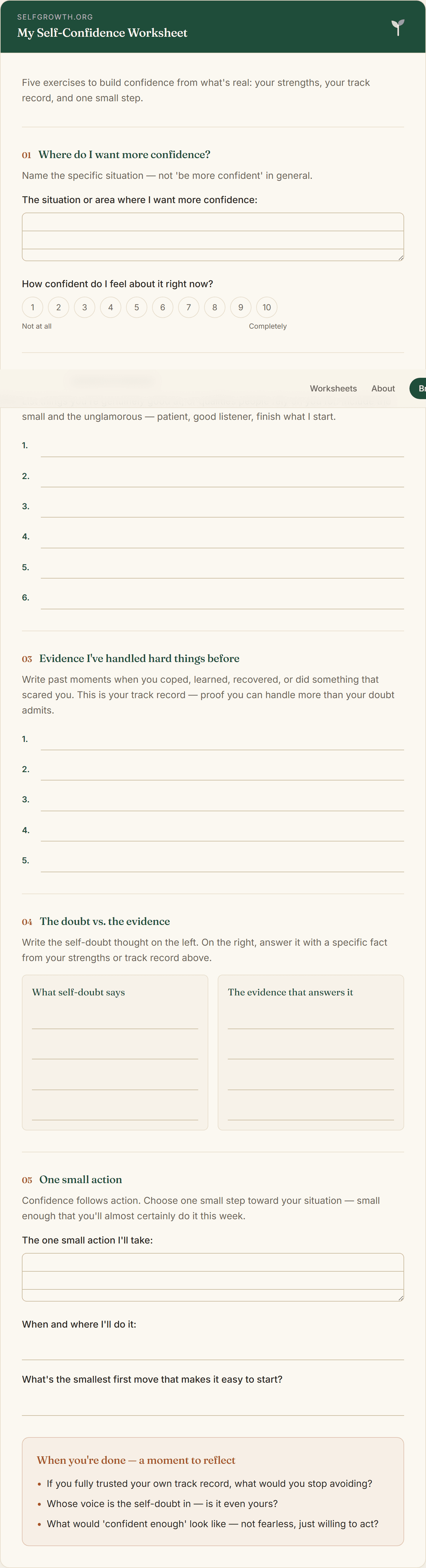
Self-Confidence Worksheet
Free printable self-confidence worksheets (PDF) for one situation you dread: list your strengths and past wins, answer self-doubt, and take one small step.
Open worksheet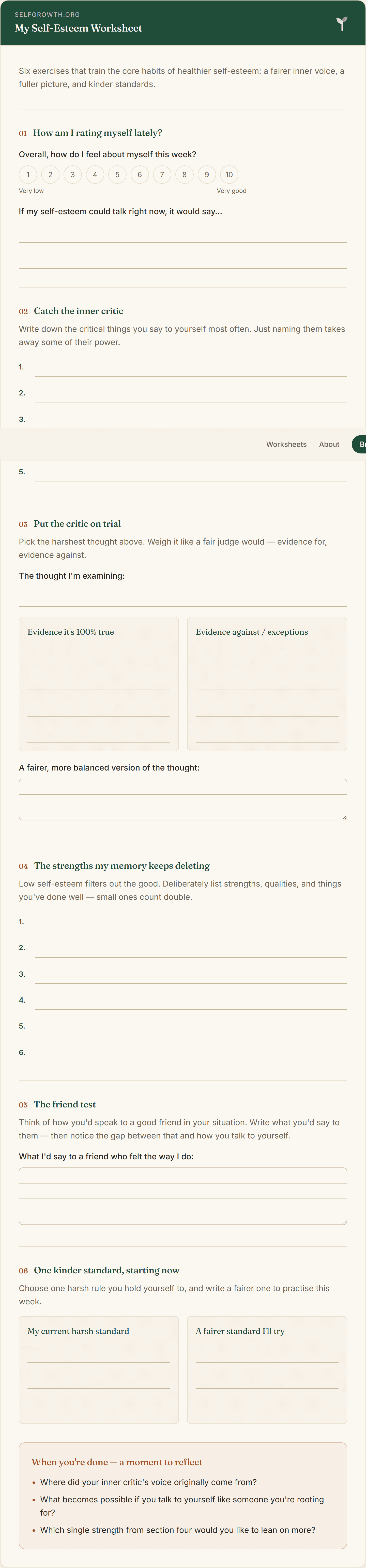
Self-Esteem Worksheet
Free printable self-esteem worksheets (PDF) for adults and older teens: catch your inner critic, test it against evidence, and list the strengths you overlook.
Open worksheet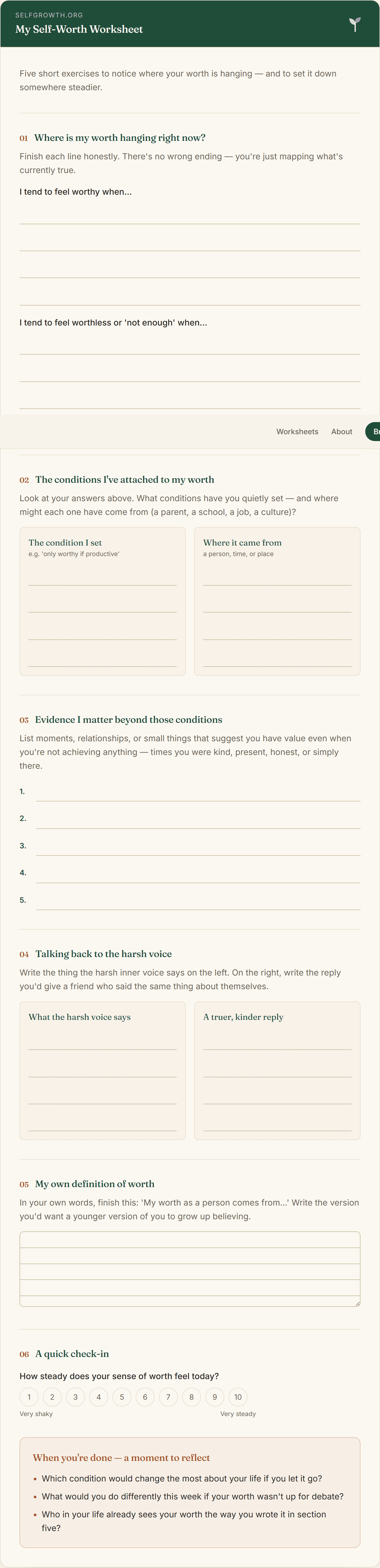
Self-Worth Worksheet
Free printable self-worth worksheets (PDF): find the conditions you've tied your worth to, see where they came from, and write a steadier definition of worth.
Open worksheet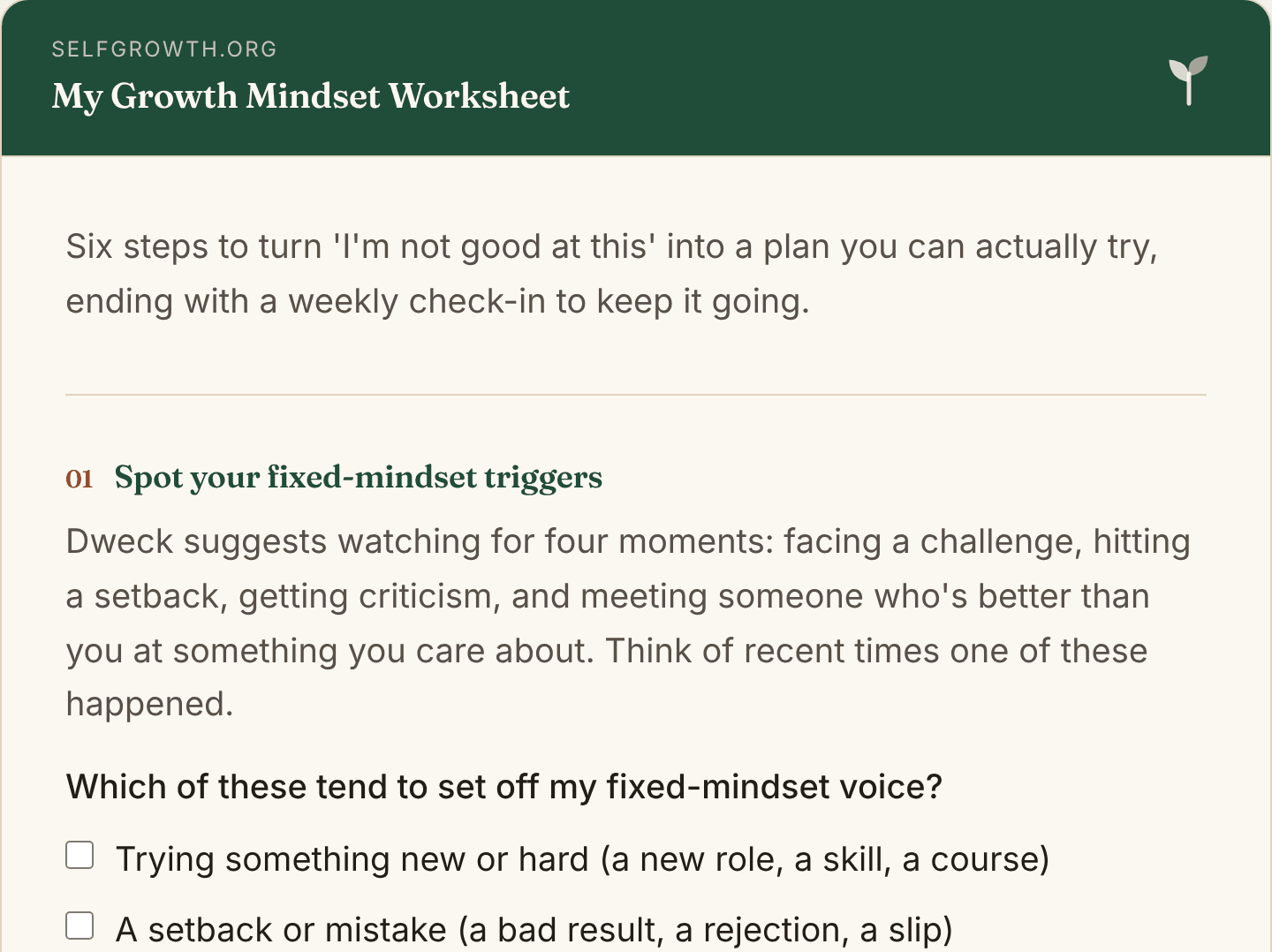
Growth Mindset Worksheet
A free, printable growth mindset worksheet for adults: spot your fixed-mindset triggers, rewrite them, plan practice, review a setback and use the power of yet.
Open worksheetRelated guides
New worksheets, straight to your inbox
An occasional new worksheet or tool, sent only when there's something genuinely worth your time. No spam, no pressure, unsubscribe any time.