
Guide
How to quiet your inner critic
Updated June 28, 2026 · 9 min read
To quiet your inner critic, don't try to silence it, change your relationship to it. Catch the exact thought, check whether it's fair or just loud (would you say it to a friend?), and answer back with something fair and believable rather than falsely positive. Doing that repeatedly is what slowly turns the volume down.
By the Self Growth team · drawn from CBT, compassion-focused therapy, and self-compassion research · how we make these
Almost everyone has a voice in their head that criticises them, and for many people it's relentless: 'you're not good enough', 'you always mess this up', 'everyone can see you don't belong'. It can feel like the truth, or like it's the only thing keeping you in line. It's usually neither. The harsh inner critic is rarely accurate and rarely the reason you get things done. It's an old alarm doing a clumsy job of trying to protect you.
This guide covers where that voice comes from, why it's so much louder than praise, and the actual skill of handling it: how to catch a critical thought, check whether it's fair, and answer it without lying to yourself. The aim isn't to silence the critic by force, that tends to make it louder, but to loosen its grip so it stops running the show. There's a free worksheet at the end that walks you through it on a real example.
Why is the inner critic so loud?
It helps to know the critic isn't a flaw in your character or a sign something's wrong with you. It's the noisy side of a system that's meant to keep you safe. For most people the critical voice started early, as a way to stay out of trouble: pre-empt the telling-off, push yourself to perform, notice the mistake before someone else did. It worked well enough that it stuck, and now it fires on its own, long after it's useful.
Two things make it feel so overwhelming. The first is that your brain is wired to weight threats more heavily than reassurance, bad feels stronger than good, so a single harsh thought drowns out a dozen quiet bits of evidence that you're fine. The second is that the critic speaks with total confidence and zero nuance. It doesn't say 'that could have gone better'; it says 'you're useless'. Loud and certain is not the same as right.
The inner critic is an old alarm, not a reliable witness.
Your inner critic is not a reliable narrator
When you actually slow down and read what the critic says, it almost always breaks the same handful of rules of fair thinking. Cognitive therapists call these 'distortions', and once you can name the move, the voice loses a lot of its authority. The most common ones:
- All-or-nothing: one stumble means 'I always fail', one flaw means 'I'm a failure'. No middle, no 'mostly fine'.
- Labelling: turning a thing you did into a thing you are, 'I made a mistake' becomes 'I'm an idiot'.
- Mind-reading: deciding you know what others think, 'they all think I'm boring', with no actual evidence.
- Catastrophising: leaping to the worst case, 'I'll get found out, lose everything, and never recover'.
- Discounting the good: waving away anything positive as luck, a fluke, or 'they were just being nice'.
- Should-statements: a running list of how you ought to be, each one a fresh stick to beat yourself with.
You don't have to memorise the list. Just noticing 'ah, that's labelling' or 'that's the worst-case story again' is enough to put a gap between you and the thought, and a gap is all you need to start answering it.
Catch it: hear the voice as a voice
You can't answer a thought you haven't noticed. The critic mostly works in the background, colouring how you feel without ever quite saying itself out loud, so the first skill is simply catching it in the act. The tell is usually the feeling: a sudden dip, a flush of shame, a 'what's the point', often right after a mistake, a comparison, or someone else's success.
When you feel that dip, stop and ask: what did I just say to myself? Then write the words down, exactly as they came, 'you're going to embarrass yourself', not a tidied-up version. Seeing the sentence on paper does something useful: it turns a vague cloud of bad feeling into a specific claim you can actually examine. A claim can be questioned. A cloud can't.
Check it: is this fair, or just loud?
Once the thought is written down, hold it up to two simple tests. The first is the evidence test: what actually supports this thought, and what argues against it? Not what feels true, what you could show someone. Usually the 'for' column is thin ('I felt awkward') and the 'against' column, once you bother to fill it in, is longer than you expected.
The second is the friend test, and it's the more powerful of the two. Imagine someone you care about said this exact thing about themselves, after the exact same event. Would you agree with them? Almost never. You'd see the situation more fairly and more kindly at once, and you'd probably say something they could actually believe. That gap, between what you'd say to them and what you say to yourself, is the whole problem in miniature, and the friend test closes it.
Open the Negative Self-Talk WorksheetChange it: answer back fairly, not falsely
Here's where a lot of advice goes wrong. The fix for 'I'm useless' is not 'I'm amazing'. Grand positive statements you don't actually believe tend to backfire, and the research bears this out: for people who are already hard on themselves, repeating glowing affirmations can make them feel worse, because the gap between the words and what they feel just highlights the lie. Your mind quietly argues back.
What works is a fair answer, not a flattering one, something true that you can genuinely accept. The move is to take the harsh, absolute thought and rewrite it as the balanced, specific version a fair observer would give:
- 'I always ruin everything' becomes 'I handled that part badly, and I handled the rest fine'.
- 'I'm an idiot' becomes 'I made a mistake, which capable people do every day'.
- 'Everyone thinks I'm a fraud' becomes 'I felt out of my depth, which isn't the same as being one'.
Notice these aren't cheerful. They're just fair. The goal isn't to feel great about the mistake; it's to stop adding a second, untrue injury ('and that proves I'm worthless') on top of the first. Fair and believable beats grand and hollow every time.
Unhook from the voice
Sometimes a thought is too sticky to argue with head-on. Two small shifts in language put distance between you and it, so you can see it as mental noise rather than fact.
The first is to name the thought as a thought. Instead of 'I'm going to fail', try 'I'm having the thought that I'm going to fail'. It sounds almost silly, but that one phrase changes your relationship to the words: you're now the person noticing the thought, not the thought itself. The second is to talk to yourself by name, or as 'you', rather than 'I'. 'You can handle this, [your name]' creates a small but real bit of distance, the same distance that lets you advise a friend calmly when you'd be panicking in their shoes. Researchers have found this kind of distanced self-talk genuinely helps people steady themselves under pressure.
- 1
Something triggers it
A mistake, a setback, a comparison, sometimes just a quiet moment.
- 2
The critic speaks in absolutes
'You always mess this up', 'you're not good enough', said as if it were plain fact.
- 3
It lands as a feeling
Shame, anxiety, a sinking 'what's the point', louder than any evidence against it.
- 4
You shrink or overdo it
You hold back, avoid, over-apologise, or push twice as hard to outrun the voice.
- 5
The voice feels confirmed
Withdrawing or stumbling looks like proof it was right, so next time it fires faster.
Catching the thought is where the loop breaks
Unhooking doesn't make the thought disappear, and it isn't meant to. It just stops you from automatically obeying it, which is the only thing the critic really needs you to do to keep its power.
Talk to yourself like someone you're helping
The deepest fix isn't a clever comeback for each thought; it's changing the default tone. Most people believe, somewhere, that the harshness is necessary, that if they ease up on themselves they'll go soft and stop trying. The evidence points the other way. Self-criticism is linked to more anxiety and giving up; treating yourself fairly when you fall short is linked to more resilience and, oddly, more follow-through. The whip doesn't actually make a better worker, it makes a more frightened one.
Being kinder to yourself isn't about excusing things or pretending a mistake didn't matter. It rests on three plain ideas: speak to yourself as you would to someone you're trying to help, not someone you're trying to punish; remember that struggling and falling short is part of being human, not proof you're uniquely broken; and face the painful feeling without drowning in it or shoving it away. Practised over time, that becomes the new default voice, and the critic, slowly, becomes just one opinion in the room rather than the only one.
Open the Negative Self-Talk WorksheetWhat actually works, in order
If you take nothing else from this, take these five moves. Each has its own section above; this is the whole method on one screen.
- 1Catch it: when your mood dips, stop and write down the exact words you just said to yourself.
- 2Name the move: spot which unfair rule it's breaking, all-or-nothing, labelling, mind-reading, catastrophising.
- 3Check it: run it past the evidence test and the friend test, would you say this to someone you care about?
- 4Answer fairly: rewrite the harsh, absolute thought as the balanced, believable version, true, not flattering.
- 5Default to kindness: over time, make 'speak to yourself like someone you're helping' the voice you reach for first.
Where to go next
Pick what fits where you are. Each links to a free worksheet you can fill in online or print.
To work a real critical thought through the whole catch-check-change process right now, use the negative self-talk worksheet.
Open the Negative Self-Talk WorksheetIf the harsh voice has worn down how you see yourself more broadly, the self-esteem worksheets rebuild the fairer view underneath it.
Open the Self-Esteem WorksheetAnd if you sense the criticism is really about feeling you have to earn your worth, the self-worth worksheets go to that root.
Open the Self-Worth WorksheetWhen the voice is more than a harsh critic
Answering your inner critic is a skill, and like any skill it helps with the ordinary version of the problem. But it has limits, and it's worth being honest about them. If the voice is relentless and cruel, if it tips into real hopelessness, or if it ever turns to thoughts of harming yourself, that is well past what a worksheet is for, and it's not a sign you've failed at this.
If that's closer to your experience, please treat yourself as you would a friend in the same place, and reach out to a GP or a qualified mental health professional. These guides and worksheets are educational self-reflection tools, not therapy or medical advice. Some inner voices need real support, not a better comeback, and asking for that is one of the fairer things you can do for yourself.
How we put this together
This guide is written in plain language from established, evidence-based ideas, not personal opinion. It's an educational self-reflection resource, not therapy or medical advice, see our editorial standards.
If you want to go deeper
- Burns, D. D. (1980). Feeling Good: The New Mood Therapy, which popularised the cognitive distortions behind most negative self-talk.
- Gilbert, P. (2009). The Compassionate Mind, the compassion-focused-therapy view of the inner critic as an over-active threat system.
- Neff, K. (2011). Self-Compassion: The Proven Power of Being Kind to Yourself, on treating yourself with the fairness you'd give a friend.
- Kross, E. et al. (2014). Self-talk as a regulatory mechanism: How you do it matters. Journal of Personality and Social Psychology, 106(2), on distanced self-talk.
- Wood, J. V., Perunovic, W. Q. E. & Lee, J. W. (2009). Positive self-statements: Power for some, peril for others. Psychological Science, 20(7).
Questions people ask
- How do I quiet my inner critic?
- Don't try to silence it by force, that usually makes it louder. Instead, catch the exact critical thought and write it down, check whether it's actually fair (would you say it to a friend in the same situation?), and answer it with something true and believable rather than a grand positive statement. Over time, making your default self-talk fairer and kinder is what turns the volume down.
- Why is my inner critic so harsh?
- Because it's part of a threat system that's meant to protect you, and it's miscalibrated. For most people the critical voice formed early as a way to stay safe, pre-empt criticism, push to perform, catch the mistake first, and it kept running long after it was useful. Your brain also weights negatives more heavily than positives, so the harsh thought feels louder and more certain than all the evidence against it.
- Is it bad to talk to myself harshly to stay motivated?
- It tends to work against you. Self-criticism is linked to more anxiety and to giving up, while treating yourself fairly when you fall short is linked to more resilience and better follow-through. Harshness creates a more frightened, avoidant version of you, not a more productive one. A fair, honest 'that went badly, here's what I'll do differently' motivates far better than 'you're useless'.
- What's the difference between answering the critic and toxic positivity?
- Answering the critic means replacing an unfair, harsh thought with a fair, true one, 'I handled that part badly and the rest fine', not pretending everything's wonderful. Toxic positivity, or repeating affirmations you don't believe ('I'm amazing'), tends to backfire for people who are hard on themselves, because the gap between the words and the feeling just highlights the lie. Aim for fair and believable, not flattering.
- What is negative self-talk?
- Negative self-talk is the stream of critical, often automatic things you say to yourself, 'I'm not good enough', 'I always mess this up', 'everyone can tell'. It usually runs on a few unfair patterns: all-or-nothing thinking, labelling yourself for a single act, assuming you know what others think, and catastrophising. Naming the pattern is the first step to answering it instead of believing it.
- Can you ever get rid of your inner critic completely?
- Probably not, and that isn't the goal. The critic is part of a protective system that's wired in; trying to delete it or shout it down usually backfires. What does change is your relationship to it: with practice it goes from the loud, automatic truth you obey to one opinion among others, one you can hear, question, and often set aside. A quieter, fairer inner voice is a realistic aim; a silent one isn't.
Worksheets to do the work
Free to fill in online or print. No email needed.
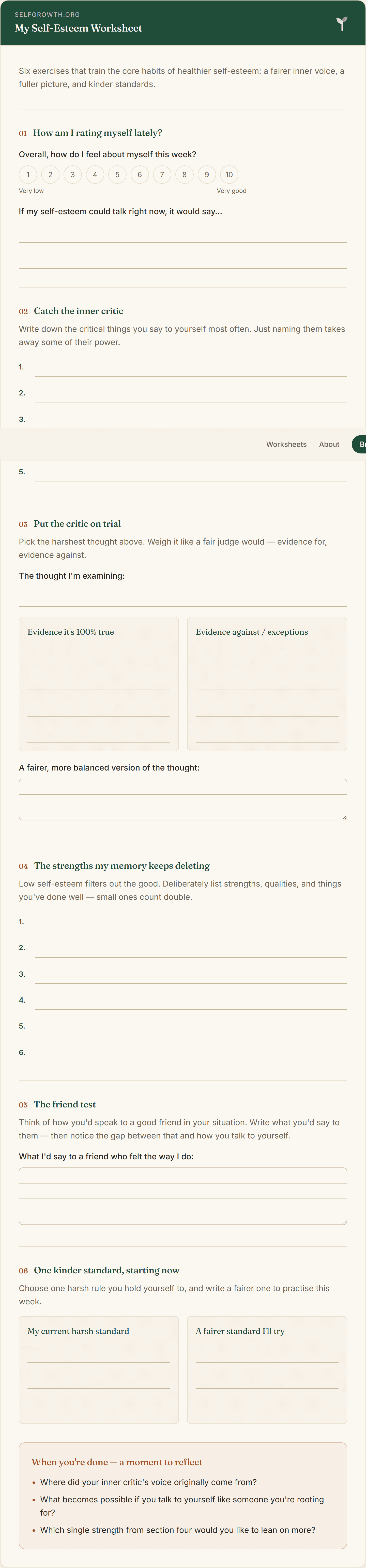
Self-Esteem Worksheet
Free, printable self-esteem worksheets with guided exercises to challenge your inner critic, recognise your strengths, and build steadier, healthier self-esteem.
Open worksheet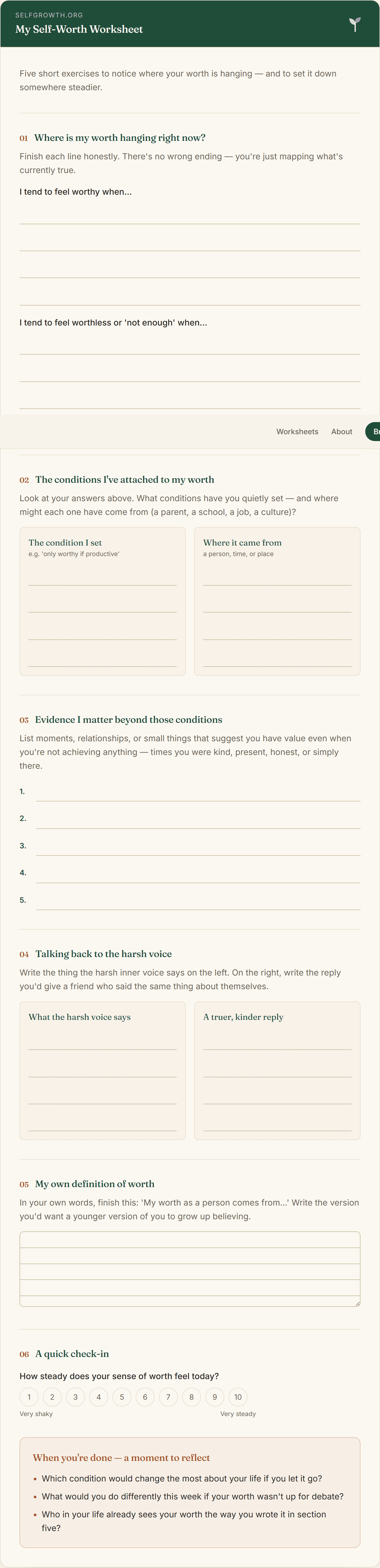
Self-Worth Worksheet
A free, printable self-worth worksheet with five short exercises to separate your value from your achievements and rebuild a steadier sense of worth.
Open worksheet
Negative Self-Talk Worksheet
A free, printable negative self-talk worksheet: catch a harsh inner-critic thought, check whether it's fair, and answer it with something true and kinder.
Open worksheetNew worksheets, straight to your inbox
An occasional new worksheet or tool, sent only when there's something genuinely worth your time. No spam, no pressure, unsubscribe any time.