
Inner critic
Negative Self-Talk Worksheet: A Free, Printable Tool to Answer Your Inner Critic
Updated June 28, 2026 · 6 min read · Free to print
A negative self-talk worksheet walks you through one critical thought at a time: you catch the exact words your inner critic used, name the unfair thinking pattern behind them, check the thought against the evidence and the friend test, and rewrite it as a fair, believable answer. It ends by re-rating how much you still believe the original thought.
By the Self Growth team · drawn from CBT, compassion-focused therapy, and self-compassion research · how we make these
A clean, print-ready PDF, properly formatted, free, no email needed.
The harsh voice in your head, 'you're not good enough', 'you always mess this up', 'everyone can tell', feels like the truth, but it almost never is. It's an old alarm doing a clumsy job of protecting you, and it speaks in absolutes a fair observer never would. The good news is that answering it is a skill, not a personality trait, and a worksheet is one of the best ways to learn it.
This page takes a single critical thought and walks it through the whole process: catch the exact words, spot the unfair rule the thought is breaking, hold it up to the evidence and the friend test, and write the fair, believable version in its place. Not a glossy affirmation you don't buy, a true answer you can actually accept.
You don't need to feel calm or motivated to use it. In fact the best time to fill it in is right after the voice has piped up, while the thought is still fresh and you can write it down word for word.
- 1
Something triggers it
A mistake, a setback, a comparison, sometimes just a quiet moment.
- 2
The critic speaks in absolutes
'You always mess this up', 'you're not good enough', said as if it were plain fact.
- 3
It lands as a feeling
Shame, anxiety, a sinking 'what's the point', louder than any evidence against it.
- 4
You shrink or overdo it
You hold back, avoid, over-apologise, or push twice as hard to outrun the voice.
- 5
The voice feels confirmed
Withdrawing or stumbling looks like proof it was right, so next time it fires faster.
Catching the thought is where the loop breaks
How to use this worksheet
- 1Use it on one specific thought, not your whole self-image. Pick the sentence the critic actually said.
- 2Write the harsh thought down exactly as it came, not a tidied-up version. The exact words are what you'll answer.
- 3Be fair, not flattering. The aim is a true, believable answer, not pretending the mistake didn't happen.
- 4Come back to it. The voice is a habit, and habits change by repetition, not by getting it perfect once.
The worksheet
selfgrowth.org
Answering My Inner Critic
Seven short steps to take one harsh thought from 'that's just the truth' to a fairer answer you can actually believe.
01Catch the thought
You can't answer a thought you haven't noticed. Start with the moment the voice piped up, and write its exact words down.
What happened? The situation, in one line:
The exact words my inner critic said (write them as they came, not tidied up):
How strongly do I believe it right now?
02Name what it's doing
The critic almost always breaks a rule of fair thinking. Naming the move takes away a lot of its authority. Tick any that fit.
03Check it against the evidence
Not what feels true, what you could actually show someone. Usually the 'against' column is longer than the voice would have you believe.
Evidence the thought is true
Evidence it isn't (or is exaggerated)
04The friend test
Imagine someone you care about said this exact thing about themselves, after the exact same event. You'd see it more fairly and more kindly at once. Say that to yourself.
What would I say to a friend who said this about themselves?
05Answer back fairly, not falsely
The fix for 'I'm useless' is not 'I'm amazing', a statement you don't believe just highlights the lie. Write the fair, believable version a fair observer would give.
The harsh thought
The fair, believable answer
06Unhook from it
When a thought is too sticky to argue with, put some distance between you and it, so you can see it as mental noise rather than fact.
Rewrite the thought starting with 'I'm having the thought that...':
If it helps, a name for this voice (so it's a voice in the room, not the truth):
07How do you feel now?
Re-rate the original thought. It rarely drops to zero, and it doesn't need to. A little more distance is the win.
How strongly do I believe the original thought now?
Anything I want to remember for next time the voice shows up:
When you're done, a moment to reflect
- Whose voice does your inner critic sound like? Where might it have first learned to talk to you this way?
- What is the critic trying to protect you from, and is that fear still accurate today?
- If you spoke to yourself this week the way you'd speak to a good friend, what would actually change?
Why these steps, and where they come from
The backbone of this worksheet is cognitive behavioural therapy, specifically the cognitive restructuring or 'thought record' work that goes back to Aaron Beck and was popularised for a wide audience by David Burns in Feeling Good. The core idea is simple and well-supported: harsh automatic thoughts tend to break a handful of recurring rules of fair thinking (the cognitive distortions), and catching the thought, testing it, and answering it with a fairer one reliably loosens its grip. That's the catch, check, answer spine of the page.
Two further bodies of work shape the later steps. Paul Gilbert's compassion-focused therapy frames the inner critic not as the truth but as an over-active threat system that's trying, badly, to keep you safe, which is why the worksheet treats the voice as something to understand rather than obey. And Kristin Neff's research on self-compassion, along with Ethan Kross's work on distanced self-talk (talking to yourself by name or as 'you'), informs the friend test and the unhooking step: treating yourself with the fairness you'd give someone else is linked to more resilience, not less drive.
One deliberate choice runs through all of it: the worksheet asks for fair answers, not flattering ones. Research on positive self-statements (Wood and colleagues, 2009) found that grand affirmations can actually make people who are hard on themselves feel worse, so every step here aims for true-and-believable over glowing. This is an educational tool for the everyday inner critic, not therapy; if the voice is relentless or cruel, please reach for real support too.
These are educational self-reflection tools, not therapy, see our editorial standards.
If you want to go deeper
- Burns, D. D. (1980). Feeling Good: The New Mood Therapy, which popularised the cognitive distortions and thought records behind this worksheet.
- Gilbert, P. (2009). The Compassionate Mind, the compassion-focused-therapy view of the inner critic as an over-active threat system.
- Neff, K. (2011). Self-Compassion: The Proven Power of Being Kind to Yourself.
- Kross, E. et al. (2014). Self-talk as a regulatory mechanism: How you do it matters. Journal of Personality and Social Psychology, 106(2).
- Wood, J. V., Perunovic, W. Q. E. & Lee, J. W. (2009). Positive self-statements: Power for some, peril for others. Psychological Science, 20(7).
Questions people ask
- What is a negative self-talk worksheet?
- It's a structured page that takes one critical thought through a clear process: catching the exact words, naming the unfair thinking pattern behind them, checking the thought against the evidence and the friend test, and rewriting it as a fair, believable answer. The structure does the work that 'just think more positively' can't, because it gives you something specific to question instead of a vague bad feeling.
- How do I stop negative self-talk?
- Not by forcing the voice quiet, which tends to make it louder, but by changing your relationship to it. Catch the exact thought, spot the unfair rule it's breaking (all-or-nothing, labelling, catastrophising), check whether you'd say it to a friend, and answer it with something true rather than flattering. Done repeatedly, fairer self-talk slowly becomes the default. This worksheet walks you through each step.
- Aren't I just making excuses for myself by being kinder?
- No, and this is the most common worry. Answering the critic fairly isn't pretending a mistake didn't happen, it's refusing to add a second, untrue injury ('and that proves I'm worthless') on top of the real one. The evidence is clear that self-criticism is linked to more anxiety and giving up, while fair, honest self-talk is linked to more resilience and follow-through. Fairness motivates better than the whip.
- Why answer the thought instead of just thinking positive?
- Because glowing positive statements you don't believe tend to backfire, especially for people who are already hard on themselves: the gap between 'I'm amazing' and how you actually feel just highlights the lie, and your mind argues back. A fair, believable answer ('I handled that part badly and the rest fine') is something you can genuinely accept, which is why it sticks where an affirmation slides off.
- How often should I use this worksheet?
- Whenever the inner critic is loud enough to knock you off course, and ideally soon after, while the exact words are fresh. Early on you might work one thought a day; later you'll often run the catch-check-answer steps in your head without the page. The voice is a habit built by repetition, so it changes the same way, a little, often, rather than perfectly once.
- Is this worksheet free, and is it a substitute for therapy?
- It's completely free to fill in online or print, with no payment and no email needed. It's an educational self-reflection tool, not therapy or medical advice. It helps with the everyday harsh inner voice; if that voice is relentless and cruel, tips into real hopelessness, or ever turns to thoughts of harming yourself, please treat that as beyond a worksheet and reach out to a GP or qualified professional.
Keep going, related worksheets
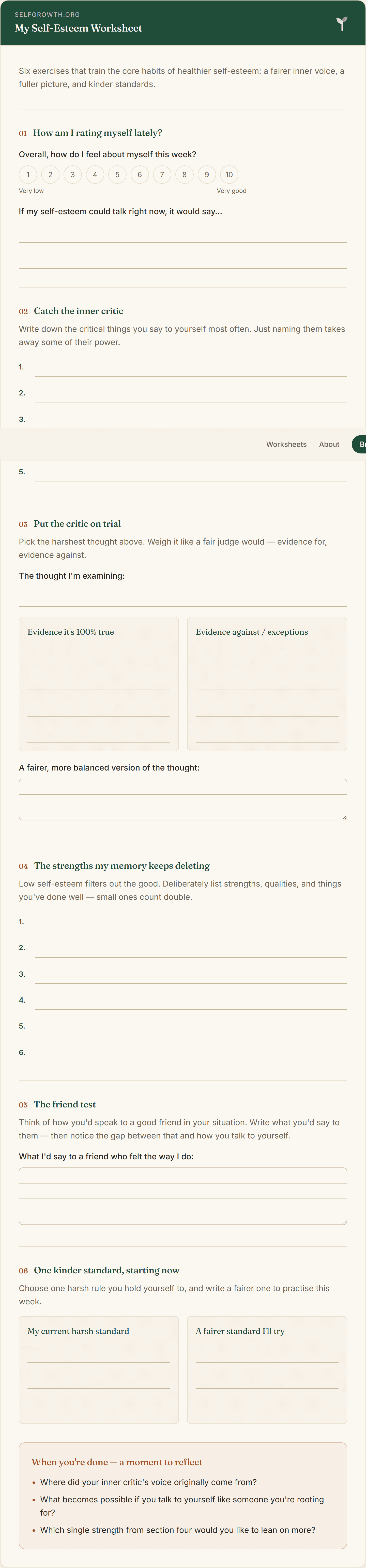
Self-Esteem Worksheet
Free, printable self-esteem worksheets with guided exercises to challenge your inner critic, recognise your strengths, and build steadier, healthier self-esteem.
Open worksheet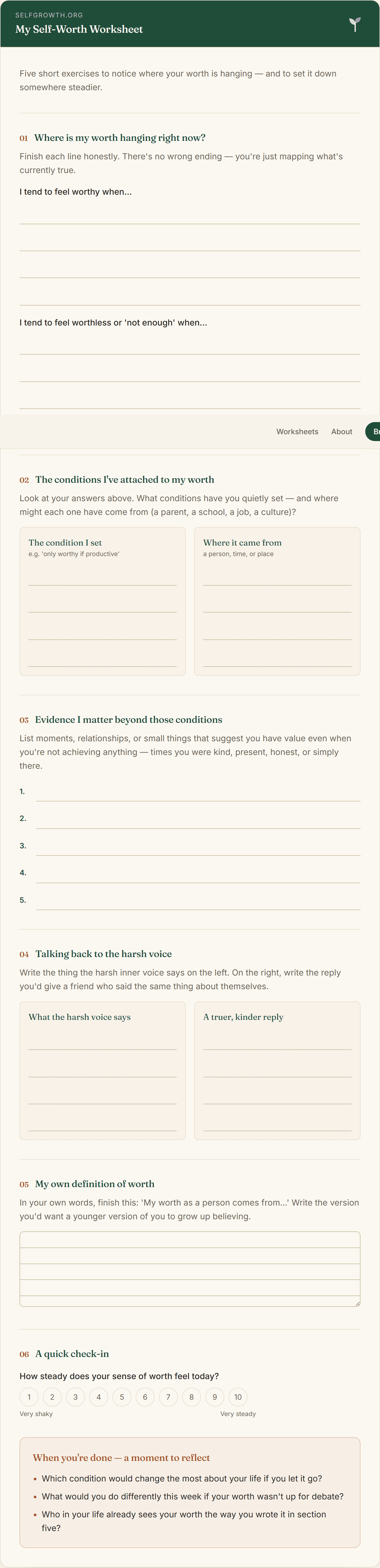
Self-Worth Worksheet
A free, printable self-worth worksheet with five short exercises to separate your value from your achievements and rebuild a steadier sense of worth.
Open worksheet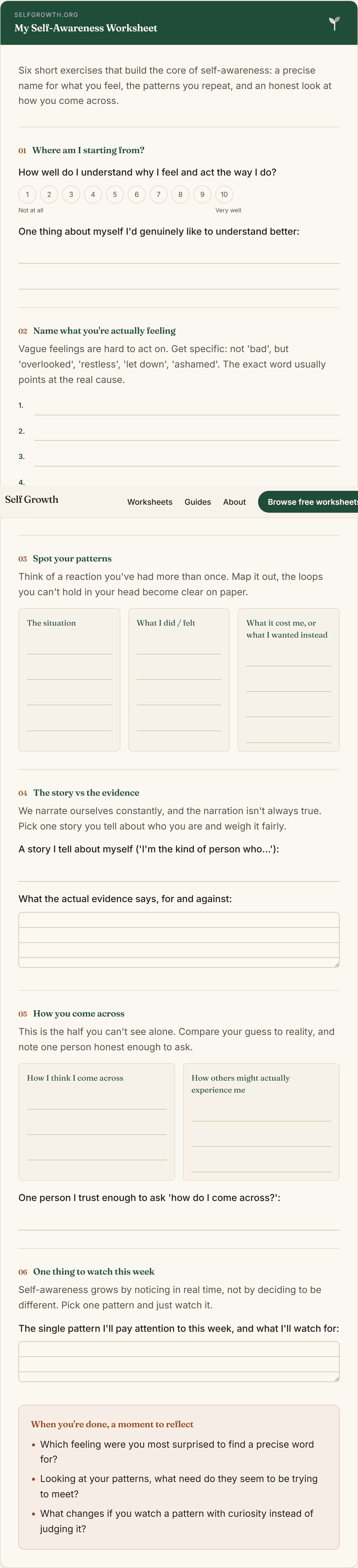
Self-Awareness Worksheet
A free, printable self-awareness worksheet with guided exercises to name your feelings, spot your patterns, and see how you come across, so you understand yourself better.
Open worksheetNew worksheets, straight to your inbox
An occasional new worksheet or tool, sent only when there's something genuinely worth your time. No spam, no pressure, unsubscribe any time.