
Self-awareness
Self-Awareness Worksheet: A Free, Printable Tool to Understand Yourself Better
Updated June 27, 2026 · 7 min read · Free to print
A self-awareness worksheet helps you see yourself more clearly by slowing down and writing it out. This free, printable worksheet walks you through the core moves: naming what you actually feel, spotting the patterns you repeat, testing the stories you tell about yourself, and checking how you come across to others against how you think you do.
By the Self Growth team · drawn from research on self-awareness and emotional intelligence · how we make these
A clean, print-ready PDF, properly formatted, free, no email needed.
Self-awareness is just seeing yourself clearly, what you feel, why you react the way you do, and how you land on other people. Most of us assume we know ourselves well, and most of us know ourselves a bit less well than we think. That gap is normal, and it's exactly what this worksheet is for.
It works because writing slows you down. A feeling you'd skate past in your head has to be named on paper, and patterns you can't hold in mind become obvious once a few of them are sitting in front of you. None of this is about judging yourself, it's about looking fairly.
Do it once for a reset when you feel muddled, or keep it as a regular practice and watch the patterns you spot start to change.
How to use this worksheet
- 1Allow about 20 minutes. Print it for a calmer, handwritten session, or fill it in on screen.
- 2Be specific rather than sweeping. 'I felt left out at lunch on Tuesday' is workable; 'I'm just an anxious person' isn't.
- 3Be honest, not kind-or-cruel. The aim is accuracy, not a good report or a bad one.
- 4Save it and come back in a few weeks. Comparing what you notice over time is where the real insight shows up.
The worksheet
selfgrowth.org
My Self-Awareness Worksheet
Six short exercises that build the core of self-awareness: a precise name for what you feel, the patterns you repeat, and an honest look at how you come across.
01Where am I starting from?
How well do I understand why I feel and act the way I do?
One thing about myself I'd genuinely like to understand better:
02Name what you're actually feeling
Vague feelings are hard to act on. Get specific: not 'bad', but 'overlooked', 'restless', 'let down', 'ashamed'. The exact word usually points at the real cause.
- 1.
- 2.
- 3.
- 4.
- 5.
03Spot your patterns
Think of a reaction you've had more than once. Map it out, the loops you can't hold in your head become clear on paper.
The situation
What I did / felt
What it cost me, or what I wanted instead
04The story vs the evidence
We narrate ourselves constantly, and the narration isn't always true. Pick one story you tell about who you are and weigh it fairly.
A story I tell about myself ('I'm the kind of person who…'):
What the actual evidence says, for and against:
05How you come across
This is the half you can't see alone. Compare your guess to reality, and note one person honest enough to ask.
How I think I come across
How others might actually experience me
One person I trust enough to ask 'how do I come across?':
06One thing to watch this week
Self-awareness grows by noticing in real time, not by deciding to be different. Pick one pattern and just watch it.
The single pattern I'll pay attention to this week, and what I'll watch for:
When you're done, a moment to reflect
- Which feeling were you most surprised to find a precise word for?
- Looking at your patterns, what need do they seem to be trying to meet?
- What changes if you watch a pattern with curiosity instead of judging it?
The approach behind this worksheet
This worksheet is built on a simple distinction from the psychologist Tasha Eurich's research: internal self-awareness (understanding your own feelings, values and patterns) and external self-awareness (understanding how you come across to others). Most people are stronger in one than the other, so the worksheet works on both, the feeling-naming and pattern-spotting sections build the internal kind, and the 'how you come across' section builds the external kind that you genuinely can't see on your own.
Naming feelings precisely draws on a well-supported idea in emotion research: putting an accurate word to what you feel (sometimes called affect labelling) tends to take some of the heat out of it and makes the cause easier to see. In Daniel Goleman's model of emotional intelligence, this kind of self-awareness is the foundation the other skills rest on. These are educational self-reflection tools, written to be done alone or alongside therapy, not a replacement for it.
These are educational self-reflection tools, not therapy, see our editorial standards.
If you want to go deeper
- Tasha Eurich — Insight: The Power of Self-Awareness in a Self-Deluded World (Crown, 2017): the internal vs external self-awareness distinction.
- Daniel Goleman — Emotional Intelligence: Why It Can Matter More Than IQ (Bantam, 1995).
- Lieberman, M. D. et al. (2007). Putting feelings into words: affect labelling. Psychological Science, 18(5).
Questions people ask
- What is a self-awareness worksheet?
- It's a guided set of exercises that help you see yourself more clearly by writing things down: naming what you feel, mapping the patterns you repeat, testing the stories you tell about yourself, and comparing how you think you come across with how others actually experience you. Writing slows you down enough to notice what you'd otherwise skate past.
- What are the signs of low self-awareness?
- Common signs include being repeatedly surprised by how people react to you, blaming circumstances or others for patterns that keep recurring, struggling to name what you feel beyond 'fine' or 'bad', and a gap between how you think you come across and how others actually experience you. Almost everyone has blind spots like these; the 'how you come across' exercise here is designed to bring them into view.
- How do I become more self-aware?
- Build small, regular habits rather than trying to think harder about yourself: name feelings precisely, pause between a trigger and your reaction, keep a short log of situations and how you responded, and ask one trusted person how you come across. This worksheet puts the naming and pattern-spotting into a structure so you're not doing it all from memory.
- What are good self-awareness questions?
- The useful ones are concrete: What exactly am I feeling, in one precise word? What situation set this off? What did I do, and what did it cost me? What story am I telling about myself here, and does the evidence back it? How might someone else have experienced that moment? This worksheet walks through questions like these in order.
- Are these worksheets free to print?
- Yes. Everything on selfgrowth.org is free to fill in online or print, no payment and no email required. Use the Download PDF button for a clean copy, or Print for a paper version.
- Is this a substitute for therapy?
- No. These are educational self-reflection tools, not therapy or medical advice. If looking inward surfaces heavy material, or you're dealing with lasting low mood, anxiety or trauma, please talk to a GP or a qualified professional alongside this.
Keep going, related worksheets
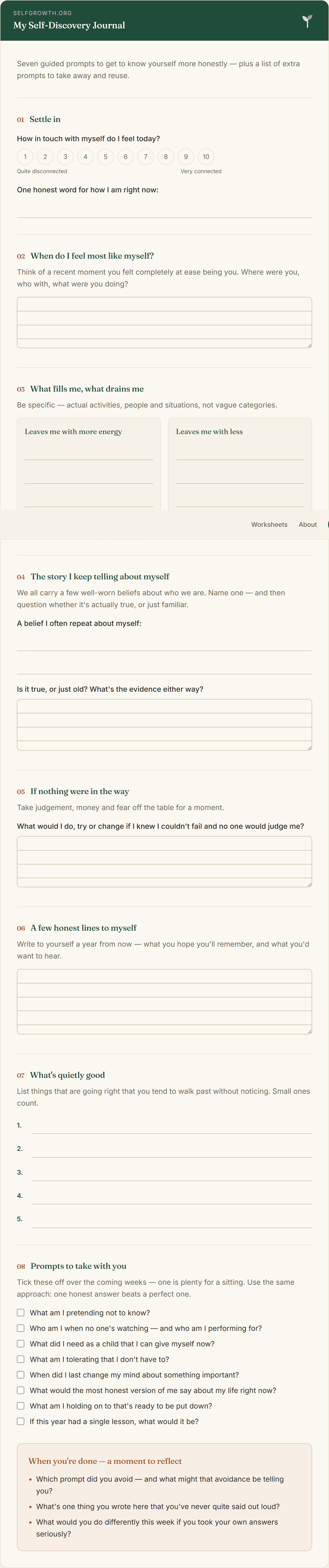
Self-Discovery Journal Prompts
Free, printable self-discovery journal prompts, guided questions with space to write, to explore your values, patterns and what you really want.
Open worksheet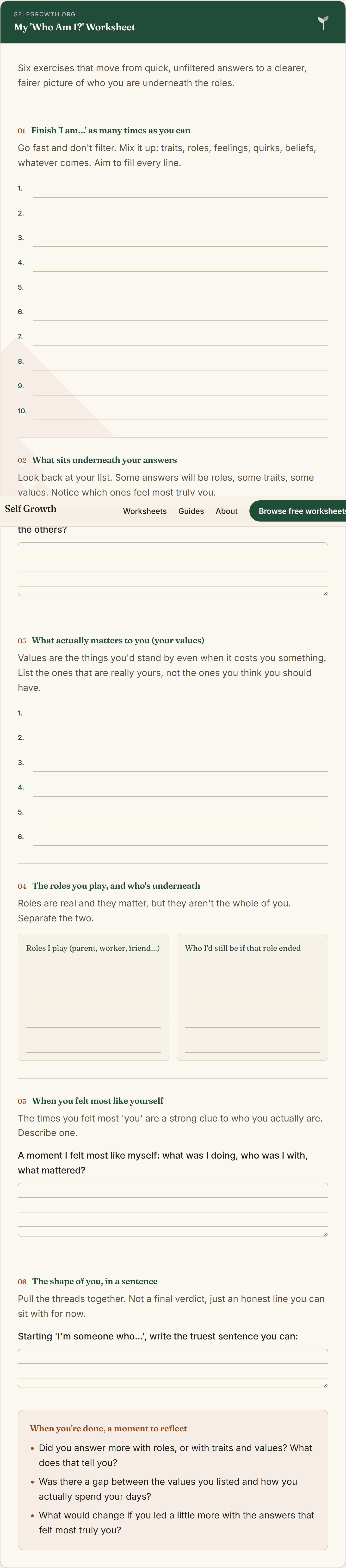
Who Am I? Worksheet
A free, printable 'Who am I?' worksheet to explore your identity, values and the person underneath your roles, with the classic twenty-statements exercise and guided prompts.
Open worksheet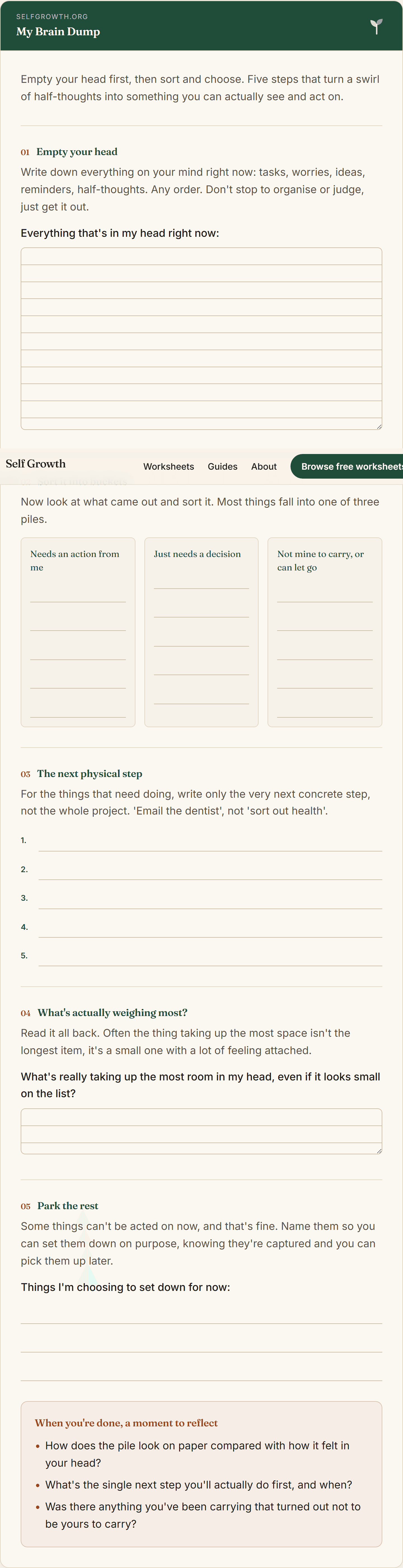
Brain Dump Template
A free, printable brain dump template to empty a cluttered mind onto the page, sort it into what needs action and what to let go, and find the next clear step.
Open worksheetNew worksheets, straight to your inbox
An occasional new worksheet or tool, sent only when there's something genuinely worth your time. No spam, no pressure, unsubscribe any time.