
Self-awareness
Who Am I? Worksheet: A Free, Printable Tool to Explore Your Identity and Values
Updated June 27, 2026 · 7 min read · Free to print
A 'Who am I?' worksheet helps you separate who you really are from the roles you play and the labels you've been given. This free, printable worksheet uses the classic exercise of finishing 'I am…' many times over, then helps you sort your answers, name your values, and put the real you into a single honest sentence.
By the Self Growth team · drawn from self-concept psychology and values-based approaches · how we make these
A clean, print-ready PDF, properly formatted, free, no email needed.
'Who am I?' is one of those questions that feels enormous until you start writing, and then it gets surprisingly workable. Most of us answer it day to day with roles, parent, worker, the reliable one, and forget there's a person underneath who'd still be there if the roles changed.
This worksheet uses an old and well-tested approach from psychology: finish the sentence 'I am…' as many times as you can, quickly, before your inner editor catches up. What pours out, and the order it comes in, tells you a lot. Then you sort it, look for what actually matters to you, and pull it back together.
There are no right answers here, and nothing to score. It's a mirror, not a test. Do it in one sitting, or come back to it at a turning point when the question feels live again.
How to use this worksheet
- 1Allow about 20 minutes, and try to do the first exercise fast, without overthinking.
- 2Write for yourself, not for how it would sound to anyone else. No one has to read this.
- 3If you get stuck, that's information too. Notice which kinds of answers come easily and which don't.
- 4Save it and revisit it after a big change. Watching your answers shift over time is part of the point.
The worksheet
selfgrowth.org
My 'Who Am I?' Worksheet
Six exercises that move from quick, unfiltered answers to a clearer, fairer picture of who you are underneath the roles.
01Finish 'I am…' as many times as you can
Go fast and don't filter. Mix it up: traits, roles, feelings, quirks, beliefs, whatever comes. Aim to fill every line.
- 1.
- 2.
- 3.
- 4.
- 5.
- 6.
- 7.
- 8.
- 9.
- 10.
02What sits underneath your answers
Look back at your list. Some answers will be roles, some traits, some values. Notice which ones feel most truly you.
Which answers feel most genuinely 'me', and why those rather than the others?
03What actually matters to you (your values)
Values are the things you'd stand by even when it costs you something. List the ones that are really yours, not the ones you think you should have.
- 1.
- 2.
- 3.
- 4.
- 5.
- 6.
04The roles you play, and who's underneath
Roles are real and they matter, but they aren't the whole of you. Separate the two.
Roles I play (parent, worker, friend…)
Who I'd still be if that role ended
05When you felt most like yourself
The times you felt most 'you' are a strong clue to who you actually are. Describe one.
A moment I felt most like myself: what was I doing, who was I with, what mattered?
06The shape of you, in a sentence
Pull the threads together. Not a final verdict, just an honest line you can sit with for now.
Starting 'I'm someone who…', write the truest sentence you can:
When you're done, a moment to reflect
- Did you answer more with roles, or with traits and values? What does that tell you?
- Was there a gap between the values you listed and how you actually spend your days?
- What would change if you led a little more with the answers that felt most truly you?
The approach behind this worksheet
The opening exercise is a plain-language version of the Twenty Statements Test, devised by the sociologists Manford Kuhn and Thomas McPartland in 1954 to study how people describe themselves. The instruction is simply to finish 'I am…' up to twenty times, fast. Speed matters: it gets past the careful, curated self and lets the more automatic answers through, and the order they arrive in, roles first or values first, is itself revealing.
The later sections draw on values-clarification work from acceptance and commitment therapy (ACT), where naming what genuinely matters to you, rather than what you think should, is treated as a compass for decisions. Separating roles from the person underneath, and noticing when you felt most yourself, are gentle ways into the same question. These are educational self-reflection tools, written to be done alone or alongside therapy, not a replacement for it.
These are educational self-reflection tools, not therapy, see our editorial standards.
If you want to go deeper
- Kuhn, M. H. & McPartland, T. S. (1954). An empirical investigation of self-attitudes (the Twenty Statements Test). American Sociological Review, 19(1).
- Russ Harris — The Happiness Trap (2008): a plain-English introduction to ACT values work.
- Carl Rogers — On Becoming a Person (1961), on the self underneath roles and conditions.
Questions people ask
- What is a 'Who am I?' worksheet?
- It's a guided exercise for exploring your identity: who you are beneath your roles, what you value, and what feels most genuinely you. It usually starts with finishing the sentence 'I am…' many times over, quickly, then helps you sort and make sense of what came out. It's a mirror for self-understanding, not a personality test with a score.
- How do I answer the question 'who am I?'
- Start small and fast rather than reaching for one grand answer. Finish 'I am…' as many ways as you can without filtering, then look at what came up: which answers are roles, which are traits, which are values, and which feel most truly you. The patterns across your answers say more than any single line.
- Is it normal to not know who you are?
- Completely. The question tends to get loud at turning points: after a big change or loss, when a role you'd built your identity around ends, or simply when life slows down enough to ask. Not having a tidy answer isn't a problem to fix so much as an invitation to look, which is exactly what this worksheet helps you do, one honest 'I am…' at a time.
- What is the 'I am' or twenty statements exercise?
- It's a classic self-concept exercise from psychology where you complete the sentence 'I am…' up to twenty times as quickly as you can. Going fast gets past your inner editor, and what you write, plus the order it arrives in, reveals how you actually see yourself. This worksheet is built around that exercise.
- Are these worksheets free to print?
- Yes. Everything on selfgrowth.org is free to fill in online or print, no payment and no email required. Use the Download PDF button for a clean copy, or Print for a paper version.
- Is this a substitute for therapy?
- No. This is an educational self-reflection tool, not therapy. Identity questions can stir up real feelings, especially after a big change or loss. If that happens and it stays heavy, it's worth working through it with a counsellor or GP alongside this.
Keep going, related worksheets
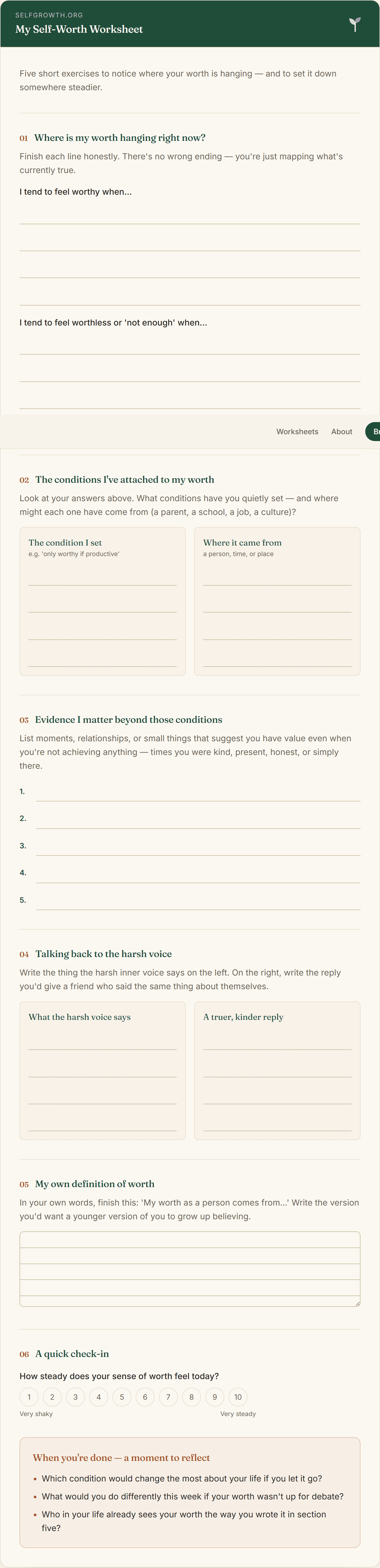
Self-Worth Worksheet
A free, printable self-worth worksheet with five short exercises to separate your value from your achievements and rebuild a steadier sense of worth.
Open worksheet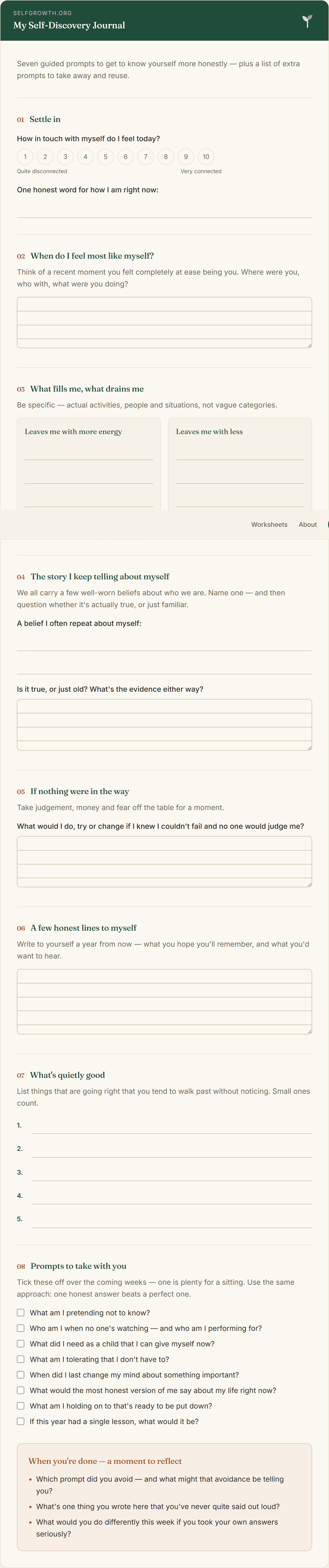
Self-Discovery Journal Prompts
Free, printable self-discovery journal prompts, guided questions with space to write, to explore your values, patterns and what you really want.
Open worksheet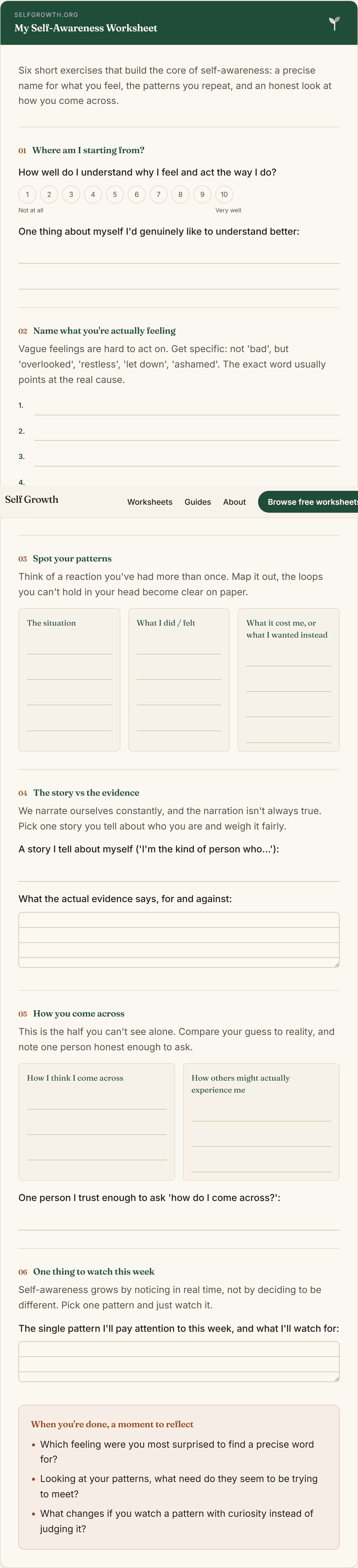
Self-Awareness Worksheet
A free, printable self-awareness worksheet with guided exercises to name your feelings, spot your patterns, and see how you come across, so you understand yourself better.
Open worksheetNew worksheets, straight to your inbox
An occasional new worksheet or tool, sent only when there's something genuinely worth your time. No spam, no pressure, unsubscribe any time.