
Journaling
Self-Discovery Journal Prompts: A Free, Printable Worksheet to Get to Know Yourself
Updated June 24, 2026 · 6 min read · Free to print
Self-discovery journal prompts are open questions that help you understand yourself more honestly, your values, your patterns, and what you actually want underneath the noise. This free, printable worksheet gives you a guided set with space to write, plus a list of extra prompts to keep, so journaling has a direction instead of a blank page staring back.
By the Self Growth team · drawn from research on expressive writing & journaling for wellbeing · how we make these
A clean, print-ready PDF, properly formatted, free, no email needed.
A blank journal is intimidating precisely because it asks 'so… what are you thinking?', the broadest possible question. Prompts solve that. A good prompt narrows the lens to one honest, answerable thing, and that small bit of structure is often the difference between three real sentences and another night of writing nothing.
These prompts are built for self-discovery specifically, not a daily diary of events, but questions aimed at the things you don't usually stop to put into words: what you value, where your energy goes, the stories you keep telling about yourself, and what you'd reach for if fear weren't in the room.
There's good evidence that writing things down helps. Research on expressive writing (putting difficult or important experiences into words on paper), links it to better mood and a clearer head. You don't need to write well or write much. You just need to be honest, on a page no one else has to see.
How to use this worksheet
- 1Give yourself 15–20 quiet minutes. Print it, or type straight onto the page.
- 2Write for yourself, not an audience. Spelling, grammar and 'making sense' don't matter here.
- 3Don't force every prompt. Start with the one that makes you flinch slightly, that's usually the honest one.
- 4Keep what you write. Coming back in a few months and re-reading is where a lot of the self-knowledge lands.
The worksheet
selfgrowth.org
My Self-Discovery Journal
Seven guided prompts to get to know yourself more honestly, plus a list of extra prompts to take away and reuse.
01Settle in
How in touch with myself do I feel today?
One honest word for how I am right now:
02When do I feel most like myself?
Think of a recent moment you felt completely at ease being you. Where were you, who with, what were you doing?
03What fills me, what drains me
Be specific, actual activities, people and situations, not vague categories.
Leaves me with more energy
Leaves me with less
04The story I keep telling about myself
We all carry a few well-worn beliefs about who we are. Name one, and then question whether it's actually true, or just familiar.
A belief I often repeat about myself:
Is it true, or just old? What's the evidence either way?
05If nothing were in the way
Take judgement, money and fear off the table for a moment.
What would I do, try or change if I knew I couldn't fail and no one would judge me?
06A few honest lines to myself
Write to yourself a year from now, what you hope you'll remember, and what you'd want to hear.
07What's quietly good
List things that are going right that you tend to walk past without noticing. Small ones count.
- 1.
- 2.
- 3.
- 4.
- 5.
08Prompts to take with you
Tick these off over the coming weeks, one is plenty for a sitting. Use the same approach: one honest answer beats a perfect one.
When you're done, a moment to reflect
- Which prompt did you avoid, and what might that avoidance be telling you?
- What's one thing you wrote here that you've never quite said out loud?
- What would you do differently this week if you took your own answers seriously?
Why these prompts, and where the idea comes from
The prompts here are shaped by research on expressive writing, pioneered by the psychologist James Pennebaker. His studies found that writing honestly about meaningful or difficult experiences (even for just a few minutes over a few days), was associated with measurable improvements in mood and wellbeing. The mechanism seems to be partly about putting tangled feelings into words, which helps make sense of them.
We've chosen prompts aimed at self-understanding (values, energy, the stories you tell about yourself), and kept them gentle and open. This is an educational journaling tool, not therapy; if writing surfaces something heavy that doesn't settle, it's worth talking to a professional.
These are educational self-reflection tools, not therapy, see our editorial standards.
If you want to go deeper
- James W. Pennebaker — Opening Up by Writing It Down: How Expressive Writing Improves Health and Eases Emotional Pain (with Joshua Smyth).
- Pennebaker, J. W. (1997). Writing about emotional experiences as a therapeutic process. Psychological Science.
Questions people ask
- What are self-discovery journal prompts?
- They're open-ended questions designed to help you understand yourself more honestly (your values, patterns, needs and desires), rather than just record what happened in your day. A prompt narrows the blank page down to one answerable question, which makes it far easier to write something real.
- How do I start journaling if I never know what to write?
- Start with a prompt rather than a blank page, that's exactly what this worksheet is for. Pick one question, set a timer for five minutes, and write whatever comes without editing. The goal is honesty, not quality. Most people find that once the first few sentences are down, the rest follows.
- Does journaling actually help?
- Research on expressive writing (writing about meaningful or difficult experiences), has linked it to improvements in mood and a clearer sense of perspective. It isn't a cure-all, and it isn't therapy, but as a low-cost habit for understanding yourself it has a genuinely good track record.
- How often should I use journal prompts?
- Whatever you'll actually keep up. A few minutes a few times a week is plenty, consistency matters more than length. The 'prompts to take with you' list at the end of this worksheet is there so you've always got a next question ready.
- Is this worksheet free to print?
- Yes. Everything on selfgrowth.org is free to fill in online or print, no payment and no email required. Use the Download PDF button for a clean copy, or Print for a paper version.
- Is journaling a substitute for therapy?
- No. This is an educational self-reflection tool, not therapy or medical advice. Writing about your life can surface heavy things, grief, trauma, or low mood that lingers. If something doesn't settle, please talk to a qualified professional or a local support line rather than working through it alone.
Keep going, related worksheets
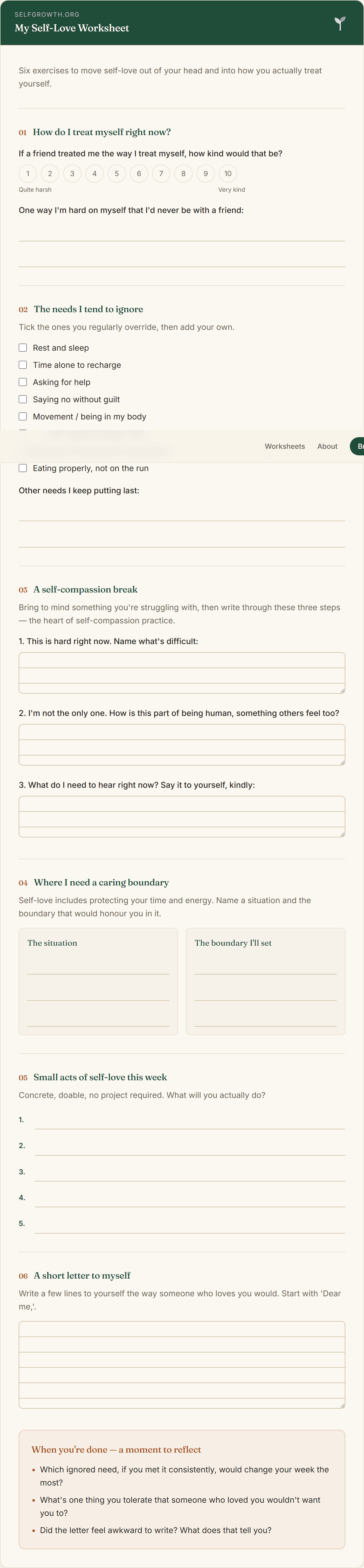
Self-Love Worksheet
A free, printable self-love worksheet that turns self-love from a vague idea into specific actions, meeting your needs, setting boundaries, and treating yourself with care.
Open worksheet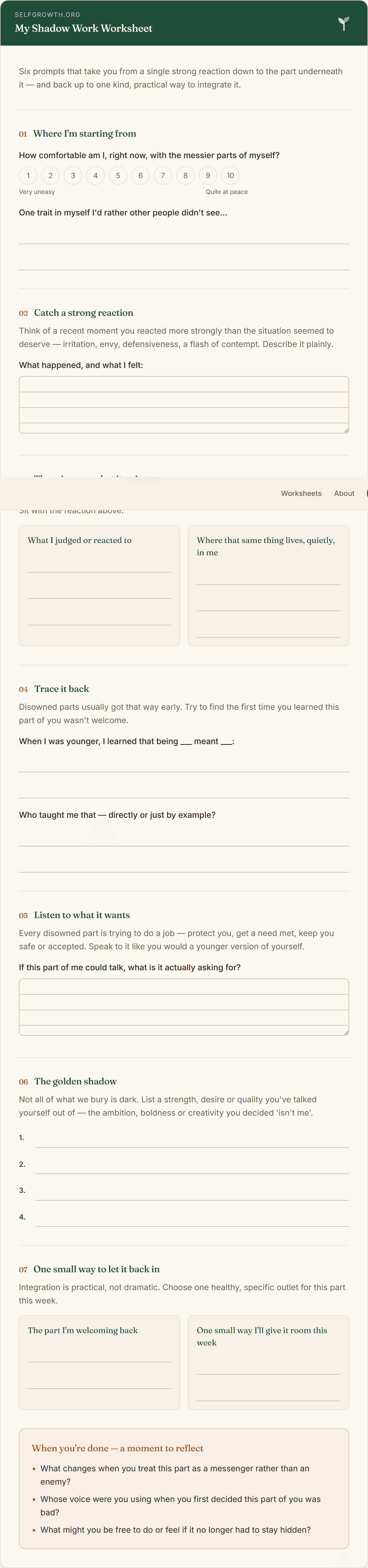
Shadow Work Worksheet
A free, printable shadow work worksheet: guided prompts to spot your triggers and projections, trace them to their roots, and meet the parts you hide.
Open worksheet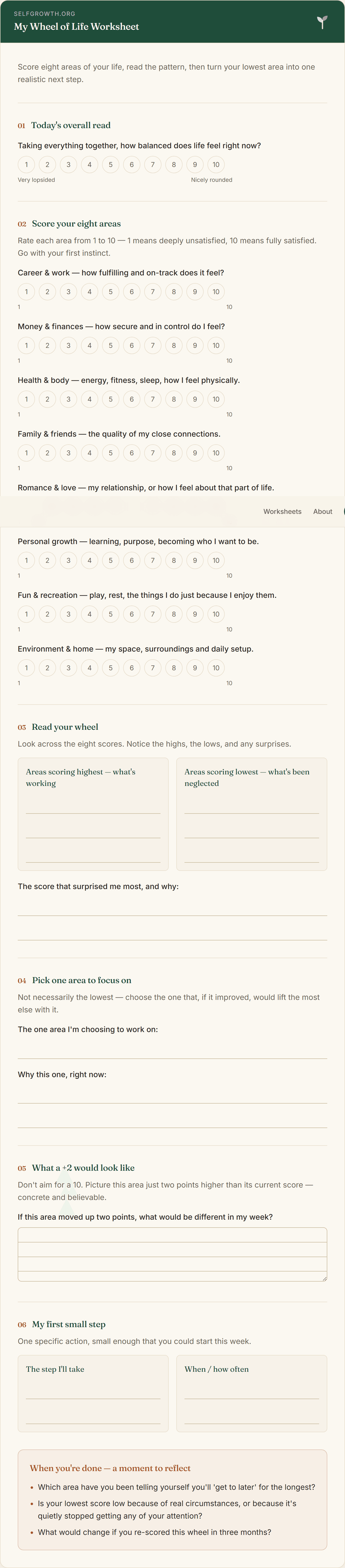
Wheel of Life Worksheet
A free, printable Wheel of Life worksheet. Score eight areas of your life out of ten, see where you're out of balance, and pick one to work on next.
Open worksheetNew worksheets, straight to your inbox
An occasional new worksheet or tool, sent only when there's something genuinely worth your time. No spam, no pressure, unsubscribe any time.