
Guide
What is shadow work, and how do you start?
Updated June 25, 2026 · 9 min read
Shadow work is the practice of getting to know the parts of yourself you've pushed out of sight, the anger, envy, neediness or even unused talent you learned to hide. You start small: catch a strong reaction, trace where it came from, listen to what that part actually wants, and find one healthy way to let it back in. The goal is integration, not getting rid of anything.
By the Self Growth team · drawn from Jungian depth psychology · how we make these
Shadow work has become a popular phrase, and like most popular phrases it's picked up a lot of mystique it doesn't need. Stripped back, it's a simple idea from the psychologist Carl Jung: there are parts of ourselves we learned, early on, to keep hidden, and those parts don't disappear. They run quietly in the background until we turn round and get to know them.
You'll see what the shadow actually is, why it's worth meeting rather than fighting, and how to start in a way that's gentle and safe rather than overwhelming, with a free worksheet to do the work on paper.
What "the shadow" means
Your shadow is the collection of traits, feelings and impulses you've pushed out of awareness because, somewhere along the way, you learned they weren't safe or acceptable to show. Anger, jealousy, neediness, selfishness, the obvious ones. But the shadow isn't only the ugly stuff.
Plenty of good things end up in there too: confidence that got shut down for being "too much", ambition that wasn't welcome, playfulness, desire, a talent you were taught not to make a fuss about. Anything you decided you shouldn't be can get tucked away.
The idea comes from Carl Jung, who used the word "shadow" for everything in us that the conscious, presentable self disowns. His point wasn't that the shadow is evil, it's that what we refuse to look at tends to run us from behind. Shadow work is simply choosing to look.
The self you show
The shadow, pushed out of sight
Not only the difficult parts, good traits get pushed down here too.
Why hidden parts matter
What we refuse to look at tends to run us from behind.
Hiding a part of yourself doesn't remove it, it just sends it underground, where it leaks out sideways. That's the practical reason shadow work is worth doing: the parts you won't look at end up running you.
- A reaction far bigger than the situation deserves is usually a shadow part being touched.
- The exact trait that makes your blood boil in other people is often one you won't allow in yourself. This is called projection.
- Habits you can't explain and patterns you keep repeating often have a hidden part underneath them, trying to get a need met.
Meeting these parts on purpose means they no longer have to fight for your attention. That's the whole point: not to scrub yourself clean of everything difficult, but to stop being driven by parts you refuse to look at.
How to start, safely
Shadow work isn't about dredging up your worst memories. The gentlest and most useful way in is to start from something concrete and recent, then work backwards.
- 1Pick one specific moment you reacted more strongly than the situation seemed to call for. A single incident, not your whole life.
- 2Describe plainly what happened and what you felt. Honesty on paper is easier than honesty out loud, and no one else has to read it.
- 3Ask what that reaction points to. What trait or need was being touched? What were you taught about showing it?
- 4Listen to what the part actually wants. Underneath most shadow parts is an ordinary need: to be safe, seen, allowed, respected.
- 5Find one small, healthy way to let it back in, rather than acting it out or pushing it down again.
The free worksheet below walks you through exactly these steps, in order, so you're not digging at random.
Open the Shadow Work WorksheetWhen shadow work needs a therapist
Shadow work can stir up real, heavy material: old trauma, grief, genuine distress. That's not a sign you're doing it wrong, but it is a sign to slow down. If something painful keeps surfacing, or you find yourself feeling worse for days rather than lighter, this is work to do alongside a therapist rather than alone with a worksheet.
A GP can point you to talking therapies, and a trauma-informed therapist can hold the heavier material safely in a way a worksheet can't. These are educational self-reflection tools, not therapy. Going gently isn't a lack of courage, it's how this work is meant to be done.
How we put this together
This guide is written in plain language from established, evidence-based ideas, not personal opinion. It's an educational self-reflection resource, not therapy or medical advice, see our editorial standards.
If you want to go deeper
- Carl Jung — collected works on the shadow and the process of individuation.
- Robert A. Johnson — Owning Your Own Shadow: Understanding the Dark Side of the Psyche (1991).
- Connie Zweig & Jeremiah Abrams (eds.) — Meeting the Shadow (1991).
Questions people ask
- What is shadow work in simple terms?
- Shadow work is getting to know the parts of yourself you've learned to hide, like anger, envy or neediness, as well as good traits that got shut down, such as confidence or ambition. You do it so those hidden parts stop running you from the background.
- Is shadow work safe to do on your own?
- For most people, starting gently with a structured worksheet is fine. Begin with a single recent reaction rather than your hardest memories. If heavy material like trauma or grief keeps coming up, it's safer to do the work alongside a therapist rather than alone.
- How do you start shadow work as a beginner?
- Start small and concrete. Pick one recent moment you overreacted to, describe what you felt, and trace it back to the part of you it touched and the need underneath. A guided worksheet keeps you from digging at random.
- What are some shadow work prompts?
- Useful prompts work backwards from a real reaction: What trait in others most irritates me, and do I deny it in myself? When did I last overreact, and what was it protecting? What did I learn growing up that I shouldn't be? What does this hidden part actually want? The free worksheet walks through prompts like these in order.
- Can shadow work be dangerous?
- For most people, starting gently is fine. The risk isn't the practice itself, it's going too deep too fast, alone, into material you're not ready for. If you have a history of trauma, or heavy feelings keep surfacing, do it alongside a therapist rather than solo. Going slowly is the safe way, not a weakness.
- Is shadow work the same as therapy?
- No. Shadow work is a self-reflection practice you can do on your own. Therapy is professional support with a trained person. Shadow work can sit alongside therapy, but it doesn't replace it, especially if difficult or traumatic material surfaces.
Worksheets to do the work
Free to fill in online or print. No email needed.
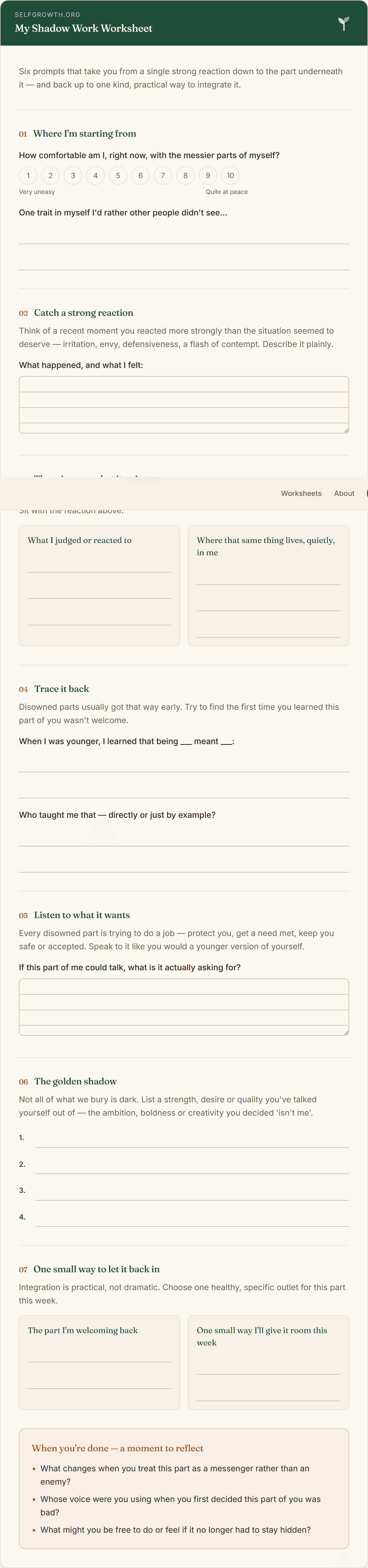
Shadow Work Worksheet
A free, printable shadow work worksheet: guided prompts to spot your triggers and projections, trace them to their roots, and meet the parts you hide.
Open worksheet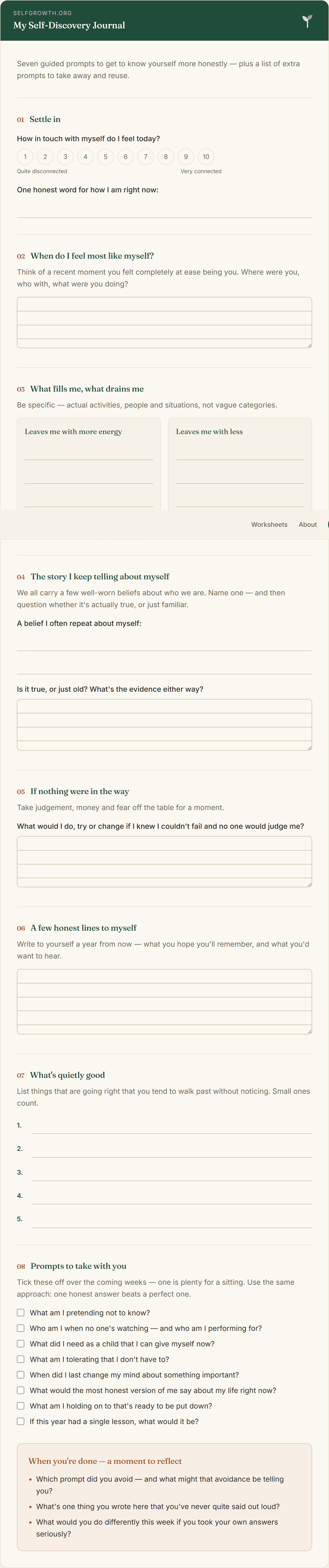
Self-Discovery Journal Prompts
Free, printable self-discovery journal prompts, guided questions with space to write, to explore your values, patterns and what you really want.
Open worksheetNew worksheets, straight to your inbox
An occasional new worksheet or tool, sent only when there's something genuinely worth your time. No spam, no pressure, unsubscribe any time.