
Shadow work
Shadow Work Worksheet: A Free, Printable Set of Prompts to Meet the Parts You Hide
Updated June 27, 2026 · 8 min read · Free to print
Shadow work is the practice of getting to know the parts of yourself you've pushed out of sight, the anger, envy, neediness or even unused talent you learned to hide. This free, printable worksheet walks you through it gently: catch a strong reaction, trace where it came from, listen to what that part actually wants, and find one healthy way to let it back in.
By the Self Growth team · drawn from Jungian depth psychology & the shadow-integration tradition · how we make these
A clean, print-ready PDF, properly formatted, free, no email needed.
Everyone carries parts of themselves they keep out of sight, the anger, jealousy, neediness or selfishness they learned, somewhere along the way, weren't safe to show. This hidden side is often called your 'shadow', and it isn't all dark: confidence, ambition and playfulness get shut down early just as easily, and end up tucked away in there too.
The catch is that hiding a part of yourself doesn't remove it, it just sends it underground, where it tends to leak out sideways: as a disproportionate reaction, a habit you can't explain, or the exact trait in other people that makes your blood boil. Shadow work is simply turning around and getting to know those parts on purpose, instead of being run by them.
This worksheet gives you a calm, structured way in. You'll start from something concrete (a recent strong reaction), and work back to what it's protecting, rather than digging at random. Integration, not exorcism, is the goal: the point isn't to get rid of these parts, it's to stop them having to fight for your attention.
The self you show
The shadow, pushed out of sight
Not only the difficult parts, good traits get pushed down here too.
How to use this worksheet
- 1Set aside 25–30 minutes somewhere private. This works best printed and handwritten, the slower pace helps.
- 2Start with one specific incident, not your whole life. A single moment you overreacted to is more useful than a general theme.
- 3Be honest on paper in a way you don't have to be out loud. No one else needs to read this.
- 4Go gently. If something heavy surfaces (old trauma, grief, real distress), it's a sign to pause and, if it keeps coming up, to do this work alongside a therapist rather than alone.
The worksheet
selfgrowth.org
My Shadow Work Worksheet
Six prompts that take you from a single strong reaction down to the part underneath it, and back up to one kind, practical way to integrate it.
01Where I'm starting from
How comfortable am I, right now, with the messier parts of myself?
One trait in myself I'd rather other people didn't see…
02Catch a strong reaction
Think of a recent moment you reacted more strongly than the situation seemed to deserve, irritation, envy, defensiveness, a flash of contempt. Describe it plainly.
What happened, and what I felt:
03The mirror · what it points to
Often the thing that most irritates us in others is a trait we won't allow in ourselves. Sit with the reaction above.
What I judged or reacted to
Where that same thing lives, quietly, in me
04Trace it back
Disowned parts usually got that way early. Try to find the first time you learned this part of you wasn't welcome.
When I was younger, I learned that being ___ meant ___:
Who taught me that, directly or just by example?
05Listen to what it wants
Every disowned part is trying to do a job, protect you, get a need met, keep you safe or accepted. Speak to it like you would a younger version of yourself.
If this part of me could talk, what is it actually asking for?
06The golden shadow
Not all of what we bury is dark. List a strength, desire or quality you've talked yourself out of, the ambition, boldness or creativity you decided 'isn't me'.
- 1.
- 2.
- 3.
- 4.
07One small way to let it back in
Integration is practical, not dramatic. Choose one healthy, specific outlet for this part this week.
The part I'm welcoming back
One small way I'll give it room this week
When you're done, a moment to reflect
- What changes when you treat this part as a messenger rather than an enemy?
- Whose voice were you using when you first decided this part of you was bad?
- What might you be free to do or feel if it no longer had to stay hidden?
The approach behind this worksheet
The 'shadow' comes from the work of the Swiss psychiatrist Carl Jung, who used it to describe the disowned parts of the personality, what we repress, deny or never develop. The central, hopeful idea is integration: bringing those parts into awareness so they can be understood and given a healthy place, rather than acting on us from the dark.
The prompts here lean on three reliable doorways into the shadow that this tradition describes, projection (the traits in others that trigger us), tracing a reaction to its origin, and the 'golden shadow' of buried strengths. They're written as gentle self-reflection, not depth analysis, and they're not a substitute for therapy.
These are educational self-reflection tools, not therapy, see our editorial standards.
If you want to go deeper
- Robert A. Johnson — Owning Your Own Shadow: Understanding the Dark Side of the Psyche (1991).
- Connie Zweig & Jeremiah Abrams (eds.) — Meeting the Shadow: The Hidden Power of the Dark Side of Human Nature (1991).
- C. G. Jung — Aion and the Collected Works, where the concept of the shadow is developed.
Questions people ask
- What is shadow work, in simple terms?
- Shadow work is deliberately getting to know the parts of yourself you usually keep out of sight, feelings, impulses and traits you learned to hide because they felt unacceptable. The idea comes from Carl Jung, who called this hidden material the 'shadow'. The work is about understanding and integrating those parts so they stop running you from the background, not about getting rid of them.
- Is shadow work safe to do on my own?
- For most everyday material (irritation, envy, self-criticism), gentle journaling like this is safe and useful. But shadow work can also surface heavier things: trauma, grief, or feelings that overwhelm you. If that happens, that's not a failure, it's a signal to slow down and ideally do the work alongside a therapist rather than alone. This worksheet is an educational reflection tool, not therapy.
- How is shadow work different from normal journaling?
- Ordinary journaling records what happened and how you feel. Shadow work points specifically at the parts you avoid (your triggers, projections and disowned traits), and asks where they came from and what they want. It's journaling aimed at the blind spots rather than the highlights.
- How often should I do shadow work?
- There's no rule. Many people do it whenever a strong reaction catches their attention, a flare of envy or defensiveness is a ready-made starting point. Others keep a gentle weekly rhythm. Little and regular tends to work better than long, intense sessions.
- Is shadow work a substitute for therapy?
- No. Shadow work like this is an educational self-reflection practice, and it can sit well alongside therapy, but it isn't a replacement for it. Because it deliberately looks at buried or painful material, it can surface trauma or grief that's hard to handle alone. If that happens, treat it as a signal to slow down, and if it keeps coming up, work through it with a qualified therapist rather than on your own.
- Is this worksheet free to print?
- Yes. Everything on selfgrowth.org is free to fill in online or print, no payment and no email required. Use the Download PDF button for a clean copy, or Print for a paper version.
Keep going, related worksheets
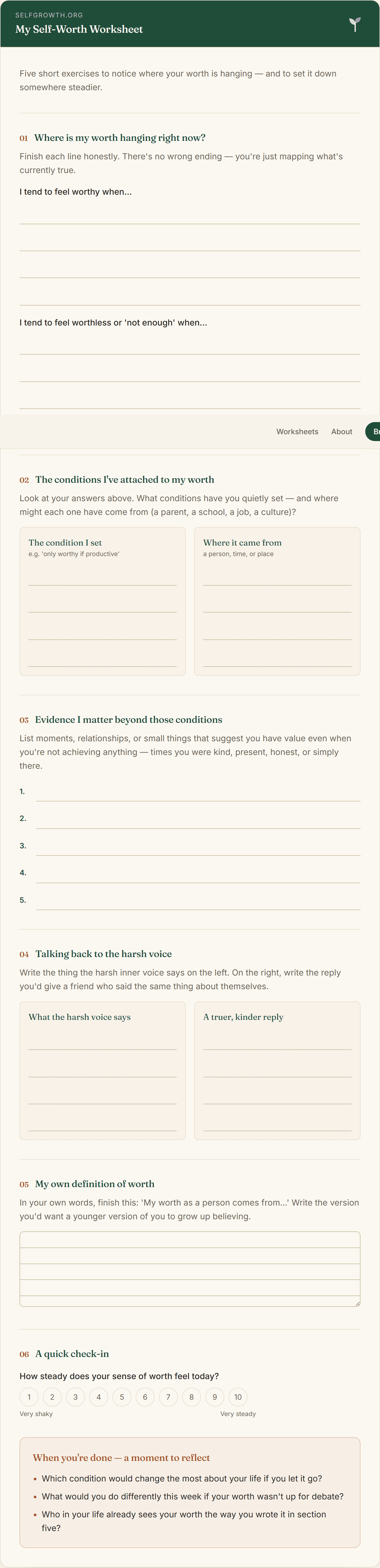
Self-Worth Worksheet
A free, printable self-worth worksheet with five short exercises to separate your value from your achievements and rebuild a steadier sense of worth.
Open worksheet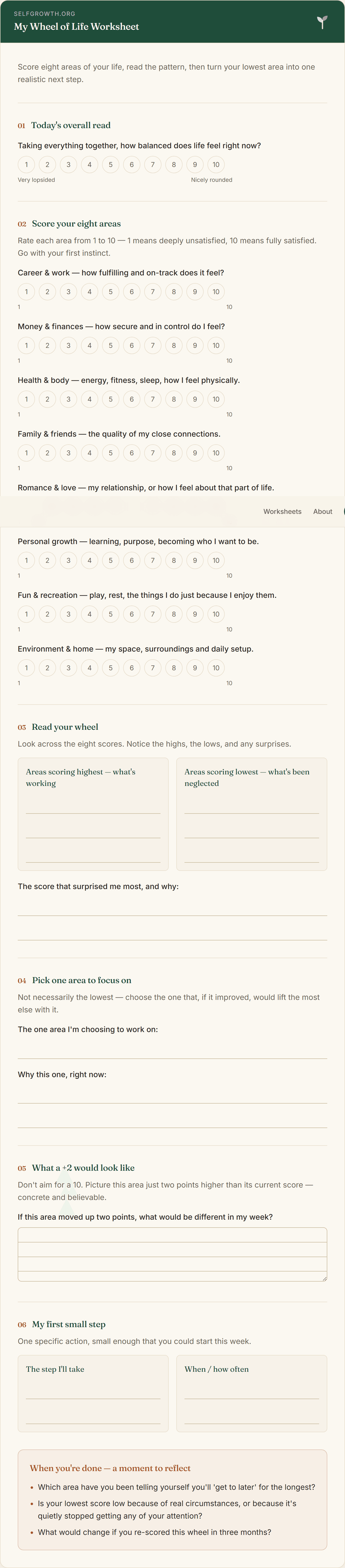
Wheel of Life Worksheet
A free, printable Wheel of Life worksheet. Score eight areas of your life out of ten, see where you're out of balance, and pick one to work on next.
Open worksheet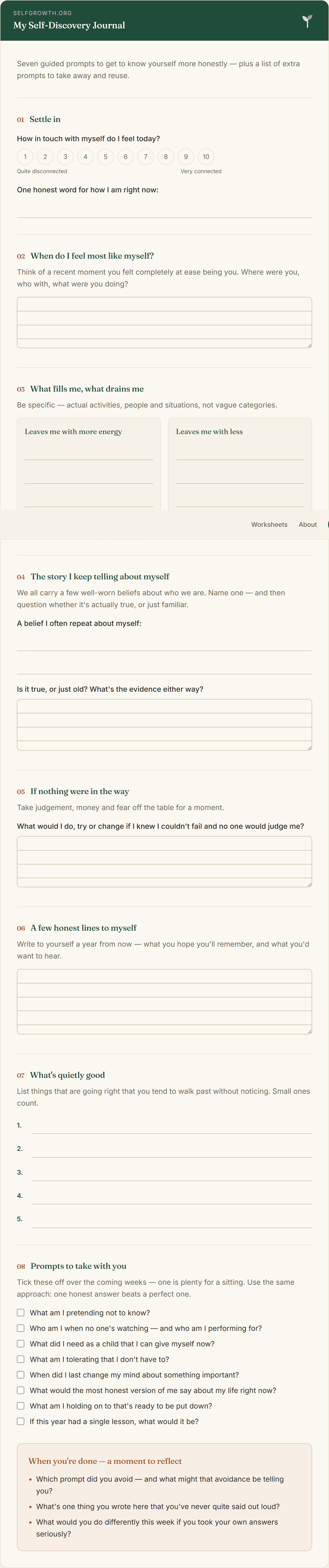
Self-Discovery Journal Prompts
Free, printable self-discovery journal prompts, guided questions with space to write, to explore your values, patterns and what you really want.
Open worksheetNew worksheets, straight to your inbox
An occasional new worksheet or tool, sent only when there's something genuinely worth your time. No spam, no pressure, unsubscribe any time.