
Life balance
Wheel of Life Worksheet: A Free, Printable Template to See Where Your Life Is Out of Balance
Updated June 24, 2026 · 6 min read · Free to print
The Wheel of Life is a simple self-assessment that scores eight areas of your life (work, money, health, relationships, growth, fun, love and home), out of ten. Seeing all eight side by side shows you, at a glance, where life feels full and where it's running on empty. This free, printable worksheet walks you through scoring it and turning the lowest area into one realistic next step.
By the Self Growth team · drawn from the coaching tradition · how we make these
A clean, print-ready PDF, properly formatted, free, no email needed.
It's easy to pour energy into one or two parts of life (usually work), and quietly let the rest drift, without ever noticing the imbalance. The Wheel of Life is a coaching tool designed to make that imbalance visible. You rate eight areas of life out of ten, and the spread of your scores does the rest: a healthy life tends to look fairly round, while a lopsided wheel shows you exactly where attention has gone missing.
It's deliberately quick and a little rough. The point isn't a precise measurement, it's the honest gut-level read you get when you score 'health' a 3 and 'career' a 9 in the same minute. That contrast is usually where the useful conversation with yourself begins.
This worksheet takes you through the whole loop: score the eight areas, read what the pattern is telling you, choose a single area to focus on, and define one small, doable step, because trying to fix all eight at once is the fastest way to change nothing.
How to use this worksheet
- 1Allow about 15 minutes. Print it, or fill it in on screen, either works.
- 2Score on instinct. Your first number is usually the truest; don't overthink each one.
- 3Score how satisfied you feel, not how you think you 'should' feel or how it looks to others.
- 4Resist fixing everything. The whole method works because you pick one area, not eight.
The worksheet
selfgrowth.org
My Wheel of Life Worksheet
Score eight areas of your life, read the pattern, then turn your lowest area into one realistic next step.
01Today's overall read
Taking everything together, how balanced does life feel right now?
02Score your eight areas
Rate each area from 1 to 10, 1 means deeply unsatisfied, 10 means fully satisfied. Go with your first instinct.
Career & work, how fulfilling and on-track does it feel?
Money & finances, how secure and in control do I feel?
Health & body, energy, fitness, sleep, how I feel physically.
Family & friends, the quality of my close connections.
Romance & love, my relationship, or how I feel about that part of life.
Personal growth, learning, purpose, becoming who I want to be.
Fun & recreation, play, rest, the things I do just because I enjoy them.
Environment & home, my space, surroundings and daily setup.
✦Your wheel
It fills in as you score the eight areas above. A round wheel means balance; a spiky one shows where energy has pooled and where it's drained away.
03Read your wheel
Look across the eight scores. Notice the highs, the lows, and any surprises.
Areas scoring highest, what's working
Areas scoring lowest, what's been neglected
The score that surprised me most, and why:
04Pick one area to focus on
Not necessarily the lowest, choose the one that, if it improved, would lift the most else with it.
The one area I'm choosing to work on:
Why this one, right now:
05What a +2 would look like
Don't aim for a 10. Picture this area just two points higher than its current score, concrete and believable.
If this area moved up two points, what would be different in my week?
06My first small step
One specific action, small enough that you could start this week.
The step I'll take
When / how often
When you're done, a moment to reflect
- Which area have you been telling yourself you'll 'get to later' for the longest?
- Is your lowest score low because of real circumstances, or because it's quietly stopped getting any of your attention?
- What would change if you re-scored this wheel in three months?
Where the Wheel of Life comes from
The Wheel of Life is a coaching tool, widely credited to Paul J. Meyer, who taught it through the Success Motivation Institute he founded in the 1960s. It has since become a staple of life and executive coaching because it does one thing very well: it turns a vague sense of 'something's off' into a clear picture of which area is being neglected.
This version keeps the method simple, score, read the pattern, pick one area, take one step. It's a structured self-reflection exercise, not therapy or professional coaching, and it works best as a recurring check-in you can compare over time.
These are educational self-reflection tools, not therapy, see our editorial standards.
If you want to go deeper
- Paul J. Meyer — founder of the Success Motivation Institute, credited with popularising the Wheel of Life.
- Henry Kimsey-House, Karen Kimsey-House, Phillip Sandahl & Laura Whitworth — Co-Active Coaching, where the wheel is a core tool.
Questions people ask
- What is the Wheel of Life used for?
- It's a quick self-assessment that helps you see how balanced your life is across the areas that matter, work, money, health, relationships, growth, fun, love and home. By scoring each one out of ten and comparing them, you spot where life feels full and where it's running low, which makes it easier to decide what actually deserves your attention next.
- What are the eight areas of the Wheel of Life?
- There's no single official list, but a common set is: career and work, money and finances, health and body, family and friends, romance and love, personal growth, fun and recreation, and environment and home. This worksheet uses those eight. Feel free to rename one if a different label fits your life better.
- How often should I fill in a Wheel of Life?
- Many people use it as a periodic check-in, every few months, or at the start of a new year or season. Re-scoring it and comparing to last time is where a lot of the value is: it shows you whether the area you chose to focus on is actually moving.
- What's a 'good' Wheel of Life score?
- There isn't one, and a wheel of all 10s isn't the goal. What matters more than the height of the scores is how even they are. A roughly round wheel suggests balance; a spiky one shows where energy has pooled and where it's drained away. Use it to guide attention, not to grade yourself.
- Is this worksheet free to print?
- Yes. Everything on selfgrowth.org is free to fill in online or print, no payment and no email required. Use the Download PDF button for a clean copy, or Print for a paper version.
- Is the Wheel of Life a substitute for therapy or coaching?
- No. It's a structured self-reflection exercise, not therapy, medical advice or professional coaching. If a low score reflects something you're genuinely struggling with (low mood, anxiety, or a situation that feels stuck), it's worth talking it through with a qualified professional.
Keep going, related worksheets
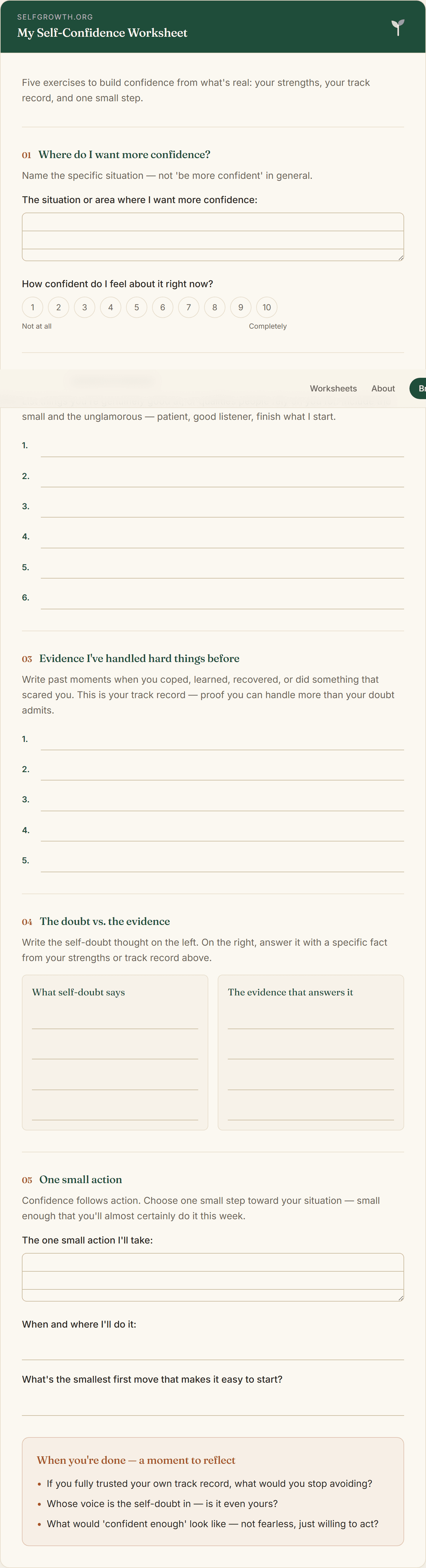
Self-Confidence Worksheet
A free, printable self-confidence worksheet that builds confidence from real evidence (your strengths, past wins, and one small action), instead of empty hype.
Open worksheet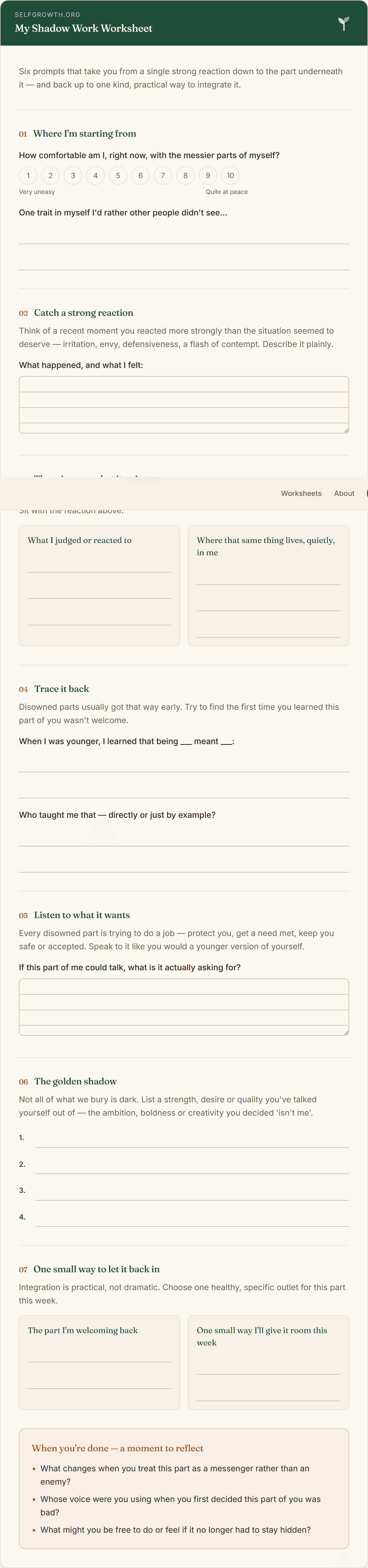
Shadow Work Worksheet
A free, printable shadow work worksheet: guided prompts to spot your triggers and projections, trace them to their roots, and meet the parts you hide.
Open worksheet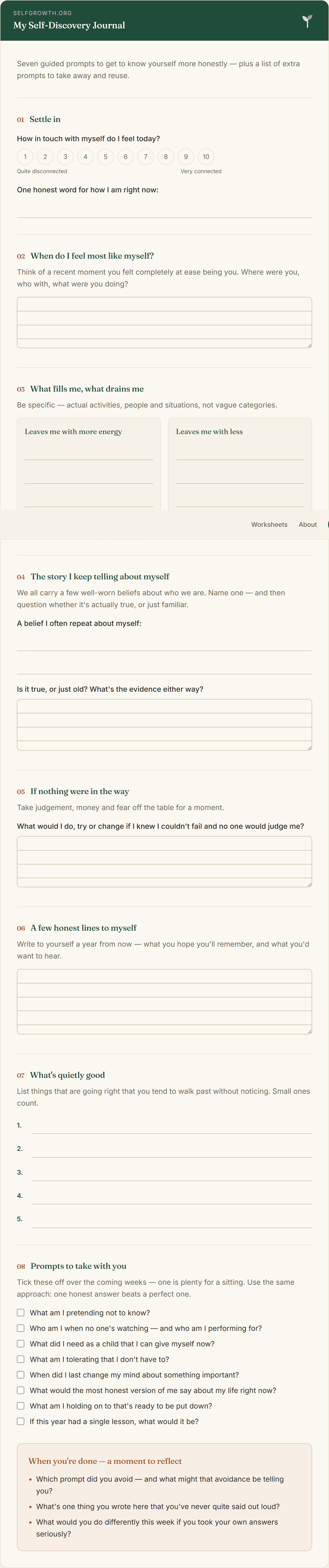
Self-Discovery Journal Prompts
Free, printable self-discovery journal prompts, guided questions with space to write, to explore your values, patterns and what you really want.
Open worksheetNew worksheets, straight to your inbox
An occasional new worksheet or tool, sent only when there's something genuinely worth your time. No spam, no pressure, unsubscribe any time.