
Guide
How to do a wheel of life assessment
Updated June 25, 2026 · 8 min read
The wheel of life is a quick way to see how balanced your life feels right now. You rate around eight areas, such as health, money, work and relationships, from one to ten, then plot the scores as a wheel. The shape shows at a glance where you feel full and where you feel thin, so you can choose one area to focus on rather than trying to fix everything.
By the Self Growth team · drawn from coaching practice · how we make these
When everything feels a bit off but you can't say why, it's usually because "life" is too big to think about all at once. The wheel of life is a simple tool that breaks it into pieces you can actually look at, so a vague heaviness turns into something specific you can do something about.
It takes about ten minutes. You'll see how to score it honestly, how to read the shape you end up with, and how to turn it into one small change rather than an overwhelming to-do list, with a free interactive worksheet that draws your wheel for you.
What the wheel of life is
The wheel of life is a circle divided into segments, one for each important area of your life. Common areas are health, money, career or work, relationships, family, personal growth, fun and recreation, and your physical surroundings. You can adjust them to fit your life.
You rate your satisfaction in each area from one to ten, then mark each score along its segment and join them up. The result is a shape. A balanced life makes a fairly round wheel. A lopsided one makes a wheel that would give you a bumpy ride, which is often exactly how it feels.
A balanced life makes a fairly round wheel. A lopsided one gives you a bumpy ride.
The eight areas, and what each one covers
There's no single official list, and you should rename or swap any of these so they fit your life. A common set of eight is:
- Health, how you feel physically: energy, sleep, fitness, how you eat and move.
- Money, your sense of security and control around finances, not how much you have.
- Career or work, whether what you do with your days feels worthwhile and fairly rewarded.
- Relationships, your closest connections: a partner, or the people you're most intimate with.
- Family and friends, the wider circle of people you belong to and lean on.
- Personal growth, whether you're learning, stretching and becoming more yourself.
- Fun and recreation, how much room there is for play, rest and things you do purely because you enjoy them.
- Environment, the spaces you live and work in, and whether they lift you or drain you.
Eight is a guide, not a rule. Some people add spirituality, contribution, or romance as its own slice. Pick the areas that actually make up your life.
How to score it honestly
The whole value of the wheel comes from scoring it honestly, so a few things help:
- Rate how satisfied you feel, not how good it looks from outside or how good it "should" be. This is for you, not for show.
- Go with your first instinct. The number that pops up before you start reasoning is usually the truest one.
- Don't compare areas to each other, or to other people. A six in health means how you feel about your health, full stop.
- There are no wrong scores and nothing to feel bad about. A low number isn't a failure, it's just information about where to look.
How to read your wheel
Once it's drawn, resist the urge to fix every low score at once. That's the fast route to doing nothing. Instead, read it like this:
- 1Notice the overall shape. Is it roughly round, or badly out of balance? Neither is good or bad, it's just your starting point.
- 2Find the gap that bothers you most. Not necessarily the lowest score, but the one with the most feeling attached to it. That's where your energy is.
- 3Pick one area to nudge up by a single point. Ask what a six instead of a five would look like in practice, and what one small thing would start moving it.
- 4Come back to it in a few weeks and score it again. Watching the shape change over time is far more motivating than one perfect snapshot.
The interactive worksheet below draws your wheel as you score it, and saves your result so you can compare it next time.
Open the Wheel of Life WorksheetWhen to use it
The wheel is most useful at the turning points: the start of a year, after a big change, or any time you feel stuck and can't name why. It's a thinking tool, not a verdict on your life, and a low-scoring area is an invitation, not a judgement.
If several areas are very low and have stayed that way, and life feels consistently heavy rather than just unbalanced, that's worth taking seriously and a good reason to reach out for real support, not just a worksheet.
How we put this together
This guide is written in plain language from established, evidence-based ideas, not personal opinion. It's an educational self-reflection resource, not therapy or medical advice, see our editorial standards.
If you want to go deeper
- The wheel of life is a long-standing coaching and personal-development exercise, widely taught in life coaching and self-help. It has no single agreed origin.
Questions people ask
- What is the wheel of life?
- The wheel of life is a coaching tool that splits your life into around eight areas, such as health, money, work and relationships, and asks you to rate your satisfaction in each from one to ten. Plotted as a wheel, the scores show at a glance where your life feels full and where it feels thin.
- What are the eight areas of the wheel of life?
- There's no single fixed list, but common areas are health, money or finances, career or work, relationships, family, personal growth, fun and recreation, and physical environment. You can rename or swap areas so the wheel reflects what matters in your life.
- How often should you do a wheel of life?
- Once every few months works well for most people, plus any time you hit a turning point such as a new year, a big change, or a stuck patch. Doing it repeatedly and comparing the shapes is more useful than one perfect assessment.
- How do you fill in a wheel of life?
- Rate your satisfaction in each area from one to ten, going with your first instinct rather than overthinking, then mark each score along its segment and join them up. Rate how you genuinely feel, not how it looks from outside. The interactive worksheet draws the wheel for you as you score, and saves it so you can compare next time.
- What questions do you ask in a wheel of life exercise?
- After scoring, the useful questions are reflective: which area, if it improved, would lift everything else? What would a single point higher actually look like here? What one small thing could start moving it this week? The point is to choose one area to nudge, not to fix everything at once.
Worksheets to do the work
Free to fill in online or print. No email needed.
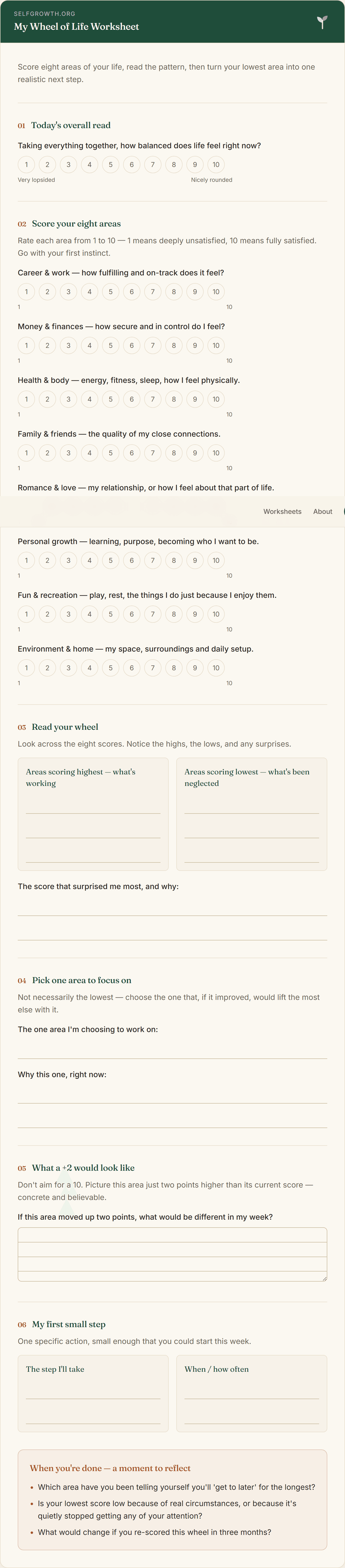
Wheel of Life Worksheet
A free, printable Wheel of Life worksheet. Score eight areas of your life out of ten, see where you're out of balance, and pick one to work on next.
Open worksheet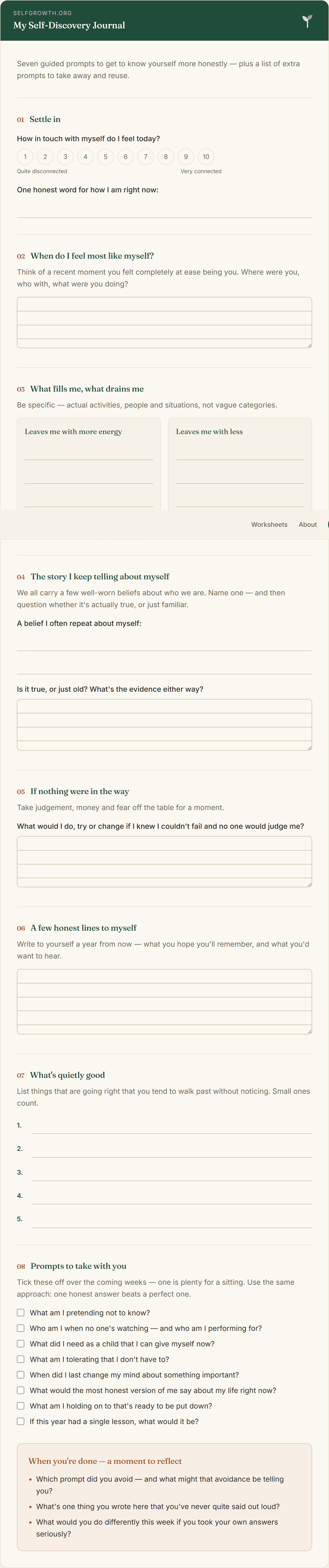
Self-Discovery Journal Prompts
Free, printable self-discovery journal prompts, guided questions with space to write, to explore your values, patterns and what you really want.
Open worksheetNew worksheets, straight to your inbox
An occasional new worksheet or tool, sent only when there's something genuinely worth your time. No spam, no pressure, unsubscribe any time.