
Guide
How to be more self-aware
Updated June 27, 2026 · 9 min read
Self-awareness grows less from thinking hard about yourself and more from noticing yourself in action: catching what you feel as it happens, spotting the patterns you repeat, and checking how you come across against what people actually see. You build it with small, regular habits, a precise name for the feeling, a pause before the reaction, and an honest question to someone you trust.
By the Self Growth team · drawn from research on self-awareness and emotional intelligence · how we make these
Self-awareness gets talked about as if it were a personality trait you either have or you don't. It's closer to a skill, and like any skill it's built by practice rather than by wanting it badly enough. Most of us know ourselves less well than we assume, which is oddly good news, because it means there's room to change.
You'll see what self-awareness actually is, the two different kinds that often get muddled, why it's worth the effort, and the small, repeatable habits that build it, with a free worksheet for each part so you're not just reading about it.
What self-awareness actually is
Self-awareness is simply seeing yourself clearly: knowing what you feel, why you tend to react the way you do, what matters to you, and how you land on the people around you. It isn't endless self-analysis, and it isn't harsh self-judgement. It's accurate, fair attention turned inward.
The organisational psychologist Tasha Eurich, who has studied this closely, finds it helps to split it into two kinds, because people are often strong in one and weak in the other:
- Internal self-awareness: how well you understand your own feelings, values, patterns and what drives you.
- External self-awareness: how well you understand the way you come across to other people.
You can be deeply reflective and still have no idea how you're experienced in a room. You can read other people well and still be a stranger to your own feelings. Knowing which one is the gap tells you where to put the work.
Internal
How well you understand your own feelings, values and patterns.
External
How well you understand the way you come across to other people.
Signs you might want more of it
Low self-awareness rarely announces itself. It tends to show up sideways, in patterns you can feel but not quite name. You might recognise some of these:
- You react strongly and only later, if at all, work out why.
- The same arguments, the same stuck patterns, keep showing up with different people.
- Feedback about how you come across genuinely surprises you.
- Asked what you feel, the honest answer is 'good', 'bad' or 'stressed', and not much more precise than that.
- Your decisions often don't match what you say you want.
- You're quick to know what's wrong with everyone else and slow to see your own part.
Recognising a few of these isn't a character flaw. It's just a sign that the attention you turn outward all day has rarely been turned inward, which is a habit, and habits can be built.
Why it's worth the effort
You can't manage a feeling you haven't noticed, or change a pattern you can't see.
Self-awareness is the quiet foundation under most of the things people actually want: steadier moods, fewer reactions you regret, relationships that don't keep hitting the same wall, decisions that fit the life you're trying to build.
In Daniel Goleman's work on emotional intelligence, self-awareness is the first pillar, the one the others rest on, because you can't manage a feeling you haven't noticed, or change a pattern you can't see. It's not about becoming someone else. It's about being run less by parts of yourself you've never looked at.
How to build it, in practice
None of this is dramatic. Self-awareness is built from small, repeatable moves, done often enough to become automatic.
- 1Name the feeling precisely. 'Bad' is too blunt to act on. Was it let down, overlooked, anxious, ashamed, restless? The exact word points at the real cause.
- 2Put a pause between the trigger and the response. Even a few seconds of noticing, 'I've gone tense, something just landed', turns a reflex into a choice.
- 3Keep a short pattern log. Jot the situation, what you did, and what it cost you. Patterns you can't hold in your head become obvious on paper after a week or two.
- 4Ask one person you trust how you come across. External self-awareness is the half you can't see alone, and a single honest answer is worth a month of guessing.
- 5Check your choices against your values. When a decision feels off, it's often quietly out of step with something that matters to you.
The free worksheet below walks through the feeling-naming and pattern-spotting in order, so you're not trying to do it all from memory.
Open the Self-Awareness WorksheetWhere to start, depending on what's foggy
You don't need to do all of this at once. Pick the one that fits where you are, and begin there. Each links to a free worksheet you can fill in online or print.
If you react and repeat patterns without quite knowing why, start with the self-awareness worksheet. It's built around naming feelings and spotting the loops you're in.
Open the Self-Awareness WorksheetIf the deeper question is 'who am I, underneath the roles', the who am I worksheet works on identity and values rather than day-to-day reactions.
Open the Who Am I? WorksheetAnd if your head is simply too full to think clearly, start by emptying it. The brain dump template gets everything out of your head and onto the page so you can actually see it.
Open the Brain Dump TemplateWhen to get more support
Looking inward can surface heavier things: old grief, trauma, a low mood that's been there a while. That's not a sign you're doing it wrong, but it is a sign to slow down. If what comes up keeps you feeling worse for days rather than clearer, this is work to do alongside someone, not alone with a worksheet.
A GP is a good first step and can point you to talking therapies. These guides and worksheets are educational self-reflection tools, not therapy, and if things feel heavy you deserve real support, not just a page to fill in.
How we put this together
This guide is written in plain language from established, evidence-based ideas, not personal opinion. It's an educational self-reflection resource, not therapy or medical advice, see our editorial standards.
If you want to go deeper
- Tasha Eurich — Insight: The Power of Self-Awareness in a Self-Deluded World (2017), which sets out internal vs external self-awareness.
- Daniel Goleman — Emotional Intelligence: Why It Can Matter More Than IQ (1995).
- Carl Rogers — On Becoming a Person (1961), on seeing oneself honestly as the ground for change.
Questions people ask
- What is self-awareness?
- Self-awareness is seeing yourself clearly and fairly: knowing what you feel, why you tend to react as you do, what matters to you, and how you come across to other people. It isn't constant self-analysis or self-criticism, it's accurate attention turned inward, and it's a skill you can build with practice.
- What are the two types of self-awareness?
- Internal self-awareness is how well you understand your own feelings, values and patterns. External self-awareness is how well you understand the way you come across to others. People are often strong in one and weak in the other, so it helps to know which is your gap before you start working on it.
- How do I become more self-aware?
- Build small, repeatable habits: name what you feel precisely rather than 'good' or 'bad', put a pause between a trigger and your reaction, keep a short log of situations and how you responded, and ask one trusted person how you come across. Self-awareness grows from noticing yourself in action, not from thinking harder about yourself.
- Why is self-awareness important?
- It's the foundation under steadier moods, fewer reactions you regret, and relationships that stop hitting the same wall. In Daniel Goleman's model of emotional intelligence it comes first, because you can't manage a feeling you haven't noticed or change a pattern you can't see.
- Can you actually improve self-awareness?
- Yes. Self-awareness is a skill, not a fixed trait, so it responds to practice. The fastest gains usually come from the part you can't see alone, external self-awareness, which is why asking someone you trust for honest feedback tends to move it more than reflection on its own.
- Is journaling good for self-awareness?
- It can be, when it's structured rather than just venting. Writing down a feeling, the situation that triggered it and what you did makes patterns visible that are hard to hold in your head. A guided worksheet or a regular set of prompts gives the practice a shape, which is what turns it into insight rather than a diary.
Worksheets to do the work
Free to fill in online or print. No email needed.
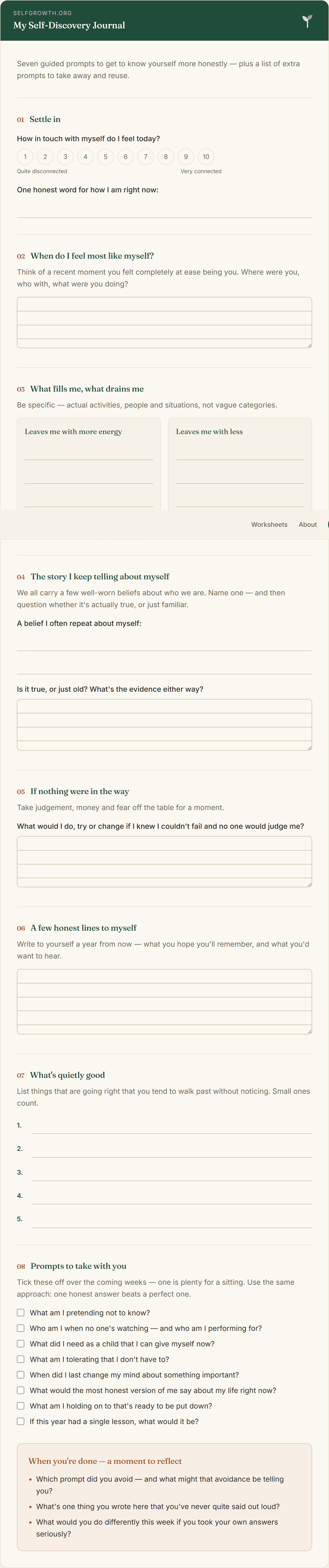
Self-Discovery Journal Prompts
Free, printable self-discovery journal prompts, guided questions with space to write, to explore your values, patterns and what you really want.
Open worksheet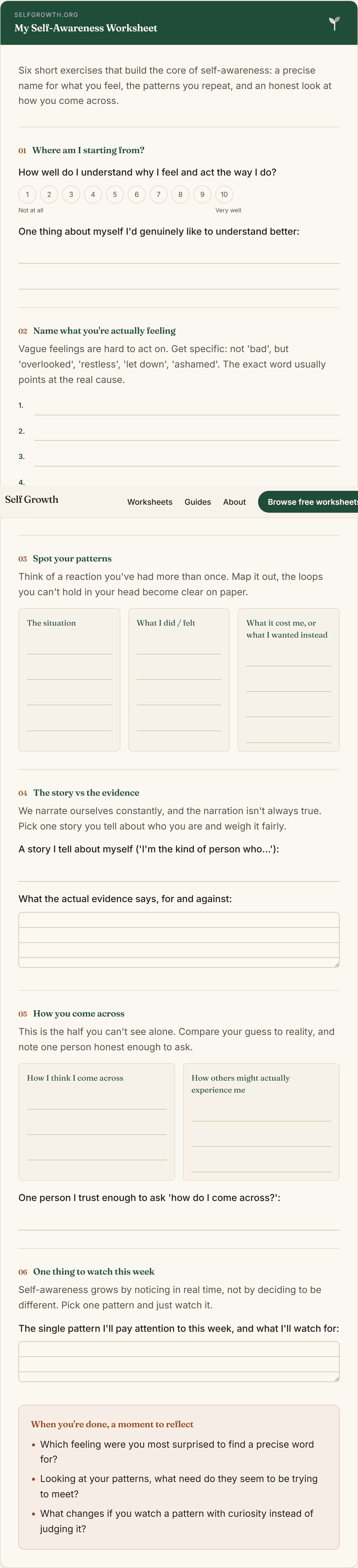
Self-Awareness Worksheet
A free, printable self-awareness worksheet with guided exercises to name your feelings, spot your patterns, and see how you come across, so you understand yourself better.
Open worksheet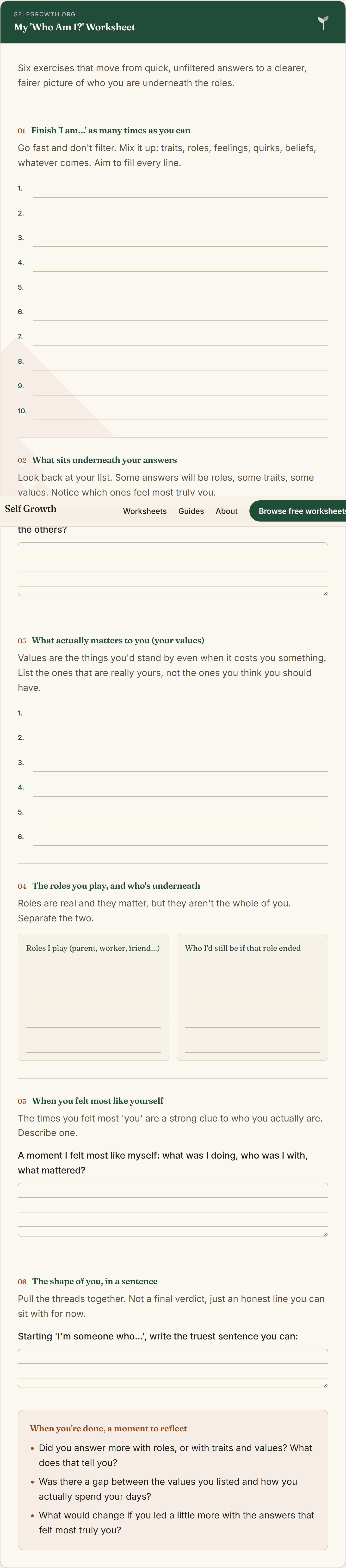
Who Am I? Worksheet
A free, printable 'Who am I?' worksheet to explore your identity, values and the person underneath your roles, with the classic twenty-statements exercise and guided prompts.
Open worksheet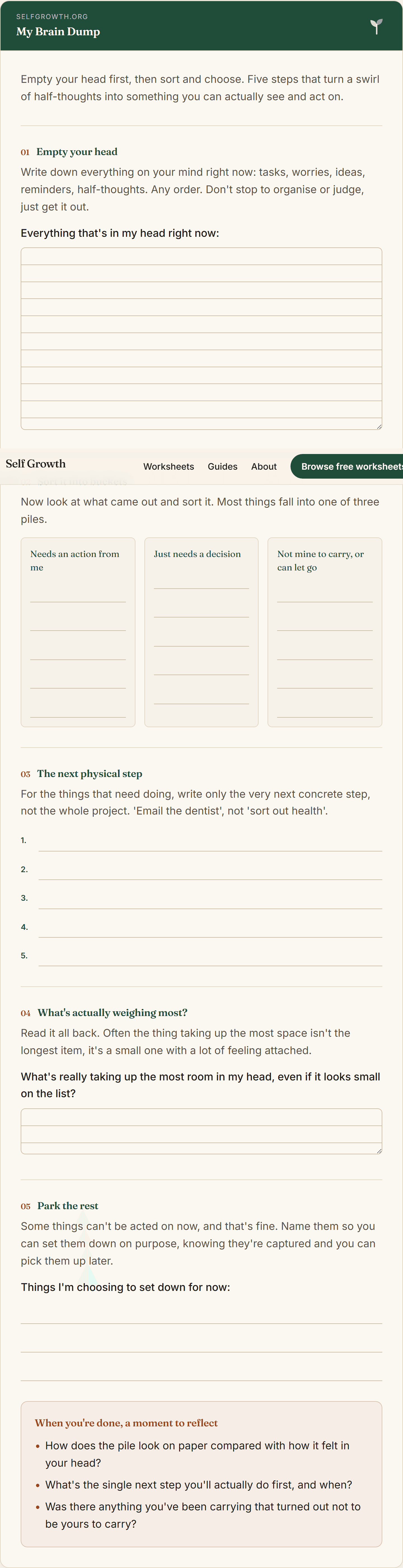
Brain Dump Template
A free, printable brain dump template to empty a cluttered mind onto the page, sort it into what needs action and what to let go, and find the next clear step.
Open worksheetNew worksheets, straight to your inbox
An occasional new worksheet or tool, sent only when there's something genuinely worth your time. No spam, no pressure, unsubscribe any time.