
Self-awareness
Brain Dump Template: A Free, Printable Tool to Clear a Cluttered Mind
Updated June 27, 2026 · 6 min read · Free to print
A brain dump is when you get everything that's in your head down on paper, in any order, without filtering. This free, printable template gives you space to empty your mind, then sort what came out into what needs an action, what just needs a decision, and what you can set down, so a swirl of half-thoughts turns into something you can actually see and handle.
By the Self Growth team · drawn from cognitive offloading and productivity practice · how we make these
A clean, print-ready PDF, properly formatted, free, no email needed.
When your head feels full, it's usually not that there's too much to do, it's that it's all circling at once with nowhere to land. Your mind is good at having thoughts and bad at holding them, so the same five worries keep going round, crowding out any space to think.
A brain dump fixes that by moving everything out of your head and onto the page. Once it's written down, your mind can stop gripping it, and you can finally look at the whole pile instead of being chased by bits of it. Almost always, it turns out to be more manageable on paper than it felt in your head.
This template gives you room to empty out, then a simple way to sort what comes up and pick the genuine next step. Use it when you're overwhelmed, before bed when your mind won't settle, or as a weekly clear-out.
How to use this worksheet
- 1Set a timer for five to ten minutes for the first section and just write. No order, no neatness, no judging.
- 2Get it all out before you start sorting. Switching between dumping and organising is what keeps you stuck.
- 3Print it if you can, the physical act of writing tends to settle a busy mind more than typing.
- 4Don't aim to solve everything. The goal is to see clearly and pick one next step, not to empty your whole life in one go.
The worksheet
selfgrowth.org
My Brain Dump
Empty your head first, then sort and choose. Five steps that turn a swirl of half-thoughts into something you can actually see and act on.
01Empty your head
Write down everything on your mind right now: tasks, worries, ideas, reminders, half-thoughts. Any order. Don't stop to organise or judge, just get it out.
Everything that's in my head right now:
02Sort it into buckets
Now look at what came out and sort it. Most things fall into one of three piles.
Needs an action from me
Just needs a decision
Not mine to carry, or can let go
03The next physical step
For the things that need doing, write only the very next concrete step, not the whole project. 'Email the dentist', not 'sort out health'.
- 1.
- 2.
- 3.
- 4.
- 5.
04What's actually weighing most?
Read it all back. Often the thing taking up the most space isn't the longest item, it's a small one with a lot of feeling attached.
What's really taking up the most room in my head, even if it looks small on the list?
05Park the rest
Some things can't be acted on now, and that's fine. Name them so you can set them down on purpose, knowing they're captured and you can pick them up later.
Things I'm choosing to set down for now:
When you're done, a moment to reflect
- How does the pile look on paper compared with how it felt in your head?
- What's the single next step you'll actually do first, and when?
- Was there anything you've been carrying that turned out not to be yours to carry?
The approach behind this template
A brain dump works because of something researchers call cognitive offloading: your working memory can only hold a few things at once, so when it's overloaded, moving information out of your head and onto an external surface frees up the mental space those open loops were eating. The same idea sits at the heart of David Allen's 'Getting Things Done', whose 'mind sweep', capturing everything in one place, then deciding the next action, this template is a simple version of.
The structure also borrows from cognitive behavioural self-help: vague, swirling worry is hard to act on, so naming each item, sorting it, and choosing a single concrete next step turns a fog of overwhelm into specific, smaller pieces. There's a separate, well-studied benefit to writing about what's on your mind, expressive writing, but that's the emotional cousin of this practical tool. These are educational self-help tools, not a replacement for therapy.
These are educational self-reflection tools, not therapy, see our editorial standards.
If you want to go deeper
- David Allen — Getting Things Done: The Art of Stress-Free Productivity (2001): the 'mind sweep' and next-action method.
- Risko, E. F. & Gilbert, S. J. (2016). Cognitive offloading. Trends in Cognitive Sciences, 20(9).
- James W. Pennebaker — Writing to Heal (2004), on the benefits of writing about what's on your mind.
Questions people ask
- What is a brain dump?
- A brain dump is the simple practice of writing down everything that's on your mind, in any order, without filtering or organising as you go. The point is to get thoughts out of your head and onto the page, so your mind can stop circling them and you can see the whole lot at once instead of being chased by pieces of it.
- How do I do a brain dump?
- Give yourself five to ten minutes and write down everything on your mind, with no order and no editing. Get it all out before you start sorting. Then group what came up into what needs an action, what needs a decision, and what you can let go, and pick the single next step for the things that matter most. This template walks you through exactly that.
- Does a brain dump help with anxiety or overwhelm?
- Many people find it does. When worries circle in your head they feel endless; written down, they're usually fewer and more manageable than they felt. Getting them out of your mind and onto paper, then choosing one next step, can take the edge off overwhelm. It's a self-help tool, though, not a treatment for anxiety, see the note below on getting more support.
- When should I do a brain dump?
- Whenever your head feels too full to think: when you're overwhelmed, at the start of a week to clear the decks, or before bed when your mind won't switch off. A quick brain dump at night, getting tomorrow's worries onto paper, is one of the more reliable ways to stop lying there running the same list.
- Are these templates free to print?
- Yes. Everything on selfgrowth.org is free to fill in online or print, no payment and no email required. Use the Download PDF button for a clean copy, or Print for a paper version.
- Is this a substitute for therapy?
- No. A brain dump is a practical self-help tool, not therapy or medical advice. If anxiety, racing thoughts or overwhelm are a regular part of your life rather than an occasional bad day, it's worth talking to a GP or a qualified professional alongside tools like this.
Keep going, related worksheets
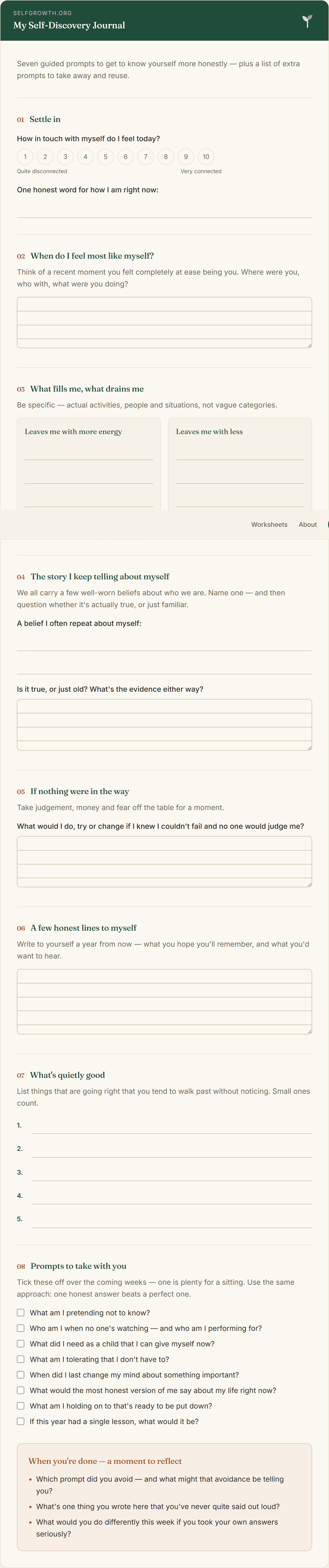
Self-Discovery Journal Prompts
Free, printable self-discovery journal prompts, guided questions with space to write, to explore your values, patterns and what you really want.
Open worksheet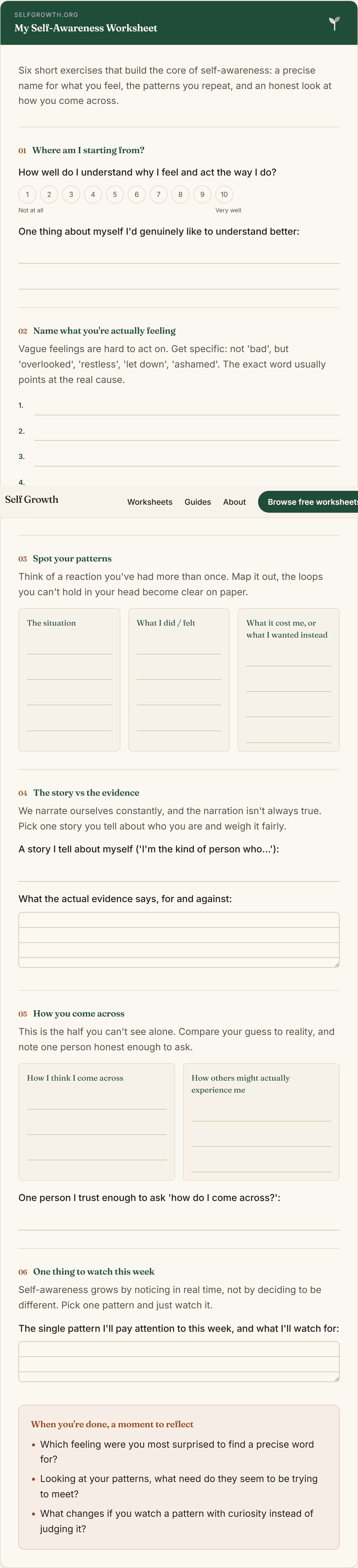
Self-Awareness Worksheet
A free, printable self-awareness worksheet with guided exercises to name your feelings, spot your patterns, and see how you come across, so you understand yourself better.
Open worksheet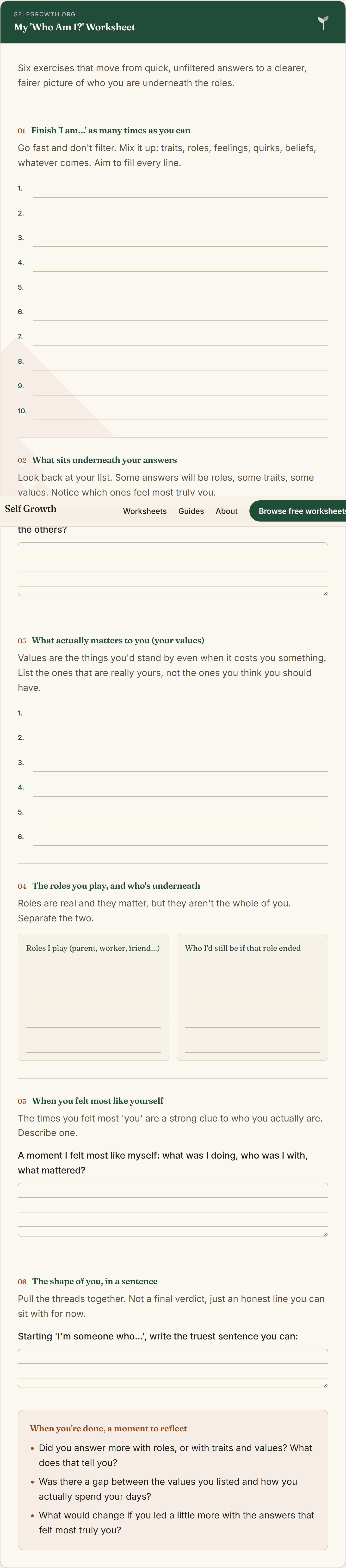
Who Am I? Worksheet
A free, printable 'Who am I?' worksheet to explore your identity, values and the person underneath your roles, with the classic twenty-statements exercise and guided prompts.
Open worksheetNew worksheets, straight to your inbox
An occasional new worksheet or tool, sent only when there's something genuinely worth your time. No spam, no pressure, unsubscribe any time.