
Guide
Assertive communication: how to be more assertive, with examples
Updated 11 October 2026 · 12 min read
Assertive communication means saying what you think, feel and want clearly and calmly, while respecting the other person. It sits between passive (going along, saying nothing) and aggressive (blaming, shouting, steamrolling). To be more assertive, start small, use 'I' statements, keep it short, say no without a long excuse, and repeat yourself calmly if pushed.
By the Self Growth team · drawn from assertiveness training · how we make these
Maybe you replay conversations for hours afterwards, thinking of what you should have said. Maybe you say yes, then quietly seethe. Or maybe you hold it all in until it comes out as a snap you regret. All of these are signs the same skill is missing: saying what you need, plainly, at the time.
That skill is assertiveness. It isn't about being loud, winning arguments or getting your own way. It's about being honest and fair at once: fair to yourself, and fair to the other person. And it can be learned. This guide covers what it looks like, how it differs from the other styles, and how to practise it, with a free worksheet to plan your words.
What is assertive communication?
Assertive communication is saying what you think, feel or want directly and respectfully. You stand up for yourself without putting the other person down. You can disagree, ask for something, or say no, and still be kind.
Assertive means honest and respectful at the same time: to you, and to them.
Being assertive doesn't guarantee you get what you want. The other person still gets to say no too. What it does is make your position clear, so a decision is made with your view on the table rather than buried under it.
Assertiveness is closely tied to boundaries. A boundary is the limit; assertiveness is how you say it. If you're working on a specific limit, the guide to setting boundaries goes deeper on that part.
Passive vs aggressive vs assertive: the four communication styles
It helps to see assertiveness next to the other ways you might respond. Imagine a friend cancels on you at the last minute, for the third time this month. Here's how each style might sound.
Passive: you put the other person's wishes ahead of your own and keep quiet to avoid conflict.
- 'Oh, no worries at all, it's fine!' (when it isn't fine).
- Going along with plans you don't want, then feeling drained or resentful.
- Apologising when you've done nothing wrong, or not saying anything at all.
Aggressive: you get your point across at the other person's expense.
- 'You always do this. You're so selfish.'
- Raising your voice, interrupting, name-calling or threatening.
- Treating the conversation as something to win.
Passive-aggressive: you seem to go along with it, but the anger leaks out sideways.
- 'Fine. Whatever. I'm used to it by now.'
- Going quiet, sulking, or 'forgetting' to reply for days.
- Sarcasm, pointed jokes, or complaining to other people instead of to them.
Assertive: you say how it affects you and what you'd like, and leave room for them.
- 'I was really looking forward to tonight, and I feel let down when plans change last minute. Can we pick a date you're sure about?'
- Speaking calmly, at a normal volume, and looking at the person.
- Listening to their side, without dropping your own.
Most of us use all four at different times. You might be assertive at work and passive with your mum, or passive for weeks and then aggressive in one burst. Noticing your usual pattern, and who brings it out, is a good first step.
Signs you're not being assertive enough
You might recognise some of these:
- You say yes when you mean no, then feel resentful.
- You struggle to give your opinion, even when someone asks for it.
- You over-explain or apologise when you turn something down.
- You replay conversations afterwards, thinking of what you wish you'd said.
- You hold things in until they come out as an outburst.
- People seem surprised when you do disagree, because you rarely have.
If the automatic yes is the biggest part of this for you, the guide to stopping people-pleasing is a good companion to this one.
Why is it so hard to be assertive?
There's often a good reason. If you grew up somewhere disagreeing wasn't safe, or love felt like it depended on being easy and helpful, keeping quiet may once have protected you. Fear of conflict, of upsetting someone, or of being seen as rude can make a reasonable request feel risky.
Low self-esteem plays a part too. If part of you doesn't believe your needs count, asking for them feels like too much. Culture, gender expectations and your role in a family or workplace can all shape how free you feel to speak up. None of this means you can't change it. It means the discomfort is understandable, and it tends to ease with practice.
How to be more assertive, step by step
Assertiveness is a skill, so you build it like any other: practise in small, easy moments before you try the big ones.
- 1Get clear on what you want. Before you speak, finish this sentence for yourself: what I'd like is…
- 2Start small. Practise in easy moments first, like sending back a wrong order or saying which film you'd prefer.
- 3Use an 'I' statement. Say how it affects you rather than what's wrong with them: 'I feel stretched when work arrives late on a Friday.'
- 4Keep it short. One or two sentences is enough. A long justification invites debate.
- 5Say no without a big excuse. 'I can't make it this time' is a complete answer.
- 6Mind your body and voice. Stand or sit upright, keep a steady tone, and look at the person if you can.
- 7Listen, then restate. Show you've heard them, then calmly say your point again.
- 8Look back afterwards. Notice what went well, not just what didn't, and plan the next small step.
Step 3 is the heart of it. An I-statement names what happened, how you feel, and what you'd like, without blaming. The free worksheet below helps you turn 'you' statements into I-statements and plan the words for a real conversation.
Open the I-Statements WorksheetAssertive phrases to try
These are starting points. Change the words until they sound like you.
- Saying no: 'Thanks for thinking of me, but I can't take that on right now.'
- Asking for time: 'Let me think about it and come back to you tomorrow.'
- Disagreeing: 'I see it differently. Can I explain why?'
- Asking for what you need: 'I'd like us to split the cooking this week.'
- When you're interrupted: 'I'd like to finish my point, then I'll hear yours.'
- Raising a problem: 'I feel frustrated when the plan changes at the last minute. Could you let me know a day before?'
- Holding your view: 'I understand that's how you see it. My answer is still no.'
- At work: 'I can do this, or the report, by Friday. Which matters more?'
Notice what's missing: no 'sorry to bother you', no 'this is probably silly', no long list of reasons. You can be warm without shrinking what you're saying.
How to handle pushback
Sometimes the other person won't like what you've said. They might argue, guilt-trip or criticise. Two techniques from assertiveness training can help you stay calm without getting dragged into a fight. Both were popularised by psychologist Manuel J. Smith in his 1975 book When I Say No, I Feel Guilty, and they're now widely taught.
The broken record: calmly repeat your main point, in the same few words, however the other person comes at it. You don't need a new reason each time.
- Them: 'Oh come on, it's only one evening.' You: 'I know. I can't make it this time.'
- Them: 'But everyone else is coming.' You: 'I hear you. I can't make it this time.'
Fogging: when someone criticises you, agree with whatever part is true, or might be true, without getting defensive and without changing your decision. It takes the heat out, because there's nothing to fight against.
- Them: 'You're being really stubborn about this.' You: 'Maybe I am. I'm still not going to lend the car.'
- Them: 'You never used to mind.' You: 'That's true, I didn't. I do now.'
Use both sparingly and kindly. They're for staying steady under pressure, not for shutting someone down when they have a fair point. If they do have one, it's fine to say so and change your mind.
Fair fighting rules for a hard conversation
Fair fighting rules are simple ground rules for disagreeing without wounding each other. They're meant for couples, friends and family who care about each other and want to sort something out. They're not for a relationship where someone is controlling, threatening or violent (see the next section).
- Pick your moment. Not when one of you is exhausted, drunk, rushing out or in front of others.
- Start gently. Raise the problem without blame: 'I've been feeling left out at weekends', not 'You never include me'. The Gottman Institute, a couples research and therapy organisation, calls this a soft start-up.
- Stick to one issue. Don't bring up everything from the past five years.
- Talk about behaviour, not character. 'You were late' is fair; 'You're useless' isn't.
- No name-calling, swearing at each other, threats or 'always' and 'never'.
- Take turns. Let them finish, and try saying back what you heard before you answer.
- Take a break if it gets too heated. Agree to stop for a while, and say when you'll come back to it.
- Look for something you can both live with, rather than a winner and a loser.
If anger is the bit that gets away from you, the anger management worksheet can help you spot the build-up before you speak.
When assertiveness isn't safe
Everything above assumes the other person is basically safe to disagree with. If a partner, family member or anyone else is controlling, threatening or violent, speaking up can make things more dangerous, not less. In that situation, don't confront them on your own. Get support first.
In the UK, the National Domestic Abuse Helpline is free and open 24 hours on 0808 2000 247. In the US, the National Domestic Violence Hotline is on 1-800-799-7233. If you're in immediate danger, call 999 in the UK, 911 in the US, or your local emergency number.
Does assertiveness training actually work?
Assertiveness training was once a very popular area of psychology research. A 2018 review by Brittany Speed, Brandon Goldstein and Marvin Goldfried, in Clinical Psychology: Science and Practice, called it 'a forgotten evidence-based treatment'.
The review argues it can help with many different problems, rather than just one. It also notes that research on it as a stand-alone treatment has dropped off sharply. So much of the evidence is older, and the honest summary is: promising, well established in practice, and in need of more modern research.
Two tools on this page have different roots. I-statements come from psychologist Thomas Gordon, who described 'I-messages' in his 1970 book Parent Effectiveness Training. The broken record and fogging were popularised by Manuel J. Smith. These are communication techniques taught by therapists and trainers, rather than treatments tested one by one in trials.
When to get more support
This guide is for everyday communication, not therapy. If speaking up brings on intense anxiety or panic, if old fears of conflict or rejection feel overwhelming, or if low mood is making every conversation feel impossible, you deserve more support than a page can give.
A GP is a good first step and can point you to talking therapies. Assertiveness is something therapists often help with, and they can let you practise conversations before you have them. If you're struggling to cope or having thoughts of harming yourself, contact a crisis line now: Samaritans on 116 123 (UK), 988 (US), or find a line in your country at findahelpline.com.
How we put this together
This guide is written in plain language. It draws on assertiveness-training research, including a 2018 review, and on widely taught communication techniques (I-statements, the broken record and fogging) whose roots we name. Where the evidence is older or thin, we say so. It's an educational self-reflection resource, not therapy or medical advice, see our editorial standards.
If you want to go deeper
- Speed, B. C., Goldstein, B. L. & Goldfried, M. R. (2018). Assertiveness training: A forgotten evidence-based treatment. Clinical Psychology: Science and Practice, 25(1), e12216 (doi:10.1111/cpsp.12216).
- Smith, M. J. (1975). When I Say No, I Feel Guilty: How to Cope Using the Skills of Systematic Assertive Therapy. New York: Dial Press.
- Gordon, T. (1970). P.E.T.: Parent Effectiveness Training. New York: P. H. Wyden.
- Wilde, E. (2013). How to fight smarter: Soften your start-up. The Gottman Institute blog, gottman.com.
Your questions, answered
- What is an example of assertive communication?
- Say a colleague keeps handing you their work. An assertive reply is: 'I can't take this on as well as my own deadlines. Can we ask the manager which comes first?' It's calm, short and honest. It says what you can and can't do, without blaming them or pretending it's fine.
- What's the difference between assertive and aggressive?
- Assertive communication respects both people: you say what you want, and you leave room for theirs. Aggressive communication gets your point across at the other person's expense, through blame, shouting, threats or put-downs. 'I'd like to finish my point' is assertive. 'Shut up and let me talk' is aggressive.
- What are the four types of communication styles?
- They're often described as passive (keeping quiet to avoid conflict), aggressive (getting your way at someone else's expense), passive-aggressive (going along with it on the surface while the anger leaks out in sulking or sarcasm) and assertive (saying what you think and want, honestly and respectfully).
- What causes a lack of assertiveness?
- Often it's learned. Growing up where disagreeing wasn't safe, feeling that love depended on being easy-going, low self-esteem, fear of conflict or rejection, and cultural or family expectations can all make speaking up feel risky. It's a habit, not a fixed trait, and it can change with practice.
- Can you learn to be more assertive?
- Yes. It's a skill, not a personality type. Start with small, low-stakes moments, use I-statements, keep it short, and practise saying no without a long excuse. Assertiveness training has a long history in psychology, and a 2018 review called it an evidence-based treatment, though much of that research is older.
- What are fair fighting rules?
- Ground rules for disagreeing without hurting each other: pick a calm moment, start gently, stick to one issue, talk about behaviour rather than character, no name-calling or threats, take turns, and take a break if it gets heated. They're for when you and the other person care about each other, not for a relationship that feels controlling or unsafe.
- Is this free, and is it therapy?
- It's free, with no payment and no email needed, and the I-statements worksheet can be filled in online or printed. This guide is a self-help tool, not therapy. If speaking up brings intense anxiety, or a relationship feels unsafe, please talk to a GP, a therapist or a domestic abuse service.
Worksheets to do the work
Free to fill in online or print. No email needed.
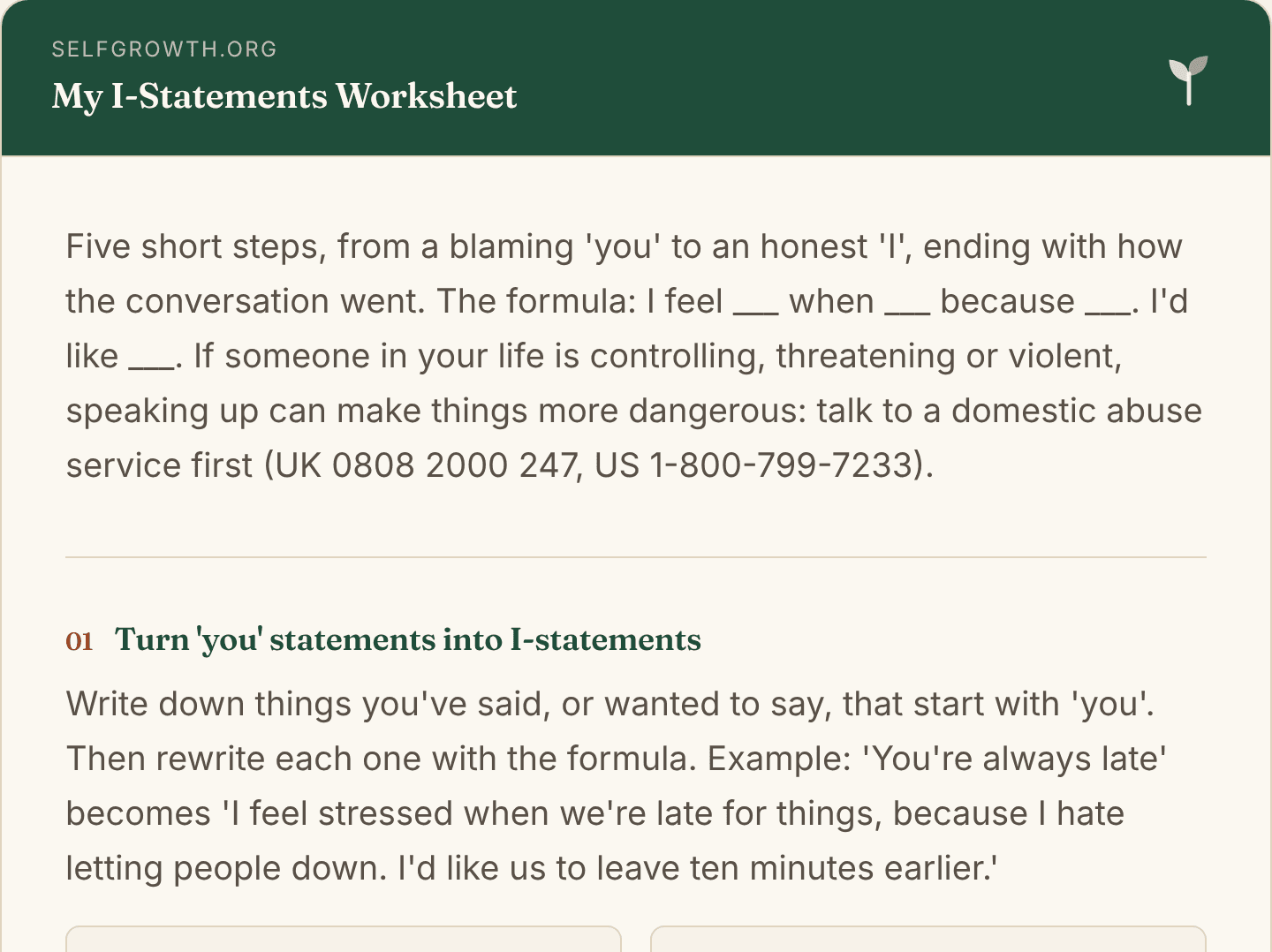
I-Statements Worksheet
A free, printable I-statements worksheet with I statement examples, the 'I feel... when... because...' formula, and space to plan one real conversation.
Open worksheet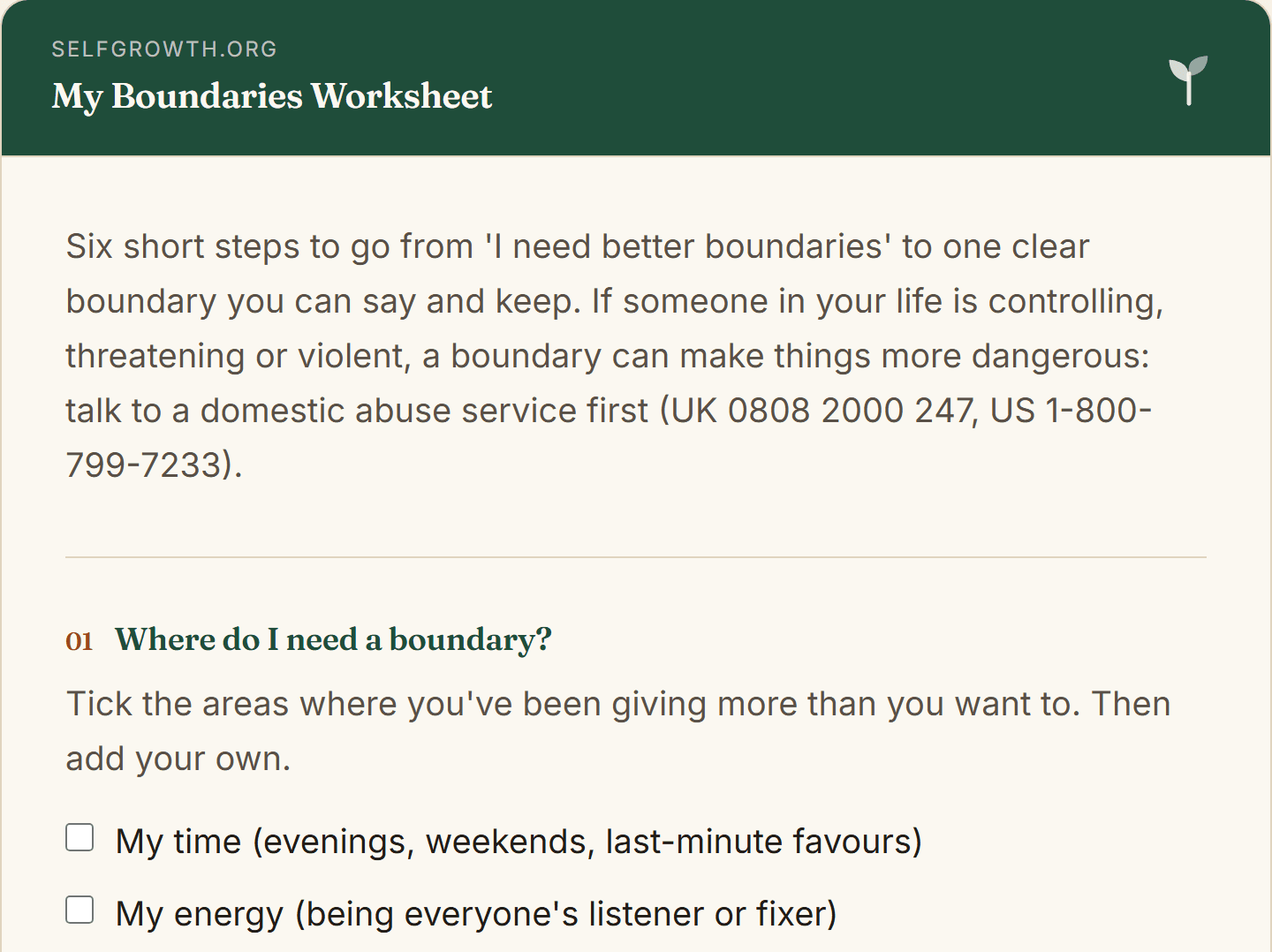
Boundaries Worksheet
A free, printable boundaries worksheet: spot where you need a limit, write it as something you'll do, plan the exact words, and decide what you'll do if it's crossed.
Open worksheet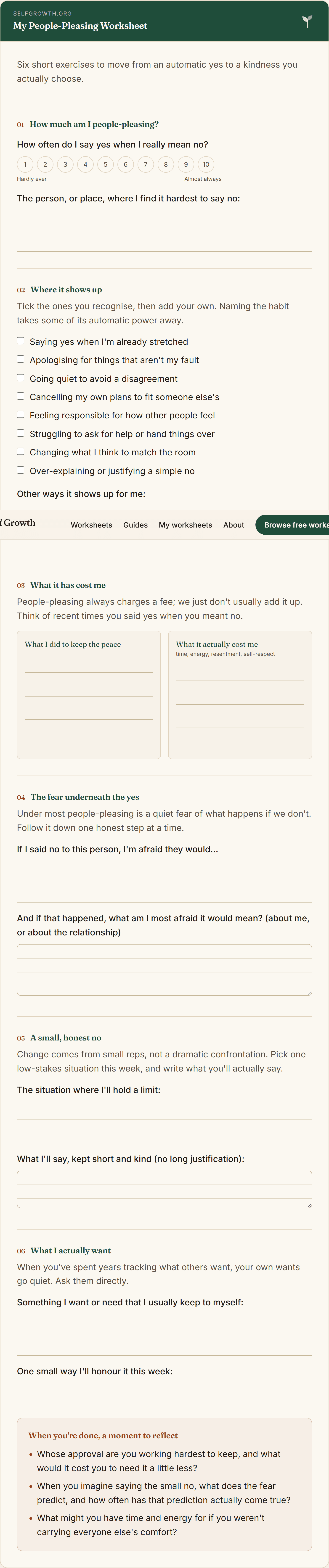
People-Pleasing Worksheet
A free, printable people-pleasing worksheet: see where you over-give, name the fear underneath, count the real cost, and practise one small, honest no.
Open worksheet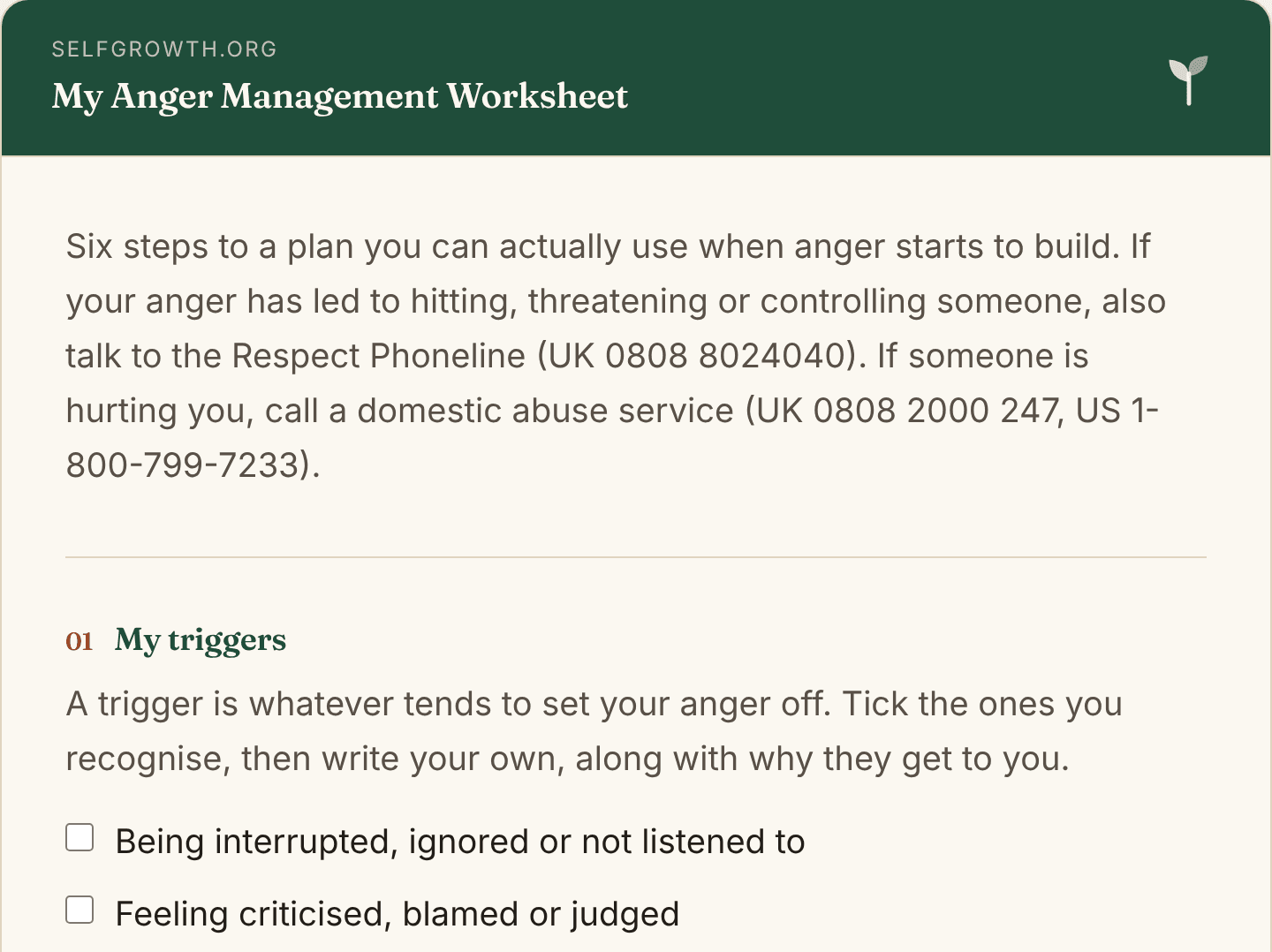
Anger Management Worksheet
A free anger management worksheet for adults: your triggers, an anger thermometer with your own warning signs, a time-out plan and calming skills. Free PDF.
Open worksheet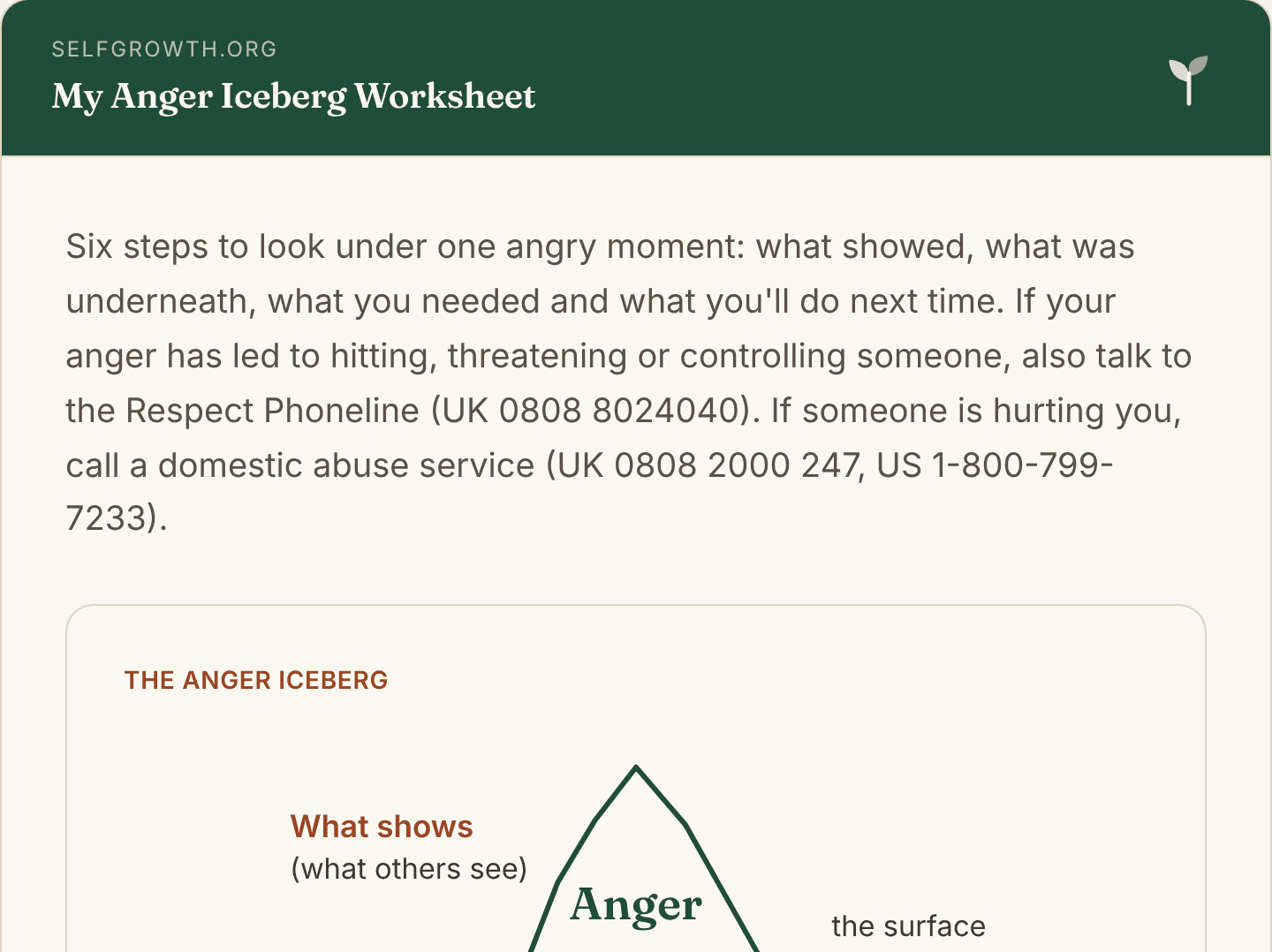
Anger Iceberg Worksheet
A free anger iceberg worksheet and PDF: see what showed on the surface, find the hurt, fear or shame underneath, name what you needed and plan a repair.
Open worksheetRelated guides
New worksheets, straight to your inbox
An occasional new worksheet or tool, sent only when there's something genuinely worth your time. No spam, no pressure, unsubscribe any time.