
Boundaries
Boundaries Worksheet: A Free, Printable Way to Set a Boundary and Keep It
Updated October 6, 2026 · 6 min read · Free to print
A boundaries worksheet helps you work out where you need a limit and how to say it. This free, printable worksheet walks you through spotting situations that leave you resentful or drained, writing the boundary as something you'll do, planning your exact words, and deciding what you'll do if it's crossed.
By the Self Growth team · drawn from assertiveness training and dialectical behaviour therapy · how we make these
Print it, or save the PDF and fill it in by hand. Free, no email needed.
Most of us know we 'need better boundaries' long before we know which ones. The feeling comes first: resentment after another yes, dread before a certain call, the tiredness of always being on hand. A worksheet turns that feeling into something specific you can act on.
A boundary is a limit on what you'll do, give or accept, and the most useful ones describe your own action rather than someone else's behaviour. 'I'll leave at 10' is a boundary. 'They need to stop keeping me late' is a wish. This worksheet helps you write the first kind.
You'll work on one boundary at a time, from the signal that something needs to change through to the words you'll use and what you'll do if it's ignored. Nobody else has to see what you write.
Too open
You say yes to almost everything and carry other people's moods as your own. Resentment builds quietly.
Healthy
You're clear about what you will and won't do, kind about it, and flexible where it doesn't matter much.
Walls
You keep people at a distance so nothing can hurt. Help and closeness get shut out too.
Healthy boundaries sit in the middle: firm where it matters, flexible where it doesn't
How to use this worksheet
- 1Set aside about 15 to 20 minutes somewhere you won't be interrupted.
- 2Pick one situation to work on. A small, low-stakes one is the best place to start.
- 3Write the boundary as your own action, something you can do whatever the other person does.
- 4Keep your page and come back to it after you've said the words, to note what happened.
The worksheet
selfgrowth.org
My Boundaries Worksheet
Six short steps to go from 'I need better boundaries' to one clear boundary you can say and keep. If someone in your life is controlling, threatening or violent, a boundary can make things more dangerous: talk to a domestic abuse service first (UK 0808 2000 247, US 1-800-799-7233).
01Where do I need a boundary?
Tick the areas where you've been giving more than you want to. Then add your own.
How often do I feel resentful after saying yes?
02The signals
Resentment, dread and exhaustion are often the first sign a limit is missing. Think of recent moments when you felt one of them.
Entry 1
Entry 2
Entry 3
The one I'll work on first (pick something small):
03My boundary, as something I'll do
Write the limit as your own action, not as a rule for someone else. You can keep this boundary whatever they do.
Instead of 'they need to…', my boundary is 'I will…':
e.g. 'I'll answer non-urgent messages in the morning', not 'they must stop messaging late'
Why this matters to me:
04The words I'll use
Plan it before the moment arrives. Keep each part short and kind. You don't need a long justification.
What's happening (just the facts):
How it affects me:
What I'm asking for, or saying no to:
Why it helps (us, or me):
Put together, in my own words:
05If it's crossed
The follow-through is the boundary; the words just announce it. Decide now, so you're not deciding under pressure. If following through could put you at risk, don't: talk to a domestic abuse service instead (UK 0808 2000 247, US 1-800-799-7233).
If the boundary isn't respected, what I'll calmly do:
e.g. end the call, leave, hand the task back, repeat it once
What I'll tell myself when the guilt kicks in:
06Practise it
When and where I'll say it:
How confident do I feel about saying it?
Afterwards: what actually happened, and what I learned:
When you're done, a moment to reflect
- What did you fear would happen when you set the boundary, and what actually happened?
- Where else in your life might the same boundary, or a gentler version of it, help?
- What would change if you trusted that people who care about you can handle a clear, kind no?
The approach behind this worksheet
'Boundaries' is an everyday word rather than a research term, so this worksheet draws on the nearest evidence. The main one is assertiveness training: saying what you want and don't want, plainly and respectfully. It's set out in classics like Alberti and Emmons's Your Perfect Right. A 2018 review by Brittany Speed, Brandon Goldstein and Marvin Goldfried called it 'a forgotten evidence-based treatment', noting that research on it has dropped off sharply.
The 'words I'll use' step follows the first four parts of DEAR MAN, a skill from Marsha Linehan's dialectical behaviour therapy for asking for what you want: describe, express, assert and reinforce. The other three (stay mindful, appear confident, negotiate) are about how you say it. Writing the boundary as your own action, and planning the follow-through, comes from everyday clinical practice rather than a specific study. If a relationship feels controlling or unsafe, support from a professional matters more than any worksheet.
These are educational self-reflection tools, not therapy, see our editorial standards.
If you want to go deeper
- Robert E. Alberti & Michael L. Emmons — Your Perfect Right: Assertiveness and Equality in Your Life and Relationships (10th ed., Impact, 2017).
- Brittany C. Speed, Brandon L. Goldstein & Marvin R. Goldfried — Assertiveness training: A forgotten evidence-based treatment, Clinical Psychology: Science and Practice, 25(1), 2018 (doi:10.1111/cpsp.12216).
- Marsha M. Linehan — DBT Skills Training Manual (2nd ed., Guilford Press, 2015), source of the DEAR MAN interpersonal effectiveness skill.
Your questions, answered
- What is a boundaries worksheet?
- It's a set of guided exercises that helps you find where you need a limit and plan how to set it: spotting the situations that leave you resentful or drained, writing the boundary as your own action, planning the words, and deciding what you'll do if it's crossed. It turns 'I need better boundaries' into one specific step.
- What are examples of healthy boundaries?
- Not answering work messages after a set time, saying you'll talk about something tomorrow rather than tonight, asking people to knock before coming into your room, declining to lend money, and changing the subject when someone raises a topic you don't want to discuss. Each one names what you will do, not what the other person must do.
- How do I set a boundary without feeling guilty?
- You may not be able to skip the guilt at first. Guilt after a fair boundary usually means an old habit is protesting, not that you did something wrong. Keep it short and kind, follow through, and give it time. For many people the guilt fades as the boundary becomes normal.
- What if someone ignores my boundary?
- Repeat it once, briefly, then do what you planned: end the call, leave, or hand the task back. You don't need to win the argument. If someone keeps crossing the same line, you can see them less or rely on them less. If a relationship feels controlling or unsafe, talk to a domestic abuse service before setting boundaries in it.
- Is setting boundaries selfish?
- No. Boundaries let you give where you choose to, rather than out of fear, which usually makes relationships warmer, not colder. People can trust your yes when they know you can say no. You can care deeply about someone and still hold a limit.
- Is this boundaries worksheet free, and is there a PDF?
- Yes. It's free, with no payment and no email needed. You can fill it in on screen and keep your answers, or download the printable PDF and write on it by hand.
- Is this the same as therapy?
- No. This is an educational self-reflection tool, not therapy or medical advice. It sits well alongside therapy. If setting boundaries brings up fear, trauma or anxiety that won't settle, or a relationship feels unsafe, please reach out to a qualified professional or a local support line.
Keep going, related worksheets
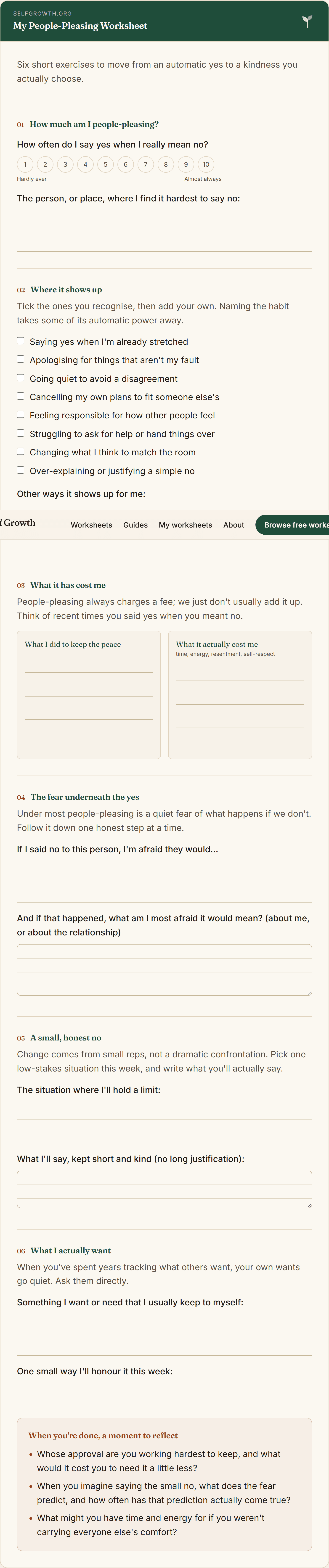
People-Pleasing Worksheet
A free, printable people-pleasing worksheet: see where you over-give, name the fear underneath, count the real cost, and practise one small, honest no.
Open worksheet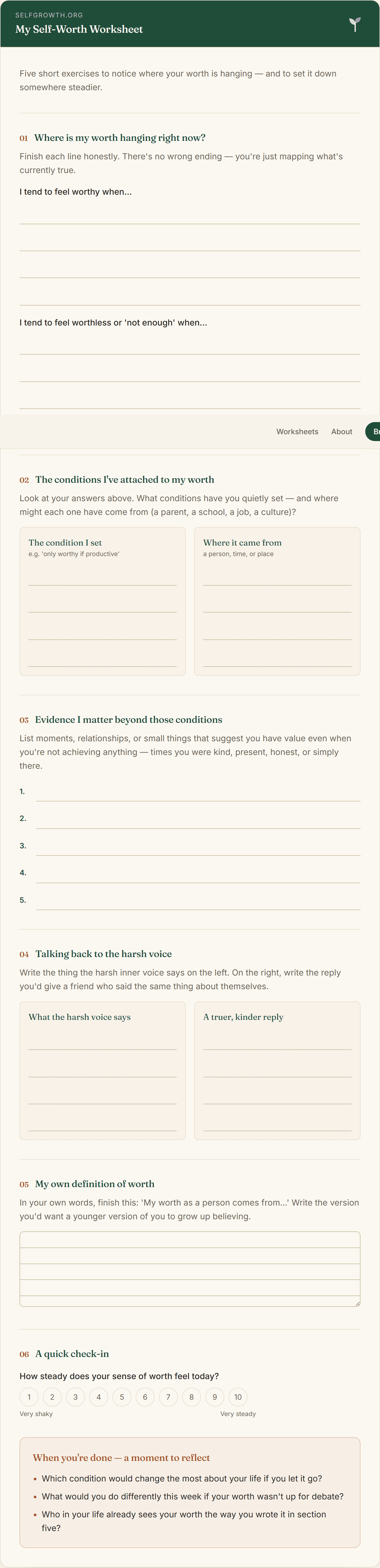
Self-Worth Worksheet
A free, printable self-worth worksheet with five short exercises to separate your value from your achievements and rebuild a steadier sense of worth.
Open worksheet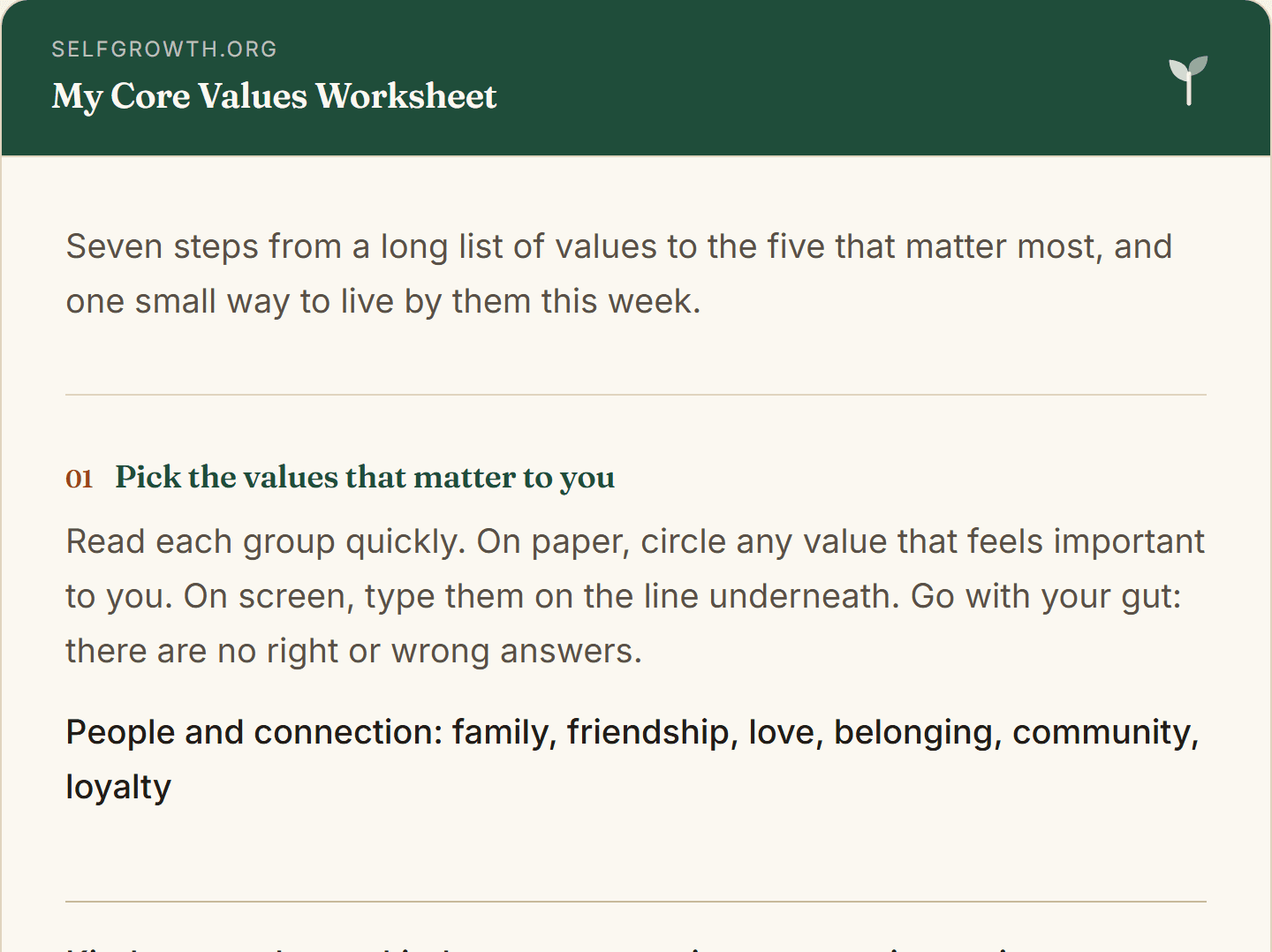
Core Values Worksheet
A free, printable core values worksheet: pick values from a list, narrow them to your top five, put them in your own words and plan one step to live by them.
Open worksheetNew worksheets, straight to your inbox
An occasional new worksheet or tool, sent only when there's something genuinely worth your time. No spam, no pressure, unsubscribe any time.