
People-pleasing
People-Pleasing Worksheet: A Free, Printable Tool to Stop Saying Yes When You Mean No
Updated June 27, 2026 · 6 min read · Free to print
A people-pleasing worksheet helps you see where you say yes when you mean no, and start changing it. This free, printable worksheet walks you through spotting where you over-give, naming the fear underneath the yes, counting what people-pleasing has actually cost you, and practising one small, honest no, so your kindness becomes a choice rather than a reflex.
By the Self Growth team · drawn from assertiveness training and cognitive behavioural therapy · how we make these
A clean, print-ready PDF, properly formatted, free, no email needed.
People-pleasing isn't the same as being kind. Kindness is something you choose; people-pleasing is something you do because saying no feels dangerous, as if disappointing someone might cost you the relationship. So you say yes when you're already stretched, apologise for things that aren't your fault, and quietly put your own needs at the back of every queue.
It usually looks like being easy-going from the outside. Inside, it tends to build up as resentment, exhaustion, and a slow loss of touch with what you actually want, because you've spent so long tracking what everyone else wants instead.
This worksheet won't ask you to stop caring about people. It helps you see the pattern clearly, find the fear that drives it, and take one small step toward kindness that doesn't cost you yourself. Nobody else has to see what you write.
- 1
A request, or a hint of disapproval
Someone wants something, or might be let down.
- 2
Fear spikes
They'll be upset, or think less of me, or pull away.
- 3
You say yes / over-give
Agree, apologise, smooth it over, before you've checked what you want.
- 4
Short-term relief
The tension drops. For now, everyone's happy.
- 5
Resentment and exhaustion build
A quiet no to yourself, again, that has to go somewhere.
And the next request starts the loop again
How to use this worksheet
- 1Set aside about 15 to 20 minutes somewhere you won't be interrupted.
- 2Answer honestly, not generously. The point is to see the pattern, not to look reasonable.
- 3If a question stings a little, that's usually the useful one. Write a sentence and keep going.
- 4Keep what you write and come back to it. Noticing the pattern in real time is where the change starts.
The worksheet
selfgrowth.org
My People-Pleasing Worksheet
Six short exercises to move from an automatic yes to a kindness you actually choose.
01How much am I people-pleasing?
How often do I say yes when I really mean no?
The person, or place, where I find it hardest to say no:
02Where it shows up
Tick the ones you recognise, then add your own. Naming the habit takes some of its automatic power away.
Other ways it shows up for me:
03What it has cost me
People-pleasing always charges a fee; we just don't usually add it up. Think of recent times you said yes when you meant no.
What I did to keep the peace
What it actually cost me
time, energy, resentment, self-respect
04The fear underneath the yes
Under most people-pleasing is a quiet fear of what happens if we don't. Follow it down one honest step at a time.
If I said no to this person, I'm afraid they would…
And if that happened, what am I most afraid it would mean? (about me, or about the relationship)
05A small, honest no
Change comes from small reps, not a dramatic confrontation. Pick one low-stakes situation this week, and write what you'll actually say.
The situation where I'll hold a limit:
What I'll say, kept short and kind (no long justification):
06What I actually want
When you've spent years tracking what others want, your own wants go quiet. Ask them directly.
Something I want or need that I usually keep to myself:
One small way I'll honour it this week:
When you're done, a moment to reflect
- Whose approval are you working hardest to keep, and what would it cost you to need it a little less?
- When you imagine saying the small no, what does the fear predict, and how often has that prediction actually come true?
- What might you have time and energy for if you weren't carrying everyone else's comfort?
The approach behind this worksheet
People-pleasing tends to sit on two foundations: a learned habit of avoiding conflict, and a shaky sense that your worth depends on other people's approval. This worksheet works on both. The assertiveness tradition, set out in classics like Alberti and Emmons's Your Perfect Right, treats saying no as a skill you can practise rather than a personality you're stuck with, which is why the worksheet asks you to rehearse a real, specific no rather than just resolve to 'have better boundaries'.
The cognitive side comes from naming the fear underneath the yes and testing it against what actually happens, the same evidence-weighing move that cognitive behavioural therapy uses for the inner critic. Some therapists frame chronic people-pleasing as the 'fawn' response, a way of staying safe by keeping others happy. These are educational self-reflection tools, not therapy, and if the pattern is rooted in trauma, support from a professional matters more than any worksheet.
These are educational self-reflection tools, not therapy, see our editorial standards.
If you want to go deeper
- Harriet B. Braiker — The Disease to Please: Curing the People-Pleasing Syndrome (McGraw-Hill, 2001).
- Robert E. Alberti & Michael L. Emmons — Your Perfect Right: Assertiveness and Equality in Your Life and Relationships (10th ed., Impact, 2017).
- Aziz Gazipura — Not Nice: Stop People Pleasing, Staying Silent, and Feeling Guilty (Tower Press, 2017).
Questions people ask
- What is a people-pleasing worksheet?
- It's a guided set of exercises that help you see and change a people-pleasing pattern: where you over-give, the fear that drives the automatic yes, what the habit has cost you, and how to practise a small, honest no. It turns a vague 'I should set better boundaries' into specific, doable steps.
- What are the signs of people-pleasing?
- Common signs include saying yes when you mean no, apologising constantly, avoiding any disagreement, feeling responsible for everyone else's feelings, struggling to ask for help, and changing your opinion to match the room. Underneath is usually a fear that disappointing someone will cost you the relationship.
- Why am I such a people-pleaser?
- It's usually learned rather than a flaw in your character. Many people-pleasers grew up in homes where keeping others happy felt necessary for safety or approval, so pleasing became an automatic way to avoid conflict or rejection. Some psychologists call it the 'fawn' response, a stress reaction alongside fight, flight and freeze. Because it's learned, it can be unlearned.
- How do I stop people-pleasing?
- Start small and specific. Notice the automatic yes before it leaves your mouth, buy yourself time ('let me check and get back to you'), then practise one low-stakes no, kept short and without a long justification. Expect it to feel uncomfortable at first; that discomfort is the habit changing, not a sign you've done something wrong. This worksheet walks you through it step by step.
- Is people-pleasing a bad thing?
- Caring about people is good; people-pleasing is when that care runs on fear and quietly erases you. The aim isn't to stop being kind, it's to make kindness a choice rather than a reflex, so it doesn't leave you resentful and depleted. Healthy generosity and chronic people-pleasing feel very different from the inside.
- Is this the same as therapy?
- No. This is an educational self-reflection tool, not therapy or medical advice. It sits well alongside therapy, but if people-pleasing is tied to trauma, anxiety, or a relationship that feels unsafe, please reach out to a qualified professional or a local support line.
Keep going, related worksheets
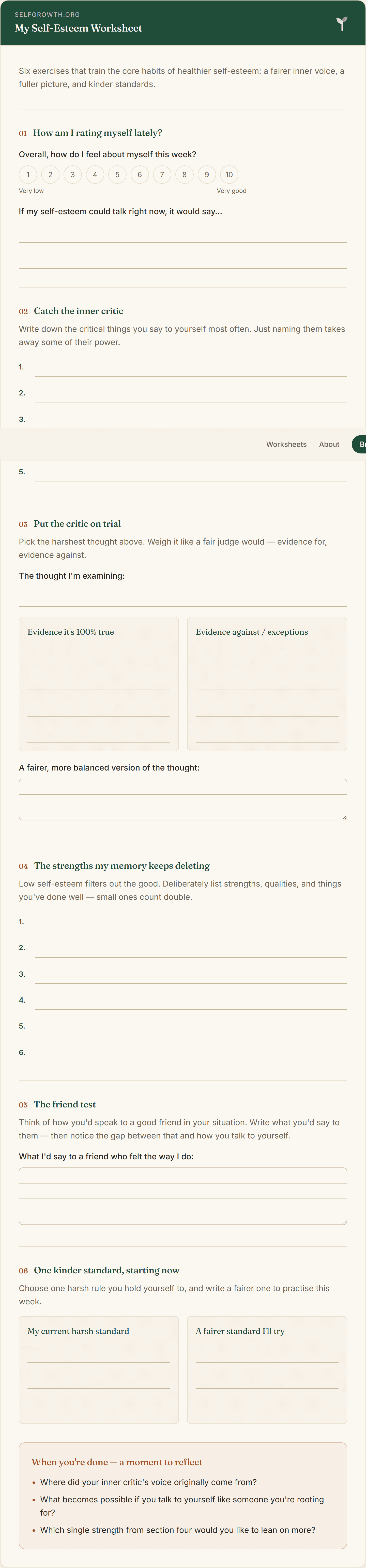
Self-Esteem Worksheet
Free, printable self-esteem worksheets with guided exercises to challenge your inner critic, recognise your strengths, and build steadier, healthier self-esteem.
Open worksheet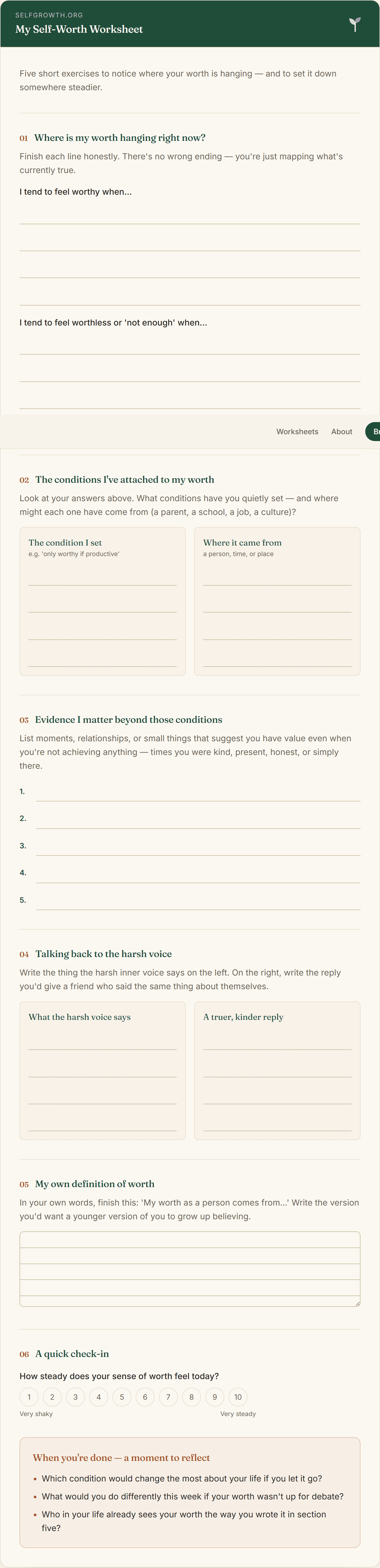
Self-Worth Worksheet
A free, printable self-worth worksheet with five short exercises to separate your value from your achievements and rebuild a steadier sense of worth.
Open worksheet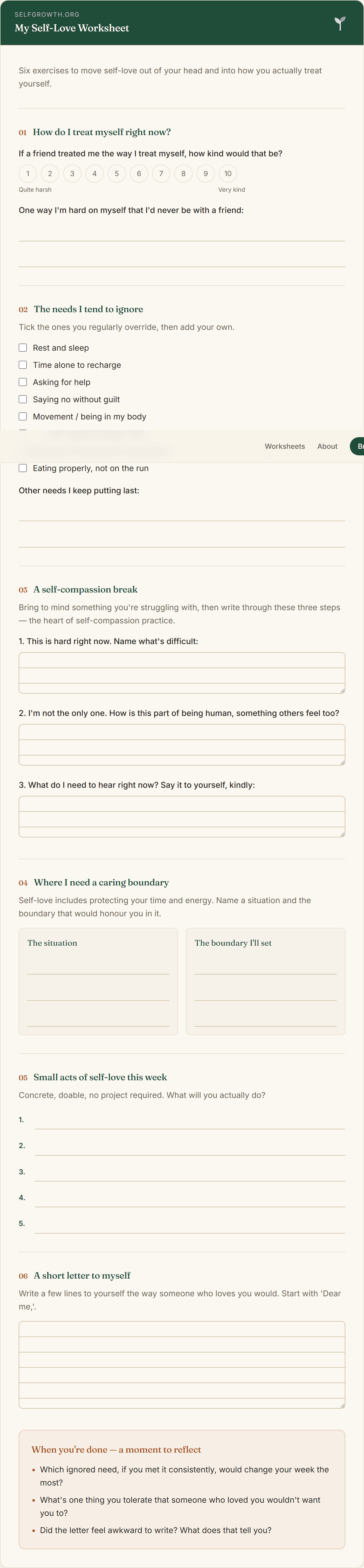
Self-Love Worksheet
A free, printable self-love worksheet that turns self-love from a vague idea into specific actions, meeting your needs, setting boundaries, and treating yourself with care.
Open worksheetNew worksheets, straight to your inbox
An occasional new worksheet or tool, sent only when there's something genuinely worth your time. No spam, no pressure, unsubscribe any time.