
Guide
How to stop people-pleasing
Updated June 27, 2026 · 9 min read
You stop people-pleasing not by caring less, but by noticing the automatic yes before it leaves your mouth, buying yourself time, and practising small, honest nos until disappointing someone stops feeling dangerous. The work is partly a skill (saying no) and partly a belief (that your worth doesn't depend on everyone's approval), and both can be built with practice.
By the Self Growth team · drawn from assertiveness training and cognitive behavioural therapy · how we make these
People-pleasing is often mistaken for kindness, but they run on different fuel. Kindness is something you choose because you want to. People-pleasing is something you do because saying no feels unsafe, as if disappointing someone might cost you the relationship. From the outside it looks easy-going. Inside, it tends to build up as resentment, exhaustion, and a quiet loss of touch with what you actually want.
The good news is that people-pleasing is a learned habit, not a fixed part of who you are, which means it can be unlearned. This guide covers what it actually is, how to spot it, why we fall into it, and the small, repeatable steps that loosen its grip, with a free worksheet so you're not just reading about it.
What people-pleasing actually is
People-pleasing is a habit of putting other people's comfort ahead of your own needs, again and again, to avoid conflict, rejection, or disapproval. It's not the occasional favour or compromise that every relationship needs. It's the automatic yes, the over-apology, the agreeing-to-keep-the-peace that happens before you've even checked what you want.
The clearest way to tell people-pleasing from genuine kindness is to look at the motive. Kindness comes from 'I want to'. People-pleasing comes from 'I have to, or something bad will happen'. One leaves you warm; the other leaves you depleted and quietly resentful.
Some therapists describe chronic people-pleasing as the 'fawn' response, a way of staying safe by keeping others happy, sitting alongside the better-known fight, flight and freeze reactions to stress. That framing matters because it reframes people-pleasing as a protective pattern you learned, not a weakness in your character.
Signs you're a people-pleaser
People-pleasing rarely announces itself. It hides behind being 'low-maintenance' or 'the reliable one'. You might recognise some of these:
- You say yes when you're already stretched, then resent it later.
- You apologise for things that aren't your fault, sometimes for simply existing.
- You'll do almost anything to avoid a disagreement.
- You feel responsible for how everyone around you is feeling.
- Praise makes you uncomfortable, but criticism can floor you for days.
- You change what you think, or what you'll admit to thinking, to match the room.
- Asking for help, or handing a task over, feels almost impossible.
- You're not always sure what you want, because you're so used to tracking what others want.
Recognising several of these isn't a verdict on your character. It's a sign that pleasing became your way of staying safe, and that, like any habit, it can be changed.
Why we do it
People-pleasing is almost always learned, usually early. If approval felt conditional growing up, or keeping a parent happy felt necessary for things to stay calm, you may have learned that your needs come second and that disappointing people is dangerous. That lesson then quietly runs the show decades later.
- A childhood where love or peace felt like it had to be earned by being good, helpful, or undemanding.
- Conflict that felt unsafe, so avoiding it became a survival skill.
- Low self-worth, where your value feels tied to being useful to other people.
- Being praised, as a child, mainly for being 'easy' or 'selfless'.
None of this is your fault, and naming where it came from isn't about blame. It's about seeing the pattern clearly enough to choose differently now.
Why it backfires
Every yes you don't mean is a quiet no to yourself.
People-pleasing feels generous, but it runs on a hidden loop that slowly wears you down. A request lands, fear of disappointing them spikes, you say yes, you get a short hit of relief, and underneath, resentment and tiredness build, until the next request starts the loop again.
- 1
A request, or a hint of disapproval
Someone wants something, or might be let down.
- 2
Fear spikes
They'll be upset, or think less of me, or pull away.
- 3
You say yes / over-give
Agree, apologise, smooth it over, before you've checked what you want.
- 4
Short-term relief
The tension drops. For now, everyone's happy.
- 5
Resentment and exhaustion build
A quiet no to yourself, again, that has to go somewhere.
And the next request starts the loop again
Over time the cost compounds. You lose touch with your own wants, your relationships quietly tilt out of balance, and the resentment you never voice can leak out sideways. People also can't get close to a version of you that's always performing agreeableness, so the connection people-pleasing is meant to protect is often exactly what it erodes.
How to stop, in practice
You don't stop people-pleasing with one dramatic confrontation. You stop it with small, repeated reps that slowly teach your nervous system that a no is survivable.
- 1Catch the automatic yes. The moment you feel the reflex to agree, pause. Just noticing 'that was the reflex, not a decision' is most of the battle.
- 2Buy yourself time. 'Let me check and get back to you' breaks the automatic yes and gives you room to decide what you actually want.
- 3Start with a small, low-stakes no. Don't begin with the hardest person in your life. Practise on something minor where the cost of a no is low.
- 4Keep the no short. A simple 'I can't this time' needs no essay. Over-explaining invites negotiation and signals the no is up for debate.
- 5Expect the discomfort, and let it pass. Guilt after a fair no isn't a sign you did wrong; it's the old habit protesting. It fades, and it fades faster each time.
- 6Separate kindness from compliance. You can care about someone and still say no. Ask 'do I want to, or am I just afraid not to?'
The free worksheet below turns these into something you can actually do: it helps you see where you over-give, name the fear under the yes, and rehearse one small no for this week.
Open the People-Pleasing WorksheetWhere to start, depending on what's hardest
Pick the one that fits where you are. Each links to a free worksheet you can fill in online or print.
If you want to tackle the pattern head-on, start with the people-pleasing worksheet. It walks you from the automatic yes to a small, honest no.
Open the People-Pleasing WorksheetIf the deeper issue is that your worth feels tied to other people's approval, the self-worth worksheet works on the foundation underneath the habit.
Open the Self-Worth WorksheetAnd if a harsh inner critic keeps telling you that saying no makes you selfish, the self-esteem worksheet helps you answer that voice more fairly.
Open the Self-Esteem WorksheetWhen to get more support
Sometimes people-pleasing runs deeper than a habit, especially when it grew out of trauma or a relationship that doesn't feel safe to say no in. If the thought of holding a boundary brings real fear, or the pattern is bound up with anxiety or low mood that won't lift, this is work to do with someone, not alone with a worksheet.
A GP is a good first step and can point you toward talking therapies, where assertiveness and the beliefs underneath people-pleasing are common, very workable ground. These guides and worksheets are educational self-reflection tools, not therapy, and if things feel heavy you deserve real support, not just a page to fill in.
How we put this together
This guide is written in plain language from established, evidence-based ideas, not personal opinion. It's an educational self-reflection resource, not therapy or medical advice, see our editorial standards.
If you want to go deeper
- Harriet B. Braiker — The Disease to Please: Curing the People-Pleasing Syndrome (McGraw-Hill, 2001).
- Robert E. Alberti & Michael L. Emmons — Your Perfect Right: Assertiveness and Equality in Your Life and Relationships (10th ed., Impact, 2017).
- Pete Walker — Complex PTSD: From Surviving to Thriving (2013), which popularised the 'fawn' response.
Questions people ask
- What is people-pleasing?
- People-pleasing is a habit of putting other people's comfort ahead of your own needs, repeatedly, to avoid conflict, rejection or disapproval. It differs from kindness in its motive: kindness comes from 'I want to', people-pleasing from 'I have to or something bad will happen'. Some therapists call it the 'fawn' response, a learned way of staying safe by keeping others happy.
- What are the signs of people-pleasing?
- Common signs include saying yes when you mean no, apologising constantly, avoiding all disagreement, feeling responsible for everyone's feelings, finding praise uncomfortable but criticism crushing, changing your opinion to match the room, and struggling to ask for help. Underneath is usually a fear that disappointing someone will cost you the relationship.
- Why do I people-please?
- It's almost always learned, usually early. If approval felt conditional or keeping a parent calm felt necessary, you may have learned that your needs come second and that disappointing people is dangerous. Low self-worth and a fear of conflict feed it too. Because it's a learned pattern rather than a fixed trait, it can be unlearned.
- Is people-pleasing a trauma response?
- It can be. Some clinicians describe chronic people-pleasing as the 'fawn' response, a way of managing threat by appeasing others, alongside fight, flight and freeze. That doesn't mean everyone who people-pleases has trauma, but it does reframe the habit as a protective pattern you learned rather than a personal weakness. If it's rooted in trauma, working with a therapist tends to help most.
- How do I stop people-pleasing?
- Start small and specific. Catch the automatic yes, buy yourself time ('let me check and get back to you'), then practise one low-stakes no kept short and without a long justification. Expect guilt at first; it's the old habit protesting, and it fades faster each time. Working through a structured worksheet helps turn the intention into real practice.
- Is people-pleasing bad, or is it just being nice?
- Caring about people is good. People-pleasing is when that care runs on fear and quietly erases you, leaving resentment and burnout in its place. The goal isn't to stop being kind, it's to make kindness a choice rather than a reflex. Genuine generosity and chronic people-pleasing feel very different from the inside, one fills you, the other empties you.
Worksheets to do the work
Free to fill in online or print. No email needed.
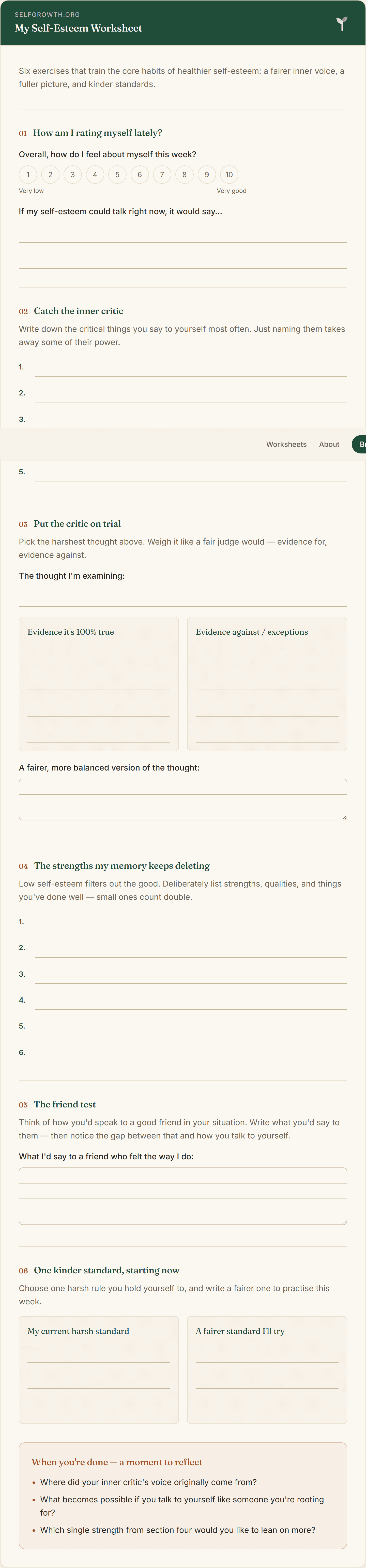
Self-Esteem Worksheet
Free, printable self-esteem worksheets with guided exercises to challenge your inner critic, recognise your strengths, and build steadier, healthier self-esteem.
Open worksheet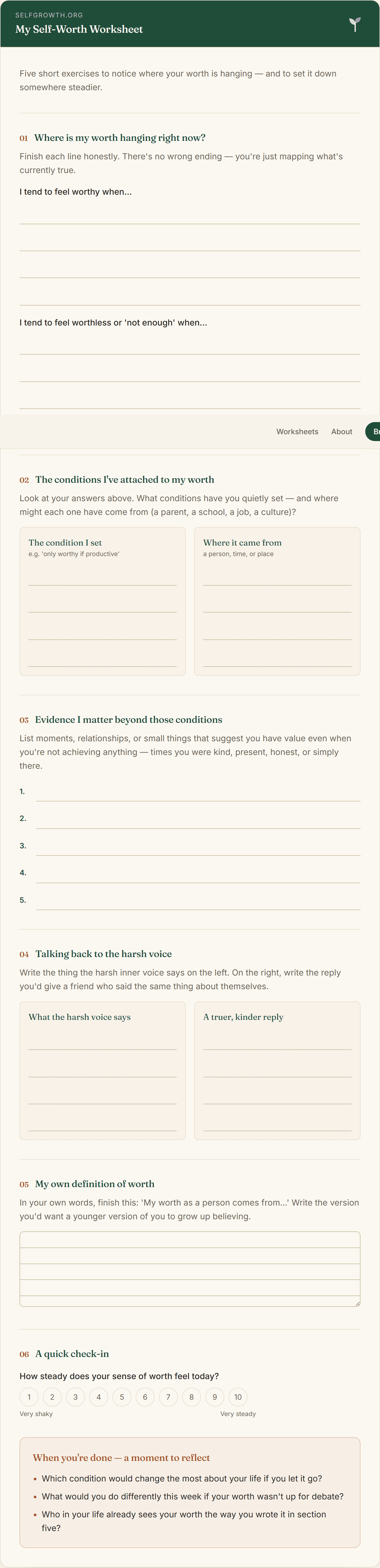
Self-Worth Worksheet
A free, printable self-worth worksheet with five short exercises to separate your value from your achievements and rebuild a steadier sense of worth.
Open worksheet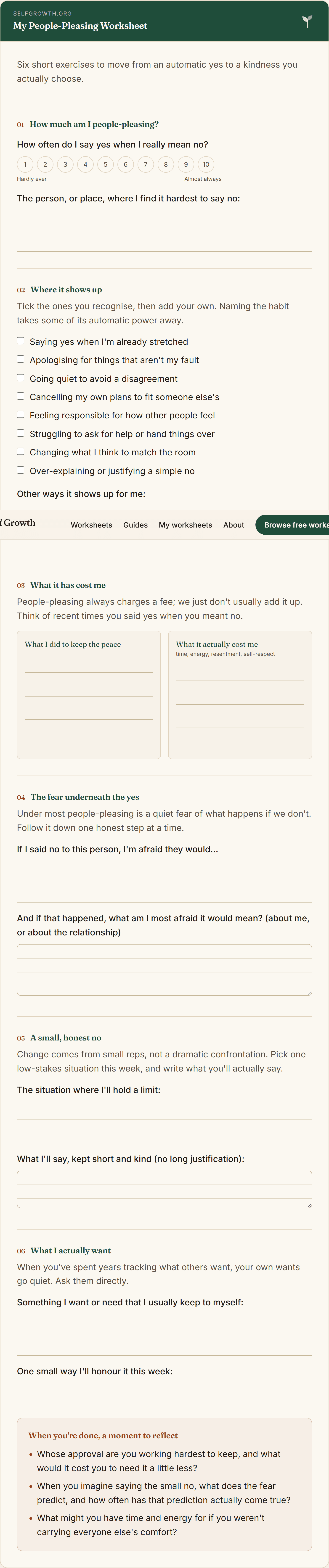
People-Pleasing Worksheet
A free, printable people-pleasing worksheet: see where you over-give, name the fear underneath, count the real cost, and practise one small, honest no.
Open worksheetNew worksheets, straight to your inbox
An occasional new worksheet or tool, sent only when there's something genuinely worth your time. No spam, no pressure, unsubscribe any time.