
Guide
How to set boundaries
Updated October 6, 2026 · 9 min read
You set a boundary by deciding what you will and won't do, saying it clearly and kindly, and following through. A boundary is about your own actions, not about controlling someone else: 'If you call after 9pm, I'll answer in the morning.' Start with something small, keep the words short, and expect it to feel uncomfortable at first.
By the Self Growth team · drawn from assertiveness training and dialectical behaviour therapy · how we make these
A boundary is the line between what you're willing to do, give or accept, and what you're not. Most of us only notice we need one when something has already gone past it: the resentment after another evening given away, the dread before a certain phone call, the tiredness of always being available.
Setting boundaries isn't about building walls or becoming hard. It's about being clear, so people know where they stand with you, and so your yes means yes. It's a skill, and like any skill it gets easier with practice. The free worksheet below helps you plan one boundary, down to the exact words.
What are healthy boundaries?
A healthy boundary is a clear limit on what you'll do, give or put up with, said kindly and kept consistently. The key word is 'you'. A boundary describes your own action, not someone else's behaviour. 'Stop calling me so late' is a request they can ignore. 'I don't take calls after 9pm, so I'll ring you back in the morning' is a boundary, because it's something you can actually do.
A boundary is something you do, not something you make other people do.
Healthy boundaries are firm where it matters and flexible where it doesn't. You might hold a hard line about how you're spoken to, and bend happily about who chooses the restaurant. Without enough boundaries, you end up saying yes to everything and carrying other people's moods as if they were yours. With too many, you shut out closeness and help along with the hurt.
Too open
You say yes to almost everything and carry other people's moods as your own. Resentment builds quietly.
Healthy
You're clear about what you will and won't do, kind about it, and flexible where it doesn't matter much.
Walls
You keep people at a distance so nothing can hurt. Help and closeness get shut out too.
Healthy boundaries sit in the middle: firm where it matters, flexible where it doesn't
It's worth being honest about one thing: 'boundaries' is an everyday word more than a scientific one. The research it rests on is mostly about assertiveness, meaning saying what you want and don't want, plainly and respectfully, and about how people manage the line between work and home.
Examples of healthy boundaries
There's no official list of boundary types, but grouping them by what they protect makes them easier to spot. Here are some everyday examples of each:
- Your time: 'I can help on Saturday morning, but I need the afternoon for myself.'
- Your energy and feelings: 'I want to support you, but I can't talk about this tonight. Can we pick it up tomorrow?'
- Your body and space: 'Please knock before you come into my room.' Or simply: 'I'd rather not hug, but it's lovely to see you.'
- Money and belongings: 'I'm not able to lend money, but I'm happy to help you look at your options.'
- Conversations: 'I'm not going to discuss my weight. Let's talk about something else.'
- Work and home: 'I don't check work messages after 7pm. If it's urgent, call me.'
That last kind has been studied directly. In two qualitative studies of how people manage the line between work and home, Glen Kreiner, Elaine Hollensbe and Mathew Sheep found four kinds of 'boundary work' tactics: behavioural, temporal, physical and communicative. In plain terms, what you do, when, where, and what you tell people. Their model suggests these tactics can ease the strain when work and home pull against each other.
Signs you need better boundaries
A missing boundary rarely announces itself. It usually shows up as a feeling first. You might recognise some of these:
- You often feel resentful after saying yes.
- You dread certain calls, messages or visits, even with people you love.
- You feel responsible for keeping everyone else happy.
- You over-explain or apologise when you do say no.
- Your plans, rest or money keep getting given away.
- You feel guilty for wanting time to yourself.
- People seem surprised, or annoyed, when you do push back, because you rarely have.
Resentment is one of the most useful signals here. It often points to a place where you've been giving more than you want to, and where a clear limit would help both of you.
Why setting boundaries feels so hard
If saying no makes your heart race, you're not doing it wrong. A boundary can feel like a risk to the relationship: the other person might be hurt, angry, or think less of you. If you grew up keeping the peace, or your worth feels tied to being helpful, holding a line can feel selfish even when it's fair.
That's why boundaries and people-pleasing are two sides of the same coin. People-pleasing is the automatic yes; a boundary is the honest no, or the honest 'yes, but only this much'. If the yes comes out before you can stop it, the guide to stopping people-pleasing is a good place to start alongside this one.
Guilt after a fair boundary doesn't mean you were wrong. It may simply be the old habit protesting. For many people it fades as the boundary becomes normal.
How to set a boundary, step by step
You don't need a big speech. You need to know what you want, a few clear words, and the willingness to follow through.
One exception first. If a partner or family member is controlling, threatening or violent, setting a boundary with them can make things more dangerous. Talk to a domestic abuse service before you do: in the UK, the National Domestic Abuse Helpline on 0808 2000 247; in the US, the National Domestic Violence Hotline on 1-800-799-7233.
- 1Notice the signal. Resentment, dread or exhaustion around a person or situation is often the first sign a limit is missing.
- 2Decide what you will do. Write the boundary as your own action: 'I'll leave at 10pm', not 'they have to stop keeping me late'.
- 3Choose your words. Say what's happening, how it affects you, what you're asking for or saying no to, and why it helps. Keep it short and kind.
- 4Say it early and calmly. A boundary lands better at a quiet moment than in the middle of an argument.
- 5Follow through. If the line is crossed, do what you said you'd do. The follow-through is the boundary; the words just announce it.
- 6Expect some pushback, and let the guilt pass. People who benefited from you having no limit may test the new one. Stay kind, and stay consistent.
Step 3 draws on DEAR MAN, a skill from Marsha Linehan's dialectical behaviour therapy (DBT) for asking for what you want. You describe the situation, express how you feel, assert what you want, and reinforce it by saying why it helps. Meanwhile you stay on topic, sound confident and stay willing to negotiate. The steps also draw on assertiveness training, which a 2018 review by Brittany Speed, Brandon Goldstein and Marvin Goldfried called 'a forgotten evidence-based treatment'. The review notes that research on it has dropped off sharply, so much of the evidence is older.
Here's what that can look like. Say your sister calls every evening during dinner and stays on for an hour. You decide your boundary: you'll talk after the children are in bed. At a calm moment you say, 'I love our calls, but dinner is chaos here. Can we talk after 8 instead? I'll be able to give you my full attention.' When she rings at 6.30 the next day, you answer briefly: 'It's dinner time, I'll call you at 8.' Then you do.
The free worksheet below walks you through these steps for one boundary of your own, so you finish with the exact words and a plan for what you'll do if it's crossed.
Open the Boundaries WorksheetWhat to say: boundary scripts you can adapt
These are starting points, not lines to recite. Change the words until they sound like you.
- With a parent: 'I know you worry, and I'm glad you care. I'm not going to talk about my relationship at family dinners. If it comes up, I'll change the subject.'
- With a partner: 'I want our evenings to feel like time together. Can we keep phones away during dinner? I'll do the same.'
- With a friend who borrows money: 'I care about you, and I can't lend money any more. It's been putting a strain on me. I'm happy to help you think it through, though.'
- At work: 'I can take this on, but not by Friday alongside the report. Which would you like me to do first?'
- With yourself: 'I've said I'll stop work at 6, so I'm closing the laptop now, even though there's more to do.'
Notice what these have in common. Each one is short, says what you will do, and leaves the other person's dignity intact. None of them needs a long justification. The more you explain, the more it sounds like the boundary is up for debate.
What to do when someone ignores your boundary
Some people will test a new boundary, especially if they're used to you having none. That doesn't mean it failed. It means it's new.
- Repeat it once, calmly and briefly. 'Like I said, I'm not discussing that.' No new arguments needed.
- Follow through with your own action. Leave the conversation, end the call, hand the task back.
- Notice the pattern. If someone keeps crossing the same line after you've been clear, that tells you something about the relationship, not about whether your boundary was fair.
- Adjust how close you are, if you need to. You can see someone less, share less, or rely on them less, without a dramatic falling-out.
One important exception. If a partner or family member is controlling, threatening or violent, setting a boundary can make things more dangerous, not less. In that situation, talk to a domestic abuse service before you act. In the UK, the National Domestic Abuse Helpline is on 0808 2000 247. In the US, the National Domestic Violence Hotline is on 1-800-799-7233. If you're in immediate danger, call your local emergency number.
When to get more support
Boundaries can be hard to hold on your own, especially if they bring up old fears of rejection or conflict, or if anxiety or low mood make every conversation feel high-stakes. That's not a failure. It's a sign this is worth working on with someone.
A GP is a good first step and can point you towards talking therapies. Assertiveness is something therapists often help with, and a therapist can help you practise the conversations before you have them. This guide and the worksheet are educational self-reflection tools, not therapy, and if things feel heavy you deserve real support, not just a page to fill in.
How we put this together
This guide is written in plain language. 'Boundaries' isn't a research term, so it draws on the nearest evidence: assertiveness research, a DBT skill for asking for what you want, and two studies of how people manage the line between work and home. Where the evidence runs out, we say so. It's an educational self-reflection resource, not therapy or medical advice, see our editorial standards.
If you want to go deeper
- Robert E. Alberti & Michael L. Emmons — Your Perfect Right: Assertiveness and Equality in Your Life and Relationships (10th ed., Impact, 2017).
- Brittany C. Speed, Brandon L. Goldstein & Marvin R. Goldfried — Assertiveness training: A forgotten evidence-based treatment, Clinical Psychology: Science and Practice, 25(1), 2018 (doi:10.1111/cpsp.12216), a review of the research on assertiveness training.
- Marsha M. Linehan — DBT Skills Training Manual (2nd ed., Guilford Press, 2015), source of the DEAR MAN interpersonal effectiveness skill.
- Glen E. Kreiner, Elaine C. Hollensbe & Mathew L. Sheep — Balancing borders and bridges: Negotiating the work-home interface via boundary work tactics, Academy of Management Journal, 52(4), 704-730, 2009.
Your questions, answered
- What are boundaries?
- Boundaries are the limits you set on what you'll do, give or accept from other people. A healthy boundary is clear, kind and consistent, and it describes your own action rather than trying to control someone else's. They help people know where they stand with you, and help you stay generous without being taken for granted.
- What are examples of healthy boundaries?
- Everyday examples include not answering work messages after a set time, saying you'll talk about something tomorrow rather than tonight, asking people to knock before coming into your room, declining to lend money, and changing the subject when someone raises a topic you don't want to discuss. Each one names what you will do, not what the other person must do.
- How do I set boundaries without feeling guilty?
- You may not be able to skip the guilt at first, and that's okay. Guilt after a fair boundary usually means an old habit is protesting, not that you did something wrong. Keep the boundary short and kind, follow through, and give it time. For many people the guilt fades as the boundary becomes normal.
- How do I set boundaries with family?
- Pick one specific situation rather than everything at once. Say it at a calm moment, start with what you care about ('I love seeing you'), then name the limit and what you'll do ('I'm leaving at 8 on Sundays'). Expect some testing, and follow through kindly. If a family member is controlling or violent, talk to a domestic abuse service first.
- What should I do if someone doesn't respect my boundary?
- Repeat it once, briefly, then do what you said you'd do: end the call, leave the room, hand the task back. You don't need to win the argument. If someone keeps crossing the same line, you can choose to see them less or rely on them less. If you ever feel unsafe, contact a domestic abuse service or your local emergency number.
- Are boundaries selfish?
- No. Boundaries let you give freely where you choose to, instead of giving out of fear and quietly resenting it. They also make you easier to be close to, because people can trust your yes. Kindness and boundaries work together: you can care deeply about someone and still say no.
- Is this free, and is it therapy?
- It's free, with no payment and no email needed, and the worksheet can be filled in online or printed. This guide and the worksheet are self-reflection tools, not therapy. If boundaries bring up fear, trauma or anxiety that won't settle, a therapist can help. If you ever have thoughts of harming yourself, please contact a crisis line straight away.
Worksheets to do the work
Free to fill in online or print. No email needed.
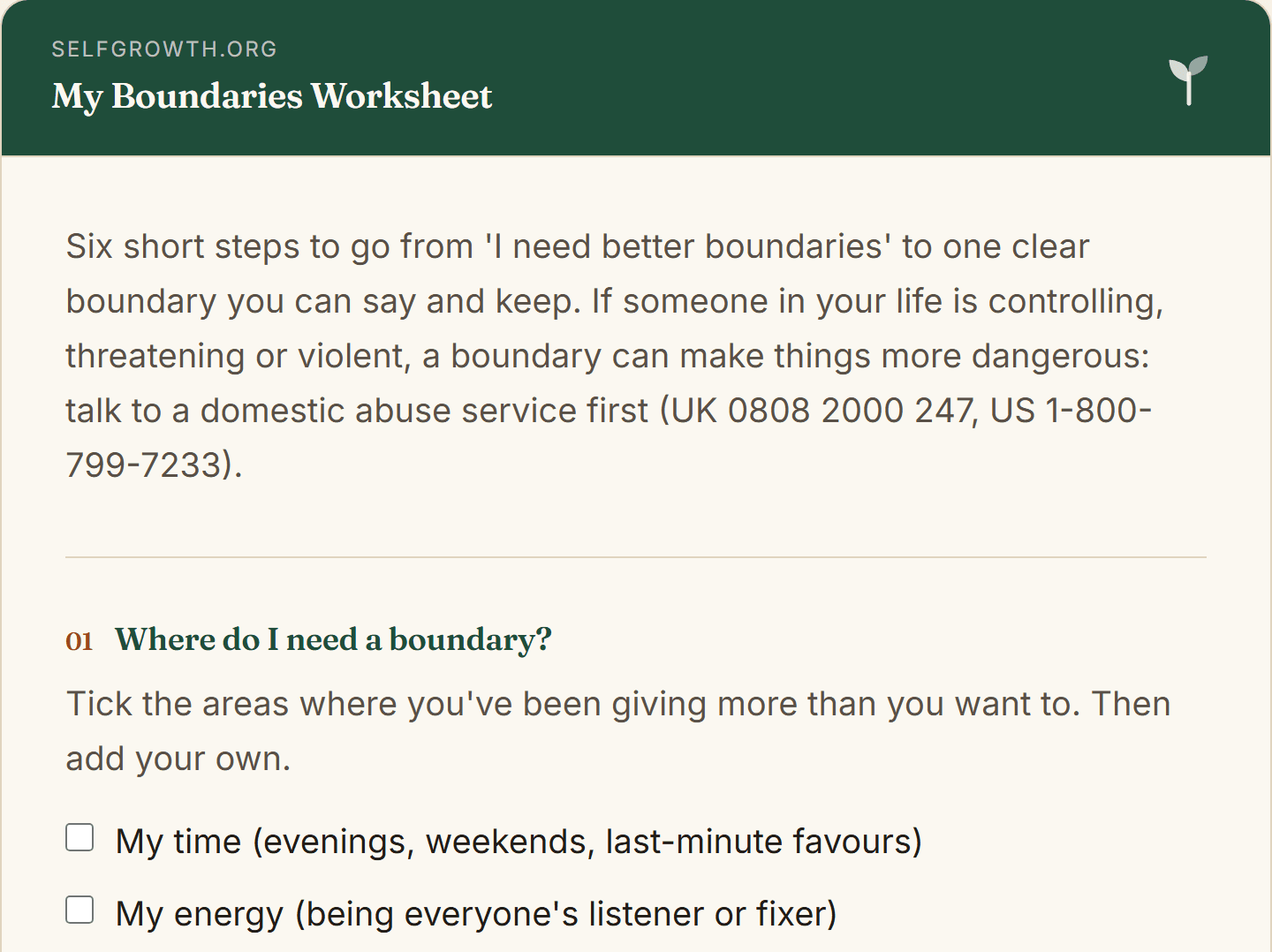
Boundaries Worksheet
A free, printable boundaries worksheet: spot where you need a limit, write it as something you'll do, plan the exact words, and decide what you'll do if it's crossed.
Open worksheet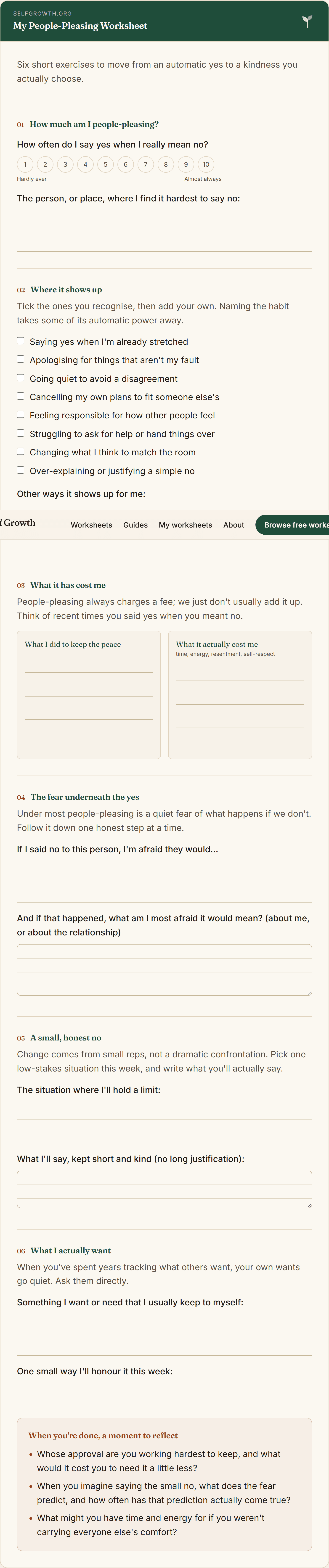
People-Pleasing Worksheet
A free, printable people-pleasing worksheet: see where you over-give, name the fear underneath, count the real cost, and practise one small, honest no.
Open worksheet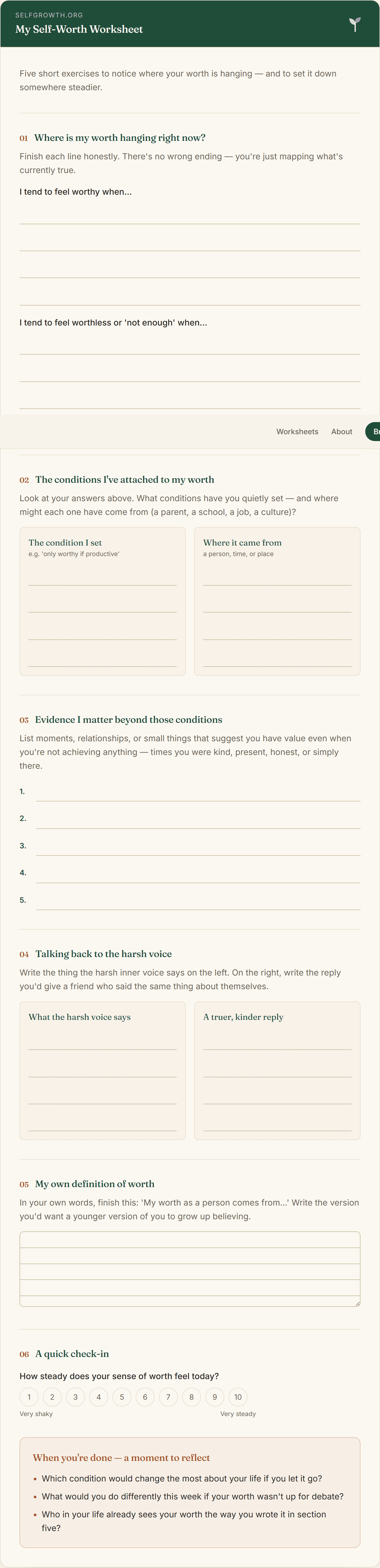
Self-Worth Worksheet
A free, printable self-worth worksheet with five short exercises to separate your value from your achievements and rebuild a steadier sense of worth.
Open worksheetRelated guides
New worksheets, straight to your inbox
An occasional new worksheet or tool, sent only when there's something genuinely worth your time. No spam, no pressure, unsubscribe any time.