
Guide
How to practise self-compassion
Updated October 4, 2026 · 11 min read
To practise self-compassion, treat yourself the way you'd treat a good friend who was struggling. That means three things: noticing the pain without drowning in it, remembering that everyone struggles, and offering yourself kindness instead of criticism. Short exercises such as the self-compassion break, a kind letter to yourself and a hand on your heart build the habit.
By the Self Growth team · drawn from self-compassion research and compassion-focused therapy · how we make these
Most people find it easy to be kind to a friend who's having a hard time. You'd listen. You'd tell them it's not the end of the world, and that they're doing their best. Then you make one mistake yourself, and the voice in your head says something you'd never say to anyone else. Self-compassion is closing that gap: giving yourself the same warmth you'd give a friend.
It isn't letting yourself off the hook, feeling sorry for yourself, or pretending everything's fine. It's a skill you can learn, and the research suggests it helps you cope and keep going. This guide covers what self-compassion is, why it can feel so hard, and six short exercises to practise it. There's a free worksheet at the end that takes you through them on a real moment.
What is self-compassion?
Self-compassion means treating yourself with care when you're struggling, when you've made a mistake, or when you feel you're not good enough. Psychologist Kristin Neff, at the University of Texas at Austin, set out the definition in a 2003 paper. She describes three parts that work together. Each one has an opposite that most of us slip into without noticing.
- 1
Mindfulness
Instead of being swept away
Notice the pain plainly, without pushing it away or making it bigger.
“This is a moment of suffering.”
- 2
Common humanity
Instead of feeling it's only you
Remember that struggling and getting things wrong is part of being human.
“Suffering is a part of life.”
- 3
Self-kindness
Instead of harsh self-judgement
Answer yourself with the warmth you'd give a good friend.
“May I be kind to myself.”
The self-compassion break says all three, in this order
Mindfulness means seeing that you're hurting, plainly, without pushing the feeling away or getting lost in it. Common humanity means remembering that everyone struggles and gets things wrong, so you're not the only one. Self-kindness means answering your pain with warmth instead of a telling-off.
Neff puts the whole idea into one question you can ask in any hard moment: 'What do I need right now?' Sometimes the answer is comfort. Sometimes it's action, like saying no, setting a limit or changing something that isn't working. Self-compassion covers both.
Signs you could do with more self-compassion
You don't need to be in a crisis for this to matter. A few common signs that you're harder on yourself than you need to be:
- You'd comfort a friend in your situation, but you tell yourself off.
- One mistake plays on a loop in your head for days.
- You feel you have to earn rest, or kindness, by doing enough first.
- When things go wrong, it feels as if everyone else has it together and it's only you.
- You either push painful feelings away or get completely swept up in them.
- You worry that going easier on yourself would make you lazy.
- Praise slides off you, but criticism sticks.
If several of these sound familiar, you're in good company. They're habits, not flaws, and habits can change.
Why is it so hard to be kind to yourself?
For a lot of people, the harsh voice started early. Paul Gilbert, the psychologist who developed compassion-focused therapy, points out that strong shame and self-criticism often grow out of hard early experiences: a lot of criticism, bullying, or not being shown much warmth. If that was your world, being hard on yourself first was a way of staying safe.
Gilbert describes three systems that shape how we feel: one that spots threats, one that drives us towards goals, and one that soothes and calms us. For people used to harsh criticism, he writes, the threat system tends to run the show, and both the outside world and their own inner world can feel hostile. He also noticed that people with a lot of shame and self-criticism can find it very hard to feel any warmth or safety towards themselves. They can see the logic of being fairer to themselves, but it doesn't help them feel any better. That's why self-compassion is something you practise, not just something you agree with.
There's also a belief that keeps the critic in charge: that if you go easy on yourself, you'll stop trying. Neff calls this fear the number one block to self-compassion. It's worth looking at closely, because the evidence points the other way.
Self-compassion isn't going easy on yourself. It's being on your own side.
Won't self-compassion make me lazy or soft?
It's the most common worry, and it's understandable. But in four experiments published in 2012, Berkeley researchers Breines and Chen found the opposite. People who were encouraged to be kind to themselves about a mistake were more motivated to make amends and to improve. After failing a hard test, they spent more time studying for the next one than people who had been given a boost to their self-esteem.
Neff's work also separates self-compassion from a few things it often gets confused with:
- It isn't self-pity. Self-pity says 'why me?'. Self-compassion says 'this is hard, and other people go through it too'.
- It isn't self-indulgence. Caring about yourself sometimes means doing the hard, healthy thing, not the easy one.
- It isn't letting yourself off the hook. Feeling safe enough to admit a mistake makes it easier to own it and put it right.
- It isn't weakness. Having your own back is what helps you face hard things, instead of fighting yourself as well.
It also seems to matter for how you feel. A 2012 review by MacBeth and Gumley pooled 20 groups of people from 14 studies and found a large link between more self-compassion and fewer mental health symptoms. That's a link, not proof that one causes the other.
Self-compassion vs self-esteem: what's the difference?
Self-esteem is how highly you rate yourself. It tends to rise when you succeed and drop when you fail, and it often depends on feeling special or above average. Self-compassion doesn't ask you to rate yourself at all. It's about how you treat yourself, especially when things go wrong.
In a study of more than 2,000 people, Neff and Roos Vonk found that self-compassion went with steadier feelings of self-worth than self-esteem did, and depended less on how things turned out. Self-esteem, but not self-compassion, was linked with narcissism. The two aren't rivals. Self-compassion can be what keeps your sense of worth steady on a bad day.
Exercise 1: The friend test
This is the simplest way in, adapted from the first exercise on Neff's website. Think of a time a close friend was struggling or felt bad about themselves. Write down what you'd say to them, and the tone you'd use. Then think of a time you were struggling, and write down what you said to yourself, and how.
Most people find a big gap. Ask yourself why. What are you afraid would happen if you spoke to yourself the way you speak to them? Then try it once, on something small, and see what actually happens.
Exercise 2: The self-compassion break
This is Neff's best-known exercise, and you can do it anywhere, at any time of day. Bring to mind something that's causing you stress right now. Let yourself feel a little of the discomfort in your body. Then say three things to yourself, slowly:
- 1'This is a moment of suffering.' That's mindfulness, naming what's happening. 'This hurts' or 'This is stress' work just as well.
- 2'Suffering is a part of life.' That's common humanity. You could also say 'I'm not alone' or 'We all struggle in our lives'.
- 3'May I be kind to myself.' That's self-kindness. Put a hand on your heart if you like, and ask what you need to hear right now: 'May I forgive myself', 'May I be patient', or your own words.
If the words feel stiff, change them. What matters is the three moves, not the exact script.
Open the Self-Compassion WorksheetExercise 3: Supportive touch
It sounds almost too simple. When you notice you're stressed, take two or three slow breaths and rest a hand over your heart. Feel the warmth and the gentle pressure, and the rise and fall of your breathing. Stay with it for as long as you like.
Neff points out that it may feel awkward at first, but your body responds to the gesture of warmth and care anyway. If a hand on your heart doesn't feel right, try a hand on your cheek, a hand on your stomach, or crossing your arms and giving yourself a gentle squeeze.
Exercise 4: Write yourself a kind letter
Pick something about yourself that often makes you feel not good enough. Write a few lines about it, and the feelings it brings up, as plainly as you can.
Then imagine a friend who is completely kind and accepting. They see all your strengths and all your flaws, and they understand how your history shaped you. Write a letter to yourself from them, about that same flaw. If they'd suggest a change, notice how kindly they'd put it. Put the letter down for a while, then come back and read it again slowly.
Exercise 5: Soften your critical self-talk
Start by catching the critic. When you feel bad, notice the exact words you just said to yourself, and the tone. Does it sound like anyone from your past? Then answer it, gently. Neff suggests saying something like: 'I know you're worried about me and feel unsafe, but you are causing me unnecessary pain.' Then reword the criticism the way a caring friend would, with a practical next step if one helps.
If your inner critic is loud and constant, the negative self-talk worksheet takes you through catching, checking and answering one thought at a time.
Open the Negative Self-Talk WorksheetExercise 6: A self-compassion journal
Neff suggests trying this every evening for a week. Look back over the day and write down anything you felt bad about, judged yourself for, or found painful. Then take each one through the three parts:
- Mindfulness: write how you felt, honestly, without making it bigger or smaller. 'I was frustrated, I snapped, and I felt foolish afterwards.'
- Common humanity: write how it's part of being human. 'Everyone over-reacts sometimes. I was late and stressed.'
- Kindness: write yourself a few kind, understanding words. 'It wasn't the end of the world. Maybe I'll be a bit more patient tomorrow.'
How to make self-compassion a habit
Like any skill, it gets easier with practice. In a small trial published in 2013, Neff and Germer found that people who took an eight-week self-compassion course became more self-compassionate and mindful, and reported better wellbeing, than a waiting-list group. The gains were still there a year later.
You don't need a course to start. If you take nothing else from this guide, take these five steps:
- 1Notice: when you feel a dip, name it plainly. 'This is hard right now.'
- 2Remember you're not alone: other people feel this too.
- 3Be kind: say what you'd say to a friend, with a hand on your heart if it helps.
- 4Ask what you need: comfort, rest, a limit, or one small step to change something.
- 5Repeat it: a little, often, especially on the days it feels least natural.
Where to go next
Pick what fits where you are. Each links to a free worksheet you can fill in online or print.
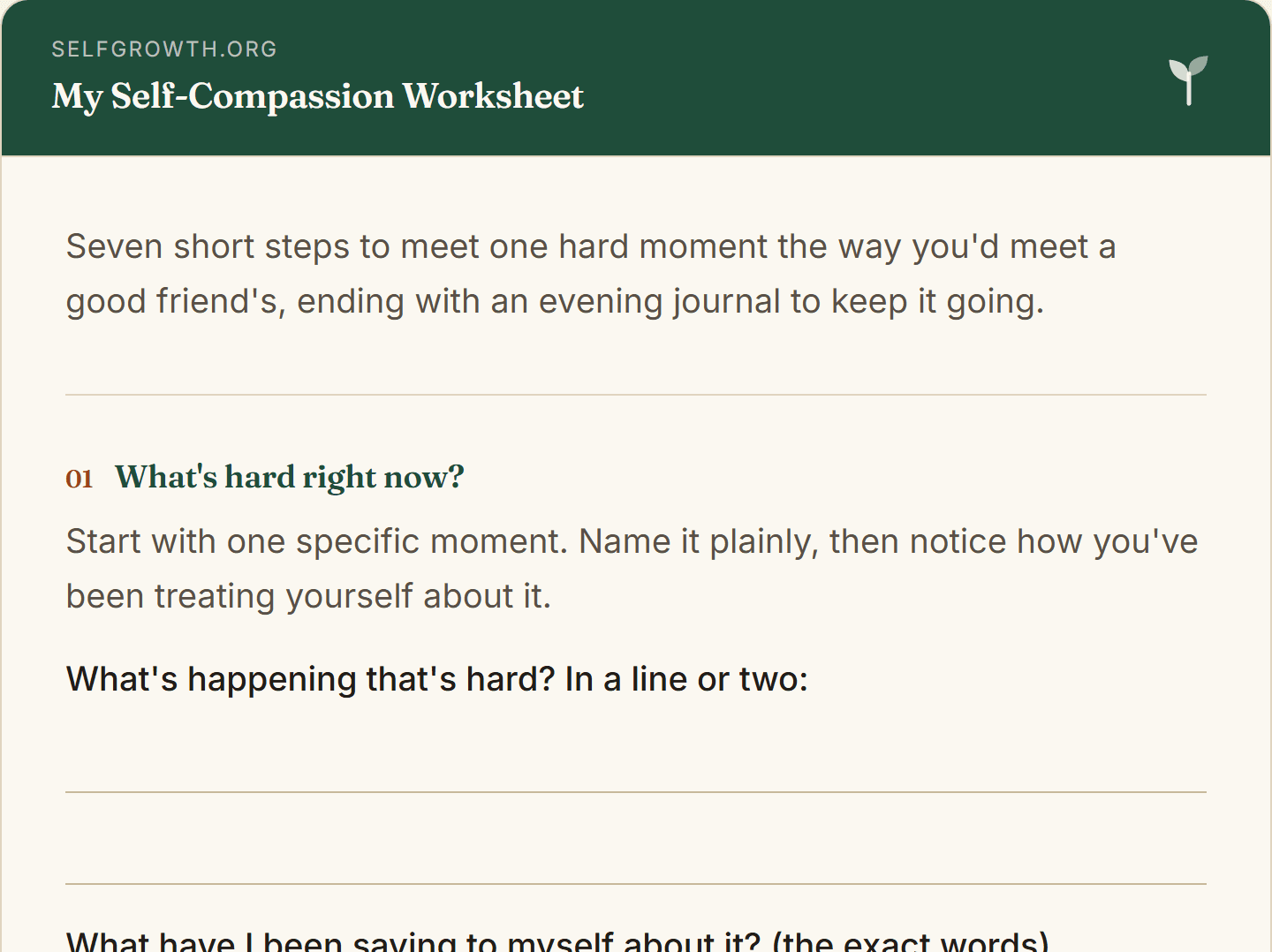
To practise the self-compassion break, the friend test, a kind letter and the evening journal on a real moment, use the self-compassion worksheet.
Open the Self-Compassion WorksheetIf a harsh inner voice is the main problem, start with the negative self-talk worksheet.
Open the Negative Self-Talk WorksheetAnd if you want to turn kindness into everyday care, like meeting your own needs and setting boundaries, try the self-love worksheet.
Open the Self-Love WorksheetWhen to get more support
Self-compassion is a helpful skill for ordinary hard times, but it isn't a fix for everything. If your inner voice is relentless or cruel, if you feel hopeless, or if you ever have thoughts of harming yourself, please reach out for real support. That isn't a sign you've failed at this.
Talk to your GP or family doctor, or a qualified mental health professional. Compassion-focused therapy was developed for people with high levels of shame and self-criticism, and your doctor can point you towards talking therapies. If you're in danger right now, call your local emergency number or a crisis line. These guides and worksheets are educational self-reflection tools, not therapy or medical advice.
How we put this together
This guide is written in plain language from established, evidence-based ideas, not personal opinion. It's an educational self-reflection resource, not therapy or medical advice, see our editorial standards.
If you want to go deeper
- Neff, K. D. (2003). Self-compassion: An alternative conceptualization of a healthy attitude toward oneself. Self and Identity, 2(2), 85-101. The paper that set out the three parts of self-compassion.
- Neff, K. D. Self-compassion exercises 1 to 6 (the friend test, the self-compassion break, the kind letter, supportive touch, changing critical self-talk and the self-compassion journal), self-compassion.org.
- Germer, C. & Neff, K. 'Working with Backdraft', self-compassion.org, on why old pain can surface when you first practise self-compassion.
- Gilbert, P. (2009). Introducing compassion-focused therapy. Advances in Psychiatric Treatment, 15(3), 199-208. On shame, self-criticism and the threat, drive and soothing systems.
- Breines, J. G. & Chen, S. (2012). Self-compassion increases self-improvement motivation. Personality and Social Psychology Bulletin, 38(9), 1133-1143.
- Neff, K. D. & Vonk, R. (2009). Self-compassion versus global self-esteem: Two different ways of relating to oneself. Journal of Personality, 77(1), 23-50.
- MacBeth, A. & Gumley, A. (2012). Exploring compassion: A meta-analysis of the association between self-compassion and psychopathology. Clinical Psychology Review, 32(6), 545-552.
- Neff, K. D. & Germer, C. K. (2013). A pilot study and randomized controlled trial of the Mindful Self-Compassion program. Journal of Clinical Psychology, 69(1), 28-44.
- Neff, K. D. (2023). Self-compassion: Theory, method, research, and intervention. Annual Review of Psychology, 74, 193-218. A recent review of the research.
Questions people ask
- What are the three parts of self-compassion?
- Kristin Neff describes three. Self-kindness: being warm and understanding with yourself instead of harshly critical. Common humanity: remembering that everyone struggles and gets things wrong, instead of feeling it's only you. Mindfulness: noticing painful feelings clearly, without pushing them away or getting swept up in them. The self-compassion break is a short exercise that takes you through all three.
- What is the self-compassion break?
- It's a short exercise from Kristin Neff for any stressful moment. You bring the situation to mind and say three things to yourself: 'This is a moment of suffering' (mindfulness), 'Suffering is a part of life' (common humanity) and 'May I be kind to myself' (self-kindness), often with a hand on your heart. You can swap in your own words, as long as you keep the three moves.
- Is self-compassion just self-pity, or letting yourself off the hook?
- No. Self-pity is 'why me?' thinking that cuts you off from others, while self-compassion reminds you that everyone struggles. And it doesn't excuse mistakes. Feeling safe enough to admit what went wrong makes it easier to take responsibility. In experiments by Breines and Chen (2012), people who were kind to themselves about a mistake were more motivated to make amends and improve, not less.
- What if self-compassion feels fake or uncomfortable?
- That's very common, especially if being hard on yourself has been the habit for years. Paul Gilbert, who developed compassion-focused therapy, found that people with a lot of shame and self-criticism often find warmth towards themselves hard to feel at first. Start small, use your own words, and try a hand on your heart, which your body can respond to even when your mind feels awkward. It gets easier with practice. Sometimes kindness also brings old pain up for a while. Neff and Germer call this 'backdraft', after the rush of flame when a door to a fire is opened. It's a known part of the process, not a sign you're doing it wrong. Go gently, come back to something steadying, and if old hurts keep flooding in, that's a good moment to get support.
- Is self-compassion the same as self-esteem?
- No. Self-esteem is how highly you rate yourself, and it tends to rise and fall with success and failure. Self-compassion is how you treat yourself, especially when things go wrong, and it doesn't depend on being better than anyone. In a study of more than 2,000 people, Neff and Vonk found that self-compassion went with steadier feelings of self-worth than self-esteem did.
- How long does it take to become more self-compassionate?
- There's no fixed timeline, and it varies from person to person. In one small trial, people who took an eight-week self-compassion course became more self-compassionate, and the change was still there a year later. Short, regular practice, like the self-compassion break on a hard day or a week of evening journaling, is a realistic way to start.
- Are these exercises free, and are they therapy?
- They're free, with no payment and no email needed, and the worksheet can be filled in online or printed. They're educational self-reflection tools, not therapy or medical advice. If you're struggling with depression, trauma or thoughts of harming yourself, please reach out to a GP or family doctor, a qualified professional or a crisis line.
Worksheets to do the work
Free to fill in online or print. No email needed.
Self-Compassion Worksheet
A free, printable self-compassion worksheet: the self-compassion break, the friend test, a kind letter and journal prompts, based on Kristin Neff's research.
Open worksheet
Negative Self-Talk Worksheet
A free, printable negative self-talk worksheet: catch a harsh inner-critic thought, check whether it's fair, and answer it with something true and kinder.
Open worksheet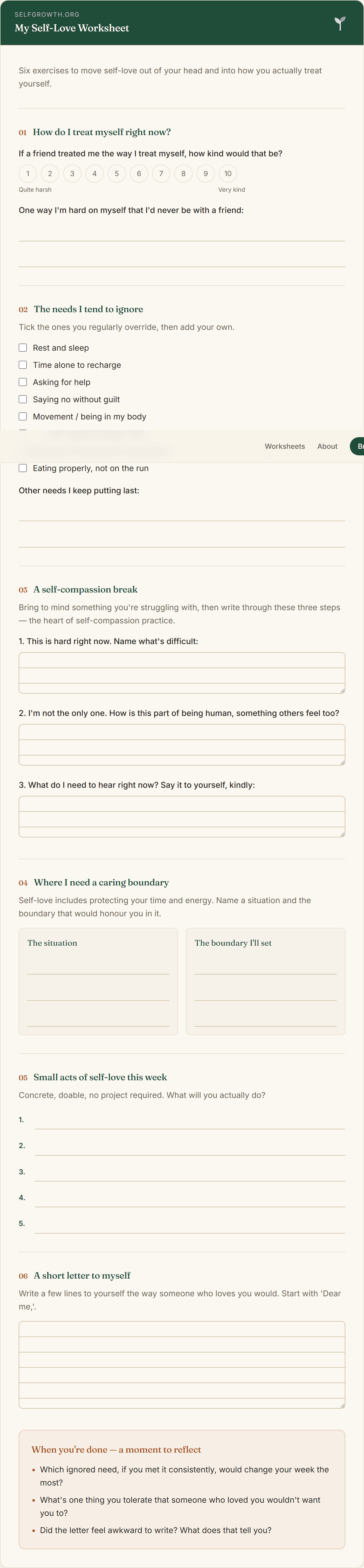
Self-Love Worksheet
A free, printable self-love worksheet that turns self-love from a vague idea into specific actions, meeting your needs, setting boundaries, and treating yourself with care.
Open worksheetRelated guides
New worksheets, straight to your inbox
An occasional new worksheet or tool, sent only when there's something genuinely worth your time. No spam, no pressure, unsubscribe any time.