
Guide
Am I a perfectionist? Signs, and how to ease it
Updated 17 October 2026 · 9 min read
Perfectionism means holding yourself to standards so high that nothing feels good enough. Signs include never feeling finished, harsh self-criticism after small slips and putting things off in case they aren't perfect. It's a pattern, not a diagnosis. Easing it starts with noticing your rules and choosing 'good enough' on purpose.
By the Self Growth team · drawn from perfectionism research and self-compassion · how we make these
You redo the email four times. You can't hand it in because it isn't quite right. You got ninety-nine things right today and your mind is on the one you didn't. And underneath, a worry: if this isn't perfect, what will people think of me?
If that sounds familiar, you may be a perfectionist. It's not a flaw in your character, and it isn't a sign something is wrong with you. It is a pattern that can cost you a lot of time, sleep and peace of mind. There's a free worksheet below if you'd like to try this on one task today.
What is perfectionism?
Perfectionism is holding yourself to standards so high that you almost never feel you've met them, and judging yourself harshly when you fall short. Wanting to do well is healthy. Perfectionism is when 'well' becomes 'flawless', and a mistake feels like proof that you're not good enough.
Psychologists Paul Hewitt and Gordon Flett argued in 1991 that perfectionism isn't one thing. They described three sides: self-oriented perfectionism (demanding perfection of yourself), other-oriented perfectionism (demanding it of other people) and socially prescribed perfectionism (feeling that other people demand it of you). You can be one, two or all three. It also helps to remember that perfectionism is a pattern, not a diagnosis. It isn't a mental illness in itself, and this guide can't tell you whether you have a condition.
Wanting to do well is not the problem. Never being allowed to be done is.
Signs of a perfectionist
Perfectionism can look like working hard, and sometimes it looks like doing nothing. You might recognise some of these:
- You rarely feel finished. You keep tweaking long after it's good enough.
- You put off starting, because you can't do it perfectly or aren't sure how to.
- Small mistakes bother you for days, and you replay them.
- You think in all-or-nothing terms: it's perfect or it's a failure.
- You find it hard to delegate, because others won't do it right.
- You talk to yourself in a way you'd never talk to a friend.
- You feel you have to earn rest, praise or love by getting things right.
- You hold back from things you might not be good at straight away.
- You expect the same of other people, and get irritated when they don't deliver.
None of these on its own means much. It's the pattern, and how much it costs you, that matters. If your inner voice is the loudest part, the guide to quieting your inner critic goes further.
Where does perfectionism come from?
We can't tell you what caused your perfectionism, and nobody can from a web page. We haven't found a single cause we can stand behind, so we won't give you a list that sounds certain. What we can offer are questions you might find useful.
- Whose voice do I hear when I think 'that isn't good enough'?
- When did I first learn that mistakes were a problem?
- Who am I trying to impress, or to avoid disappointing?
- What do I think would happen if I let something be average?
The third question matters because of Hewitt and Flett's idea of socially prescribed perfectionism. For some people, much of the pressure is felt as coming from other people, whether or not those people really expect it. Seeing that can take some of the weight off. The worksheet has a column for this.
How to ease perfectionism, step by step
You probably can't switch perfectionism off, and you don't need to. The aim is to loosen it, so that you choose your standards, rather than your standards choosing you.
- 1Notice the rule. Catch the 'must', 'should', 'always' or 'never', and write it down as it sounds in your head: 'I must never make a mistake.'
- 2Ask whose standard it is. Where did it come from, and who is it for? Would you hold a friend to it?
- 3Name the fear. Finish the sentence 'If this isn't perfect, I'm afraid that...', then ask how likely it is and how you'd cope if it happened.
- 4Pick one small task and define 'good enough' before you start. Be specific, so you'll know when you're done.
- 5Set a stop time and stop. Leave one small imperfection in place on purpose, such as sending a message after one read-through, and see what actually happens. Keep it to everyday tasks. If you notice strong urges to check, fix or repeat, or the task involves food, weight or exercise, stop and talk to your GP first.
- 6Answer a slip the way you would a friend's. Say something kind and honest, then carry on.
These steps are everyday ideas, not a tested treatment, and we know of no trial of this exact list. Step 6 draws on the same thinking as the guide to practising self-compassion, which explains how to be kind to yourself without lowering the bar for ever. It may also help to list what you're good at: the strengths list worksheet is a gentle place to start.
The free worksheet below walks you through these steps for one task of your own, and ends with a week's check.
Open the Perfectionism WorksheetWhat does research link perfectionism to?
It's worth knowing, so you can judge how much support you might want. A 2017 review by Karina Limburg and colleagues combined the results of 284 studies. It looked at two sides of perfectionism: setting very high standards for yourself (strivings), and worrying about mistakes and falling short (concerns). It tested links with depression, anxiety disorders, obsessive-compulsive disorder (OCD), eating disorders, self-harm and thoughts of suicide, and concluded that both sides are associated with various forms of mental health difficulty.
A link isn't a cause. It doesn't mean perfectionism leads to any of these. But it does explain why we suggest talking to someone if your perfectionism is tangled up with those difficulties.
When perfectionism might be something more
Perfectionism is a pattern you can work on. Sometimes it comes with something that deserves proper support.
- OCD. The NHS describes OCD as a mental health condition with obsessive thoughts and compulsive behaviours (repeated actions you feel you must do). If you keep checking, repeating or arranging things, or unwanted thoughts keep coming back and affect your daily life, speak to your GP.
- Eating disorders. The NHS describes an eating disorder as using the control of food to cope with feelings. If your perfectionism is tied up with your weight, food or exercise, see a GP as soon as you can. In the UK, the eating disorders charity Beat (helpline 0808 801 0677, as listed by the NHS) offers confidential support.
- Depression or anxiety. If you feel low, flat, hopeless or constantly on edge, that deserves attention in its own right, so speak to your GP.
Only a qualified professional can say whether any of these apply, and this guide can't. You don't need to be sure before you go. Our helplines and therapist directory lists where to start in several countries.
When to get more support
This guide and the worksheet are self-help tools, not therapy or medical advice. Perfectionism that is strong, or has been with you for years, may need more than a page to fill in. In one 2019 trial, 120 people whose perfectionism was at a clinical level (strong enough to be treated as a problem) were given either a guided online CBT (cognitive behavioural therapy) programme or a place on a waiting list. Those on the programme had fewer OCD and eating disorder symptoms and better self-esteem, and the drop in OCD and eating disorder symptoms was still there at a follow-up 24 weeks after the start (Kothari and colleagues). The same research group reported earlier that this programme did not change symptoms of depression or anxiety. It's one study, and a structured programme is much more than this page, but it shows that proper help exists and can work.
A GP can talk through what's going on and point you towards talking therapies. If you ever feel hopeless or have thoughts of harming yourself, please contact a crisis line straight away: Samaritans on 116 123 in the UK, 988 in the US, or findahelpline.com for other countries.
How we put this together
This guide is written in plain language and draws on research into perfectionism. Where a finding comes from one study, or from links rather than experiments, we say so. The steps are everyday ideas, not a tested treatment. It's an educational self-reflection resource, not therapy or medical advice, see our editorial standards.
If you want to go deeper
- Hewitt, P. L. & Flett, G. L. (1991). Perfectionism in the self and social contexts: Conceptualization, assessment, and association with psychopathology. Journal of Personality and Social Psychology, 60(3), 456-470.
- Limburg, K., Watson, H. J., Hagger, M. S. & Egan, S. J. (2017). The relationship between perfectionism and psychopathology: A meta-analysis. Journal of Clinical Psychology, 73(10), 1301-1326.
- Kothari, R., Barker, C., Pistrang, N. and colleagues (2019). A randomised controlled trial of guided internet-based cognitive behavioural therapy for perfectionism: Effects on psychopathology and transdiagnostic processes. Journal of Behavior Therapy and Experimental Psychiatry, 64, 113-122.
- NHS. Obsessive compulsive disorder (OCD) and Eating disorders (nhs.uk).
Your questions, answered
- What is perfectionism?
- Perfectionism is holding yourself to standards so high that nothing feels good enough, and fearing mistakes more than a situation calls for. It's a pattern, not a diagnosis. Psychologists Paul Hewitt and Gordon Flett described three sides: demanding perfection of yourself, demanding it of others, and feeling that others demand it of you.
- What are the signs of a perfectionist?
- Common signs include rarely feeling finished, putting things off in case they aren't perfect, replaying small mistakes, all-or-nothing thinking, finding it hard to delegate, talking to yourself harshly and feeling you have to earn rest or praise. It's the pattern and the cost that matter, not any single sign.
- Is perfectionism a mental illness?
- No, perfectionism on its own isn't a diagnosis. But research links it to other problems: a review of 284 studies found both kinds of perfectionism it looked at were associated with various forms of mental health difficulty, and tested links with depression, anxiety, OCD and eating disorders. A link isn't a cause. If yours comes with repeated checking, rituals or controlling food, speak to a GP.
- How do I stop being a perfectionist?
- You probably can't switch it off, but you can loosen it. Notice your rules, ask whose standard they are, name the fear underneath, define 'good enough' before you start a task, stop when you get there and answer slips the way you would a friend's. The free worksheet takes you through this for one task.
- Is perfectionism a good or bad thing?
- It depends what you mean. Wanting to do well is healthy and can help you. It becomes a problem when the standards feel impossible to meet, mistakes bring harsh self-criticism, and the cost, in time, sleep, relationships or peace of mind, outweighs the benefit. The worksheet has a section for sorting standards worth keeping from ones to loosen.
- Is there a free perfectionism worksheet?
- Yes. The free perfectionism worksheet helps you spot where it shows up, name your rules and fears, set a 'good enough' line for one task and practise a kinder reply. You can fill it in on screen or print it, with no payment and no email needed.
- Is this guide a substitute for therapy?
- No. It's an educational self-help guide, not therapy or medical advice. If perfectionism is seriously affecting your health, work or relationships, or comes with OCD, an eating disorder, low mood or anxiety, talk to a GP. If you ever have thoughts of harming yourself, contact a crisis line: Samaritans on 116 123 in the UK, 988 in the US, or findahelpline.com.
Worksheets to do the work
Free to fill in online or print. No email needed.
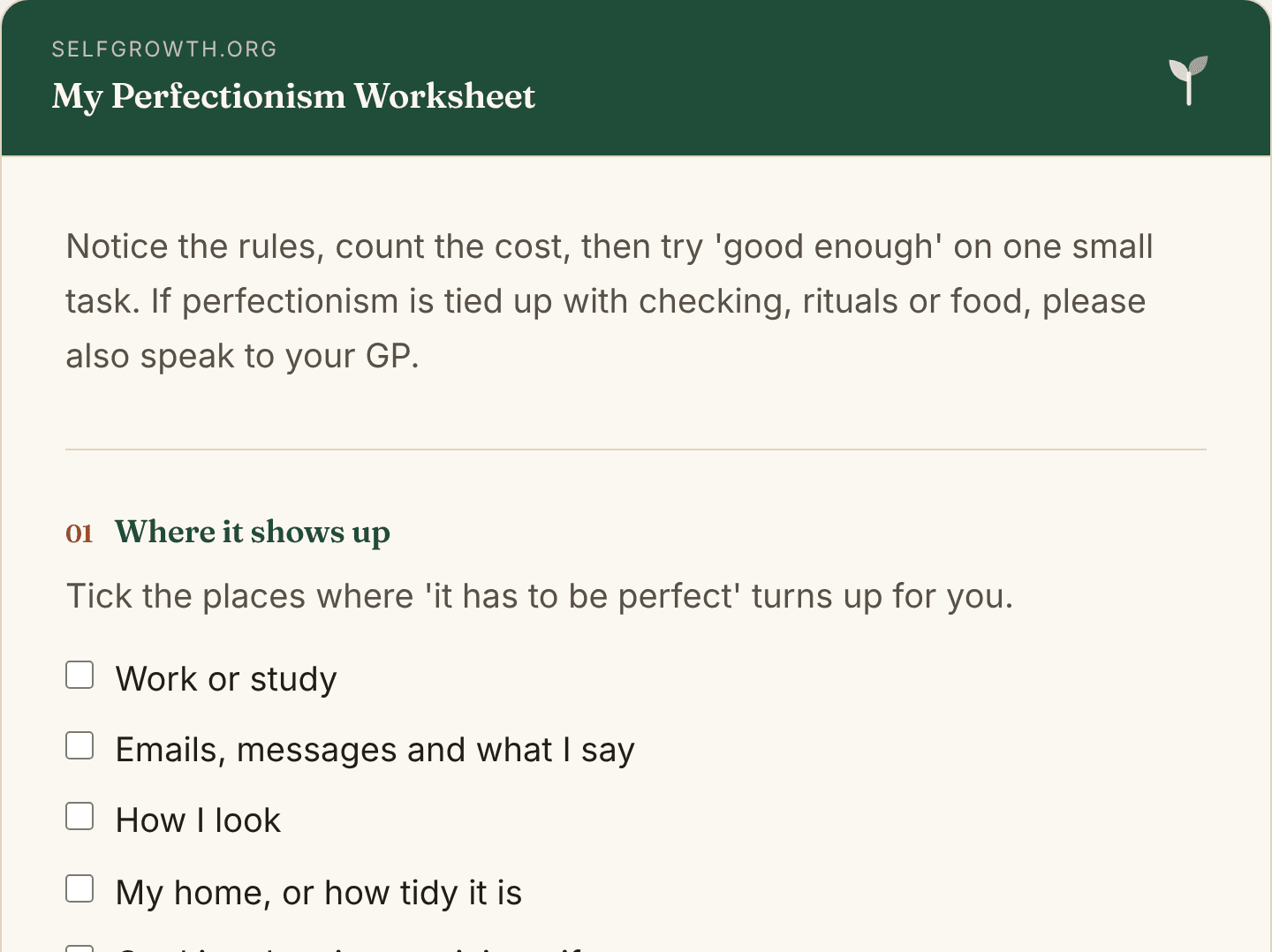
Perfectionism Worksheet
A free perfectionism worksheet: spot where it shows up, name the rules behind it, set a 'good enough' line for one task and practise a kinder reply. Free PDF.
Open worksheet
Negative Self-Talk Worksheet
A free, printable negative self-talk worksheet: catch a harsh inner-critic thought, check whether it's fair, and answer it with something true and kinder.
Open worksheet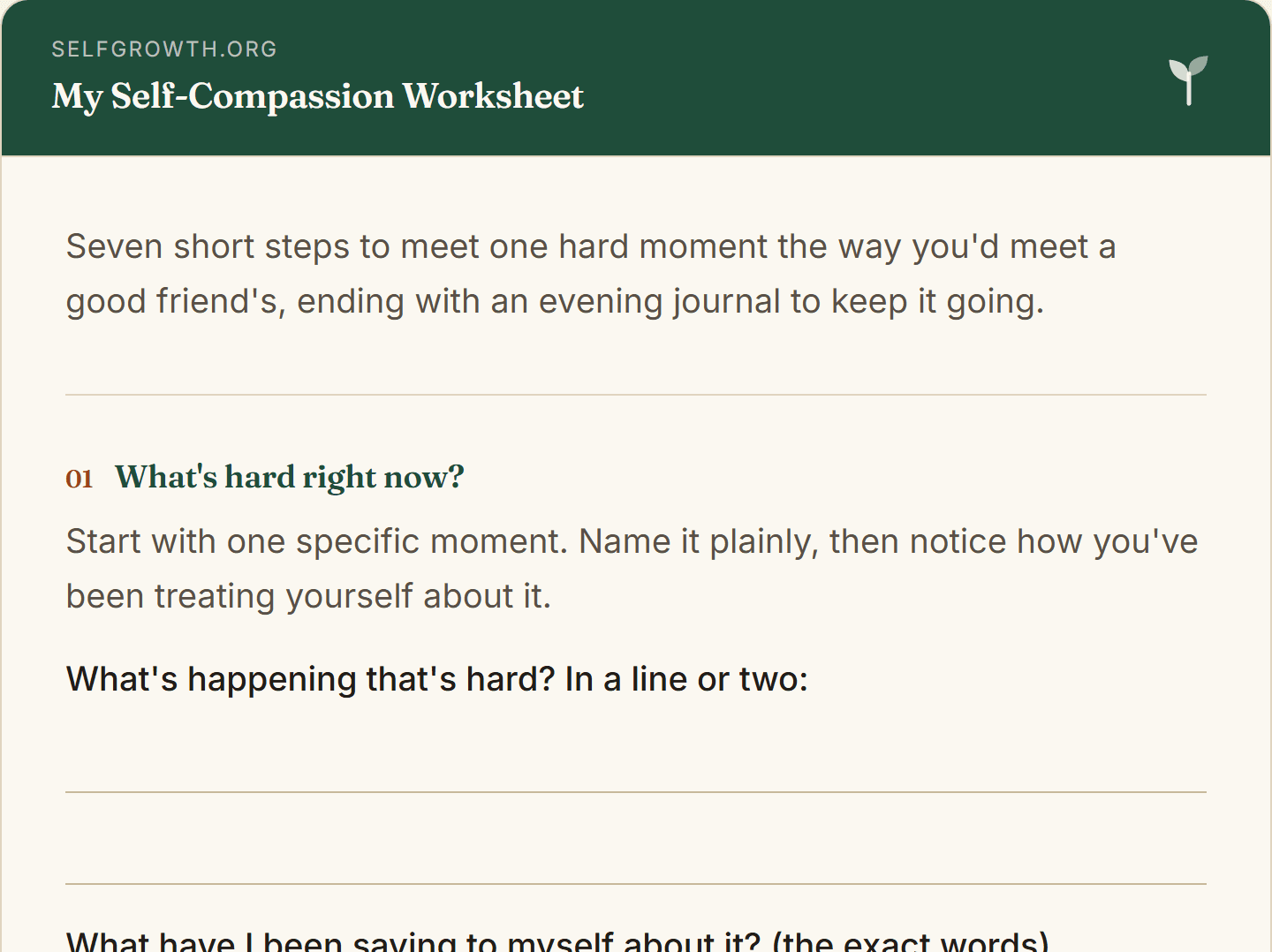
Self-Compassion Worksheet
A free, printable self-compassion worksheet: the self-compassion break, the friend test, a kind letter and journal prompts, based on Kristin Neff's research.
Open worksheet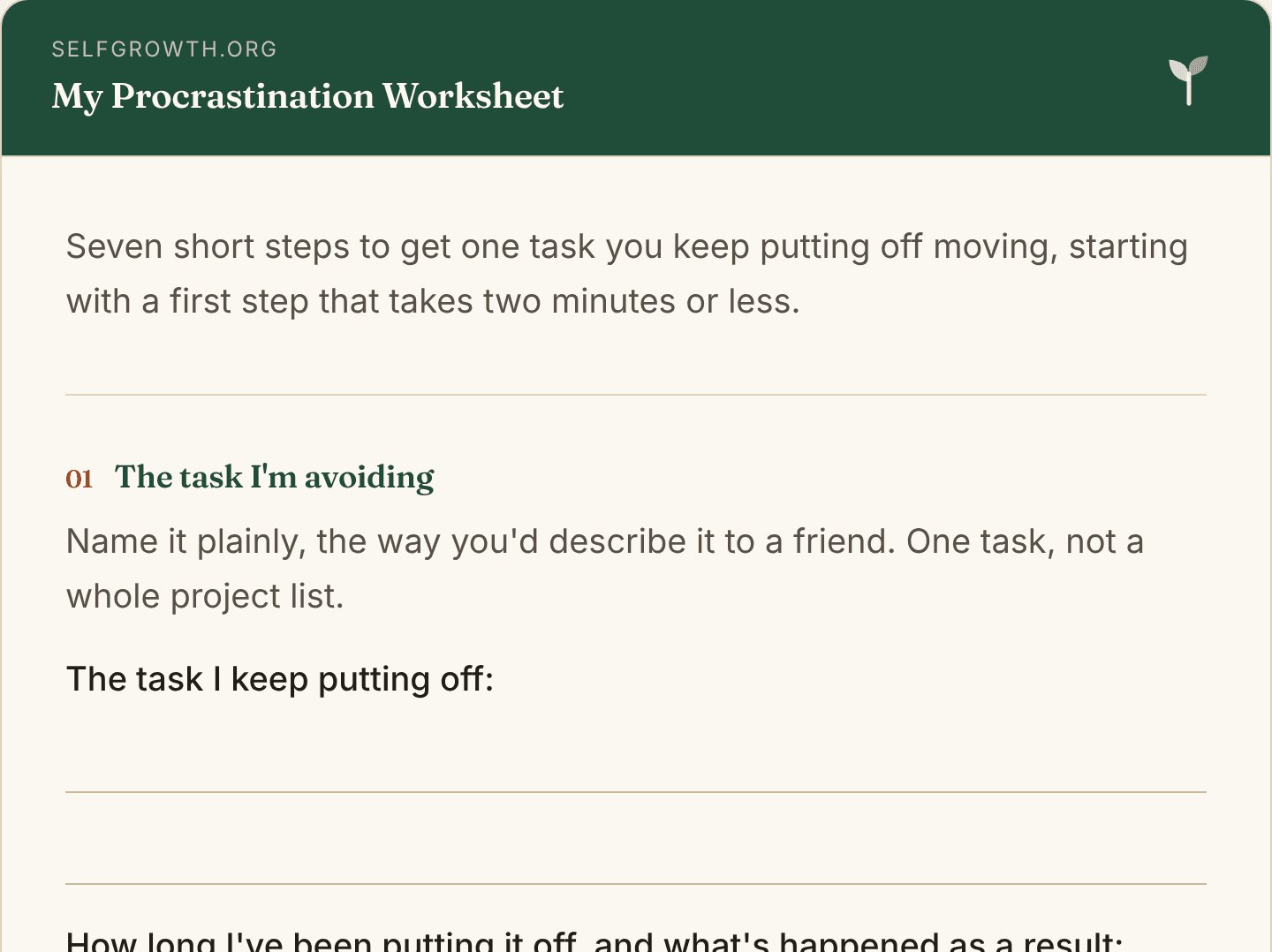
Procrastination Worksheet
A free, printable procrastination worksheet: name the feeling you're avoiding, find a two-minute first step, make an if-then plan and log seven days of starts.
Open worksheetRelated guides
New worksheets, straight to your inbox
An occasional new worksheet or tool, sent only when there's something genuinely worth your time. No spam, no pressure, unsubscribe any time.