
Guide
How to stop procrastinating
Updated 11 October 2026 · 10 min read
To stop procrastinating, deal with the feeling, not just the clock. Procrastination is often a way to escape a task that feels boring, overwhelming or risky. Name that feeling, shrink the task to a two-minute first step, decide exactly when and where you'll start, and forgive yourself when you slip. Then begin again.
By the Self Growth team · drawn from procrastination research, implementation intentions and self-forgiveness research · how we make these
You know the task matters. You might even want to do it. And yet you find yourself tidying a drawer, checking your phone again, or promising that tomorrow will be different. Afterwards comes the guilt, and the task feels even heavier than before.
If that sounds like you, it doesn't mean you're lazy or hopeless. Procrastination is a very human habit, and it makes more sense once you see what it's doing for you. This guide explains why it happens, how to spot it, and what actually helps you start. The free worksheet below takes one task you're putting off and turns it into a plan you can do today.
Why do I procrastinate?
Procrastination looks like a time problem, but it's often a feelings problem. When a task brings up something unpleasant, putting it off makes that feeling go away for now. That relief is real, and it's why the habit is so hard to break: your brain gets a small reward every time you avoid the thing.
Researchers Fuschia Sirois and Timothy Pychyl make this case in a 2013 review. They argue that procrastination is less about laziness or poor time management, and more about repairing your mood in the short term. You feel better now, and the cost lands on your future self, who has less time and more stress.
Procrastination isn't a character flaw. It's a way of getting away from a feeling.
The feelings vary. A task might be boring. It might be so big you don't know where to start. You might be afraid of doing it badly, or of being judged. You might resent having to do it at all. Naming which one it is turns a vague 'I can't make myself' into something you can work with. If you find feelings hard to name, the feelings wheel can help.
A large 2007 review by Piers Steel backs up part of this picture. It was a meta-analysis (a study that pools the results of many studies), bringing together 691 results from earlier research. Some of the strongest, most consistent links were with a task that feels unpleasant, a deadline or reward that's far off, low confidence that you can do it, a habit of acting on impulse, and lower self-control, being easily distracted and being less organised. These are links, not proof of cause, but they point to the same places this guide works on.
Signs of procrastination
Procrastination doesn't always look like doing nothing. Often it looks like being busy with the wrong things. You might recognise some of these:
- You keep moving the same task to tomorrow's list.
- You do easier jobs first (emails, tidying, errands) so the hard one never gets a turn.
- You wait until you 'feel like it', and the feeling doesn't come.
- You only start when the deadline is close enough to scare you.
- You open the task, feel a jolt of dread, and close it again.
- You spend more time planning, researching or getting ready than doing.
- You feel guilty or anxious about the task even while you're relaxing.
- You tell yourself you work better under pressure, but the last-minute rush leaves you drained.
If putting things off is one part of a wider habit of getting in your own way, such as quitting near the finish line or picking fights before something good happens, the self-sabotage worksheet looks at those patterns more broadly.
How to stop procrastinating, step by step
You don't need more willpower. You need a task that feels small enough to start, a clear moment to start it, and a kinder way to handle the days it doesn't happen.
- 1Pick one task. Not your whole to-do list, just the one thing you've been putting off longest or that's costing you most.
- 2Name the feeling. Ask what you're avoiding: boredom, overwhelm, fear of doing it badly, resentment, or not knowing where to start. Write it down in a few words.
- 3Shrink it to a two-minute first step. Make it so small it feels almost silly, such as opening the document and writing one heading, or finding the form and putting it on the table.
- 4Make an if-then plan. Decide exactly when and where you'll take that first step: 'If it's 9am and I've made my coffee, then I'll open the report and write the first heading.'
- 5Remove one friction and add one helper. Put your phone in another room, close the extra tabs, or lay out what you need the night before. Then add something that makes starting easier, like a ten-minute timer or working alongside someone.
- 6Forgive yourself when you slip, and restart. If the plan doesn't happen, say something kind and honest to yourself, and set the next start time. A slip is information, not a verdict.
Step 4 has some of the strongest evidence behind it. Psychologist Peter Gollwitzer calls these plans 'implementation intentions'. In a 1999 paper, he set out how deciding in advance 'when this happens, I'll do that' lets the moment itself prompt the action, so you don't have to rely on remembering or feeling motivated. A 2006 review by Gollwitzer and Paschal Sheeran pooled 94 independent tests and found that if-then plans made a medium-to-large difference to reaching goals. Those studies cover a range of goals, not procrastination alone, so treat it as a strong lead rather than a guarantee.
Step 6 may feel like the soft option, but there's research behind it too. In a 2010 study, Michael Wohl, Timothy Pychyl and Shannon Bennett followed first-year university students across two rounds of exams. Students who had forgiven themselves for procrastinating before the first exams felt less negative afterwards, and procrastinated less before the second exams. It's one study of students, and it shows a link rather than proof, but it fits the bigger picture: if procrastination is about escaping bad feelings, piling on more guilt gives you one more thing to escape. The self-forgiveness worksheet and the guide to self-compassion go deeper on being kind to yourself without letting yourself off the hook.
Here's what it can look like. Say you've been putting off a tax return for three weeks. You notice the feeling is overwhelm, plus a fear you'll get it wrong. Your two-minute step is finding last year's login and writing it on a sticky note. Your plan is: 'If it's Saturday and I've had breakfast, then I'll sit at the kitchen table and log in.' You leave your phone charging upstairs. On Saturday you log in, look at the first page, and stop after ten minutes. That still counts. Next time the first step is the second page.
The free worksheet below walks you through these steps for one task of your own, and ends with a seven-day log so you can see what helps.
Open the Procrastination WorksheetCommon procrastination mistakes
Some of the most familiar ways of fighting procrastination quietly make it worse:
- Waiting to feel motivated. Motivation often shows up after you start, not before. The two-minute step is there so you don't need it.
- Making the task bigger. 'Sort my whole life out this weekend' is easier to avoid than 'reply to one email'.
- Being harsh with yourself. Calling yourself lazy adds shame to whatever you were already avoiding, so the task feels worse, not better. If that voice is loud, the guide to quieting your inner critic can help.
- Planning instead of starting. A colour-coded schedule can feel productive while the task itself stays untouched.
- Relying on deadline panic. A close deadline can force you to start, but it often leaves less time to do the work well and more stress while you do it.
- Trying to fix everything at once. Work on one task until starting it feels easier, then use the same steps on the next.
When procrastination might be something more
For most of us, procrastination is a common habit, not a sign that anything is wrong. But sometimes trouble getting started is part of something that deserves proper support.
- ADHD. The NHS lists finding it hard to organise your time and finding it hard to follow instructions or finish tasks among the signs in adults. If that has been true for you for as long as you can remember, across work, home and relationships, it may be worth asking about.
- Depression. Having no motivation or interest in things, and finding it difficult to make decisions, are among the symptoms the NHS lists. If you've also felt low, hopeless or flat for weeks, it's worth talking to someone.
- Anxiety. If the fear around a task is intense, or you avoid many situations because of worry, procrastination may be one part of a bigger anxiety pattern.
Only a qualified professional can tell you whether any of these apply, and this guide can't. If any of them sound familiar, a GP or family doctor is a good first step. You don't need to be sure before you go.
When to get more support
This guide and the worksheet are self-help tools, not therapy or medical advice. If putting things off is affecting your job, your studies, your money or your health, or if the guilt around it is making you feel worthless, you deserve more than a page to fill in.
A GP can talk through what's going on and point you towards talking therapies, or an assessment if something like ADHD or depression might be part of it. If you ever feel hopeless or have thoughts of harming yourself, please contact a crisis line straight away: Samaritans on 116 123 in the UK, 988 in the US, or findahelpline.com for other countries.
How we put this together
This guide is written in plain language and draws on research into procrastination, if-then planning and self-forgiveness. Where a finding comes from one study or from links rather than experiments, we say so. It's an educational self-reflection resource, not therapy or medical advice, see our editorial standards.
If you want to go deeper
- Sirois, F. & Pychyl, T. (2013). Procrastination and the priority of short-term mood regulation: Consequences for future self. Social and Personality Psychology Compass, 7(2), 115-127.
- Steel, P. (2007). The nature of procrastination: A meta-analytic and theoretical review of quintessential self-regulatory failure. Psychological Bulletin, 133(1), 65-94.
- Wohl, M. J. A., Pychyl, T. A. & Bennett, S. H. (2010). I forgive myself, now I can study: How self-forgiveness for procrastinating can reduce future procrastination. Personality and Individual Differences, 48(7), 803-808.
- Gollwitzer, P. M. (1999). Implementation intentions: Strong effects of simple plans. American Psychologist, 54(7), 493-503.
- Gollwitzer, P. M. & Sheeran, P. (2006). Implementation intentions and goal achievement: A meta-analysis of effects and processes. Advances in Experimental Social Psychology, 38, 69-119.
- NHS. ADHD in adults (nhs.uk/conditions/adhd-adults); Symptoms of depression in adults (nhs.uk/mental-health/conditions/depression-in-adults/symptoms).
Your questions, answered
- Why do I procrastinate even on things I want to do?
- Because wanting the result isn't the same as wanting the feeling of starting. Even a task you care about can bring up fear of doing it badly, overwhelm, or not knowing where to begin. Putting it off makes that feeling go away for a while. Researchers Sirois and Pychyl describe procrastination as short-term mood repair: you feel better now, and your future self pays for it.
- What are the signs of procrastination?
- Common signs include moving the same task to tomorrow again and again, doing easy jobs first so the hard one never gets a turn, waiting until you 'feel like it', only starting when the deadline is close, spending more time planning than doing, and feeling guilty about the task even while you relax.
- Is procrastination a sign of laziness?
- No. Laziness means not wanting to make an effort. If you procrastinate, you're often working hard, just not on the thing you're avoiding, and you probably feel bad about it. Research suggests procrastination is more about managing difficult feelings than about effort or character.
- How do I stop procrastinating right now?
- Pick the one task, name the feeling you're avoiding, and shrink it to a step that takes two minutes or less, such as opening the file and writing one line. Put your phone in another room and do just that step. If you keep going, great. If you stop, you've still started, and the next step is easier.
- Can procrastination be a sign of ADHD or depression?
- It can be part of them, but on its own it isn't a sign of either. The NHS lists finding it hard to organise your time or finish tasks among the signs of ADHD in adults, and having no motivation or interest in things among the symptoms of depression. If that sounds like you, especially over a long time, talk to a GP. Only a qualified professional can assess it.
- Is there a free procrastination worksheet?
- Yes. The free procrastination worksheet takes one task you're putting off through the steps in this guide: the feeling you're avoiding, a two-minute first step, an if-then plan, a kind reply for when you slip and a seven-day log. You can fill it in on screen or print it, with no payment and no email needed.
- Is this guide a substitute for therapy?
- No. It's an educational self-help guide, not therapy or medical advice. If procrastination is seriously affecting your work, studies or health, or you think something like ADHD, depression or anxiety might be involved, talk to a GP. If you ever have thoughts of harming yourself, contact a crisis line: Samaritans on 116 123 in the UK, 988 in the US, or findahelpline.com.
Worksheets to do the work
Free to fill in online or print. No email needed.
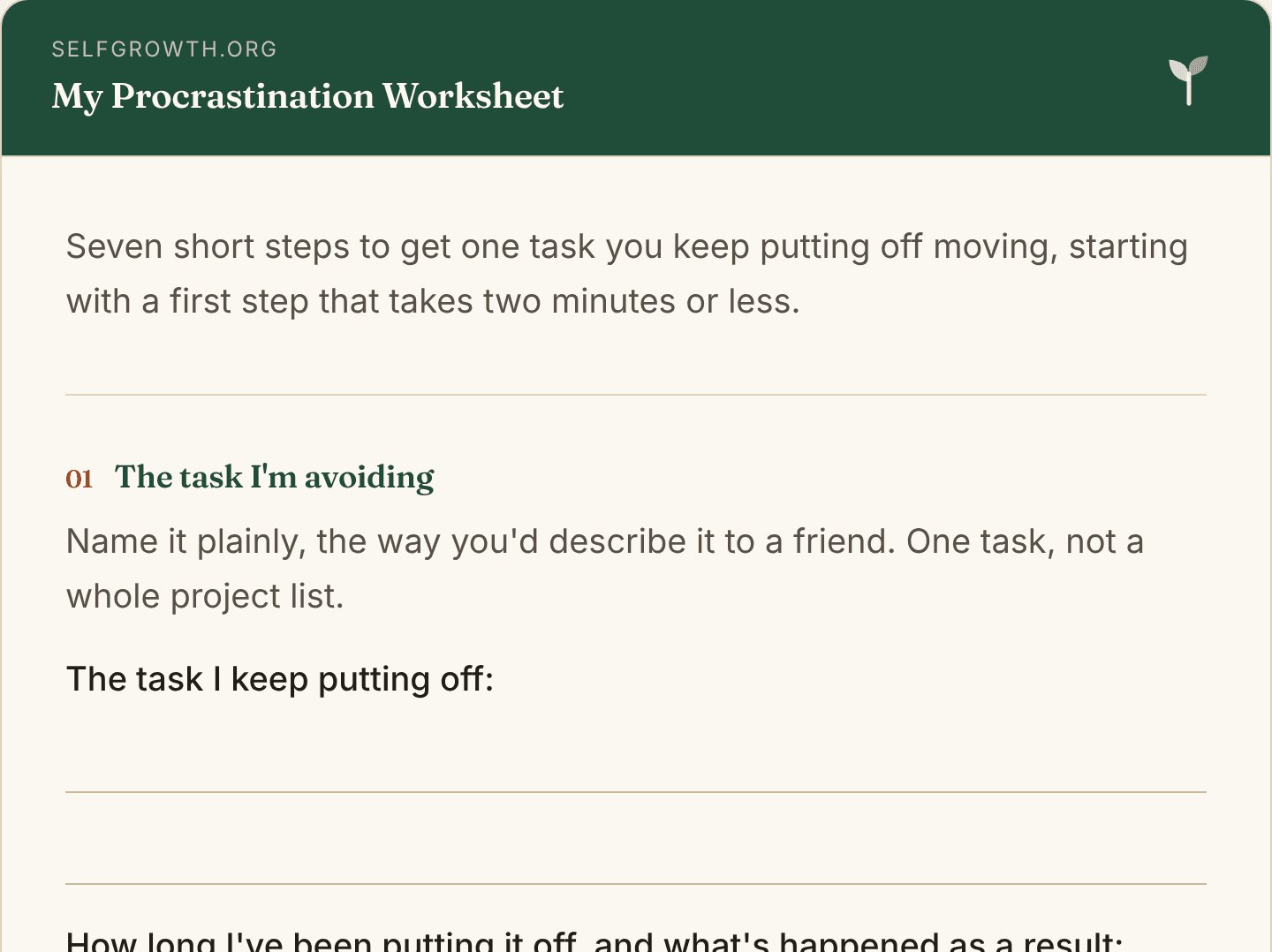
Procrastination Worksheet
A free, printable procrastination worksheet: name the feeling you're avoiding, find a two-minute first step, make an if-then plan and log seven days of starts.
Open worksheet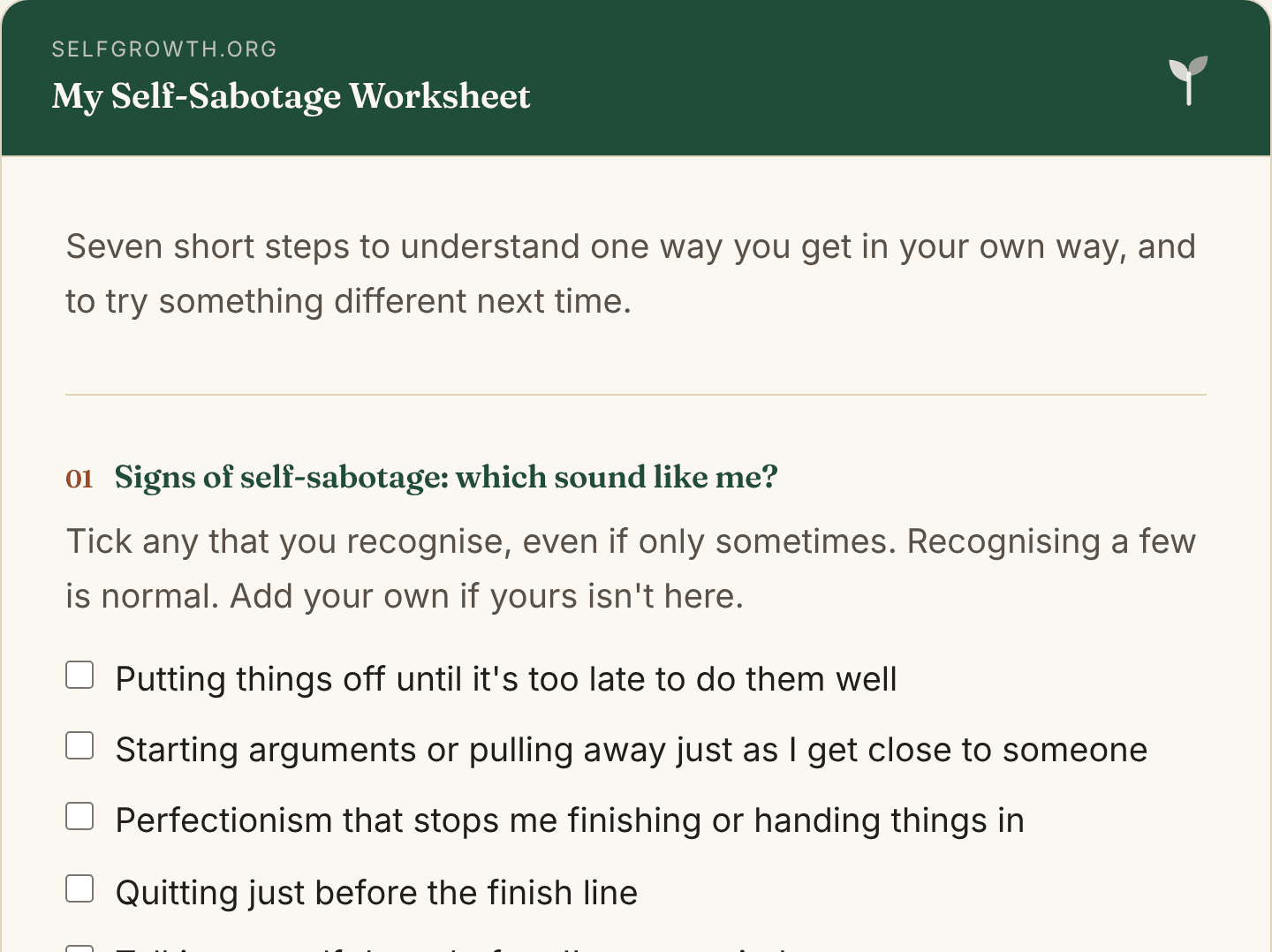
Self-Sabotage Worksheet
A free, printable self-sabotage worksheet: spot the signs, see what the habit protects you from and what it costs, find the belief under it, and plan next time.
Open worksheet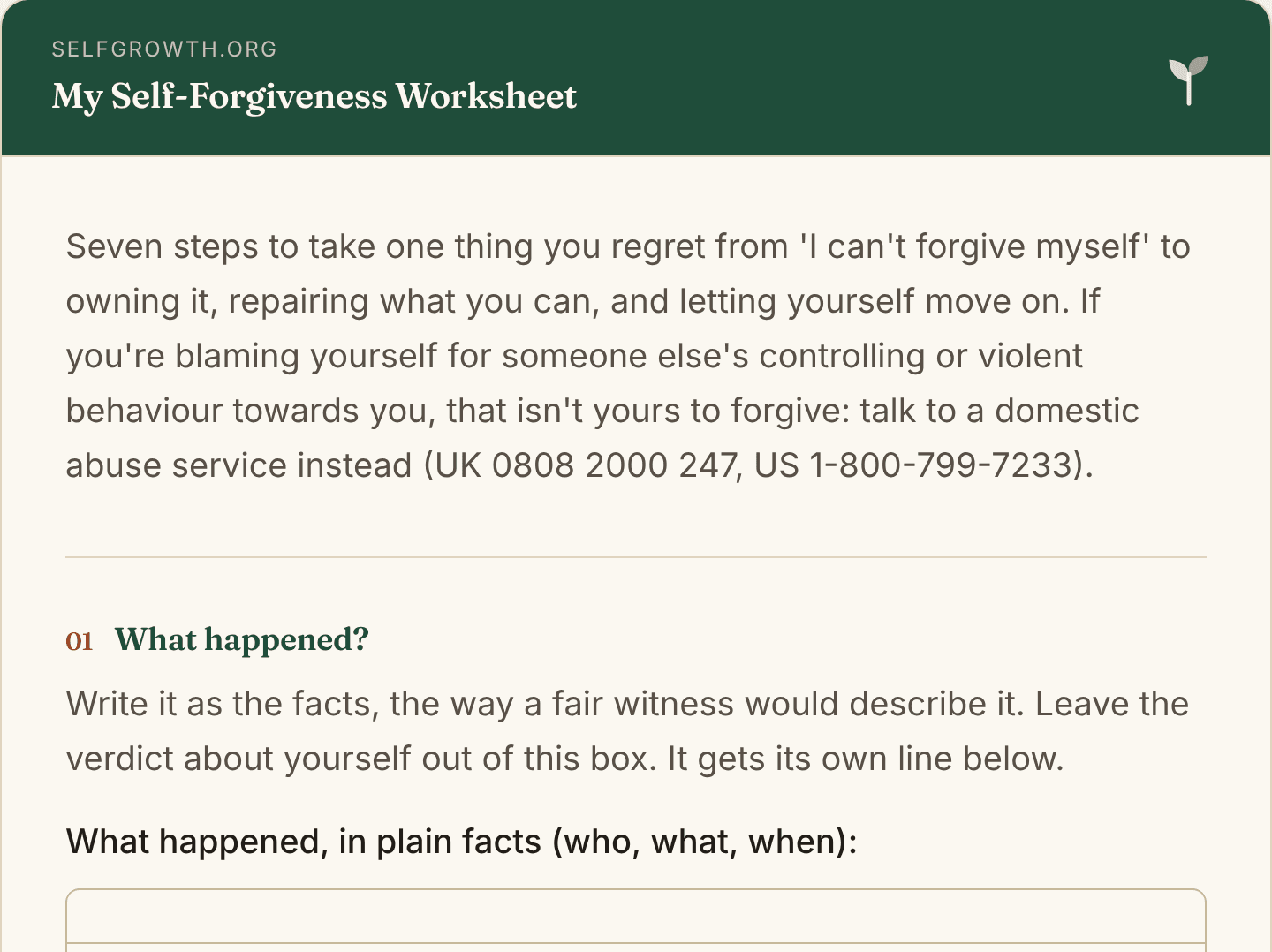
Self-Forgiveness Worksheet
A free, printable self-forgiveness worksheet for adults: own your part, tell guilt from shame, make amends where you can, and write a letter forgiving yourself.
Open worksheet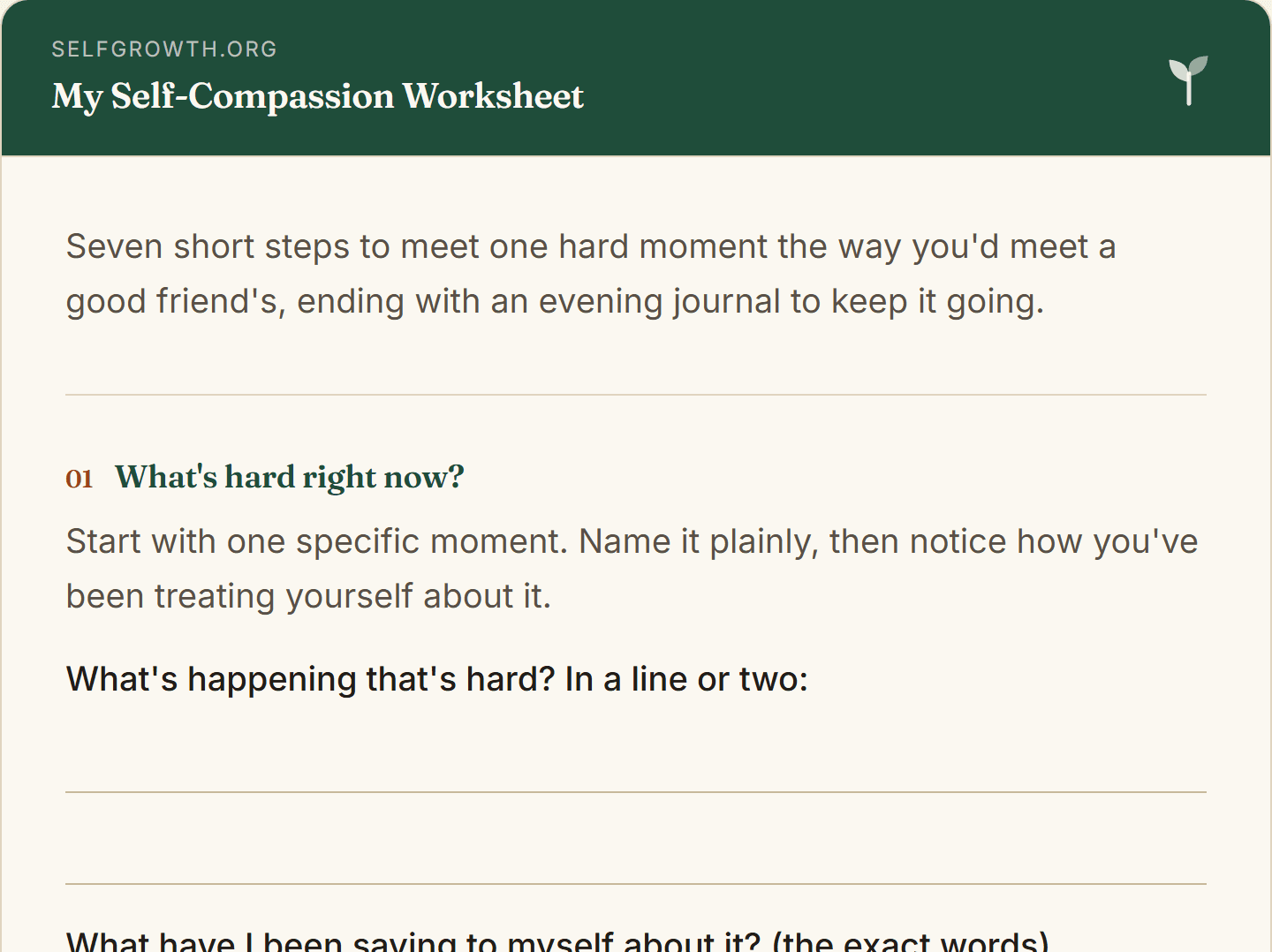
Self-Compassion Worksheet
A free, printable self-compassion worksheet: the self-compassion break, the friend test, a kind letter and journal prompts, based on Kristin Neff's research.
Open worksheetRelated guides
New worksheets, straight to your inbox
An occasional new worksheet or tool, sent only when there's something genuinely worth your time. No spam, no pressure, unsubscribe any time.