
Guide
How to build good habits that stick
Updated 11 October 2026 · 11 min read
To build a good habit, choose one small action, tie it to something you already do every day ('after I put the kettle on, I'll stretch'), and repeat it in the same place. In Phillippa Lally's 2010 study, the middle figure was 66 days (range 18 to 254), and missing a single day didn't undo it.
By the Self Growth team · drawn from habit-formation and implementation-intention research · how we make these
Most of us don't struggle to know which habits would help. You probably already know you'd feel better walking more, reading before bed or drinking more water. The hard part is the gap between knowing and doing, day after day, when you're tired and nobody's watching.
Habits don't run on willpower. They're built on repetition in the same situation, until the situation starts to do the remembering for you. This guide explains how that works, how long it honestly takes, and the small steps that make a new habit more likely to last. The free habit tracker below gives you somewhere to keep it going.
What is a habit?
A habit is something you do with little thought because a familiar situation sets it off. It has three parts: a cue (the moment or place that sets it off), a routine (the thing you do), and the context it lives in (the same time, place or preceding action, again and again). Brushing your teeth after breakfast, reaching for your phone in a queue, putting the kettle on when you get home.
Psychologists Wendy Wood and Dennis Rünger, in a 2016 review of habit research, say habits form when you do the same thing in the same situation, again and again. Over time the link between the situation and the action gets stronger, so the situation alone starts to prompt the action. You stop having to decide.
A habit is a decision your surroundings make for you, after you've made it enough times yourself.
Habits are a bigger part of everyday life than it feels. The same review describes an earlier study by Wood and colleagues in which people noted what they were doing once an hour. About 43% of their actions were done almost daily, usually in the same context. That's why changing the situation, not just your intentions, is so useful.
How long does it take to form a habit?
Often longer than the 21 days you may have heard, and it varies a lot from person to person. The best-known study is by Phillippa Lally and colleagues at University College London, published in 2010 in the European Journal of Social Psychology.
They asked 96 volunteers to pick one eating, drinking or activity habit, such as drinking a bottle of water with lunch, and do it daily after the same cue for 12 weeks. Each day, people rated how automatic the habit felt. For the 39 people whose results fitted the researchers' model well, the middle figure for the habit to get close to as automatic as it was going to get for them was 66 days. The range was 18 to 254 days.
A few honest caveats. The volunteers were recruited at a university, so they're not everyone. The study ran for 84 days, so the longest times were estimates of where each person's curve was heading, not days anyone actually counted. And in their discussion, the authors note that roughly half the people didn't do their habit consistently enough for it to become a habit at all, even though they'd volunteered to try. The exercise habits took about one and a half times longer than the eating and drinking ones, though the study wasn't large enough to be sure of that difference.
What this means for you: expect weeks or months, not days. Simple habits may settle faster than complex ones. And if it still feels like effort at day 30, nothing is wrong with you. You're on the curve.
How to build a good habit, step by step
You don't need a new morning routine or a total life overhaul. You need one small action, tied to a moment you already meet every day, and somewhere to notice that you did it.
- 1Choose one habit. Pick the one that would make the biggest difference to your week, and leave the others for later.
- 2Make it small. Shrink it until you could do it on your worst day: two pages, not a chapter; shoes on and out the door, not a 5k.
- 3Tie it to a cue you already have. Pick something you do every day without fail, such as making coffee, brushing your teeth or sitting down on the train.
- 4Write it as a plan: 'After I [cue], I will [tiny habit].' For example, 'After I pour my morning coffee, I'll write one line in my journal.'
- 5Keep the place and time the same. The more the situation repeats, the more it can start to prompt the action for you.
- 6Make it easy to start. Put the book on your pillow, the trainers by the door, the water bottle on your desk.
- 7Notice each time you do it. A tick on a paper tracker is enough.
- 8If you miss a day, start again at the next cue. One miss doesn't reset anything.
Steps 3 and 4 have some of the strongest evidence. Psychologist Peter Gollwitzer calls these if-then plans 'implementation intentions'. In a 1999 paper in American Psychologist, he set out how deciding in advance 'when this happens, I'll do that' lets the moment itself prompt the action, so you don't have to rely on remembering or feeling motivated. A 2006 review by Gollwitzer and Paschal Sheeran pooled 94 independent tests and found a medium-to-large effect of these plans on reaching goals.
Here's what that can look like. Say you want to read more. Instead of 'read every night', you decide: 'After I plug my phone in to charge, I'll read two pages in bed.' You leave the book on your pillow. Some nights you read twenty pages, some nights two. Both count. After a few weeks, plugging in your phone starts to feel like the start of reading time.
The free tracker below helps you set up one to three habits like this, with a cue, a tiny version and a simple month-long grid to tick.
Open the Habit Tracker PrintableWhat is habit stacking?
Habit stacking means attaching a new habit to one you already have, so the old one becomes the cue: 'After I brush my teeth, I'll floss one tooth.' It's the same idea as step 4 above. Writer James Clear popularised the name in his book Atomic Habits, and he credits behaviour scientist BJ Fogg, who calls it anchoring in his Tiny Habits method.
It fits what habit research finds. Wood and Rünger's review describes studies that used tooth brushing as the cue to help people build a flossing habit. The trick is choosing an anchor that really does happen every day, at a fairly fixed time and place. 'After I check my email' is a weak anchor if you check it forty times a day. 'After I sit down at my desk in the morning' is a strong one.
If you'd like to read Atomic Habits, it's a clear, practical book. It's worth knowing that Clear is a writer rather than a researcher: the core ideas fit habit research, but the book pulls ideas together rather than adding new evidence. There's more on it in the guide to the best self-growth books.
Should you track your habits?
Tracking can help, as long as it stays a tool for noticing rather than a stick to beat yourself with. A 2016 meta-analysis (a study that pools many studies) by Harkin and colleagues looked at 138 experiments on monitoring progress towards a goal. People who were helped to monitor their progress were more likely to reach their goals, and the effect was larger when progress was physically recorded, for example written down.
A paper tracker is about as simple as recording gets. One tick a day, in the same spot, takes seconds. It also shows you patterns you'd otherwise miss: the habit that only happens on weekdays, or the week everything slipped because you were ill.
Two cautions. First, phone reminders may not be the shortcut they seem: one study described in Wood and Rünger's review found that electronic reminders increased how often people did the habit but got in the way of it becoming automatic, perhaps because a reminder keeps you deciding instead of letting the situation do the prompting. Second, if a gap in your tracker makes you feel like a failure, change how you use it. A tracker is a record of what happened, not a verdict on you.
The free printable habit tracker has room for up to five habits over a month, a cue and a tiny version for each, and a short review at the end of the month.
What happens if you miss a day?
Not much, if you pick it up again. In Lally's study, missing one opportunity to do the habit did not materially affect how the habit formed. The habit felt very slightly less automatic after a missed day, then carried on climbing once people did it again.
The authors did note a different picture from an earlier study, where missing a whole week made people less likely to keep going. So the useful rule isn't 'never miss'. It's 'come back at the next cue'. If you miss a day, do the tiny version next time, without trying to make up for lost days.
If you notice yourself thinking 'I've ruined it, what's the point', that's the all-or-nothing voice, not the evidence. The guide to self-compassion has ways to answer it more kindly.
Signs a habit is starting to stick
There's no finish line, but you might notice some of these:
- You do it without having to decide to.
- The cue pulls you towards it: you sit at your desk and reach for the water bottle.
- Skipping it feels a bit odd, like leaving the house without your keys.
- It takes less effort on tired or busy days than it did at first.
- You sometimes realise you've done it without remembering starting.
These match what researchers mean by automaticity: an action that runs with little thought or effort once the situation sets it off.
Why is it so hard to build good habits?
If you've tried and stalled before, that's common, and it usually isn't a character flaw. A few common causes:
- The habit is too big. 'Go to the gym five times a week' needs a lot to go right. A tiny version survives a bad week.
- There's no clear cue. 'Sometime today' is never a specific moment, so the habit has nothing to attach to.
- You're relying on motivation. Motivation rises and falls. A cue and a plan carry you through the low days.
- The old cues are still there. If your phone is on the bedside table, scrolling will often win over reading.
- Life is stressful. Wood and Rünger's review describes research showing that stress makes people fall back on their existing habits, good or bad. A hard month isn't the time to judge whether you can change.
- You're trying to change everything at once. Each new habit needs its own repetitions. One or two at a time is plenty.
One hopeful point from the same review: life changes such as moving house or starting a new job can loosen old habits, because the old cues aren't around. If your life has just shifted, it may be a good moment to set up the habit you want.
Common mistakes when building habits
- Starting with the ideal version instead of the tiny one.
- Picking a cue that doesn't happen every day, or happens at random times.
- Tracking five new habits at once, then dropping them all together.
- Treating one missed day as proof it's not working.
- Choosing a habit because it looks good on someone else, not because it matters to you.
- Making the habit about a result you can't control ('lose weight') instead of an action you can ('walk after dinner').
- Waiting to feel ready. Feeling like it tends to come after you start, not before.
If your habit is part of a bigger goal, the goal-setting worksheet helps you turn the goal into a specific plan, and the self-growth plan helps you choose which area of life to start with. If it's the starting itself that keeps slipping, the guide to stopping procrastinating may help more.
When to get more support
Sometimes struggling with habits is about more than habits. If you can't get going with anything because you feel flat, hopeless or exhausted most days, that may be low mood or depression rather than a lack of discipline. If focus and follow-through have always been unusually hard for you, it might be worth asking about ADHD. And if the habit you want to change is drinking, drug use, gambling or eating in a way that feels out of control, that deserves proper support, not just a tracker.
A GP is a good first step and can talk you through options, including talking therapies. This guide is for self-reflection, not therapy or medical advice. If you ever have thoughts of harming yourself, please contact a crisis line straight away: Samaritans on 116 123 in the UK and Ireland, call or text 988 in the US, or find a free helpline where you live at findahelpline.com. You deserve real support, not just a checklist.
How we put this together
This guide is written in plain language from habit-formation research: a real-world study of how long habits take to form, a major review of the psychology of habit, research on if-then plans, and a meta-analysis on tracking progress. The step order and examples are ours. Where a study is small or its sample narrow, we say so. It's an educational self-reflection resource, not therapy or medical advice, see our editorial standards.
If you want to go deeper
- Lally, P., van Jaarsveld, C. H. M., Potts, H. W. W. & Wardle, J. (2010). How are habits formed: Modelling habit formation in the real world. European Journal of Social Psychology, 40(6), 998-1009.
- Wood, W. & Rünger, D. (2016). Psychology of habit. Annual Review of Psychology, 67, 289-314.
- Gollwitzer, P. M. (1999). Implementation intentions: Strong effects of simple plans. American Psychologist, 54(7), 493-503.
- Gollwitzer, P. M. & Sheeran, P. (2006). Implementation intentions and goal achievement: A meta-analysis of effects and processes. Advances in Experimental Social Psychology, 38, 69-119.
- Harkin, B., Webb, T. L., Chang, B. P. I., Prestwich, A., Conner, M., Kellar, I., Benn, Y. & Sheeran, P. (2016). Does monitoring goal progress promote goal attainment? A meta-analysis of the experimental evidence. Psychological Bulletin, 142(2), 198-229.
- Clear, J. (2018). Atomic Habits. Avery.
Your questions, answered
- How long does it take to form a habit?
- It varies a lot. In Phillippa Lally's 2010 study, people built a daily eating, drinking or activity habit after the same cue. Among those whose results fitted the model well, the median time to reach close to peak automaticity was 66 days, with a range of 18 to 254 days. So expect weeks or months, not 21 days, and don't worry if it still takes effort a month in.
- Does it really take 21 days to form a habit?
- Not as a rule. The 21-day figure is popular, but the best-known study of real-life habits found a much wider range, from 18 to 254 days, with a median of 66 among the people whose results fitted the model well. Some simple habits may settle sooner, and more complex ones, such as exercise, may take longer.
- What are the steps to build a good habit?
- Choose one habit, make it small enough for your worst day, and tie it to a cue you already have: 'After I [cue], I will [tiny habit].' Keep the time and place the same, make it easy to start, tick it off on a tracker, and if you miss a day, start again at the next cue.
- What is habit stacking?
- Habit stacking means linking a new habit to one you already do, so the existing habit becomes the cue: 'After I brush my teeth, I'll floss one tooth.' James Clear popularised the name in Atomic Habits, crediting BJ Fogg's Tiny Habits, where it's called anchoring. It's a form of the if-then planning that Peter Gollwitzer's research supports.
- What happens if I miss a day?
- Very little, as long as you pick it up again. In Lally's study, missing one opportunity did not materially affect how the habit formed. The useful rule is to come back at the next cue with the tiny version, without trying to catch up. Missing a whole week may be harder to recover from, so it's worth restarting small and soon.
- How do I build self-discipline?
- Treat it less as a trait you lack and more as something you set up. Make the action small, tie it to a cue you already have, and make the right choice the easy one, for example by leaving your trainers by the door. Once something becomes a habit it tends to take less effort, so building habits is one of the most practical routes to feeling more disciplined. If you can't get going with anything because you feel flat or exhausted most days, that may be low mood rather than a lack of discipline, and a GP can help.
- Why can't I stick to good habits?
- It's rarely about character. Common causes are a habit that's too big, no clear cue, relying on motivation, old cues still around you, stress, and trying to change too much at once. Stress in particular makes you fall back on the habits you already have. Shrink the habit, tie it to one daily moment, and give it months rather than weeks.
- Is the habit tracker free, and is this therapy?
- The habit tracker is free to fill in on screen or print, with no payment and no email needed. This guide and the tracker are self-reflection tools, not therapy. If low mood, anxiety or something like drinking or gambling is behind the struggle, a GP can help. In a crisis, call Samaritans on 116 123 (UK and Ireland), 988 (US) or find a helpline at findahelpline.com.
Worksheets to do the work
Free to fill in online or print. No email needed.
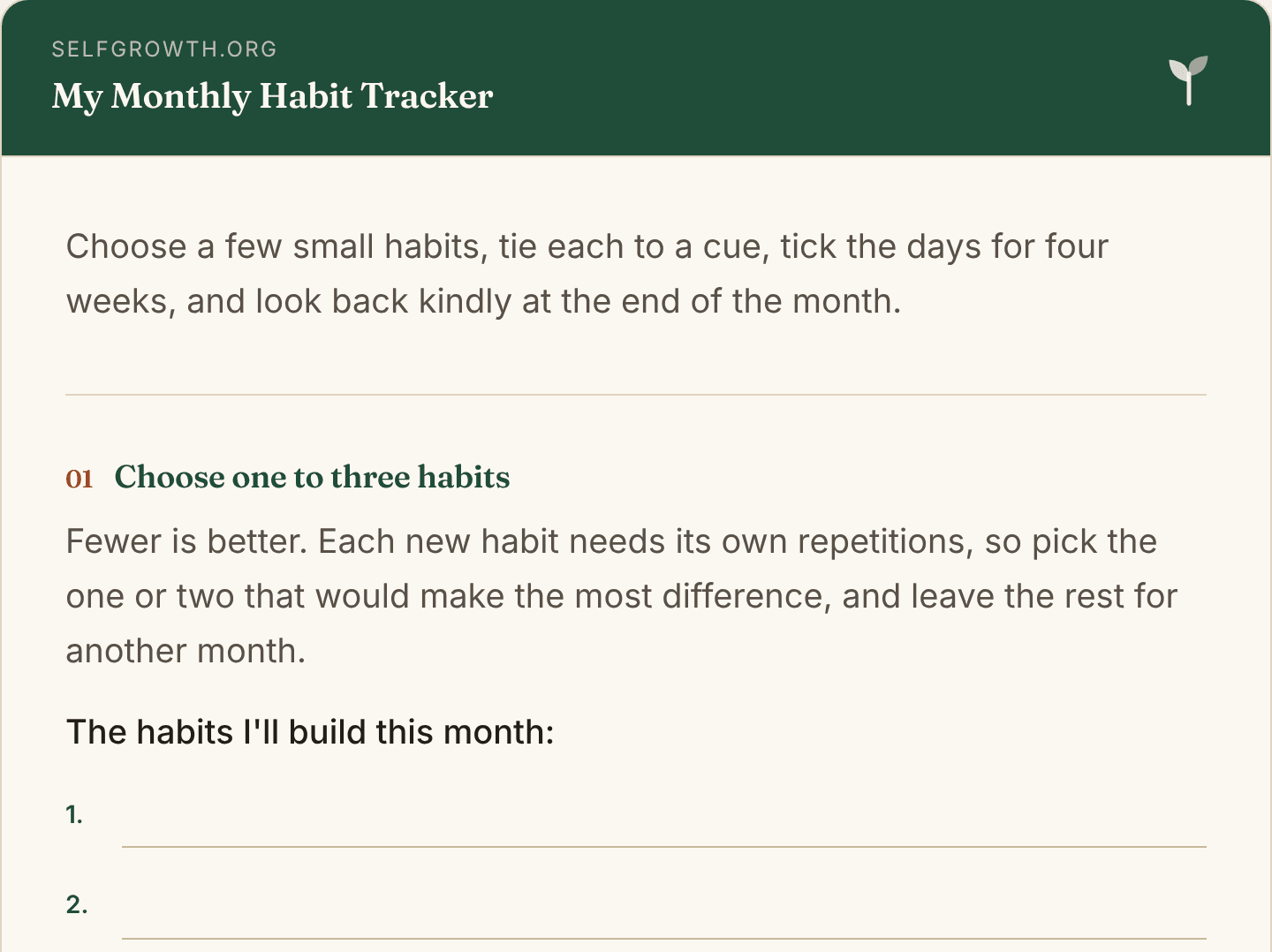
Habit Tracker Printable
A free printable habit tracker for one month: choose one to three small habits, tie each to a cue, tick the days, and review what helped. Print or fill it in.
Open worksheet
Goal-Setting Worksheet
A free, printable goal-setting worksheet that turns a vague wish into a specific goal, a when-and-where plan, and a first step you'll actually take this week.
Open worksheet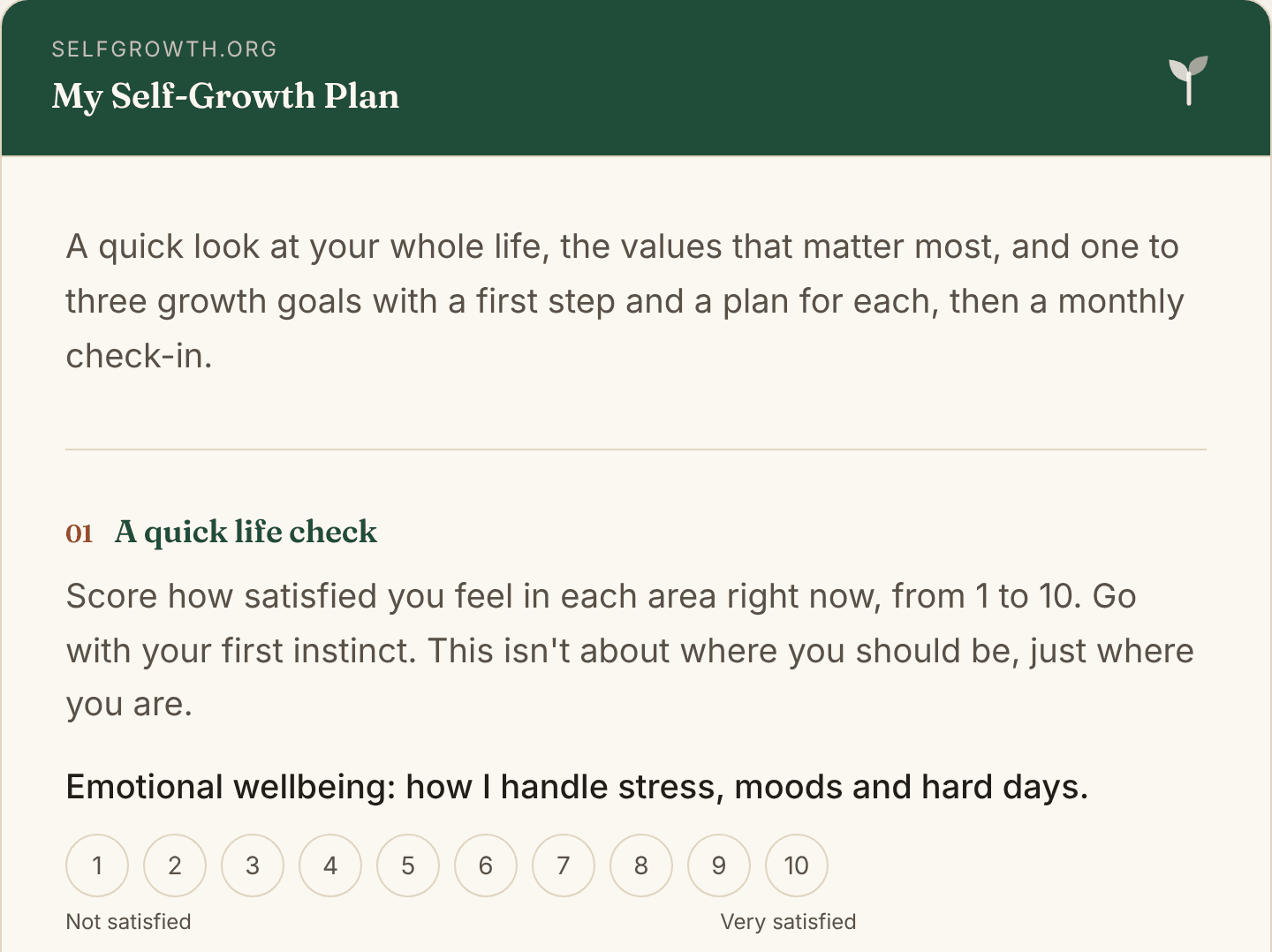
Self-Growth Plan
A free, printable self-growth plan template: check in on six areas of life, pick three values, choose one to three goals, plan a first step and review monthly.
Open worksheet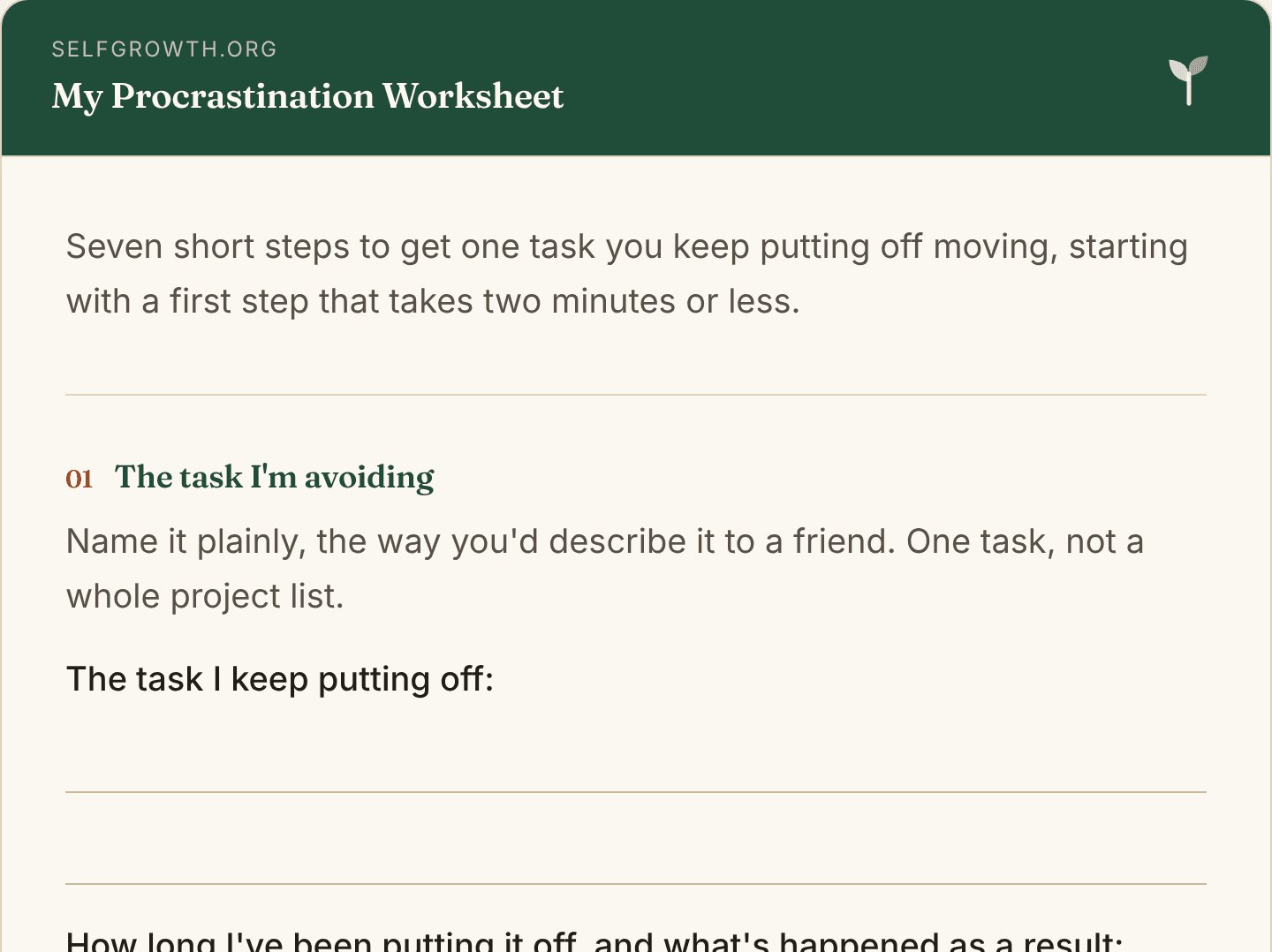
Procrastination Worksheet
A free, printable procrastination worksheet: name the feeling you're avoiding, find a two-minute first step, make an if-then plan and log seven days of starts.
Open worksheetRelated guides
New worksheets, straight to your inbox
An occasional new worksheet or tool, sent only when there's something genuinely worth your time. No spam, no pressure, unsubscribe any time.