
Habits
Habit tracker printable: a free monthly tracker for a few small habits
Updated 11 October 2026 · 5 min read · Free to print
A habit tracker printable is a one-page monthly grid where you tick off each day you do a habit. This free tracker helps you choose one to three small habits, tie each to a cue you already have, track four weeks, set a kind rule for missed days, and review the month. Print it or fill it in.
By the Self Growth team · drawn from habit-formation and goal-monitoring research · how we make these
Fill it in here (it saves in this browser, but not in a private window), print it, or download the PDF. Free, no sign-up.
A new habit often fails for reasons that have little to do with how much you wanted it. It tends to fail because it was too big, had no clear moment to happen, or quietly slipped away in a busy week before you noticed. A simple paper tracker helps with all three: it keeps the habit small and visible, and it shows you what's really happening.
This tracker is built for a month and for a few habits at a time. Before the grid, you'll choose your habits, shrink each one to a version you could do on a bad day, and tie it to something you already do. After four weeks, a short review helps you decide what to keep, shrink or change.
There are no streaks to protect and nothing to score. A gap in the grid isn't a failure. In the best-known study of how habits form, missing one day didn't materially affect the process. You just pick it up again at the next cue.
How to use this worksheet
- 1Fill in the first two sections at the start of the month. It takes about ten minutes.
- 2Keep the page somewhere you'll see it every day: on the fridge, by your bed, or open on your phone.
- 3Tick a day as soon as you've done the habit, even if you only did the tiny version. That counts.
- 4At the end of the month, do the review before you start a new page.
The worksheet
selfgrowth.org
My Monthly Habit Tracker
Choose a few small habits, tie each to a cue, tick the days for four weeks, and look back kindly at the end of the month.
01Choose one to three habits
Fewer is better. Each new habit needs its own repetitions, so pick the one or two that would make the most difference, and leave the rest for another month.
The habits I'll build this month:
- 1.
- 2.
- 3.
Why these matter to me, in my own words:
Check each habit before you start:
02The cue and the tiny version
Tie each habit to something you already do every day, and write the smallest version that still counts. 'After I pour my coffee, I'll write one line' is a plan. 'Journal more' is a wish.
Entry 1
Entry 2
Entry 3
03This month's tracker
Write each habit in the first column. In each week, mark the days you did it (M T W T F S S). A tick for the tiny version counts the same as a big day. Blank days are just information.
Entry 1
Entry 2
Entry 3
Entry 4
Entry 5
Any extra days at the end of the month:
04A kind rule for missed days
You will miss days. That's normal. Decide now what you'll do when it happens, so a missed day doesn't turn into a missed month.
My rule, ticking any that fit:
What I'll say to myself when I miss a day:
05Monthly review
At the end of the month, look back with curiosity, not judgement. The point is to learn what works for you, not to grade yourself.
What helped? (times, places, people, what I set out)
What got in the way?
Entry 1
Entry 2
Entry 3
One thing I'm glad I did this month:
When you're done, a moment to reflect
- Which habit started to feel more automatic this month, and what was its cue?
- On the days you didn't do a habit, what was going on?
- Was any habit too big? What's a smaller version that would still count?
- Who or what made the habit easier this month?
- If you dropped a habit, was it the wrong habit or the wrong time?
Do habit trackers actually work?
The tracker rests on three findings from habit research. First, habits form when you repeat the same action in the same situation, until the situation starts to prompt it. Psychologists Wendy Wood and Dennis Rünger describe this in their 2016 review of the psychology of habit. That's why the tracker asks for a cue and a place, not just a habit.
Second, deciding the moment in advance helps. Peter Gollwitzer's research on 'implementation intentions' (if-then plans such as 'after I pour my coffee, I'll write one line') found that these plans let the situation itself prompt the action. The cue column is that plan.
Third, recording progress helps. A 2016 meta-analysis by Harkin and colleagues pooled 138 experiments and found that monitoring progress made people more likely to reach their goals, especially when progress was physically recorded. And the kind rule for missed days comes from Phillippa Lally's 2010 study, where missing one opportunity made little difference to how a habit formed. The month-long grid, room for up to five habits and the review questions are our own design.
These are educational self-reflection tools, not therapy. See our editorial standards.
If you want to go deeper
- Lally, P., van Jaarsveld, C. H. M., Potts, H. W. W. & Wardle, J. (2010). How are habits formed: Modelling habit formation in the real world. European Journal of Social Psychology, 40(6), 998-1009.
- Wood, W. & Rünger, D. (2016). Psychology of habit. Annual Review of Psychology, 67, 289-314.
- Gollwitzer, P. M. (1999). Implementation intentions: Strong effects of simple plans. American Psychologist, 54(7), 493-503.
- Harkin, B., Webb, T. L., Chang, B. P. I., Prestwich, A., Conner, M., Kellar, I., Benn, Y. & Sheeran, P. (2016). Does monitoring goal progress promote goal attainment? A meta-analysis of the experimental evidence. Psychological Bulletin, 142(2), 198-229.
Your questions, answered
- What is a habit tracker?
- A habit tracker is a simple grid where you mark each day you do a habit. It makes a new habit visible, shows you patterns (which days it slips, what helps), and gives you a small moment of noticing each time. This one is a monthly tracker for a few habits, with space to plan a cue and a tiny version for each, and a short review at the end.
- How do I use a printable habit tracker?
- At the start of the month, choose one to three small habits and tie each to a cue you already have, like 'after I brush my teeth'. Write them in the grid, then tick each day you do them, even if you only managed the tiny version. Keep the page where you'll see it. At the end of the month, fill in the review and start a fresh page.
- How many habits should I track at once?
- Fewer than you think. One to three is plenty for a month, and one is a perfectly good start. Each new habit needs its own repetitions in the same situation, so adding lots at once spreads you thin. The grid has room for five, so you can also keep a couple of habits that are already going well.
- Do habit trackers actually work?
- Tracking can help. A 2016 meta-analysis (a study that pools many studies) by Harkin and colleagues found that monitoring progress made people more likely to reach their goals, with larger effects when progress was physically recorded. A tracker works best as a way of noticing, not judging. If gaps make you feel like a failure, focus on the review instead of the ticks.
- What if I miss a day on my habit tracker?
- Leave the box blank and carry on at the next cue. In Phillippa Lally's 2010 study of how habits form, missing one opportunity made little difference to the process. There's nothing to reset. If you miss several days, make the habit smaller rather than starting over from scratch.
- How long does it take for a habit to stick?
- Often longer than a month, so expect to use more than one page. In Lally's study, among the people whose results fitted the model well, the middle figure for a habit to get close to as automatic as it was going to get for them was 66 days, with a range of 18 to 254 days. Use the monthly review to decide what to carry into the next month.
- Is this habit tracker free, and is it therapy?
- It's completely free. Use the Download PDF button for a print-ready copy, or Print to print straight from the page, with no payment and no email needed. You can also fill it in on screen. It's a self-reflection tool, not therapy or medical advice. If low mood is behind the struggle, or a habit like drinking or gambling feels out of control, please talk to a GP. In a crisis, call Samaritans on 116 123 (UK and Ireland), 988 (US) or find a helpline at findahelpline.com.
Keep going, related worksheets

Goal-Setting Worksheet
A free, printable goal-setting worksheet that turns a vague wish into a specific goal, a when-and-where plan, and a first step you'll actually take this week.
Open worksheet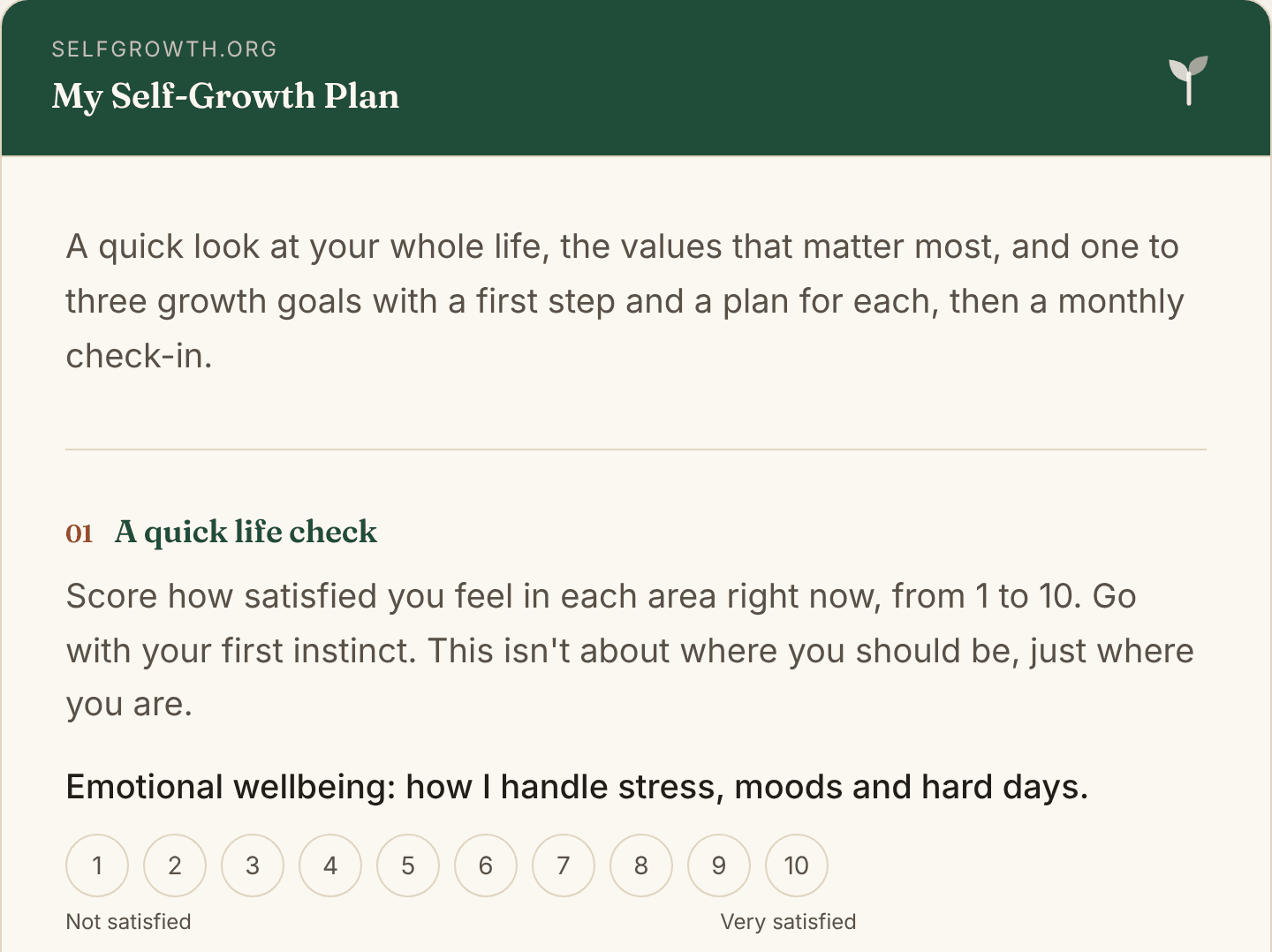
Self-Growth Plan
A free, printable self-growth plan template: check in on six areas of life, pick three values, choose one to three goals, plan a first step and review monthly.
Open worksheet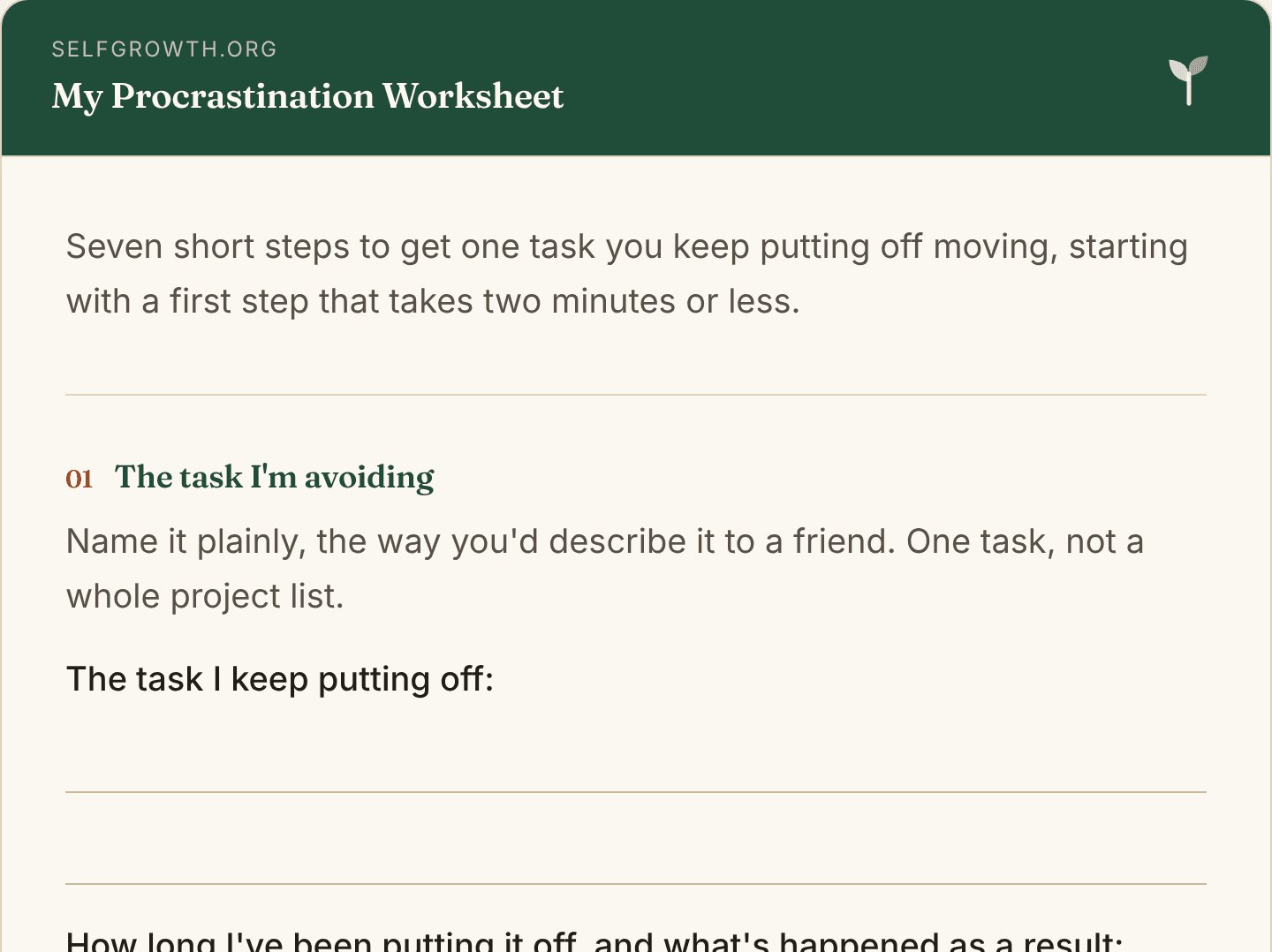
Procrastination Worksheet
A free, printable procrastination worksheet: name the feeling you're avoiding, find a two-minute first step, make an if-then plan and log seven days of starts.
Open worksheetNew worksheets, straight to your inbox
An occasional new worksheet or tool, sent only when there's something genuinely worth your time. No spam, no pressure, unsubscribe any time.