
Procrastination
Procrastination worksheet: a free, printable way to start the task you keep putting off
Updated 11 October 2026 · 6 min read · Free to print
A procrastination worksheet helps you start one task you keep putting off. Name the task, tick the feeling you're avoiding, shrink it to a two-minute first step and write an if-then plan for when you'll begin. Remove one distraction, plan a kind reply for when you slip, and log seven days. It's free to fill in or print.
By the Self Growth team · drawn from procrastination research, implementation intentions and self-forgiveness research · how we make these
Fill it in here (it saves in this browser, but not in a private window), print it, or download the PDF. Free, no sign-up.
There's a task you keep moving to tomorrow. Maybe it's an email, a form, a piece of work or a phone call. Every time you think about it you feel a small drop in your stomach, and every time you put it off you feel a bit better, then a bit worse.
That pattern isn't laziness. Procrastination is often a way to get away from a feeling the task brings up: boredom, overwhelm, the fear of doing it badly, resentment, or simply not knowing where to start. Putting it off brings relief right now, and the cost lands later. Once you know which feeling you're dodging, the task gets easier to work with.
This worksheet takes one task, just one, and turns it into a first step small enough to do today, a plan for exactly when you'll do it, and a kinder way to handle the days it doesn't happen. It ends with a seven-day log so you can see what helps. Nobody else has to see what you write.
How to use this worksheet
- 1Pick one task only. The one you've been putting off longest, or the one that's costing you most, is a good choice.
- 2Give it about 15 minutes. You don't need to finish the task today, just the page.
- 3Be honest, not harsh. Calling yourself lazy won't help you start. Noticing what's really going on will.
- 4Keep the page somewhere you'll see it, and fill in the log each day for a week.
The worksheet
selfgrowth.org
My Procrastination Worksheet
Seven short steps to get one task you keep putting off moving, starting with a first step that takes two minutes or less.
01The task I'm avoiding
Name it plainly, the way you'd describe it to a friend. One task, not a whole project list.
The task I keep putting off:
How long I've been putting it off, and what's happened as a result:
Why it matters to me (in my own words, not someone else's):
How much do I dread this task right now?
02What feeling am I avoiding?
Picture yourself sitting down to start. What's the first feeling that shows up? Tick any that fit. There's often more than one.
What do I tell myself when I put it off? (the exact words)
03The tiniest first step
Break the task into a few smaller pieces. Then make the first piece so small it takes two minutes or less, such as opening the file, finding the form or writing one sentence.
The task in smaller pieces:
- 1.
- 2.
- 3.
- 4.
- 5.
My two-minute first step:
04My if-then plan
Decide exactly when and where you'll take the first step, by linking it to something that already happens in your day. Add a backup for when the first plan doesn't happen.
Entry 1
Entry 2
Entry 3
05Make it easier to start
Small changes to your surroundings can matter more than willpower. Take one thing away that pulls you off course, and add one thing that helps you begin.
One friction I'll remove (e.g. phone in another room, extra tabs closed):
One helper I'll add (e.g. a 10-minute timer, working beside someone, things laid out the night before):
06A kind reply for when I slip
Some days the plan won't happen. Decide now what you'll say to yourself when it doesn't. Kind and honest, not harsh. Then set the next start.
What I usually say to myself when I've put something off again:
What I'll say instead (what I'd say to a friend in the same spot):
How I'll restart (the next time and place I'll try):
07My 7-day log
Each day, note whether you took a step, how you felt before and after, and what helped or got in the way. A day with no step still counts if you write down why.
Entry 1
Entry 2
Entry 3
Entry 4
Entry 5
Entry 6
Entry 7
When you're done, a moment to reflect
- What do I tend to put off most, and what feeling do those tasks have in common?
- When I finally started something I'd been avoiding, was it as bad as I expected?
- What would change if I treated a slip as information rather than proof I'm useless?
- Whose voice do I hear when I tell myself off for procrastinating?
- What's one task I could stop doing altogether, instead of carrying the guilt of putting it off?
Why do you procrastinate, and do these steps help?
The starting point is a 2013 review by Fuschia Sirois and Timothy Pychyl. They argue that procrastination is less about laziness or poor time management and more about mood. Putting off a task you dread makes you feel better now, and your future self picks up the cost. That's why step 2 asks which feeling you're avoiding, rather than how to squeeze more hours out of your day.
A 2007 meta-analysis (a study that pools many studies) by Piers Steel brought together 691 results from earlier research. Some of the strongest, most consistent links with procrastination were a task that feels unpleasant, a deadline or reward that's far off, low confidence that you can do it, a habit of acting on impulse, and lower self-control. These are links rather than proof of cause, but steps 3 and 5 aim at them: a tiny first step feels less unpleasant and more doable, and removing a distraction gives impulse less to grab.
The if-then plan in step 4 comes from Peter Gollwitzer's work on implementation intentions: deciding in advance 'when this happens, I'll do that', so the moment itself prompts the action. A 2006 review by Gollwitzer and Paschal Sheeran pooled 94 independent tests and found these plans made a medium-to-large difference to reaching goals, across many kinds of goal rather than procrastination alone. Step 6 draws on a 2010 study by Michael Wohl, Timothy Pychyl and Shannon Bennett. First-year university students who forgave themselves for procrastinating before one round of exams procrastinated less before the next. It's one study, and it shows a link over time rather than proof, but it fits the idea that being kind to yourself after a slip makes it easier to start again, not that it lets you off the hook. The guide to stopping procrastinating explains all of this in more depth.
These are educational self-reflection tools, not therapy. See our editorial standards.
If you want to go deeper
- Sirois, F. & Pychyl, T. (2013). Procrastination and the priority of short-term mood regulation: Consequences for future self. Social and Personality Psychology Compass, 7(2), 115-127.
- Steel, P. (2007). The nature of procrastination: A meta-analytic and theoretical review of quintessential self-regulatory failure. Psychological Bulletin, 133(1), 65-94.
- Wohl, M. J. A., Pychyl, T. A. & Bennett, S. H. (2010). I forgive myself, now I can study: How self-forgiveness for procrastinating can reduce future procrastination. Personality and Individual Differences, 48(7), 803-808.
- Gollwitzer, P. M. & Sheeran, P. (2006). Implementation intentions and goal achievement: A meta-analysis of effects and processes. Advances in Experimental Social Psychology, 38, 69-119.
Your questions, answered
- What is a procrastination worksheet?
- It's a structured page that helps you get started on one task you keep putting off. This one asks you to name the task, tick the feeling you're avoiding, break it into a two-minute first step, write an if-then plan for when you'll start, make starting easier, plan a kind reply for when you slip, and keep a seven-day log.
- Why do I procrastinate?
- Often because the task brings up a feeling you'd rather not have, such as boredom, overwhelm, fear of doing it badly, resentment or not knowing where to start. Putting it off makes that feeling go away for now. Researchers Sirois and Pychyl describe procrastination as short-term mood repair, with the cost passed on to your future self. It isn't the same as laziness.
- What are signs of procrastination?
- Common signs include moving the same task to tomorrow again and again, doing easy jobs first so the hard one never gets a turn, waiting to feel motivated, only starting when the deadline is close, spending more time planning than doing, and feeling guilty about the task even while you relax.
- How is this different from the self-sabotage worksheet?
- This worksheet works on one specific task you're putting off, and gets you to a first step you can take today. The self-sabotage worksheet looks at broader patterns of getting in your own way, such as quitting near the finish line or pulling away from people, and the beliefs underneath them. If procrastination is one of several patterns, try both.
- Is there a procrastination worksheet PDF?
- Yes. Use the Download PDF button for a clean, print-ready copy, or Print to print straight from the page. It's completely free, with no payment and no email needed. You can also fill it in on screen, and your answers save in your browser.
- Is this worksheet a substitute for therapy?
- No. It's an educational self-help tool, not therapy or medical advice. Trouble starting or finishing tasks can sometimes be part of ADHD, depression or anxiety. If procrastination is seriously affecting your work, studies or health, talk to a GP. If you feel hopeless or have thoughts of harming yourself, contact a crisis line: Samaritans on 116 123 in the UK, 988 in the US, or findahelpline.com elsewhere. You deserve real support, not just a worksheet.
Keep going, related worksheets
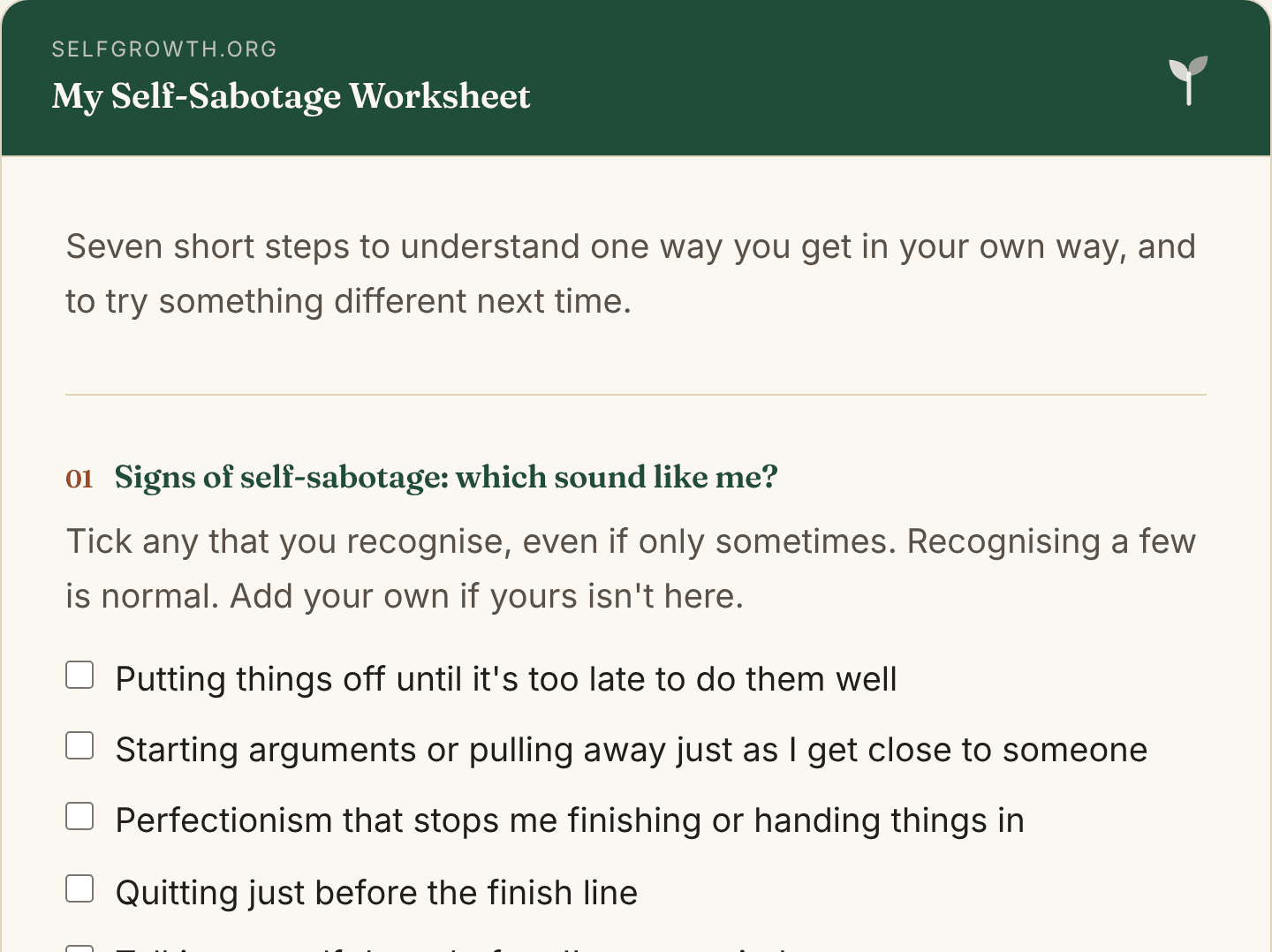
Self-Sabotage Worksheet
A free, printable self-sabotage worksheet: spot the signs, see what the habit protects you from and what it costs, find the belief under it, and plan next time.
Open worksheet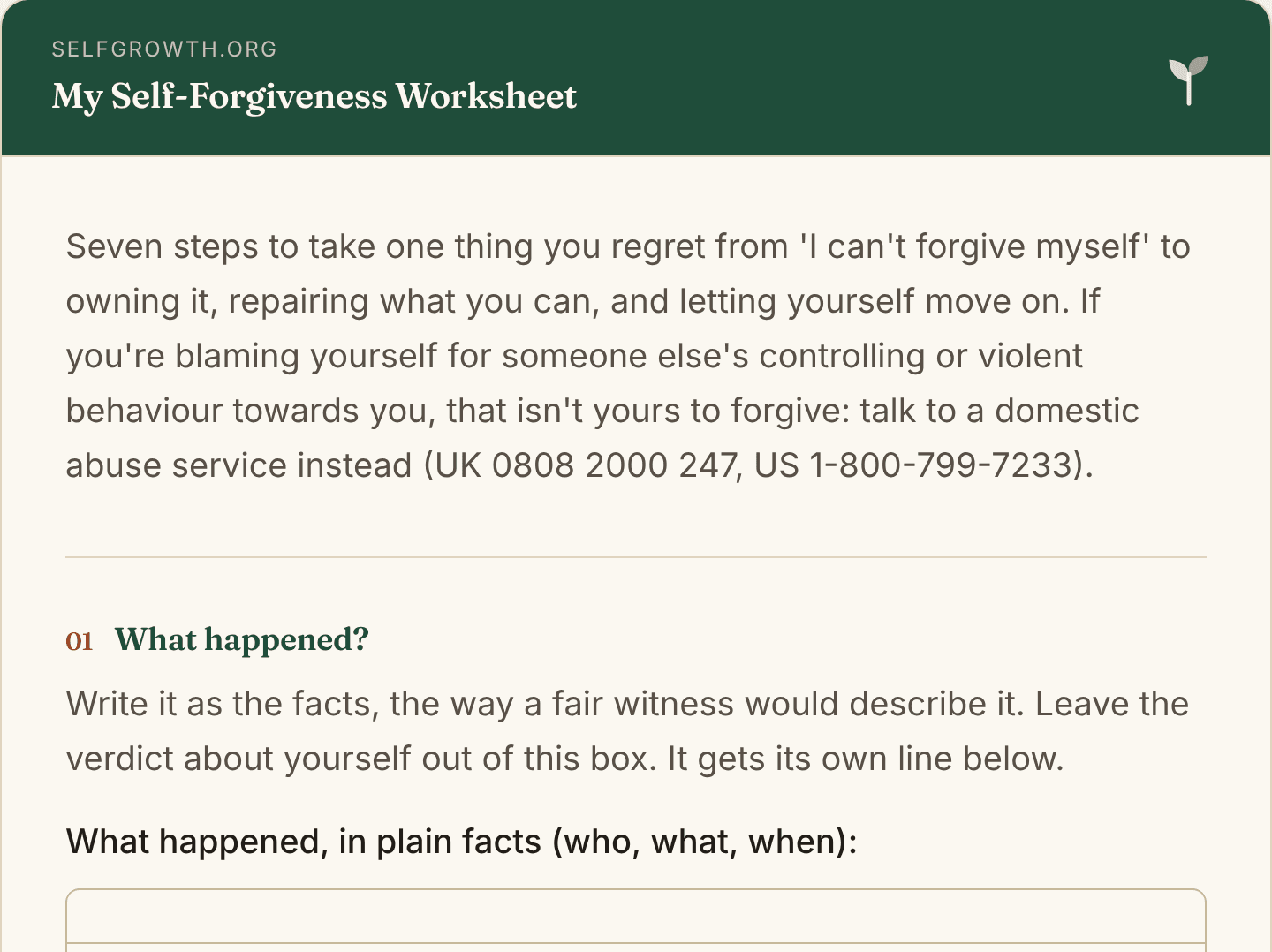
Self-Forgiveness Worksheet
A free, printable self-forgiveness worksheet for adults: own your part, tell guilt from shame, make amends where you can, and write a letter forgiving yourself.
Open worksheet
Goal-Setting Worksheet
A free, printable goal-setting worksheet that turns a vague wish into a specific goal, a when-and-where plan, and a first step you'll actually take this week.
Open worksheetNew worksheets, straight to your inbox
An occasional new worksheet or tool, sent only when there's something genuinely worth your time. No spam, no pressure, unsubscribe any time.