
Goal-setting
Goal-Setting Worksheet: A Free, Printable Template to Set Goals You'll Keep
Updated June 28, 2026 · 6 min read · Free to print
A goal-setting worksheet walks you from a vague wish to a goal you'll keep: you name what you want and why, make it specific and measurable, picture the outcome and the obstacle in its way, turn it into repeatable actions, and decide when and where you'll start. It ends with a first step for the next 48 hours.
By the Self Growth team · drawn from goal-setting theory and behavioural science · how we make these
A clean, print-ready PDF, properly formatted, free, no email needed.
Most goals don't fail because the person was lazy. They fail because the goal stayed a wish, big, vague, and floating somewhere in 'one day'. 'Get fit', 'be more organised', 'write the book' give your attention nothing to grab. A goal you'll actually keep is specific, has a reason behind it, and comes with a concrete plan for when and where you'll act.
This worksheet turns the wish into that plan. It pushes you to say exactly what you want and why it matters to you (not to anyone else), to name the real obstacle honestly rather than pretend it away, and to decide the precise moment you'll take the first step. That last part matters more than motivation: people who plan the when and where of an action are far more likely to follow through than people who only set the intention.
You don't need to feel especially motivated to fill this in, and you don't need a perfect five-year plan. You need one goal that's genuinely yours and a first step small enough that you can't really talk yourself out of it.
- Outcome
Where you want to end up, and why
The specific result, with a real date and a reason that's genuinely yours.
- Process
The repeatable action that gets you there
The small thing you can actually do and control: walk after lunch, write each morning.
- Cue
When and where you'll do it
An 'if-then' plan tied to a moment you'll meet: 'After my morning coffee, I'll...'.
- First step
The smallest version, done today
So small you can't talk yourself out of it. This is what turns intending into in-progress.
Each step makes the goal more concrete, and harder to drift away from
How to use this worksheet
- 1Give yourself 15 quiet minutes. Print it, or type straight onto the page.
- 2Pick one goal, not five. A single goal with a real plan beats a list of wishes.
- 3Be honest about the obstacle. The point isn't a tidy plan, it's a plan that survives contact with a normal week.
- 4Finish with the smallest possible first step, and put it in your calendar before you close the page.
The worksheet
selfgrowth.org
My Goal-Setting Plan
Seven short steps from a vague wish to a specific goal, a when-and-where plan, and a first step for the next 48 hours.
01Name the goal, and the reason under it
Start with what you want, in one plain sentence, then the honest reason behind it. A goal with a real 'why' survives the days you don't feel like it.
What I want, in one specific sentence:
Why it actually matters to me (not why it 'should'):
02Make it specific and measurable
'Get fit' can't be finished, started, or measured. Pin it down so that someone else could tell whether you'd done it.
How will I know I've reached it? What will be true or different?
By when (a real date, not 'soon'):
03Picture the outcome, then the obstacle
Imagining success alone tends to relax you, not move you. Pairing the outcome with the obstacle in its way is what turns a wish into action. Do both, in order.
The best realistic outcome of reaching this, what it looks and feels like:
The main inner obstacle, the habit, fear, or excuse that actually stops me:
04Turn the goal into repeatable actions
An outcome ('lose 5kg', 'finish the course') is the destination. Process goals are the small actions you can actually repeat, and the part you control. List the few that would get you there.
The repeatable action
How often
05Make a when-and-where plan
This is the step most people skip, and the one with the strongest evidence behind it. Decide the exact cue, when and where, that will trigger the action. 'I'll do it sometime' rarely happens; 'after I make my morning coffee, I'll write for 20 minutes at the kitchen table' often does.
When and where (the cue)
What I'll do
And for the obstacle above: 'If [it happens], then I will [my planned response].'
06The first small step
Momentum beats motivation. Pick a first step so small you can't reasonably refuse it, and do it within two days.
The smallest version I can do in the next 48 hours:
How ready do I feel to start?
07Check it's a good goal
Run your goal past these. The more you can honestly tick, the more likely it is to stick.
When you're done, a moment to reflect
- Is this goal actually yours, or one you think you're supposed to want?
- What's the real obstacle, and is your plan for it honest, or wishful?
- If you did only the first step this week and nothing more, would that still count as moving forward? (It does.)
Why these steps, and where they come from
The backbone of this worksheet is goal-setting theory, the body of research led by Edwin Locke and Gary Latham over several decades. Their core finding is robust and a little unglamorous: specific, suitably challenging goals lead to better performance than vague 'do your best' ones, because a clear goal directs attention and effort and tells you when you've arrived. So the worksheet pushes hard on specificity and a real deadline.
Two other findings shape the later steps. Peter Gollwitzer's work on implementation intentions, deciding in advance the exact when, where, and how of an action, shows that this simple 'if-then' planning reliably increases follow-through, which is why the when-and-where step gets its own section. A review pooling 94 studies and more than 8,000 people found this kind of planning had a medium-to-large effect on actually reaching goals, even when the people it was compared against had already set the same goal (Gollwitzer and Sheeran, 2006). And Gabriele Oettingen's research on mental contrasting (the basis of her WOOP method) found that picturing a positive outcome works far better when you also confront the obstacle in its way, rather than fantasising about success alone, hence the 'outcome, then obstacle' step.
SMART goals get a mention because the acronym is a handy tidying checklist, but it's a management heuristic, not the science, the evidence sits with specificity, implementation intentions, and mental contrasting. This is an educational tool for everyday goals and direction, not therapy; if something deeper is in the way, please reach for real support too.
These are educational self-reflection tools, not therapy, see our editorial standards.
If you want to go deeper
- Locke, E. A. & Latham, G. P. (2002). Building a practically useful theory of goal setting and task motivation. American Psychologist, 57(9).
- Gollwitzer, P. M. (1999). Implementation intentions: Strong effects of simple plans. American Psychologist, 54(7).
- Gollwitzer, P. M. & Sheeran, P. (2006). Implementation intentions and goal achievement: A meta-analysis of effects and processes. Advances in Experimental Social Psychology, 38, 69-119.
- Gabriele Oettingen — Rethinking Positive Thinking: Inside the New Science of Motivation (2014), which sets out mental contrasting and the WOOP method.
Questions people ask
- What is a goal-setting worksheet?
- It's a structured page that walks you from a vague intention to a concrete plan: naming the goal and your reason for it, making it specific and measurable, picturing the outcome and the obstacle, breaking it into repeatable actions, and deciding exactly when and where you'll start. The structure does the work a blank 'set some goals' instruction can't.
- How do I set goals I'll actually achieve?
- Make the goal specific (so you'd know when it's done), tie it to a reason that's genuinely yours, and most importantly plan the when and where of your first action rather than relying on motivation. Then shrink the first step until it's almost too easy to skip. This worksheet takes you through each of those in order.
- What's the difference between an outcome goal and a process goal?
- An outcome goal is the destination, 'lose 5kg', 'get the promotion', 'finish the manuscript'. A process goal is the repeatable action that gets you there, 'walk 30 minutes after lunch', 'write 300 words each morning'. Outcomes can be out of your direct control; processes are the part you actually control day to day, which is why this worksheet asks you to set both.
- Are SMART goals actually effective?
- SMART (specific, measurable, achievable, relevant, time-bound) is a useful checklist for tightening a vague goal, and this worksheet quietly covers most of it. But it isn't a magic formula. The strongest evidence isn't for the acronym itself, it's for two things underneath it: setting a specific, challenging goal rather than 'do your best', and planning the exact when and where you'll act.
- Why do I keep giving up on my goals?
- Usually one of three reasons: the goal was too vague to act on, it was never really yours (so motivation never showed up), or there was no plan for the obstacle that predictably appears. Vague, borrowed, and unplanned goals fade fast. A specific goal you care about, with a when-and-where plan and an honest obstacle step, is far harder to drift away from.
- Is this worksheet free, and is it a substitute for therapy?
- It's completely free to fill in online or print, with no payment and no email needed. It's an educational self-reflection tool, not therapy or medical advice. It's great for everyday goals and direction; if low mood or anxiety is what's really blocking you, that's worth taking to a qualified professional, no worksheet can stand in for that.
Keep going, related worksheets
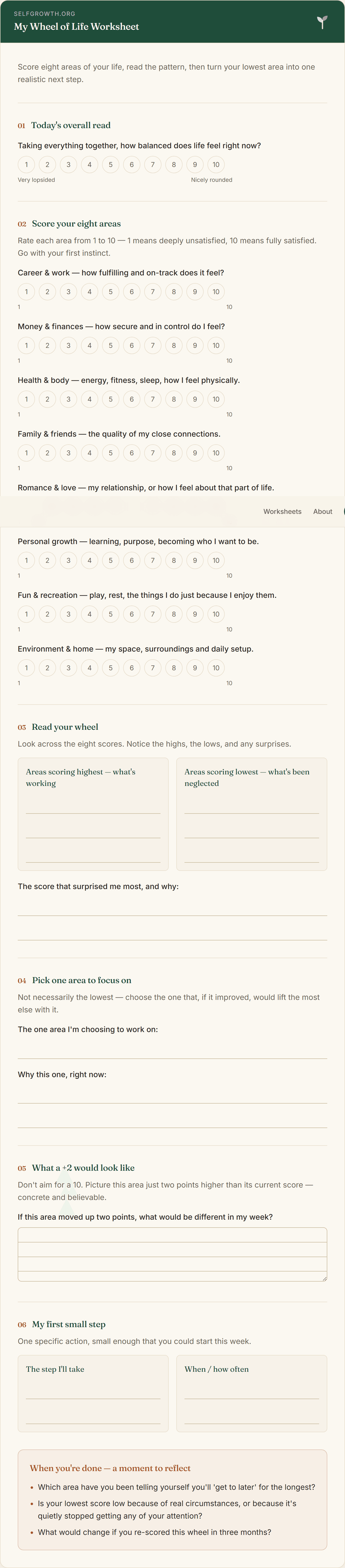
Wheel of Life Worksheet
A free, printable Wheel of Life worksheet. Score eight areas of your life out of ten, see where you're out of balance, and pick one to work on next.
Open worksheet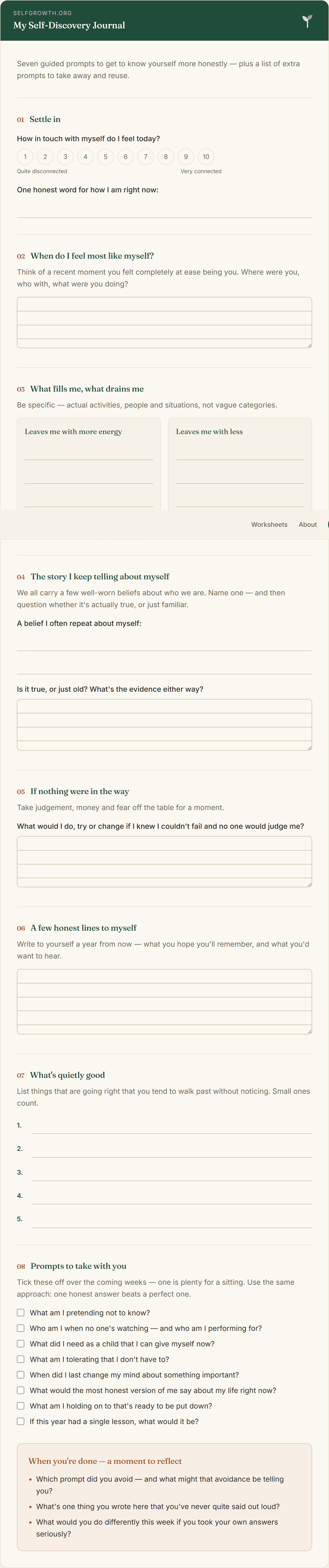
Self-Discovery Journal Prompts
Free, printable self-discovery journal prompts, guided questions with space to write, to explore your values, patterns and what you really want.
Open worksheet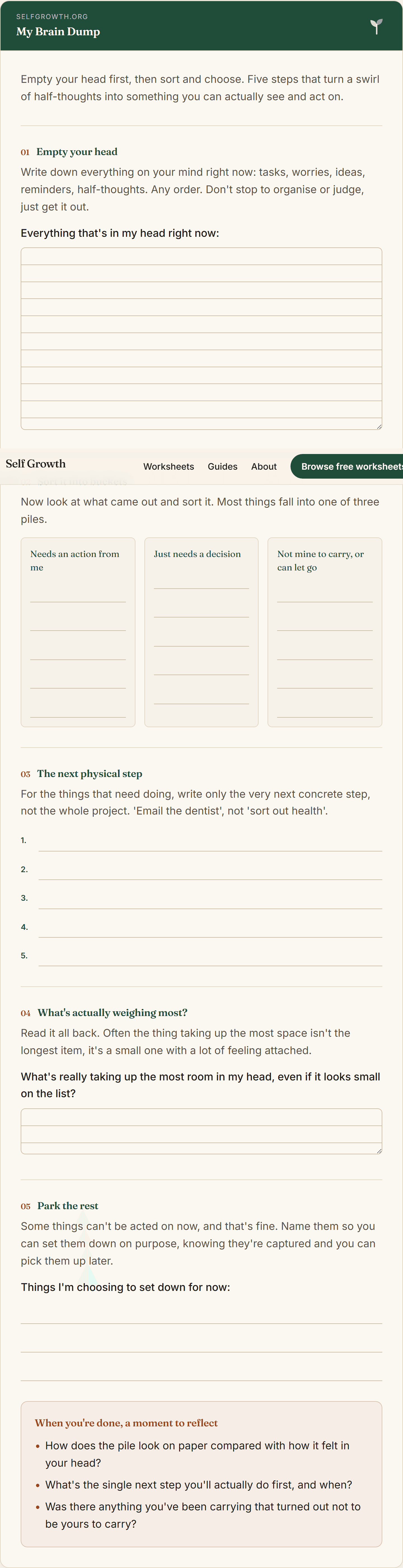
Brain Dump Template
A free, printable brain dump template to empty a cluttered mind onto the page, sort it into what needs action and what to let go, and find the next clear step.
Open worksheetNew worksheets, straight to your inbox
An occasional new worksheet or tool, sent only when there's something genuinely worth your time. No spam, no pressure, unsubscribe any time.