
Guide
How to set goals you'll actually achieve
Updated June 28, 2026 · 9 min read
To set a goal you'll actually achieve, make it specific enough that you'd know when it's done, tie it to a reason that's genuinely yours, and decide the exact when and where you'll act, not just what you want. Break the outcome into repeatable actions, plan for the obstacle that predictably appears, and start with a step small enough you can't talk yourself out of it.
By the Self Growth team · drawn from goal-setting theory and behavioural science · how we make these
Almost everyone knows how to want things. Setting a goal you actually reach is a different skill, and a learnable one. The gap between the two is rarely willpower. It's that most goals stay vague wishes, never get tied to a real reason, and never come with a plan for the ordinary week that's about to get in the way.
This guide covers what actually moves a goal from your head into your life: how to make it specific, why the reason underneath matters more than the goal itself, the difference between chasing an outcome and building a process, and the single most underrated step, deciding exactly when and where you'll act. There's a free printable worksheet at the end that turns all of it into a plan you can start this week.
Why do most goals quietly fail?
When a goal doesn't happen, the easy story is 'I wasn't disciplined enough'. Usually the real reasons are more fixable than that. A goal tends to fail for one of three reasons, and none of them is a character flaw.
- It was too vague to act on. 'Get fit' or 'be more organised' gives your attention nothing to grab. You can't start, finish, or measure a fog.
- It was never really yours. A goal you've absorbed from a parent, a partner, or the internet rarely produces motivation, because the reason behind it belongs to someone else.
- There was no plan for the obstacle. The same predictable thing derails you each time, the late meeting, the tiredness, the self-doubt, and without a plan for it, it wins by default.
Notice what's missing from that list: 'not wanting it enough'. Wanting is rarely the problem. Structure is. The rest of this guide is that structure.
Make it specific (and a little bit hard)
The most reliable finding in the whole science of goals is almost boring: specific, challenging goals beat vague, easy ones. A clear target ('walk 30 minutes, four days a week') directs your attention and tells you exactly when you've arrived. 'Do your best' does neither, there's no finish line, so there's nothing to aim at.
So sharpen the goal until someone else could tell whether you'd done it. Swap 'read more' for 'read ten pages before bed'. Swap 'save money' for 'put aside £150 a month'. And give it a real date, not 'soon'. A deadline turns a someday-wish into something the present has to deal with.
A goal you can't measure is a wish you can't finish.
Find the reason under the goal
Before you plan anything, ask why this goal matters to you, and keep asking until you hit something that's actually true. 'I want to get fit' might really be 'I want to keep up with my kids without getting winded'. The second one will get you out the door on a cold morning; the first one won't.
This is also the cleanest test for whether a goal is even worth setting. If you dig for the reason and find only 'I feel like I should', that's worth knowing now, before you spend three months half-failing at something you never wanted. A goal that's genuinely yours doesn't need to be forced; one that isn't can't be forced for long.
Outcome goals vs process goals
Most people set outcome goals, lose 5kg, get the promotion, finish the manuscript, and then feel powerless, because the outcome isn't fully in their control. You can do everything right and the scale, the panel, or the publisher still does its own thing.
The fix is to also set process goals: the small, repeatable actions that get you there and that you do control. 'Walk after lunch.' 'Write 300 words each morning.' 'Apply to two roles a week.' Keep the outcome as your direction, but aim your daily effort at the process. You can't make the outcome happen on a given day, but you can almost always do the process, and the outcomes follow the processes you actually keep.
Plan the when and where (the step almost everyone skips)
Here's the most underused tool in goal-setting, and one of the best-evidenced. Don't just decide what you'll do; decide exactly when and where you'll do it. Researchers call these 'implementation intentions', and the format is simply: 'When [situation], I will [action].'
- Not 'I'll exercise more', but 'When I get home from work, I'll change into my kit before I sit down'.
- Not 'I'll write the report', but 'After my Monday coffee, I'll write for 25 minutes at the kitchen table'.
- Not 'I'll call them back', but 'When I finish lunch, I'll make the call from the car'.
Tying an action to a specific cue you'll actually meet hands the decision to your environment instead of your willpower. On a tired day, that's exactly where you want it. In the largest review of this, pooling 94 studies and more than 8,000 people, the boost was medium-to-large: those who made a specific when-and-where plan followed through markedly more often than those who held the same goal without one (Gollwitzer and Sheeran, 2006).
- Outcome
Where you want to end up, and why
The specific result, with a real date and a reason that's genuinely yours.
- Process
The repeatable action that gets you there
The small thing you can actually do and control: walk after lunch, write each morning.
- Cue
When and where you'll do it
An 'if-then' plan tied to a moment you'll meet: 'After my morning coffee, I'll...'.
- First step
The smallest version, done today
So small you can't talk yourself out of it. This is what turns intending into in-progress.
Each step makes the goal more concrete, and harder to drift away from
Add one more 'if-then' for the obstacle you already know is coming: 'If I miss the morning slot, then I'll do ten minutes at lunch instead.' Planning the recovery in advance stops one missed day from quietly becoming the end of the whole thing.
Open the Goal-Setting WorksheetPicture the outcome, then the obstacle
There's a popular idea that vividly imagining success pulls it toward you. The research says the opposite, on its own, fantasising about the win tends to relax you and drain the very energy you'd need to chase it. Your mind treats the daydream as a small taste of having already arrived.
What works is pairing the dream with reality. Picture the outcome you want, then immediately confront the main obstacle in its way, the habit, the fear, the scheduling clash. Holding the wished-for outcome and the real barrier side by side is what converts a nice idea into actual drive. It also quietly tells you which goals are worth committing to, and which to let go. (Gabriele Oettingen built her WOOP method, wish, outcome, obstacle, plan, on exactly this.)
Start absurdly small
The first step carries far more weight than it looks. Set it too big and you'll keep 'starting tomorrow'. Set it almost embarrassingly small, one paragraph, one set of press-ups, one email, and you remove the excuse to delay. Momentum is easier to build than motivation is to summon; doing a tiny thing today beats planning a big thing for a Monday that never quite arrives.
Once you're moving, the goal stops being a thing you're psyching yourself up for and becomes a thing you're already doing. That shift, from intending to in-progress, is most of the battle, and a small enough first step is how you trigger it.
Open the Goal-Setting WorksheetWhat actually works, in order
If you take nothing else from this, take these six steps. Each one has its own section above; this is the whole method on a single screen.
- 1Make it specific, and give it a real deadline, sharp enough that someone else could tell whether you'd done it.
- 2Find the honest reason underneath it, the one that's actually yours and will get you out the door on a bad day.
- 3Set process goals, the small repeatable actions you control, not just the outcome you don't.
- 4Decide the exact when and where you'll act, and add an 'if-then' for the obstacle you know is coming.
- 5Picture the outcome you want, then immediately confront the main thing standing in its way.
- 6Start with a first step so small you can't talk yourself out of it, and do it in the next 48 hours.
Where to go next
Pick what fits where you are. Each links to a free worksheet you can fill in online or print.
To turn a goal into a real plan right now, with a specific target, a when-and-where step, and a first action, use the goal-setting worksheet.
Open the Goal-Setting WorksheetIf you're not yet sure which area to set a goal in, the wheel of life helps you see, at a glance, where life feels full and where it feels thin.
Open the Wheel of Life WorksheetAnd if the harder question is what you actually want in the first place, the self-discovery journal prompts open up values, patterns, and direction.
Open the Self-Discovery Journal PromptsWhen goals aren't the real problem
Goal-setting is a tool for direction and follow-through. It's not a fix for everything, and it's worth being honest about that. If you keep setting goals and stalling, and underneath it is persistent low mood, anxiety, burnout, or exhaustion, then more goal-setting can start to feel like one more way to fail. That's not a sign you're lazy; it's a sign the thing in the way isn't really the goal.
If that's the picture, be as kind to yourself as you'd be to a friend, and consider talking to a GP or a qualified professional. These guides and worksheets are educational self-reflection tools, not therapy, and some obstacles deserve real support, not a better plan.
How we put this together
This guide is written in plain language from established, evidence-based ideas, not personal opinion. It's an educational self-reflection resource, not therapy or medical advice, see our editorial standards.
If you want to go deeper
- Locke, E. A. & Latham, G. P. (2002). Building a practically useful theory of goal setting and task motivation. American Psychologist, 57(9).
- Gollwitzer, P. M. (1999). Implementation intentions: Strong effects of simple plans. American Psychologist, 54(7).
- Gollwitzer, P. M. & Sheeran, P. (2006). Implementation intentions and goal achievement: A meta-analysis of effects and processes. Advances in Experimental Social Psychology, 38, 69-119.
- Gabriele Oettingen — Rethinking Positive Thinking: Inside the New Science of Motivation (2014), which sets out mental contrasting and the WOOP method.
Questions people ask
- How do I set goals I'll actually achieve?
- Make the goal specific enough that you'd know when it's done, tie it to a reason that's genuinely yours, and plan the exact when and where of your first action instead of relying on motivation. Break the outcome into repeatable actions you control, plan for the obstacle you know is coming, and start with a step small enough that you can't talk yourself out of it.
- What is the best way to set goals?
- There's no single trick, but the best-evidenced approach combines a few things: a specific, slightly challenging goal (not 'do your best'), a clear reason behind it, process goals as well as the outcome, and an 'implementation intention', deciding in advance the when and where you'll act. Pairing the outcome you want with the obstacle in its way, then starting small, ties it together.
- Why can't I stick to my goals?
- Usually because the goal was too vague to act on, was never really yours, or had no plan for the obstacle that predictably shows up. Those three quietly sink most goals. A goal that's specific, genuinely yours, and backed by a when-and-where plan plus an 'if-then' for setbacks is far harder to drift away from, and missing a day isn't failure, it's just a cue to use your recovery plan.
- What's the difference between outcome and process goals?
- An outcome goal is the result you want, lose 5kg, get promoted, finish the book, and it isn't fully in your control. A process goal is the repeatable action that gets you there, walk after lunch, write each morning, and it is. Keep the outcome as your direction but aim your daily effort at the process, because outcomes follow the processes you actually keep.
- Do SMART goals really work?
- SMART (specific, measurable, achievable, relevant, time-bound) is a useful checklist for tightening a vague goal, and most good goals end up meeting it. But it isn't the science, it's a management heuristic. The real evidence sits with three things SMART partly captures: setting a specific and challenging goal, planning the exact when and where you'll act, and confronting the obstacle rather than just picturing success.
- How many goals should I set at once?
- Fewer than you'd think, often just one. Every goal needs attention, a plan, and a slice of your limited willpower, and spreading those across five goals usually means none of them gets enough. Setting one goal with a real when-and-where plan and a first step beats listing ten you only wish for. You can always add the next one once the first is genuinely underway.
Worksheets to do the work
Free to fill in online or print. No email needed.
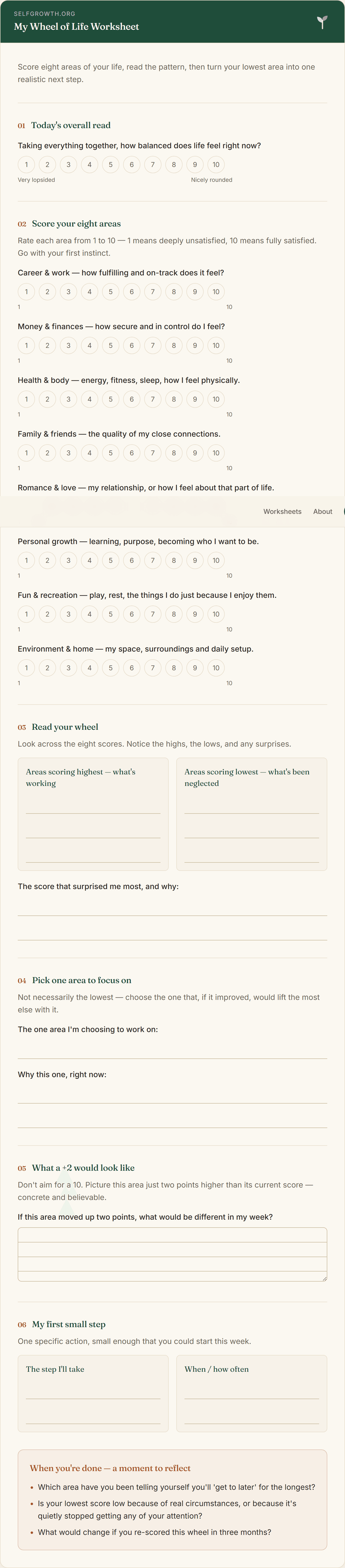
Wheel of Life Worksheet
A free, printable Wheel of Life worksheet. Score eight areas of your life out of ten, see where you're out of balance, and pick one to work on next.
Open worksheet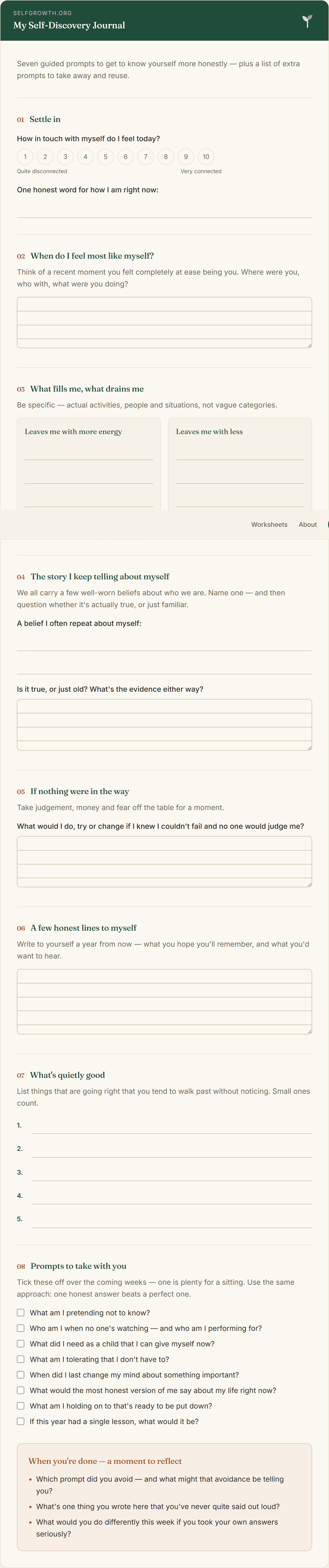
Self-Discovery Journal Prompts
Free, printable self-discovery journal prompts, guided questions with space to write, to explore your values, patterns and what you really want.
Open worksheet
Goal-Setting Worksheet
A free, printable goal-setting worksheet that turns a vague wish into a specific goal, a when-and-where plan, and a first step you'll actually take this week.
Open worksheetNew worksheets, straight to your inbox
An occasional new worksheet or tool, sent only when there's something genuinely worth your time. No spam, no pressure, unsubscribe any time.