
Self-compassion
Self-forgiveness worksheet: a free, printable way to forgive yourself and move on
Updated 11 October 2026 · 7 min read · Free to print
A self-forgiveness worksheet helps you stop punishing yourself for something you did, without pretending it didn't matter. You write down what happened, own your part (and only your part), tell guilt from shame, make amends where it's safe, and write yourself a letter of forgiveness. It's free to fill in on screen or print.
By the Self Growth team · drawn from self-forgiveness research and self-compassion · how we make these
Fill it in here (it saves in this browser, but not in a private window), print it, or download the PDF. Free, no sign-up.
Some mistakes stay with you long after everyone else has moved on. You replay the moment, you wince when it comes back, and part of you seems to think that if you just feel bad enough for long enough, it will somehow count as putting it right. It doesn't, and it rarely helps the person you hurt either.
Forgiving yourself isn't the same as letting yourself off the hook. Real self-forgiveness starts with owning what you did, feeling sorry for it, and doing what you can to repair it. Then it lets you stop treating yourself as the thing that went wrong. This worksheet takes one specific thing through those steps, in order.
You might notice you haven't forgiven yourself when you keep going over the same moment, avoid a person or place because of it, feel you don't deserve good things, or apologise again and again for something already settled. If any of that sounds familiar, you're in the right place.
One honest note before you start. Sometimes the thing you can't forgive yourself for wasn't really your fault: being hurt, controlled or abused by someone else, or something that happened to you during a traumatic event. If that's you, this worksheet isn't the right starting point. Please talk to a domestic abuse service first (UK 0808 2000 247, US 1-800-799-7233), or to a GP. And if you've seriously hurt someone or broken the law, talk to a GP or a qualified professional as well as using this page.
How to use this worksheet
- 1Pick one specific thing, not every regret you've ever had. One event, one choice, one conversation.
- 2Set aside about 20 minutes somewhere private. Nobody else has to see what you write.
- 3Be accurate rather than harsh. The aim is to see your part clearly, not to make it bigger or smaller than it was.
- 4If a step brings up more than you can sit with, stop. You can come back to it, or take it to someone you trust.
The worksheet
selfgrowth.org
My Self-Forgiveness Worksheet
Seven steps to take one thing you regret from 'I can't forgive myself' to owning it, repairing what you can, and letting yourself move on. If you're blaming yourself for someone else's controlling or violent behaviour towards you, that isn't yours to forgive: talk to a domestic abuse service instead (UK 0808 2000 247, US 1-800-799-7233).
01What happened?
Write it as the facts, the way a fair witness would describe it. Leave the verdict about yourself out of this box. It gets its own line below.
What happened, in plain facts (who, what, when):
The verdict I've been giving myself about it (the exact words):
How heavily is this weighing on me right now?
02My part, and what wasn't mine
Taking responsibility means owning your part fully. It doesn't mean owning everyone else's, or blaming yourself for what you couldn't have known at the time. Sort each piece into the right column.
Entry 1
Entry 2
Entry 3
Entry 4
What did I know at the time, compared with what I know now?
03What am I feeling: guilt or shame?
Guilt says 'I did a bad thing'. Shame says 'I am bad'. Guilt points at something you can put right. Shame points at your whole self, and tends to make you want to hide. Notice which one is talking.
Entry 1
Entry 2
Entry 3
Rewrite one shame line as a guilt line, about the action, not about who I am:
Who was affected, and what might it have been like for them?
04Making amends, if it's possible and safe
Repair is often what lets guilt settle. It isn't always possible, and it's never your job to force contact on someone who doesn't want it. If what you did was abusive or controlling towards a partner or family member, don't contact them to apologise. Talk to a service that helps people change instead (in the UK, the Respect Phoneline on 0808 8024040). Tick what fits, then choose one step.
One step I'll take, and roughly when:
05What I've learned, and what I'll do differently
Remorse earns its keep when it changes what you do next. Keep this practical.
What this taught me about myself, or about what matters to me:
Next time I'm in a similar situation, I'll:
06A letter of forgiveness to myself
Write to yourself the way a fair, kind friend would if they knew everything: what you did, why, how sorry you are and what you've done since. Name the mistake honestly, then let yourself put it down.
Start with 'Dear [your name],' and include: what happened, that I'm sorry, what I've done or will do to repair it, and that I'm allowed to move on:
07A kinder phrase for when it comes back
It probably will come back, especially at 3am or when something reminds you. Have a line ready that's honest and kind, so you don't start the whole trial again.
When it comes back, I'll say to myself (e.g. 'I've owned this and I'm putting it right. I don't need to punish myself again.'):
How heavily is this weighing on me now?
When you're done, a moment to reflect
- What would I say to a friend who had done exactly what I did, and was this sorry about it?
- What am I afraid would happen if I forgave myself?
- Is there anything I'm still avoiding owning, or anything I'm owning that was never mine?
- What value did I break, and how can I live by it from here?
- What would it look like to carry this as a lesson rather than a sentence?
Does self-forgiveness actually work, and how?
The order of this worksheet follows a model from counselling psychologists Marilyn Cornish and Nathaniel Wade (2015). They describe self-forgiveness for people who have hurt someone in four parts: responsibility, remorse, restoration and renewal. Steps 2 and 3 cover responsibility and remorse. Step 4 is restoration, or repair. Steps 5 to 7 are renewal: learning from it and letting yourself move on.
The order matters because of a distinction drawn by Michael Wenzel, Lydia Woodyatt and Kyli Hedrick (2012). They separate genuine self-forgiveness from pseudo self-forgiveness, where you feel better by playing down your part. In a role-play experiment, owning up to a wrong usually made people feel worse about themselves at first. That eased when they confessed to the person they'd hurt, because it showed they still held the values they had broken. In other words, owning it and reaffirming the values you broke seems to let you keep your responsibility without losing all regard for yourself.
Step 3 leans on research on guilt and shame. In a review by June Tangney and colleagues (2007), guilt is a bad feeling about a specific behaviour, and it tends to lead to apologies and repair. Shame is a bad feeling about your whole self, and it tends to lead to hiding, denial or wanting to escape. That's why the worksheet asks you to turn shame lines into guilt lines.
Being kind to yourself is part of this, not a way round it. Kristin Neff's research on self-compassion describes meeting your own pain with warmth rather than judgement. In experiments by Juliana Breines and Serena Chen (2012), people who took a self-compassionate view of a recent wrong they'd done reported more motivation to make amends and not repeat it. This worksheet is a self-help version of these ideas, not the therapy Cornish and Wade describe.
These are educational self-reflection tools, not therapy. See our editorial standards.
If you want to go deeper
- Cornish, M. A. & Wade, N. G. (2015). A therapeutic model of self-forgiveness with intervention strategies for counselors. Journal of Counseling & Development, 93(1), 96-104.
- Wenzel, M., Woodyatt, L. & Hedrick, K. (2012). No genuine self-forgiveness without accepting responsibility: Value reaffirmation as a key to maintaining positive self-regard. European Journal of Social Psychology, 42(5), 617-627.
- Tangney, J. P., Stuewig, J. & Mashek, D. J. (2007). Moral emotions and moral behavior. Annual Review of Psychology, 58, 345-372.
- Breines, J. G. & Chen, S. (2012). Self-compassion increases self-improvement motivation. Personality and Social Psychology Bulletin, 38(9), 1133-1143.
- Neff, K. D. (2003). Self-compassion: An alternative conceptualization of a healthy attitude toward oneself. Self and Identity, 2(2), 85-101.
Your questions, answered
- What is a self-forgiveness worksheet?
- It's a structured page that helps you work through something you regret, step by step. This one takes one specific thing through the four parts of a counselling model: taking responsibility, feeling and naming remorse, making amends where you can, and moving on (sometimes called renewal). It ends with a letter of forgiveness to yourself and a kinder phrase for when the memory comes back. It's free, and it's written for adults.
- How do I forgive myself?
- Start by owning exactly what you did, no more and no less. Let yourself feel sorry about it, and notice whether it's guilt ('I did a bad thing') or shame ('I am bad'). Then repair what you can, if it's safe and welcome, and decide what you'll do differently. Last, choose to stop punishing yourself. Forgiving yourself doesn't mean it didn't matter. It means you've dealt with it.
- What are the signs you haven't forgiven yourself?
- Common signs include replaying the same moment over and over, punishing yourself with harsh self-talk, avoiding a person or place because of it, feeling you don't deserve good things, or apologising again and again for something already settled. Some people do the opposite and refuse to think about it at all. Both can be a sign the thing hasn't been fully faced yet.
- Why can't I forgive myself?
- Often because you care about the value you broke, which is a good sign. It can also be harder when you couldn't make amends, when the other person hasn't forgiven you, when being hard on yourself is an old habit, or when shame has turned 'I did something bad' into 'I am bad'. And sometimes you can't forgive yourself because it was never your fault. Blame from abuse or trauma needs support, not a worksheet.
- Isn't forgiving myself just letting myself off the hook?
- Not if it's done honestly. Researchers Wenzel, Woodyatt and Hedrick (2012) separate genuine self-forgiveness, which keeps hold of your responsibility, from pseudo self-forgiveness, which feels better by playing down what you did. This worksheet is built for the genuine kind. And being kinder to yourself doesn't make you care less: in experiments by Breines and Chen (2012), self-compassion made people more motivated to make amends.
- Is there a free self-forgiveness worksheet PDF?
- Yes. Use the Download PDF button for a clean, print-ready copy, or Print to print straight from the page. It's completely free, with no payment and no email needed. You can also fill it in on screen, and your answers save in your browser.
- When should I get more support?
- This worksheet is a self-reflection tool, not therapy. Talk to a GP or a qualified therapist if guilt or shame is taking over your days, if the self-blame is about trauma or something done to you, or if what happened caused serious harm to someone or involves a crime. If you're being hurt by a partner or family member, call the National Domestic Abuse Helpline on 0808 2000 247 (UK) or the National Domestic Violence Hotline on 1-800-799-7233 (US). If you ever think about harming yourself, call Samaritans on 116 123 (UK) or call or text 988 (US), or find a helpline at findahelpline.com.
Keep going, related worksheets
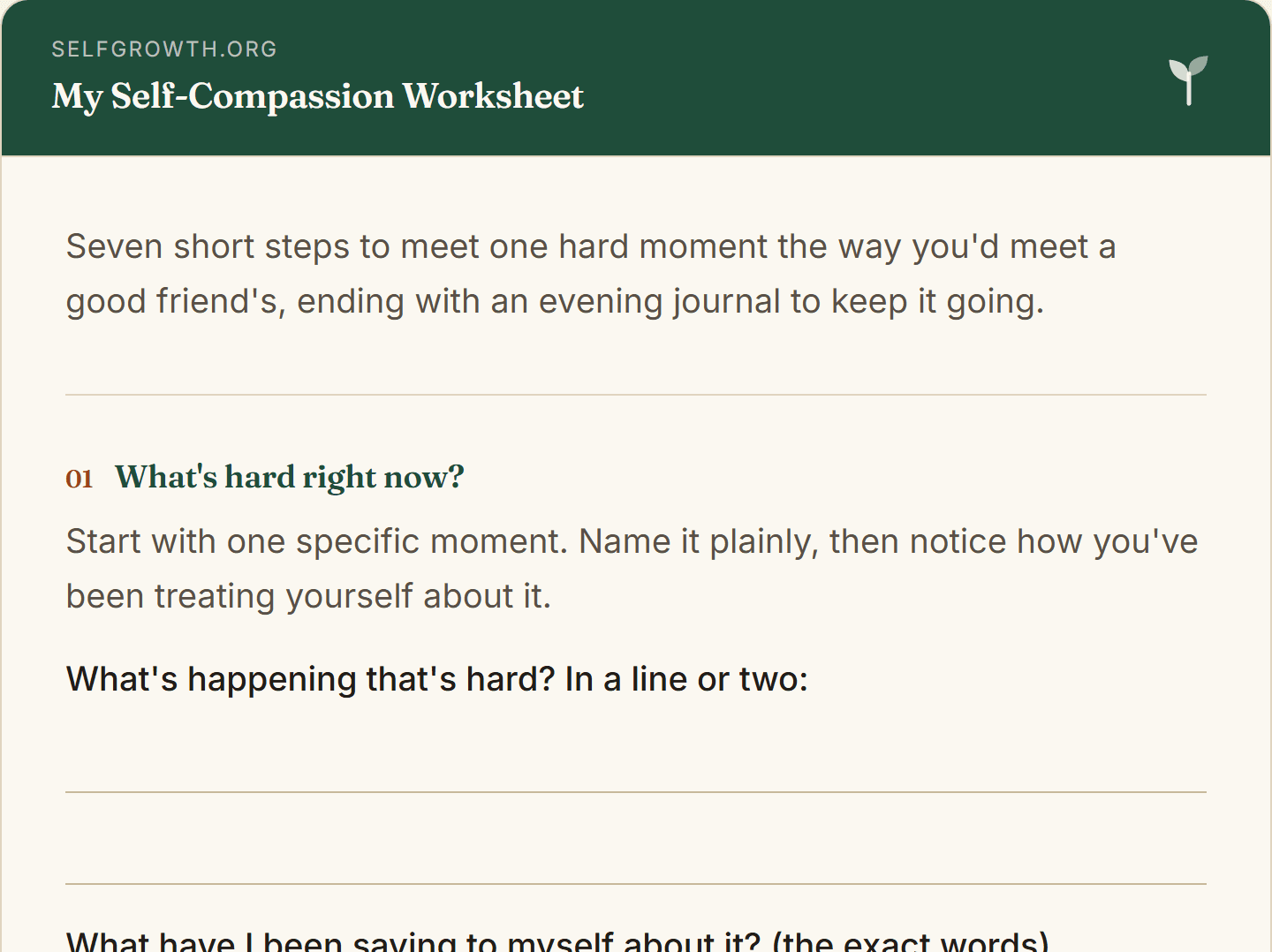
Self-Compassion Worksheet
A free, printable self-compassion worksheet: the self-compassion break, the friend test, a kind letter and journal prompts, based on Kristin Neff's research.
Open worksheet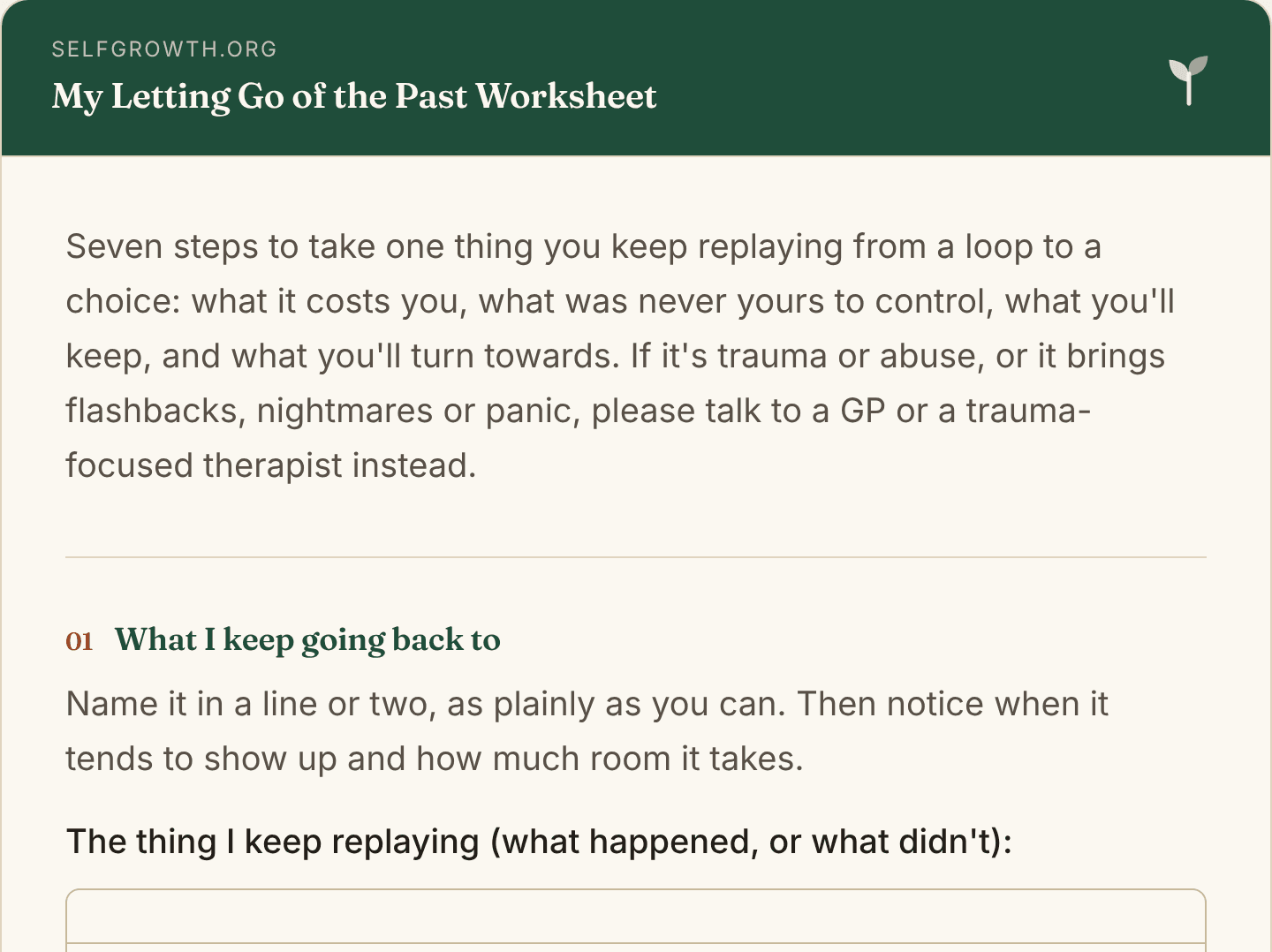
Letting Go of the Past Worksheet
A free printable letting go worksheet: see what replaying the past costs you, sort what was in your control, write an unsent letter, plan for when it returns.
Open worksheet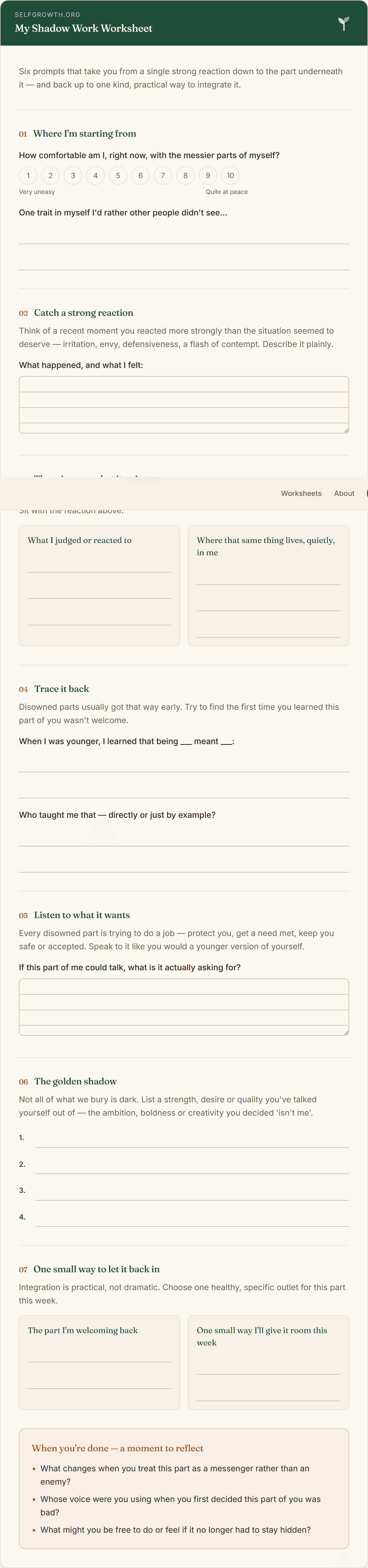
Shadow Work Worksheet
A free, printable shadow work worksheet: guided prompts to spot your triggers and projections, trace them to their roots, and meet the parts you hide.
Open worksheetNew worksheets, straight to your inbox
An occasional new worksheet or tool, sent only when there's something genuinely worth your time. No spam, no pressure, unsubscribe any time.