
Self-compassion
Letting go of the past worksheet: a free, printable way to stop replaying it and move on
Updated 11 October 2026 · 7 min read · Free to print
A letting go of the past worksheet helps you stop replaying something that's over. You name what you keep going back to, weigh what replaying it gives and costs you, sort what was in your control from what wasn't, keep the lessons, write an unsent letter, then choose what to turn towards and plan for when it returns.
By the Self Growth team · drawn from research on rumination, acceptance and commitment therapy and expressive writing · how we make these
Fill it in here (it saves in this browser, but not in a private window), print it, or download the PDF. Free, no sign-up.
Some things end, but your mind keeps going back to them. A relationship, a falling-out, a chance you missed, a version of your life that didn't happen. You replay the conversation, rewrite the ending, ask 'what if' for the hundredth time. It can feel like thinking it through, but the same loop rarely lands anywhere new.
First, an honest note. If what you can't let go of is trauma or abuse, or it comes back as flashbacks, nightmares or panic, this worksheet isn't the right tool. That kind of memory deserves proper help, not a page of prompts. Please talk to your GP, who can refer you for trauma-focused therapy. If you're in crisis, call Samaritans on 116 123 (UK and Ireland) or call or text 988 (US), or find a helpline at findahelpline.com. If someone is hurting you now, contact a domestic abuse service: in the UK, 0808 2000 247; in the US, 1-800-799-7233.
For the everyday kind of stuck, signs often look like this: the same memory pulls you back several times a day, you compare everything now with how it was, you avoid people or places tied to it, or you feel you can't start something new until you've made sense of the old. It often grows from things that were never finished: words left unsaid, no clear ending, a loss you didn't get to grieve, or a belief that if you go over it enough, you'll find the answer.
Letting go here doesn't mean forgetting, pretending it didn't matter, or forgiving anyone. It means the past takes up less room, so there's more for now. If what you keep replaying is something you did wrong, the self-forgiveness worksheet is built for that. This one is for the things you can't change, whoever was to blame.
How to use this worksheet
- 1Pick one thing you keep going back to, not your whole history. One person, one event, one chapter.
- 2Allow about 25 minutes somewhere private. Nobody else has to see what you write.
- 3Write plainly. You're not trying to solve the past, just to see it clearly enough to put some of it down.
- 4If a step stirs up more than you can sit with, stop there. Coming back to it another day is part of the process, not a failure.
The worksheet
selfgrowth.org
My Letting Go of the Past Worksheet
Seven steps to take one thing you keep replaying from a loop to a choice: what it costs you, what was never yours to control, what you'll keep, and what you'll turn towards. If it's trauma or abuse, or it brings flashbacks, nightmares or panic, please talk to a GP or a trauma-focused therapist instead.
01What I keep going back to
Name it in a line or two, as plainly as you can. Then notice when it tends to show up and how much room it takes.
The thing I keep replaying (what happened, or what didn't):
When it shows up most (times, places, reminders):
How much of my mind is it taking up right now?
02What replaying it gives me, and what it costs me
Going back over the past usually feels useful in some way, or you wouldn't keep doing it. Be honest about both sides. For example, 'it keeps them close' next to 'I can't enjoy anyone new'.
Entry 1
Entry 2
Entry 3
Entry 4
Has going over it again brought me anything new lately? If so, what?
03What was in my control, and what wasn't
Sort the pieces honestly. Your choices go on the left. Other people's choices, luck, timing and things you couldn't have known go on the right. If someone hurt you, what they did belongs on the right.
Entry 1
Entry 2
Entry 3
Entry 4
What did I know at the time, compared with what I know now?
04What I've learned, and what I want to keep
Letting go isn't throwing everything away. Some of it is worth carrying: a lesson, a good memory, a strength you found, a person who showed up for you.
What this taught me about myself, other people or what matters to me:
What I want to keep from it:
- 1.
- 2.
- 3.
05A letter I won't send
Write to the person, the place or the past itself. Say what you never got to say: what happened, how it felt, what you wish had been different, and what you're ready to put down. This letter is for you. Don't send it, and don't contact anyone who hurt you because of it.
Start with 'Dear ...' and write until you've said it:
06A small act of closing
Some endings never got a proper ending. A small, deliberate act can mark one. It doesn't have to be grand or make sense to anyone else. Tick one, or write your own.
What I'll do, and when:
07What I'll turn towards, and a plan for when it comes back
The past will still show up sometimes. Decide what you want more room for now, and have an if-then plan ready, so a reminder doesn't pull you back into the whole loop.
What matters to me now that I want more time and attention for:
One small step towards it this week:
Entry 1
Entry 2
Entry 3
How much of my mind is it taking up now?
When you're done, a moment to reflect
- What am I hoping to find if I go over it one more time?
- What would I tell a friend who had been replaying this for as long as I have?
- What part of my life is waiting for the room this is taking up?
- Who would I be, or what would I do, if this didn't define me?
- What would a day look like where I remembered it but didn't relive it?
Does writing about the past actually help you let go?
It can, if the writing goes somewhere. Psychologist Susan Nolen-Hoeksema studied rumination (going over the same painful thoughts again and again). In a 2008 review with Blair Wisco and Sonja Lyubomirsky, she sets out the well-supported findings. Rumination makes low mood worse and thinking more negative. It gets in the way of solving problems and of acting. It can wear away the support of people around you. The same review separates rumination from more useful self-reflection. That's why step 2 asks what replaying actually gives you, and why each step ends in a choice rather than another lap of the loop. Most of this research is about depression, so we use it as a guide, not a promise.
Steps 3 and 7 borrow from acceptance and commitment therapy (ACT, a talking therapy about making room for hard feelings while acting on what matters). Steven Hayes and colleagues (2013) describe acceptance as being open to what you're feeling. They're clear it is 'not passive tolerance or resignation'. In ACT, values are things you choose to move towards. Step 7 asks you to choose one. Its if-then plan comes from Peter Gollwitzer's research on implementation intentions (plans that link a situation you expect to a response you've decided in advance).
The unsent letter draws on expressive writing. In James Pennebaker and Sandra Beall's 1986 study, students who wrote about both the facts and the feelings of a traumatic event felt worse straight afterwards. But they made fewer visits to the health centre over the next six months. The authors called the findings preliminary. If writing leaves you feeling much worse, stop.
The act of closing in step 6 is a small nod to research on rituals. In three experiments, Michael Norton and Francesca Gino (2014) found that rituals after a loss (a death, a break-up, losing a lottery in the lab) went with less grief. Feeling more in control seemed to explain it, and it helped even people who didn't believe in rituals. Those studies were about grief, so treat this as a gentle idea to try. The order and wording of the steps are ours, written in plain English to be done on your own.
These are educational self-reflection tools, not therapy. See our editorial standards.
If you want to go deeper
- Nolen-Hoeksema, S., Wisco, B. E. & Lyubomirsky, S. (2008). Rethinking rumination. Perspectives on Psychological Science, 3(5), 400-424.
- Hayes, S. C., Levin, M. E., Plumb-Vilardaga, J., Villatte, J. L. & Pistorello, J. (2013). Acceptance and commitment therapy and contextual behavioral science: Examining the progress of a distinctive model of behavioral and cognitive therapy. Behavior Therapy, 44(2), 180-198.
- Pennebaker, J. W. & Beall, S. K. (1986). Confronting a traumatic event: Toward an understanding of inhibition and disease. Journal of Abnormal Psychology, 95(3), 274-281.
- Norton, M. I. & Gino, F. (2014). Rituals alleviate grieving for loved ones, lovers, and lotteries. Journal of Experimental Psychology: General, 143(1), 266-272.
- Gollwitzer, P. M. (1999). Implementation intentions: Strong effects of simple plans. American Psychologist, 54(7), 493-503.
Your questions, answered
- How do you let go of the past?
- Start with one specific thing, not everything. Name what you keep going back to, notice what replaying it gives you and what it costs you, and sort what was in your control from what wasn't. Keep what's worth keeping, say what you never got to say in a letter you won't send, then put your attention on something that matters now. This worksheet walks you through those steps in order.
- Why can't I let go of the past?
- Often because something was left unfinished: no clear ending, words you never said, a loss you didn't get to grieve, or a question nobody answered. Replaying can also feel useful, as if one more go will bring the answer, or keep a person close. And sometimes it's a sign of something that needs more than self-help, such as trauma, low mood or anxiety. If it's that, a GP is a good first step.
- What are the signs you're stuck in the past?
- Common signs include the same memory pulling you back several times a day, comparing everything now with how things were, rewriting old conversations in your head, avoiding people or places linked to it, and feeling you can't start anything new until you've made sense of the old. Losing sleep over it, or feeling low most days, is a sign to talk to someone.
- How do I stop dwelling on the past?
- Notice the loop when it starts, and name it ('this is the old replay') rather than following it. Ask whether going over it again has brought anything new. Then move your attention on purpose, ideally to something absorbing. A review by Susan Nolen-Hoeksema and colleagues (2008) notes dozens of experiments showing that positive distractions ease low mood. Step 7 helps you plan that move in advance.
- Do I have to forgive someone to move on?
- No. Forgiving someone is a choice, and you can let go of the past without making it. Moving on can simply mean the past takes up less of your life. If you'd like to forgive one day, that's yours to decide, and it doesn't mean excusing what happened or letting the person back in. If what you can't let go of is something you did, try the self-forgiveness worksheet.
- Is there a free letting go worksheet PDF?
- Yes. Use the Download PDF button for a clean, print-ready copy, or Print to print straight from the page. It's completely free, with no payment, email or sign-up. You can also fill it in on screen, and your answers save in this browser.
- When should I get more support?
- This worksheet is a self-reflection tool, not therapy. If what you can't let go of is trauma or abuse, if it comes back as flashbacks, nightmares or panic, or if it's affecting your sleep, work or relationships, talk to your GP or a qualified therapist. Trauma-focused therapy can help. If you ever think about harming yourself, call Samaritans on 116 123 (UK and Ireland) or call or text 988 (US), or find a helpline at findahelpline.com.
Keep going, related worksheets
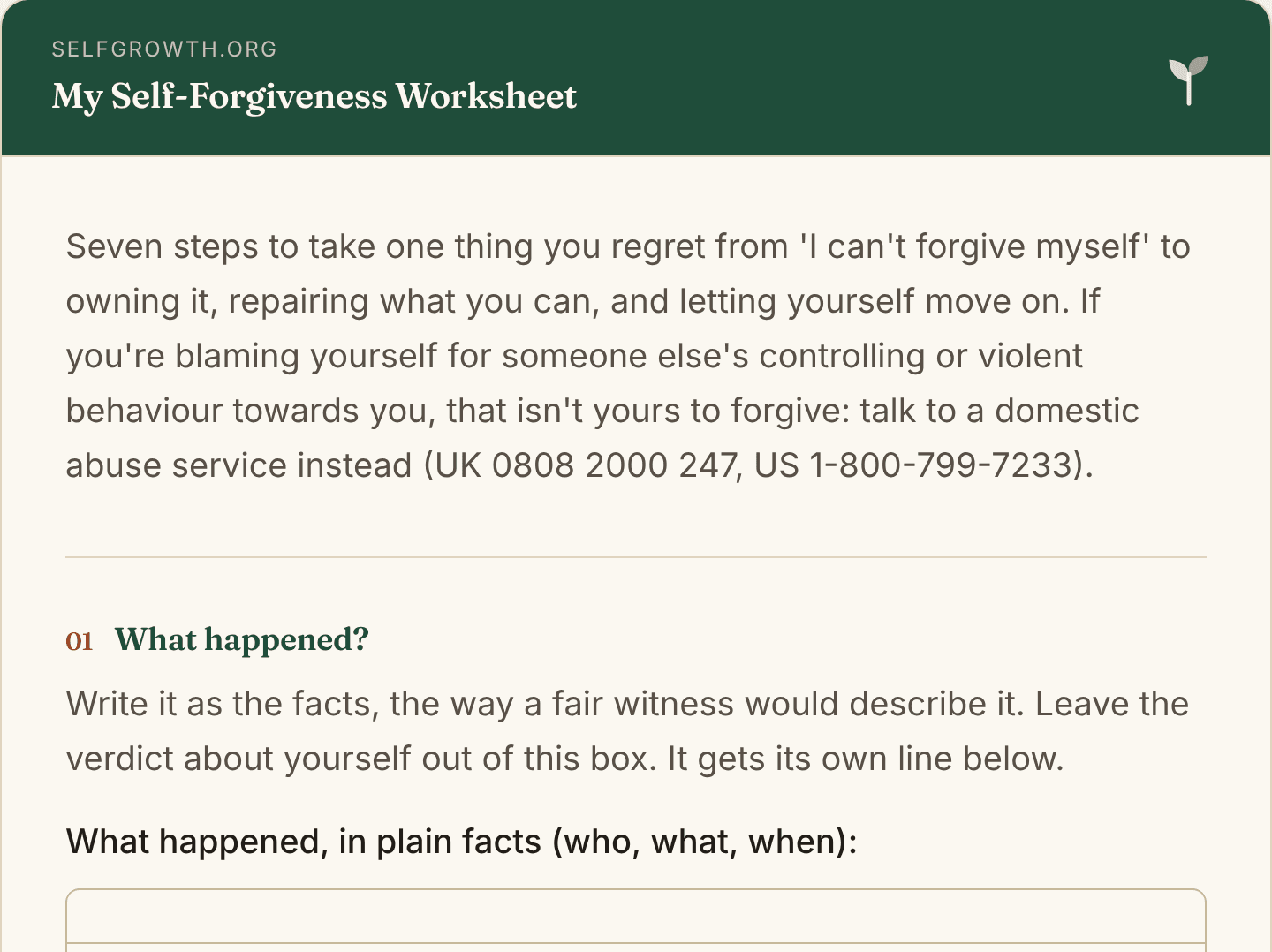
Self-Forgiveness Worksheet
A free, printable self-forgiveness worksheet for adults: own your part, tell guilt from shame, make amends where you can, and write a letter forgiving yourself.
Open worksheet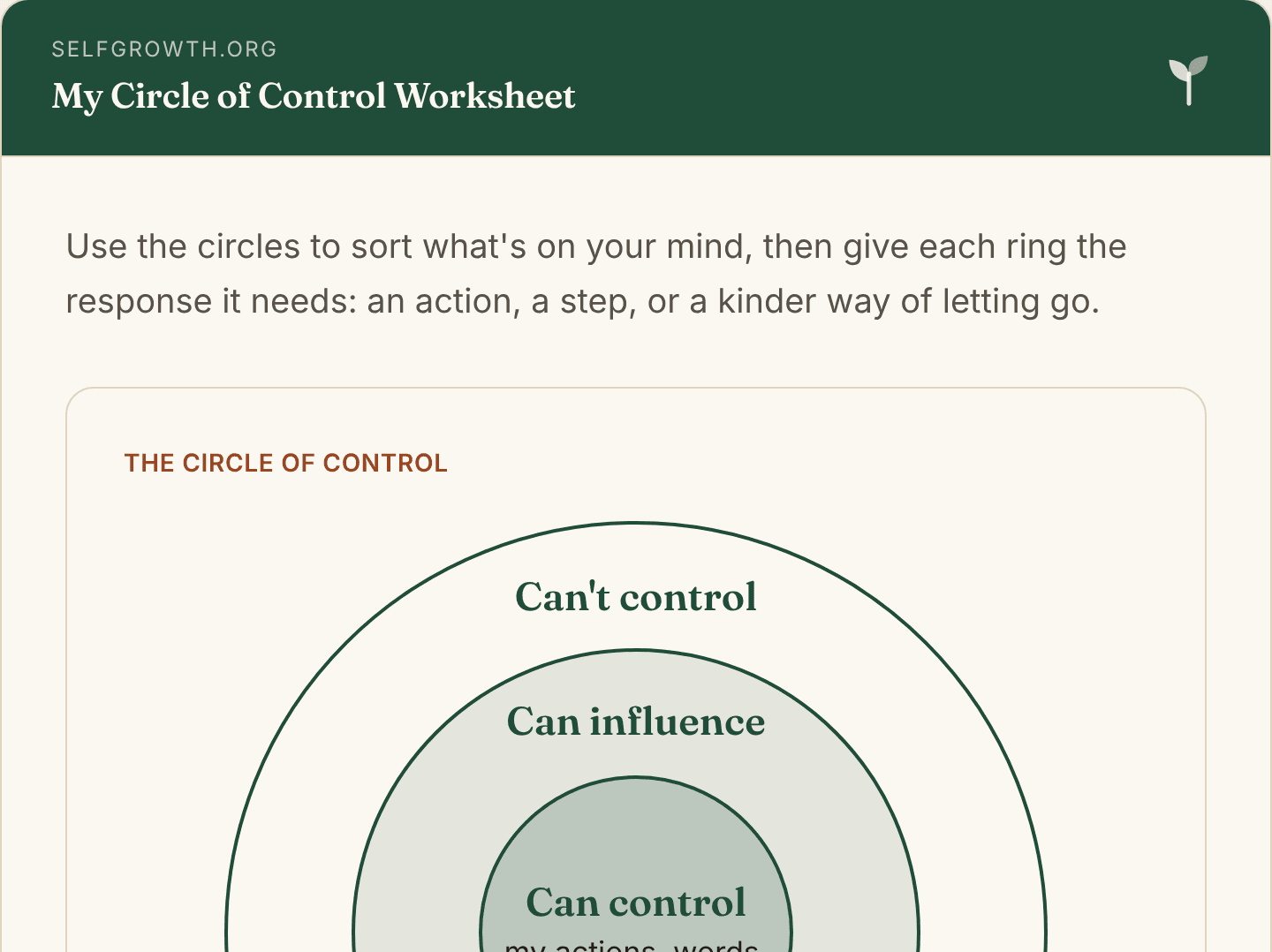
Circle of Control Worksheet
A free circle of control worksheet: sort your worries into what you can control, influence and can't control, then choose one step for each. Free PDF.
Open worksheet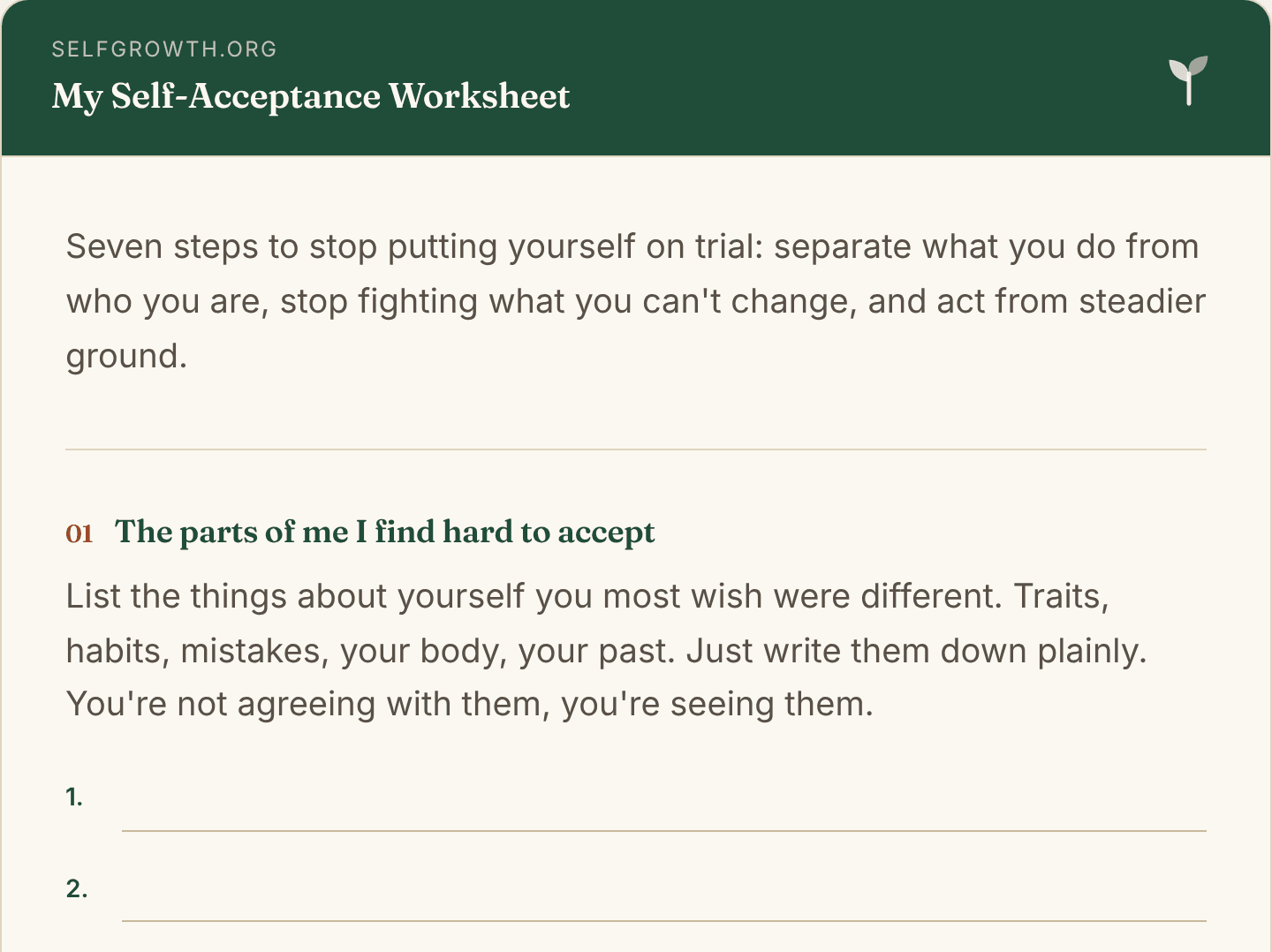
Self-Acceptance Worksheet
A free, printable self-acceptance worksheet: separate what you did from who you are, sort what you can change from what you can't, and stop fighting yourself.
Open worksheetNew worksheets, straight to your inbox
An occasional new worksheet or tool, sent only when there's something genuinely worth your time. No spam, no pressure, unsubscribe any time.