
Self-acceptance
Self-acceptance worksheet: accept yourself as a whole person, and still grow
Updated 11 October 2026 · 7 min read · Free to print
A self-acceptance worksheet helps you accept yourself as a whole person while staying honest about the specific things you'd like to change. Name the parts you find hard to accept, separate 'I did this' from 'I am this', sort what you can change from what you can't, then take one small step from acceptance, not shame.
By the Self Growth team · drawn from rational emotive behaviour therapy and acceptance and commitment therapy · how we make these
Fill it in here (it saves in this browser, but not in a private window), print it, or download the PDF. Free, no sign-up.
Self-acceptance means taking yourself as you are, the whole package, without needing to be better first. It isn't deciding everything about you is fine. It's dropping the running verdict on yourself as a person, so you can look honestly at the things you do and the things you can't change, without the weight of 'and that proves I'm no good'.
Low self-acceptance often looks like this: you keep wishing you were someone else, you replay old mistakes as if they define you, you fight facts you can't change (your body, your past, your personality), and you only feel okay about yourself on good days. It can grow out of years of being rated, by other people and then by yourself, until your worth feels like a score you can lose.
This worksheet is built on one idea from psychologist Albert Ellis: you can rate what you do without rating the whole of who you are. You'll name what's hard to accept, pull apart 'I did this' from 'I am this', sort what you can change from what you can't, and finish with one small step and a week of noticing. Acceptance isn't giving up. It's the steadier place change starts from.
How to use this worksheet
- 1Allow about 20 to 30 minutes, and pick a quiet spot. Print it, or fill it in on screen.
- 2Be specific. 'I lose my temper with my kids when I'm tired' is something you can work with. 'I'm a terrible parent' is a verdict, and verdicts are what this sheet helps you put down.
- 3You don't have to like everything you write. Accepting something isn't the same as approving of it.
- 4If one section stirs up a lot, stop there for today. Coming back to it later is part of the practice, not a failure.
The worksheet
selfgrowth.org
My Self-Acceptance Worksheet
Seven steps to stop putting yourself on trial: separate what you do from who you are, stop fighting what you can't change, and act from steadier ground.
01The parts of me I find hard to accept
List the things about yourself you most wish were different. Traits, habits, mistakes, your body, your past. Just write them down plainly. You're not agreeing with them, you're seeing them.
- 1.
- 2.
- 3.
- 4.
- 5.
Right now, how much do I feel at war with myself?
02'I did this' is not 'I am this'
Pick a few items from your list. On the left, write what you actually did or do. In the middle, the label you give yourself for it. On the right, what it doesn't prove about you as a whole person.
Entry 1
Entry 2
Entry 3
A fairer way to describe myself, behaviour and person kept apart:
03What I can change, and what I can't
Take the things on your list one at a time. Some you can change, some you can only influence, and some you can't change at all. Be honest. Fighting the third kind wears you out, and giving up on the first kind costs you too.
Entry 1
Entry 2
Entry 3
Entry 4
04The facts I keep fighting
Some things about you are simply true, whether you like them or not. Tick the areas where you notice yourself pushing against reality, then write what that fight is costing you.
Entry 1
Entry 2
Entry 3
05Acceptance statements I can actually believe
Skip the big affirmations. Write a few honest sentences you can say without wincing. For example: 'I'm a fallible human, like everyone else.' 'I don't like this about myself, and it's still part of me.' 'I made a mistake. I'm not a mistake.' Then rate how believable each one feels today.
Entry 1
Entry 2
Entry 3
Entry 4
06A small action from acceptance, not shame
Choose one thing from step 3 that you can change. Shame says 'fix yourself because you're not good enough'. Acceptance says 'I'm okay as a person, and I'd like to do this better'. Write both versions, then pick a step small enough to do this week.
Entry 1
Entry 2
One small step I'll take this week, and when:
07A week of noticing
Each evening, note one moment you judged or fought yourself, and what you did instead (or could have). Noticing is the practice. You don't have to get it right.
Entry 1
Entry 2
Entry 3
Entry 4
Entry 5
Entry 6
Entry 7
When you're done, a moment to reflect
- Which part of you have you been fighting the longest, and what has the fight actually changed?
- Whose voice first told you that you weren't acceptable as you are?
- What would you do differently tomorrow if you didn't have to earn the right to be yourself?
- Is there something you've been calling acceptance that is really giving up? What would real acceptance of it look like?
- What would you tell a friend who listed the same 'unacceptable' things about themselves?
Can you accept yourself and still change?
Yes, and that's the idea this worksheet is built on. Albert Ellis, the psychologist who founded rational emotive behaviour therapy (REBT, a form of talking therapy that works on rigid beliefs), called it unconditional self-acceptance. You accept yourself as a fallible human, whether or not you do well and whether or not others approve, and you rate only your actions, not yourself as a whole. In one of his articles, published by the Albert Ellis Institute, he puts the rule plainly: 'Don't give any kind of global, generalized rating to your self, your essence, or your being.' He also argued that this makes you more responsible, not less, because you can admit a mistake without it proving you're worthless.
Ellis wrote about accepting, without liking, the hard conditions you truly can't change, while working on the ones you can. That's where step 3 comes from. Acceptance and commitment therapy (ACT) adds a related idea about feelings. Steven Hayes and colleagues describe acceptance as making room for whatever you're feeling, rather than fighting it. They're clear it is 'not passive tolerance or resignation'. Step 4, on the facts you keep fighting, borrows that stance.
Psychologist Carol Ryff's 1989 model of psychological well-being names self-acceptance as one of six dimensions. Across the theories she reviewed, it was the quality that came up most often. Her description includes accepting both your good and bad qualities, which is the honest balance this sheet aims for. The order of the steps and the wording are ours, written in plain English to be done on your own.
These are educational self-reflection tools, not therapy. See our editorial standards.
If you want to go deeper
- Ellis, A. (n.d.). Showing people they are not worthless individuals. Albert Ellis Institute (article, albertellis.org).
- Ellis, A. (2005). The myth of self-esteem: How rational emotive behavior therapy can change your life forever. Prometheus Books.
- Hayes, S. C., Levin, M. E., Plumb-Vilardaga, J., Villatte, J. L. & Pistorello, J. (2013). Acceptance and commitment therapy and contextual behavioral science: Examining the progress of a distinctive model of behavioral and cognitive therapy. Behavior Therapy, 44(2), 180-198.
- Ryff, C. D. (1989). Happiness is everything, or is it? Explorations on the meaning of psychological well-being. Journal of Personality and Social Psychology, 57(6), 1069-1081.
Your questions, answered
- What is self-acceptance?
- Self-acceptance is taking yourself as a whole person, strengths, flaws, history and all, without needing to be different first. In Carol Ryff's 1989 model of psychological well-being, it's one of six core dimensions. Her description of someone high in self-acceptance is a person with a positive attitude towards themselves, who recognises and accepts both their good and bad qualities and feels positive about their past.
- How do you accept yourself?
- Start by naming what you find hard to accept, plainly and specifically. Then separate what you did from who you are: 'I made a mistake' is a fact about a moment, not a verdict on you. Sort what you can change from what you can't, put your effort into the first, and practise letting the second be. Steps 1 to 4 of this worksheet walk you through that in order.
- What are some self-acceptance activities?
- Five you can do on paper: listing the parts of you you find hard to accept, the 'I did this' versus 'I am this' columns, sorting things into change, influence or accept, writing acceptance statements you can actually believe, and a week of noticing when you judge yourself. This worksheet includes all five, plus one small step to take from acceptance rather than shame.
- What are the signs of low self-acceptance?
- Common signs include wishing you were someone else, replaying mistakes as proof you're not good enough, feeling okay about yourself only when things go well, hiding parts of yourself in case people judge them, and fighting facts you can't change, such as your body or your past. Ryff describes people low in self-acceptance as dissatisfied with themselves, troubled by certain personal qualities and wishing to be different.
- Why is it so hard to accept myself?
- Often because you've been rated for a long time, at home, at school, at work and online, and you've learned to rate yourself the same way. Albert Ellis argued that the habit of giving yourself one overall score is the real problem, because any score can be lost. Painful experiences, harsh criticism or comparison can make that habit stronger. It's learned, so it can be practised out of.
- Does accepting yourself mean giving up on change?
- No. Acceptance isn't resignation, and it isn't approving of harmful behaviour. Ellis argued that accepting yourself as a person makes it easier to own a mistake and work on changing it, because you're not also defending your whole worth. In acceptance and commitment therapy, acceptance means making room for what you feel rather than fighting it, not putting up with things or giving up. You can accept yourself and still change.
- What's the difference between self-acceptance, self-esteem and self-compassion?
- Self-esteem is how highly you rate yourself, so it rises and falls with how you're doing. Self-acceptance, in Ellis's sense, means not giving yourself an overall rating at all, only rating specific things you do. Self-compassion is how you treat yourself when you're struggling: with kindness rather than harshness. They support each other. If your inner critic is the main problem, the negative self-talk worksheet fits better. For a hard moment, try the self-compassion worksheet.
- Is there a self-acceptance worksheet PDF?
- Yes. Use the Download PDF button near the top of this page for a clean, printable copy to fill in by hand, or Print to print straight from the page. It's free, with no payment, email or sign-up. You can also fill it in on screen, where your answers save in this browser.
- Is this worksheet a substitute for therapy?
- No. It's an educational self-reflection tool, not therapy or medical advice. If disliking yourself is constant, if it's tied to depression, an eating problem or trauma, or it's getting in the way of daily life, talk to your GP or a qualified therapist. If you're having thoughts of harming yourself, contact a crisis line now: Samaritans on 116 123 in the UK, 988 in the US, or findahelpline.com elsewhere. You deserve real support, not just a worksheet.
Keep going, related worksheets
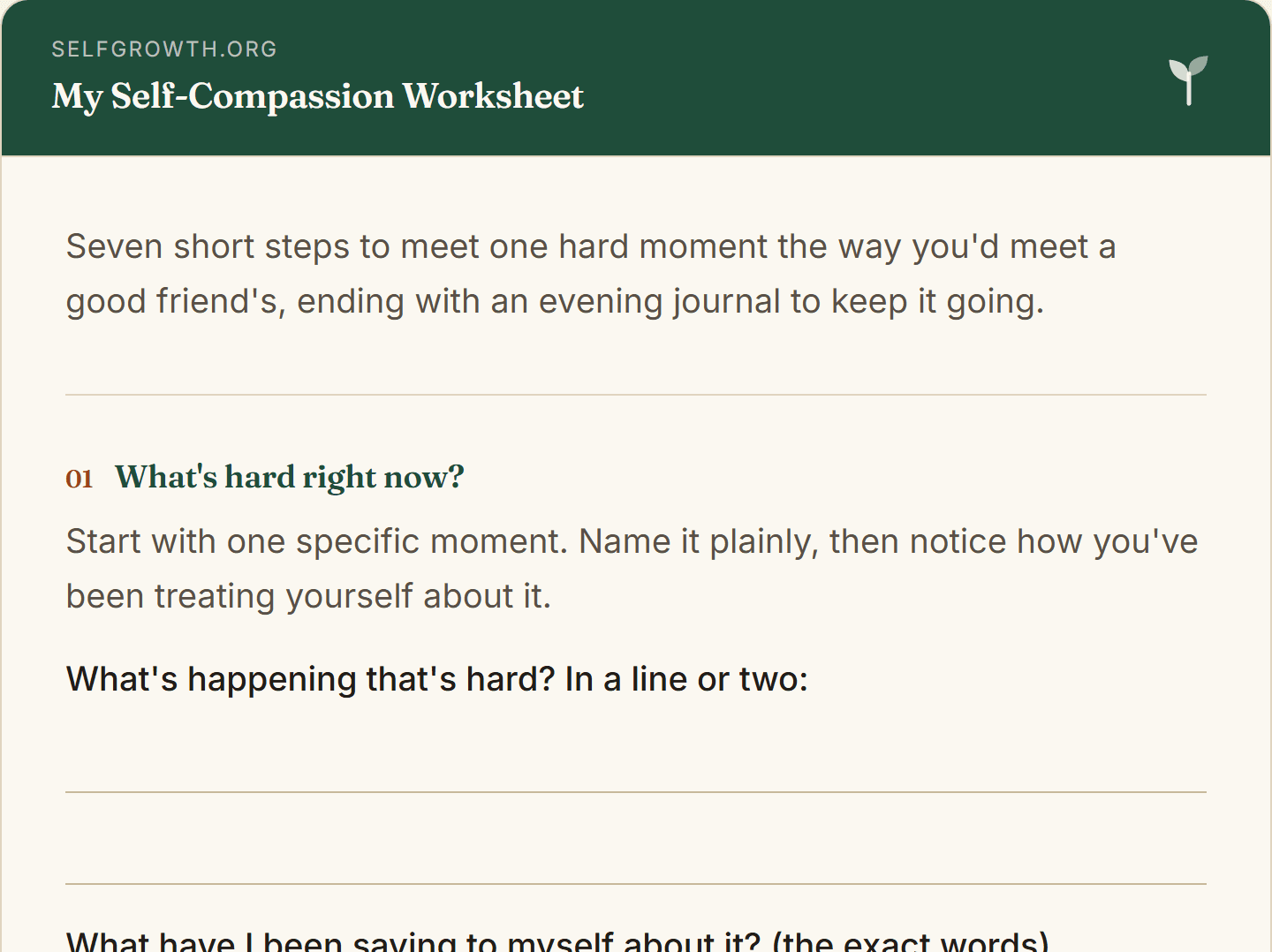
Self-Compassion Worksheet
A free, printable self-compassion worksheet: the self-compassion break, the friend test, a kind letter and journal prompts, based on Kristin Neff's research.
Open worksheet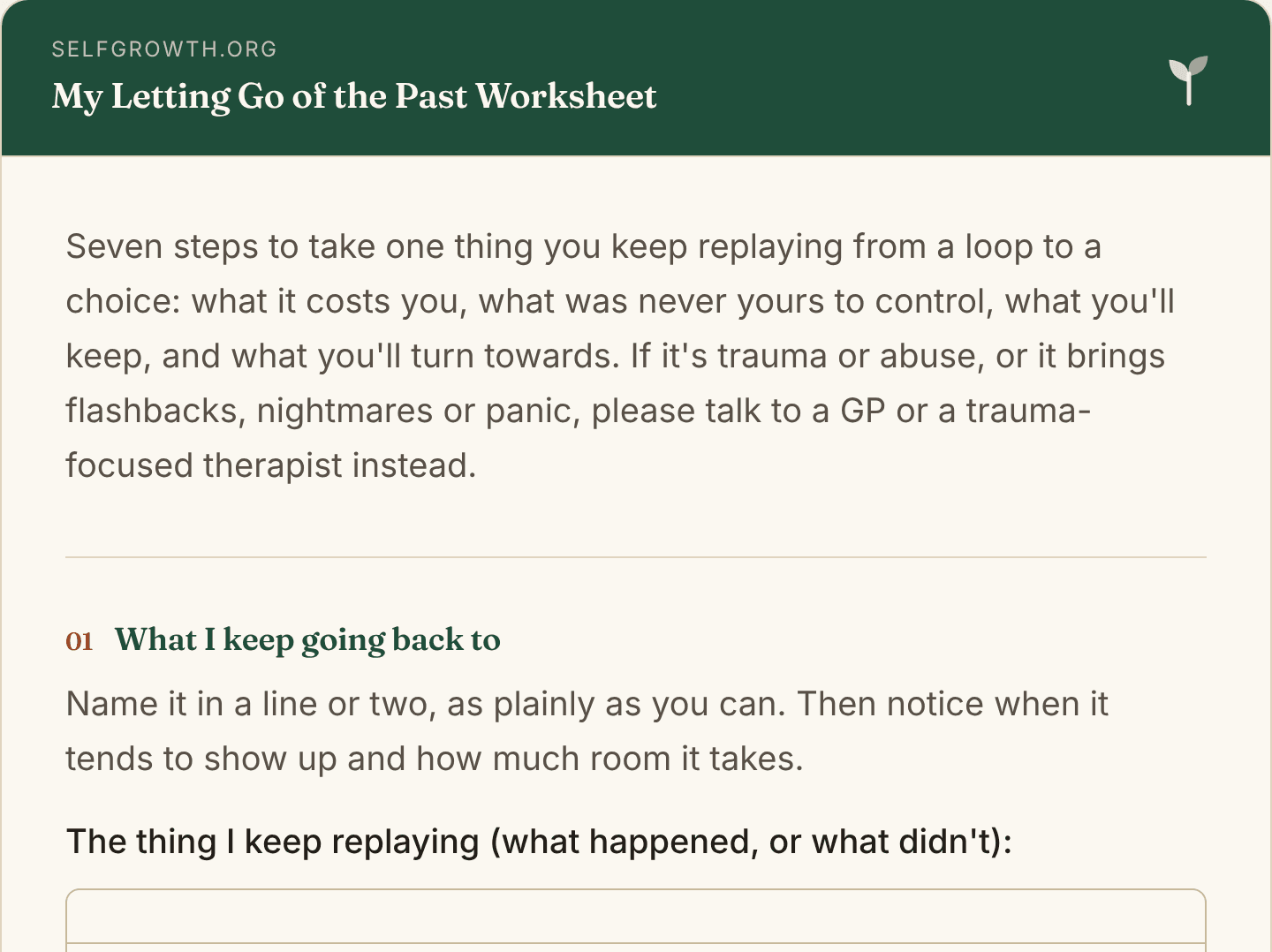
Letting Go of the Past Worksheet
A free printable letting go worksheet: see what replaying the past costs you, sort what was in your control, write an unsent letter, plan for when it returns.
Open worksheet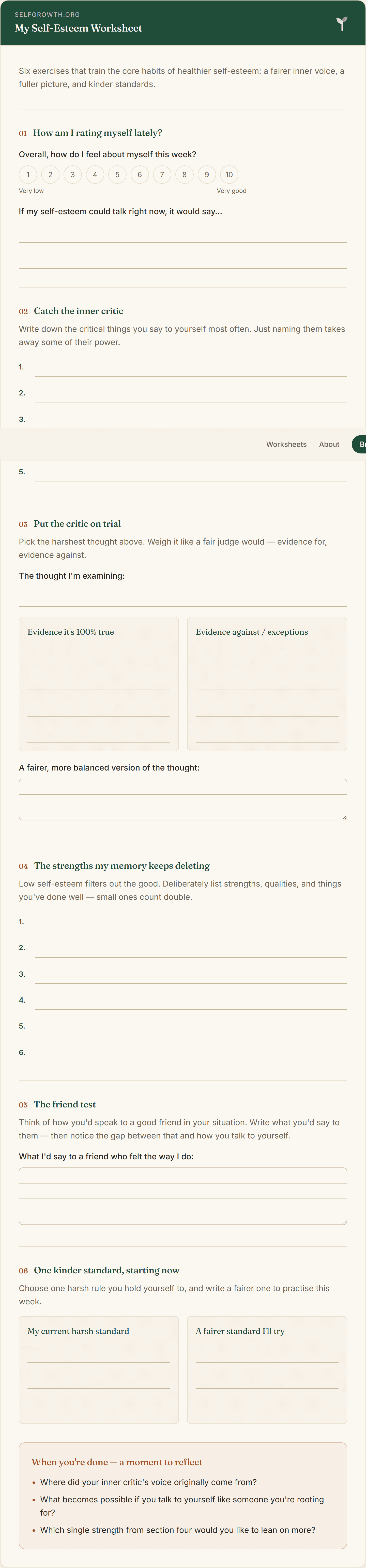
Self-Esteem Worksheet
Free printable self-esteem worksheets (PDF) for adults and older teens: catch your inner critic, test it against evidence, and list the strengths you overlook.
Open worksheetNew worksheets, straight to your inbox
An occasional new worksheet or tool, sent only when there's something genuinely worth your time. No spam, no pressure, unsubscribe any time.