
Self-compassion
Self-Compassion Worksheet: A Free, Printable Way to Be Kinder to Yourself
Updated October 4, 2026 · 6 min read · Free to print
A self-compassion worksheet helps you treat yourself the way you'd treat a struggling friend. This one takes a single hard moment through Kristin Neff's self-compassion break (noticing the pain, remembering you're not alone, offering yourself kindness), then the friend test, a kind letter and an evening journal. It's free to fill in or print.
By the Self Growth team · drawn from self-compassion research and compassion-focused therapy · how we make these
A clean, print-ready PDF, properly formatted, free, no email needed.
When something goes wrong, most of us are far harder on ourselves than we'd ever be on a friend. Self-compassion is learning to close that gap: noticing that you're hurting, remembering you're not the only one, and answering yourself with some warmth instead of a telling-off.
This worksheet takes one hard moment through exercises from psychologist Kristin Neff's work: the self-compassion break, the friend test and a kind letter. It ends with an evening journal you can keep for a week, and a few journal prompts. None of it asks you to pretend things are fine, or to excuse a real mistake.
If being kind to yourself feels awkward or even fake, that's normal, especially if being hard on yourself has been the habit for years. You don't have to believe every word yet. Just try the moves.
- 1
Mindfulness
Instead of being swept away
Notice the pain plainly, without pushing it away or making it bigger.
“This is a moment of suffering.”
- 2
Common humanity
Instead of feeling it's only you
Remember that struggling and getting things wrong is part of being human.
“Suffering is a part of life.”
- 3
Self-kindness
Instead of harsh self-judgement
Answer yourself with the warmth you'd give a good friend.
“May I be kind to myself.”
The self-compassion break says all three, in this order
How to use this worksheet
- 1Pick one specific hard moment, not your whole life. Something from today or this week is ideal.
- 2Go slowly. A few honest lines in each box are worth more than filling every one.
- 3Use your own words. If a suggested phrase feels stiff, change it until it sounds like you.
- 4Keep the letter, and come back to the evening journal. Self-compassion grows with repetition, a little and often.
The worksheet
selfgrowth.org
My Self-Compassion Worksheet
Seven short steps to meet one hard moment the way you'd meet a good friend's, ending with an evening journal to keep it going.
01What's hard right now?
Start with one specific moment. Name it plainly, then notice how you've been treating yourself about it.
What's happening that's hard? In a line or two:
What have I been saying to myself about it? (the exact words)
How harshly am I treating myself about this right now?
02A self-compassion break
Kristin Neff's three-step practice. Bring the moment to mind and let yourself feel a little of it. If it helps, put a hand on your heart as you write.
1. Mindfulness: 'This is a moment of suffering.' What am I feeling, said plainly, without making it bigger or smaller?
2. Common humanity: 'I'm not alone.' Who else might feel this way in a situation like mine?
3. Kindness: 'May I be kind to myself.' What do I need to hear right now?
03The friend test
Imagine a close friend came to you with this exact problem. Notice the difference between how you'd treat them and how you've been treating yourself.
What I'd say to a friend
And the tone I'd use
What I've said to myself
And the tone I've used
What am I afraid would happen if I spoke to myself the way I'd speak to them?
04What do I need right now?
Self-compassion isn't only soothing. Sometimes the kind thing is to rest, and sometimes it's to act. Tick what fits.
One kind thing I'll do for myself today:
05A letter from a kind friend
Imagine a friend who is completely kind and accepting. They see all your strengths and all your flaws, and they understand what shaped you. Write to yourself from them, about this moment or a flaw you often judge yourself for.
Start with 'Dear [your name],' and write as they would:
06How do I feel now?
Re-rate it. It doesn't need to drop to zero. A little more warmth is the win.
How harshly am I treating myself about this now?
A phrase I want to remember next time:
07Keep it going: an evening journal
Neff suggests trying this every evening for a week. Note one thing from the day you felt bad about, then take it through the three parts.
Mindfulness
How I felt, said plainly
Common humanity
How it's part of being human
Kindness
What I'd say to myself kindly
When you're done, a moment to reflect
- When did you last treat a friend with real kindness? What would it take to give yourself the same?
- What does your harshest inner voice say most often, and whose voice does it sound like?
- What are you afraid would happen if you stopped being so hard on yourself?
- What are you struggling with that many other people struggle with too?
- What would having your own back look like this week?
Why these steps, and where they come from
The spine of this worksheet is Kristin Neff's research on self-compassion. Neff, a psychologist at the University of Texas at Austin, describes self-compassion as three parts working together: mindfulness (seeing your pain clearly), common humanity (remembering that everyone struggles) and self-kindness (meeting it with warmth rather than judgement). The self-compassion break in step 2, the friend test in step 3, the letter in step 5 and the evening journal in step 7 are adapted from the exercises she shares on her website, self-compassion.org. Step 4 comes from the question she calls central to self-compassion: 'What do I need right now?'
Paul Gilbert's compassion-focused therapy shapes the tone. Gilbert noticed that people with a lot of shame and self-criticism often find it very hard to feel warmth towards themselves, even when they can see the logic of being fairer. That's why the worksheet asks you to practise the moves, with a hand on your heart if it helps, rather than wait until you feel convinced. And the research suggests it helps you own your mistakes rather than dodge them: in experiments by Breines and Chen (2012), people who were kind to themselves about a mistake were more motivated to put it right and to improve.
We've reworded Neff's exercises in plain English and put them in an order you can work through in one sitting. Her original versions are free on her website if you want to go further.
These are educational self-reflection tools, not therapy, see our editorial standards.
If you want to go deeper
- Neff, K. D. Self-compassion exercises 1 to 6, including the self-compassion break, self-compassion.org.
- Neff, K. D. (2003). Self-compassion: An alternative conceptualization of a healthy attitude toward oneself. Self and Identity, 2(2), 85-101.
- Gilbert, P. (2009). Introducing compassion-focused therapy. Advances in Psychiatric Treatment, 15(3), 199-208.
- Breines, J. G. & Chen, S. (2012). Self-compassion increases self-improvement motivation. Personality and Social Psychology Bulletin, 38(9), 1133-1143.
Questions people ask
- What is a self-compassion worksheet?
- It's a structured page that helps you treat yourself, in a hard moment, the way you'd treat a friend. This one takes one specific moment through Kristin Neff's self-compassion break, the friend test, a check on what you actually need, and a kind letter from a friend's point of view. It ends with an evening journal and a few journal prompts so the habit can keep going.
- How do you do a self-compassion break?
- Bring a stressful situation to mind and let yourself feel a little of it. Then say three things to yourself: 'This is a moment of suffering' (mindfulness), 'Suffering is a part of life' (common humanity) and 'May I be kind to myself' (self-kindness), with a hand on your heart if it helps. Use your own words if those feel stiff. Step 2 of this worksheet walks you through it in writing.
- What are some good self-compassion journal prompts?
- Try: 'When did I last treat a friend with real kindness, and what would it take to give myself the same?', 'What does my harshest inner voice say most often?', 'What am I afraid would happen if I stopped being so hard on myself?' and 'What am I struggling with that other people struggle with too?'. The evening journal in step 7 gives you a simple daily format too.
- Will being kind to myself make me lazy?
- The research suggests not. In experiments by Breines and Chen (2012), people who were encouraged to be kind to themselves about a mistake were more motivated to make amends and improve, and after failing a test they studied longer for the next one. Self-compassion isn't letting yourself off the hook. It's being on your own side while you put things right.
- Is there a self-compassion worksheet PDF?
- Yes. Use the Download PDF button for a clean, print-ready copy, or Print to print straight from the page. It's completely free, with no payment and no email needed. You can also fill it in on screen, and your answers save in your browser.
- Is this worksheet a substitute for therapy?
- No. It's an educational self-reflection tool for everyday hard moments, not therapy or medical advice. If your inner voice is relentless or cruel, if you feel hopeless, or if you ever have thoughts of harming yourself, please reach out to a GP or family doctor, a qualified mental health professional or a crisis line. You deserve real support, not just a worksheet.
Keep going, related worksheets

Negative Self-Talk Worksheet
A free, printable negative self-talk worksheet: catch a harsh inner-critic thought, check whether it's fair, and answer it with something true and kinder.
Open worksheet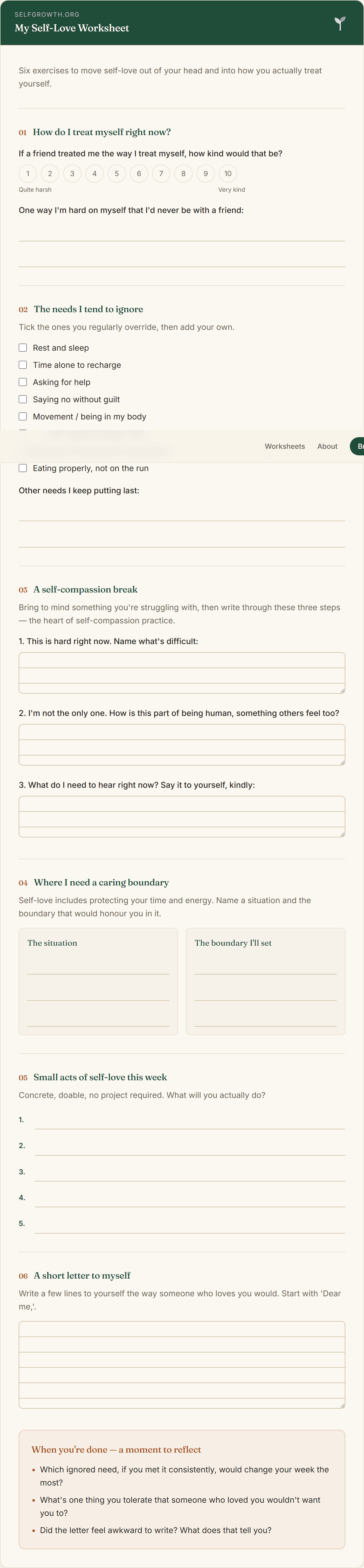
Self-Love Worksheet
A free, printable self-love worksheet that turns self-love from a vague idea into specific actions, meeting your needs, setting boundaries, and treating yourself with care.
Open worksheet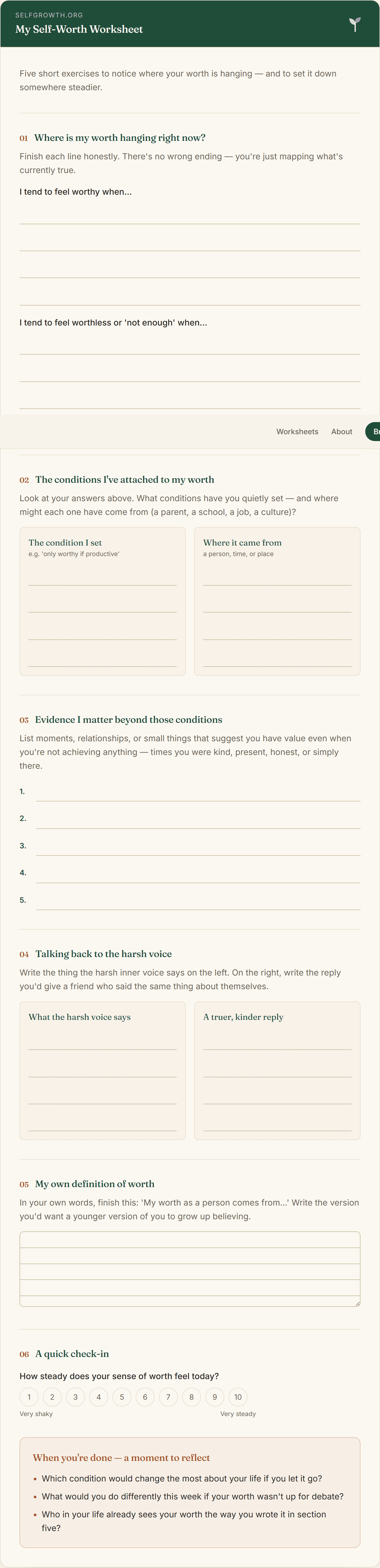
Self-Worth Worksheet
A free, printable self-worth worksheet with five short exercises to separate your value from your achievements and rebuild a steadier sense of worth.
Open worksheetNew worksheets, straight to your inbox
An occasional new worksheet or tool, sent only when there's something genuinely worth your time. No spam, no pressure, unsubscribe any time.