
Inner critic
Positive self-talk worksheet: a free, printable way to build a kinder inner voice
Updated 11 October 2026 · 6 min read · Free to print
A positive self-talk worksheet helps you build a kinder, more realistic inner voice as a habit. You note the phrases you usually say to yourself, rewrite them as balanced statements you actually believe, borrow what you'd tell a friend, write a pep talk using your own name, and practise for seven days. It's free to print.
By the Self Growth team · drawn from self-talk research, CBT and self-compassion · how we make these
Fill it in here (it saves in this browser, but not in a private window), print it, or download the PDF. Free, no sign-up.
Most of us talk to ourselves all day without noticing: 'come on, hurry up', 'typical', 'you idiot', 'why do I bother'. Those little phrases set the tone for how a day feels. Positive self-talk isn't about drowning them out with cheerfulness. It's about building a second voice that is kind, fair and on your side, and using it often enough that it starts to come first.
The word 'positive' can put people off, and for good reason. If you're already hard on yourself, telling yourself 'I'm brilliant' can feel like a lie, and your mind is quick to argue back. So this worksheet aims for something you can actually believe: statements that are balanced, specific and kind, the way a good friend would put it.
You'll start with the phrases you already use, rework them into versions that ring true, write a short pep talk for a hard moment, collect a few lines you genuinely believe, and then practise for a week. If you want to work on one harsh thought in depth first, the negative self-talk worksheet does exactly that, and pairs well with this one.
How to use this worksheet
- 1Spend a day or two just noticing what you say to yourself before you fill in the first section. Write the phrases down as they come.
- 2Test every new phrase for believability. If part of you scoffs at it, soften it until it feels at least mostly true.
- 3Use your own words. A kind phrase only works if it sounds like something you'd actually say.
- 4Keep the page somewhere you'll see it, and fill in one line of the practice log each day. The habit grows with repetition, not with getting it perfect.
The worksheet
selfgrowth.org
My Positive Self-Talk Worksheet
Seven short steps to build a kinder, more believable inner voice, ending with a week of practice.
01Notice what you usually say to yourself
Before you change your self-talk, catch it. Think about the last few days. What did you say to yourself, out loud or in your head, when things went wrong or got busy?
Phrases I often say to myself (the exact words):
- 1.
- 2.
- 3.
- 4.
- 5.
When does my self-talk get harshest? Tick any that fit.
Overall, how kind is the way I talk to myself?
02Turn them into balanced, believable versions
Take each phrase from step 1 and write a version that is kinder but still true. Not 'I'm amazing', but something a fair friend would say. Adding 'and' often helps: 'This is hard, and I'm getting through it.' Then rate how believable the new version feels.
Entry 1
Entry 2
Entry 3
Entry 4
Entry 5
If a new version scored low, how could I make it more believable? (smaller, more specific, or 'I'm learning to...')
03What would you say to a friend?
You already know how to talk kindly. You do it with people you care about. Collect that voice here so you can borrow it for yourself.
Things I say to a friend or someone I love when they're struggling:
- 1.
- 2.
- 3.
- 4.
The tone I use with them (for example warm, patient, matter-of-fact):
One of those phrases, rewritten for me:
04A pep talk for a hard moment
Pick something coming up that you're dreading: a meeting, a hard conversation, a first day. Write yourself a short pep talk using your own name and 'you' instead of 'I', the way a supportive friend would talk to you. It can help you take a step back and see the moment more calmly.
The hard moment coming up:
My pep talk, starting with my name. For example: 'Sam, you're nervous, and that makes sense. You've prepared, and you've handled hard things before.'
A one-line version to say to myself in the moment:
05Statements I actually believe
Gather the lines from this page that feel true to you, even on a bad day. A short list you believe is worth more than a long one you don't. Keep it where you'll see it.
Kind, true things I can say to myself:
- 1.
- 2.
- 3.
- 4.
- 5.
06A 7-day practice log
Once a day, note one moment when the old voice showed up and what you said to yourself instead. Some days you'll only notice it afterwards, and that still counts.
Entry 1
Entry 2
Entry 3
Entry 4
Entry 5
Entry 6
Entry 7
07Looking back on the week
Re-rate it. Change is usually small and gradual. A little more kindness than last week is the win.
Now, how kind is the way I talk to myself?
Which phrase helped most, and when do I want to use it next week?
When you're done, a moment to reflect
- Which of your usual phrases would you never say to someone you love? Where do you think you picked it up?
- When has a kind word from yourself actually helped, even a little?
- What would change this week if your first reaction to a mistake was 'that's OK, what's next?'
- Which statement on your list feels most true, and why?
Do positive affirmations work? Why this worksheet aims for believable
The most important choice on this page is aiming for believable rather than glowing. In a study published in Psychological Science, Joanne Wood and her colleagues Perunovic and Lee (2009) asked people to repeat 'I'm a lovable person'. Those with low self-esteem felt worse than people who didn't repeat it, and people with high self-esteem felt only slightly better. People with low self-esteem who were asked to think about ways the statement was both true and not true didn't take the same hit. That's why step 2 asks for balanced versions and a believability rating, and why step 5 keeps only the statements you actually believe.
The pep talk in step 4 draws on Ethan Kross and colleagues' research on distanced self-talk (2014, Journal of Personality and Social Psychology). Across seven studies, people who talked themselves through a stressful task, such as giving a speech or making a first impression, using their own name or 'you' rather than 'I' showed less distress and were rated as performing better. They also tended to see upcoming stressors as a challenge rather than a threat. It's a small shift in wording, and an easy one to practise.
The friend step comes from Kristin Neff's research on self-compassion, which describes treating yourself with the kindness you'd offer someone you care about. The rewriting in step 2 borrows from cognitive behavioural therapy, where the aim is a fairer thought, not a falsely positive one. This is an educational tool for everyday self-talk, not therapy. If your inner voice is relentless or cruel, please reach for real support too.
These are educational self-reflection tools, not therapy. See our editorial standards.
If you want to go deeper
- Wood, J. V., Perunovic, W. Q. E. & Lee, J. W. (2009). Positive self-statements: Power for some, peril for others. Psychological Science, 20(7), 860-866.
- Kross, E., Bruehlman-Senecal, E., Park, J. et al. (2014). Self-talk as a regulatory mechanism: How you do it matters. Journal of Personality and Social Psychology, 106(2), 304-324.
- Neff, K. D. (2003). Self-compassion: An alternative conceptualization of a healthy attitude toward oneself. Self and Identity, 2(2), 85-101.
Your questions, answered
- What is a positive self-talk worksheet?
- It's a structured page that helps you build a kinder, more realistic way of talking to yourself. This one starts with the phrases you already use, helps you rewrite them as balanced statements you believe, borrows the voice you use with friends, and adds a pep talk for a hard moment and a 7-day practice log. It's written for adults, and it works for older teens too.
- How do I practise positive self-talk?
- Start by noticing what you actually say to yourself, word for word. Then write a kinder version of each phrase that still feels true, such as 'I got that wrong, and I can fix it' instead of 'I'm useless'. Use it the next time the old phrase shows up, and note how it went. Doing this a little every day is what turns it into a habit.
- Do positive affirmations actually work?
- It depends on whether you believe them. In a 2009 study by Joanne Wood and colleagues, people with low self-esteem who repeated 'I'm a lovable person' felt worse afterwards, while people with high self-esteem felt only a little better. Statements that feel far from the truth can make your mind argue back. That's why this worksheet asks for believable, balanced statements rather than big affirmations.
- What are some examples of positive self-talk?
- Good examples are kind and true at the same time: 'This is hard, and I'm doing my best', 'One mistake doesn't undo everything else', 'I don't have to get this perfect', 'I've handled hard days before' and 'I'm learning'. Talking to yourself by name can help too: 'Alex, you've got this far. Take the next step.' The best examples are the ones in your own words.
- Is there a positive self-talk worksheet PDF?
- Yes. Use the Download PDF button for a clean, print-ready copy, or Print to print straight from the page. It's completely free, with no payment and no email needed. You can also fill it in on screen, and your answers save in your browser.
- Is this worksheet a substitute for therapy?
- No. It's an educational self-reflection tool for everyday self-talk, not therapy or medical advice. If your inner voice is relentless or cruel, if you feel hopeless, or if you have thoughts of harming yourself, please talk to a GP or family doctor or a qualified mental health professional. If you're in crisis, call Samaritans on 116 123 (UK), call or text 988 (US), or find a local line at findahelpline.com.
Keep going, related worksheets

Negative Self-Talk Worksheet
A free, printable negative self-talk worksheet: catch a harsh inner-critic thought, check whether it's fair, and answer it with something true and kinder.
Open worksheet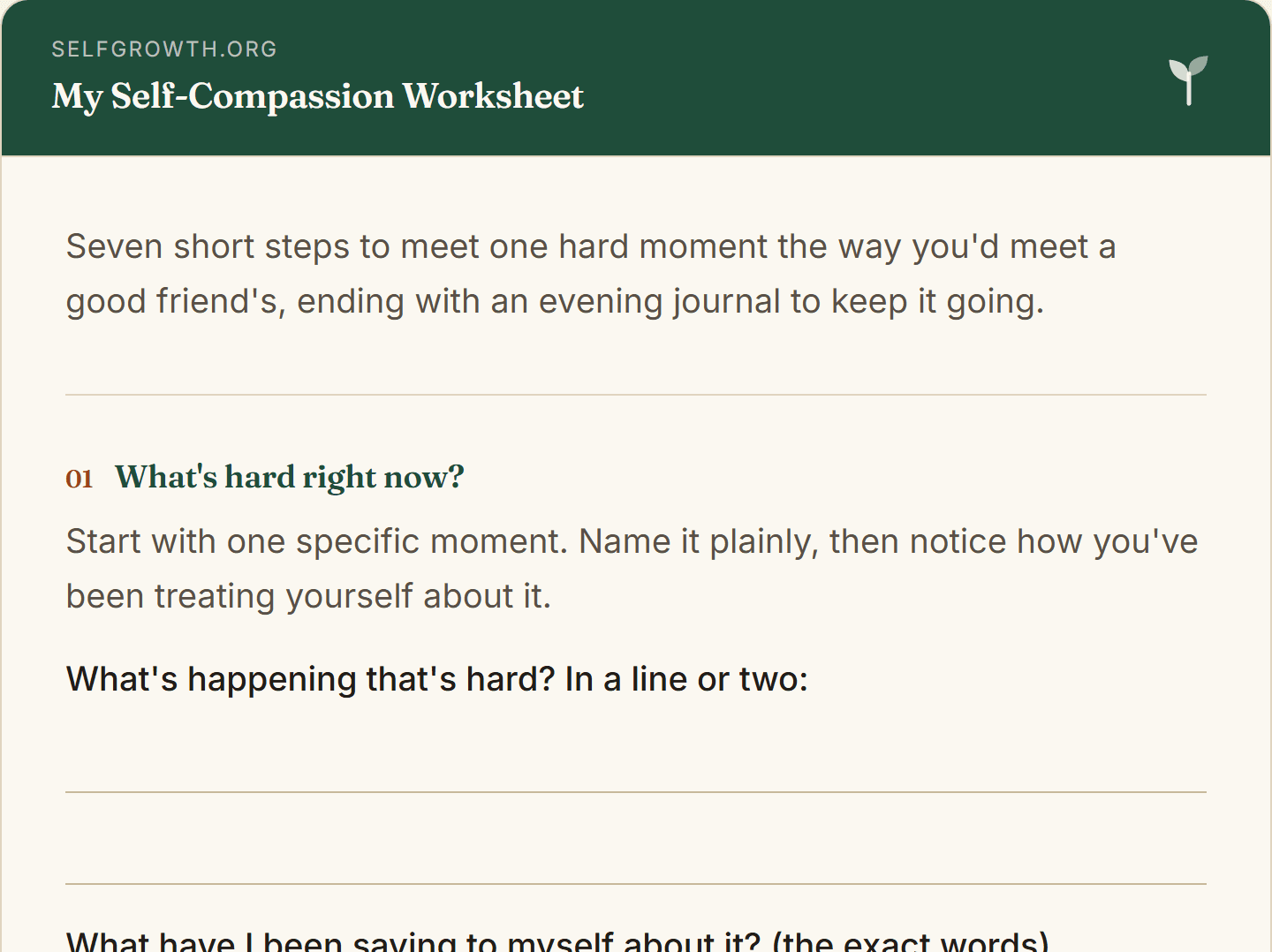
Self-Compassion Worksheet
A free, printable self-compassion worksheet: the self-compassion break, the friend test, a kind letter and journal prompts, based on Kristin Neff's research.
Open worksheet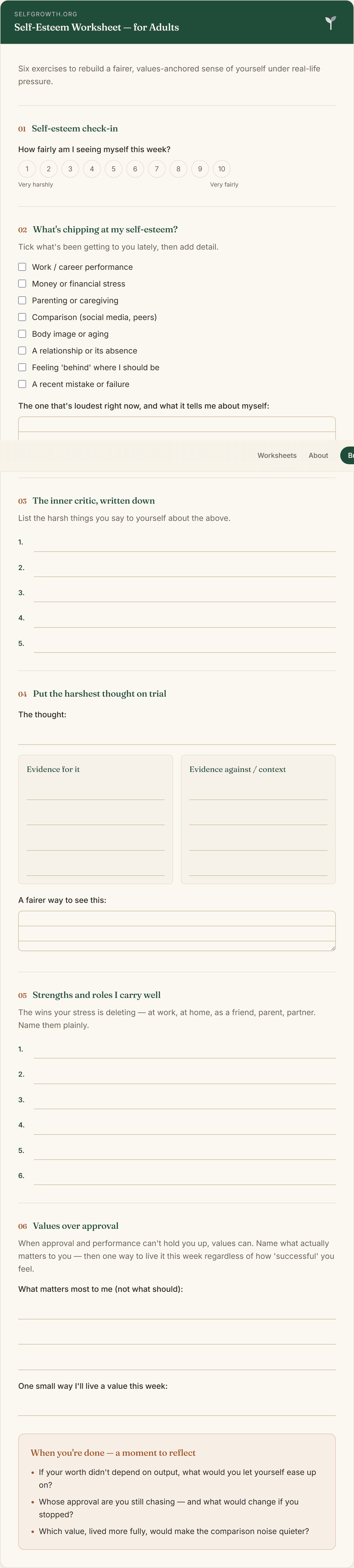
Self-Esteem (Adults)
Free printable self-esteem worksheet for adults: name the pressures wearing you down, question the 'shoulds' you judge yourself by, and credit what you carry.
Open worksheetNew worksheets, straight to your inbox
An occasional new worksheet or tool, sent only when there's something genuinely worth your time. No spam, no pressure, unsubscribe any time.