
Anxious moments
Circle of control worksheet: a free printable to sort what you can and can't control
Updated 11 October 2026 · 7 min read · Free to print
A circle of control worksheet helps you sort what's worrying you into three rings: what you can control, what you can influence and what you can't control. You choose one action for the first, one small step for the second, and practise letting go of the third. This free printable ends with a weekly check.
By the Self Growth team · drawn from Stephen Covey's circles and the Stoic dichotomy of control · how we make these
Fill it in here (it saves in this browser, but not in a private window), print it, or download the PDF. Free, no sign-up.
Some weeks your head fills up with worries of every size at once. A bill, a friend who's gone quiet, a test result, the news, something you said three days ago. They all feel equally urgent, so you spin on all of them and get traction on none. That's tiring, and it can leave you feeling helpless about things you could actually do something about.
The circle of control is a simple way to sort that pile. Picture three rings, one inside the other. In the middle is what you can control: your own actions, words, effort and choices. Around it is what you can influence but not decide: other people, how things turn out, a decision someone else will make. The outer ring is what you can't control at all: the past, the weather, the economy, what other people think. Once a worry is in the right ring, it's clearer what to do with it.
Signs you might need this: you keep going over things you can't change, you feel responsible for how everyone else feels, you put off the one thing you could do while worrying about ten you can't, or you go to bed with a racing list of 'what ifs'. The causes are often ordinary ones. Uncertainty is hard to sit with, and worrying can feel like doing something even when it isn't.
This is a self-reflection tool for everyday worry, not therapy and not a treatment for anxiety. If worry is with you most days, gets in the way of sleep, work or relationships, or comes with panic attacks that keep coming back, please talk to your GP. If you're in crisis, call Samaritans on 116 123 (UK and Ireland), call or text 988 (US), or find a helpline at findahelpline.com.
How to use this worksheet
- 1Start by getting everything out of your head onto the page. Don't sort yet, just list.
- 2Then sort each worry into one ring. Be honest. Many worries are mixed, so split them: the part you control, the part you can influence, the part you can't.
- 3Pick one thing per ring, not everything. One action, one step, one thing to practise letting go of is plenty for a week.
- 4Allow about 20 minutes. Come back to the weekly check in seven days and see what moved.
The worksheet
selfgrowth.org
My Circle of Control Worksheet
Use the circles to sort what's on your mind, then give each ring the response it needs: an action, a step, or a kinder way of letting go.
Put each worry in the ring it belongs to. Act in the middle, take a step in the second ring, and practise letting go of the outer one.
01What's worrying me right now
Write down everything that's on your mind, big or small, in any order. No sorting yet. Getting it out of your head is the first step.
Everything I'm worrying about:
- 1.
- 2.
- 3.
- 4.
- 5.
- 6.
- 7.
- 8.
How heavy does all of this feel right now?
02Sort it into the three circles
Take each worry and put it in the ring it belongs to. If one worry has parts in more than one ring, split it. 'My job interview' might be: my preparation (can control), the impression I make (can influence), whether they pick me (can't control).
Entry 1
Entry 2
Entry 3
Entry 4
Entry 5
Entry 6
03Can control: one action
Choose one thing from the middle circle and make it concrete. Small and specific beats big and vague.
The worry I'm choosing:
One action I'll take, and when (for example, 'Ring the bank on Tuesday at 10'):
What might get in the way, and what I'll do if it does:
04Can influence: one step
You can't decide how this turns out, but you can nudge it. Pick one worry from the second circle and one step that gives it your best shot.
The worry I'm choosing:
One step I could take (a conversation, a request, preparing, asking for help):
The part I'll leave to them, or to how things go:
05Can't control: letting go, and a kinder thought
Letting go doesn't mean you stop caring. It means you stop spending energy trying to change what you can't. Pick one worry from the outer circle.
The worry I'm choosing:
What letting go of this could look like (noticing the thought and coming back to now, setting it aside for later, saying 'that's not mine to fix'):
A kinder thought I can say to myself when it comes back:
When it comes back, I could:
06Weekly check
Come back in about a week. Look at what moved, without judging yourself for what didn't.
Entry 1
Entry 2
Entry 3
How heavy does it all feel now?
Did any worry move rings when I looked again? Which one?
When you're done, a moment to reflect
- Which ring do I spend most of my worrying in? Is that where my effort actually makes a difference?
- Is there something I've been treating as out of my hands that I could take one step on?
- Is there something I've been trying to control that was never mine to carry?
- What would I say to a friend who was worrying about the same things?
- What does it feel like in my body when I put an outer-circle worry down, even for a minute?
Does the circle of control actually work?
The idea is old. The Enchiridion, a short handbook of the Stoic teacher Epictetus's ideas written down by his student Arrian nearly two thousand years ago, opens with it. In Elizabeth Carter's translation, the first line reads: "Some things are in our control and others not." Epictetus advised putting your effort into the first kind and no longer fighting the second. The serenity prayer, usually credited to the American theologian Reinhold Niebuhr, asks for the same three things in plain words: calm about what you can't change, courage to change what you can, and the wisdom to tell them apart.
The circles themselves come from Stephen Covey's The 7 Habits of Highly Effective People (1989). Covey drew a circle of concern (everything you might worry about) and, inside it, a circle of influence (the part you can do something about), and argued that putting your energy into the inner circle is what being proactive means. This worksheet adds a third circle in the middle, for what you fully control, because 'I can decide this' and 'I can only affect this' call for different moves.
So does it work? Honestly, the circle of control is a teaching picture, not a tested therapy, and we don't know of trials of this exact worksheet. It does line up with stress research. Richard Lazarus and Susan Folkman separated problem-focused coping (changing the situation) from emotion-focused coping (managing how you feel about it). Later researchers tested the idea that coping works better when it fits how changeable a situation is. In one two-year study of men under long-term stress, most of them carers (Park, Folkman and Bostrom, 2001), the fit mattered when they were trying to change the situation, mattered less when they were managing their feelings, and didn't matter when they were looking for meaning in it. It's one study, so treat it as a sensible nudge rather than proof.
If you keep replaying something that's already happened, the letting go of the past worksheet goes deeper on the outer circle. If your head is simply too full to sort, start with a brain dump, and if worry has tipped into a wave of panic, the 5-4-3-2-1 grounding worksheet can help you come back to the room first.
These are educational self-reflection tools, not therapy. See our editorial standards.
If you want to go deeper
- Covey, S. R. (1989). The 7 Habits of Highly Effective People. New York: Simon & Schuster.
- Epictetus. The Enchiridion, section 1. Translated by Elizabeth Carter. The Internet Classics Archive, MIT.
- Lazarus, R. S. & Folkman, S. (1984). Stress, Appraisal, and Coping. New York: Springer.
- Park, C. L., Folkman, S. & Bostrom, A. (2001). Appraisals of controllability and coping in caregivers and HIV+ men: testing the goodness-of-fit hypothesis. Journal of Consulting and Clinical Psychology, 69(3), 481-488.
Your questions, answered
- What is the circle of control?
- It's a simple way to sort worries into three rings. In the middle is what you can control (your actions, words and choices). Around it is what you can influence but not decide (other people, outcomes). The outer ring is what you can't control (the past, the weather, the news). Each ring asks for a different response: act, nudge, or let go.
- What's the difference between the circle of control, influence and concern?
- They come from Stephen Covey's book The 7 Habits of Highly Effective People (1989). His circle of concern holds everything you care about, and his circle of influence is the part of it you can do something about. Many versions, including this one, add a separate inner circle for what you fully control, so you can tell 'I can decide this' apart from 'I can only affect this'.
- What are examples of things you can and can't control?
- You can control what you do, what you say, how much effort you put in, how you treat people, what you eat and when you go to bed, and whether you ask for help. You can influence, but not decide, how others respond to you, how a meeting goes or whether you get the job. You can't control the past, the weather, the economy, other people's feelings and choices, or chance.
- How do I stop worrying about things I can't control?
- You probably can't switch the worry off, but you can change what you do with it. Name it as an outer-circle worry, bring your attention back to something in front of you, and spend that energy on one thing in your middle circle instead. It often helps to write the worry down so it's not only in your head. If worry is with you most days or stops you living your life, talk to your GP.
- Is there a free circle of control worksheet PDF?
- Yes. Use the Download PDF button for a print-ready copy with the three circles on the sheet, or Print to print straight from the page. It's completely free, with no payment and no email needed. You can also fill it in on screen, and your answers save in your browser.
- Is a circle of control worksheet a substitute for therapy?
- No. It's an educational self-reflection tool for everyday worry, not therapy, medical advice or a treatment for anxiety. If worry is constant, keeps you awake, comes with panic attacks that keep coming back, or you feel hopeless, please speak to your GP or a mental health professional. In a crisis, call Samaritans on 116 123 (UK and Ireland), call or text 988 (US), or find a helpline at findahelpline.com.
Keep going, related worksheets
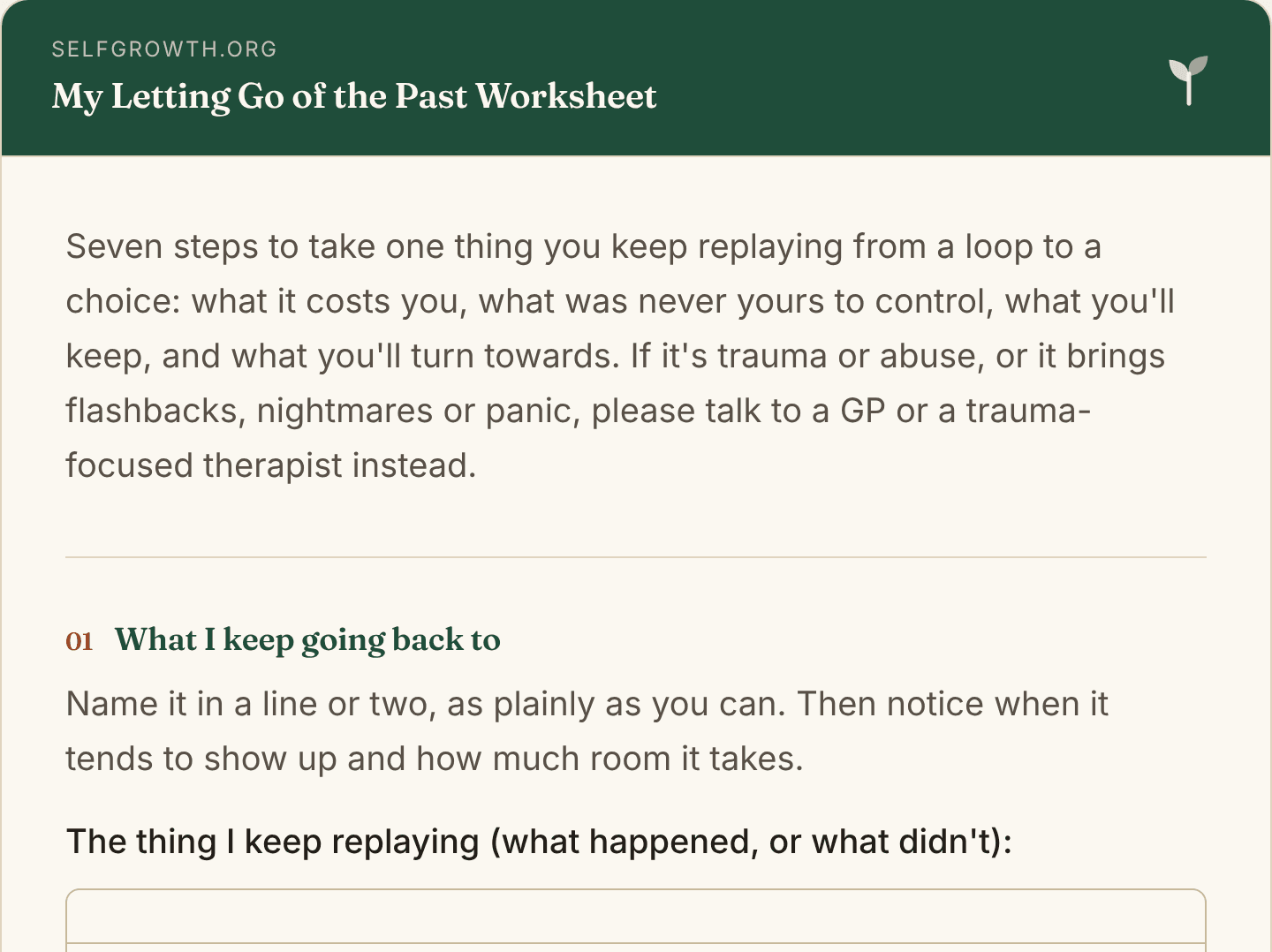
Letting Go of the Past Worksheet
A free printable letting go worksheet: see what replaying the past costs you, sort what was in your control, write an unsent letter, plan for when it returns.
Open worksheet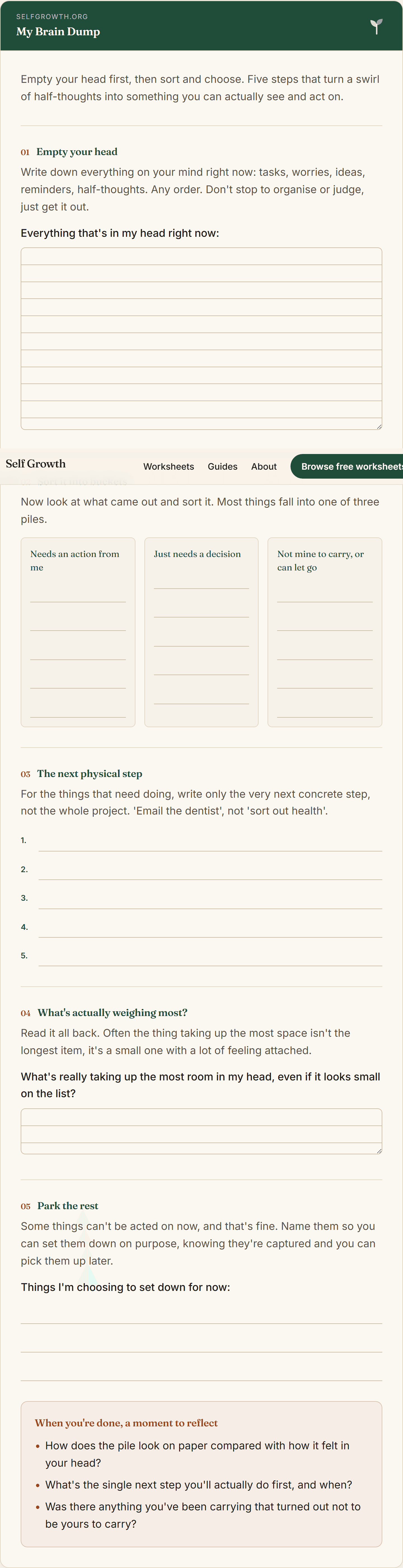
Brain Dump Template
A free, printable brain dump template to empty a cluttered mind onto the page, sort it into what needs action and what to let go, and find the next clear step.
Open worksheet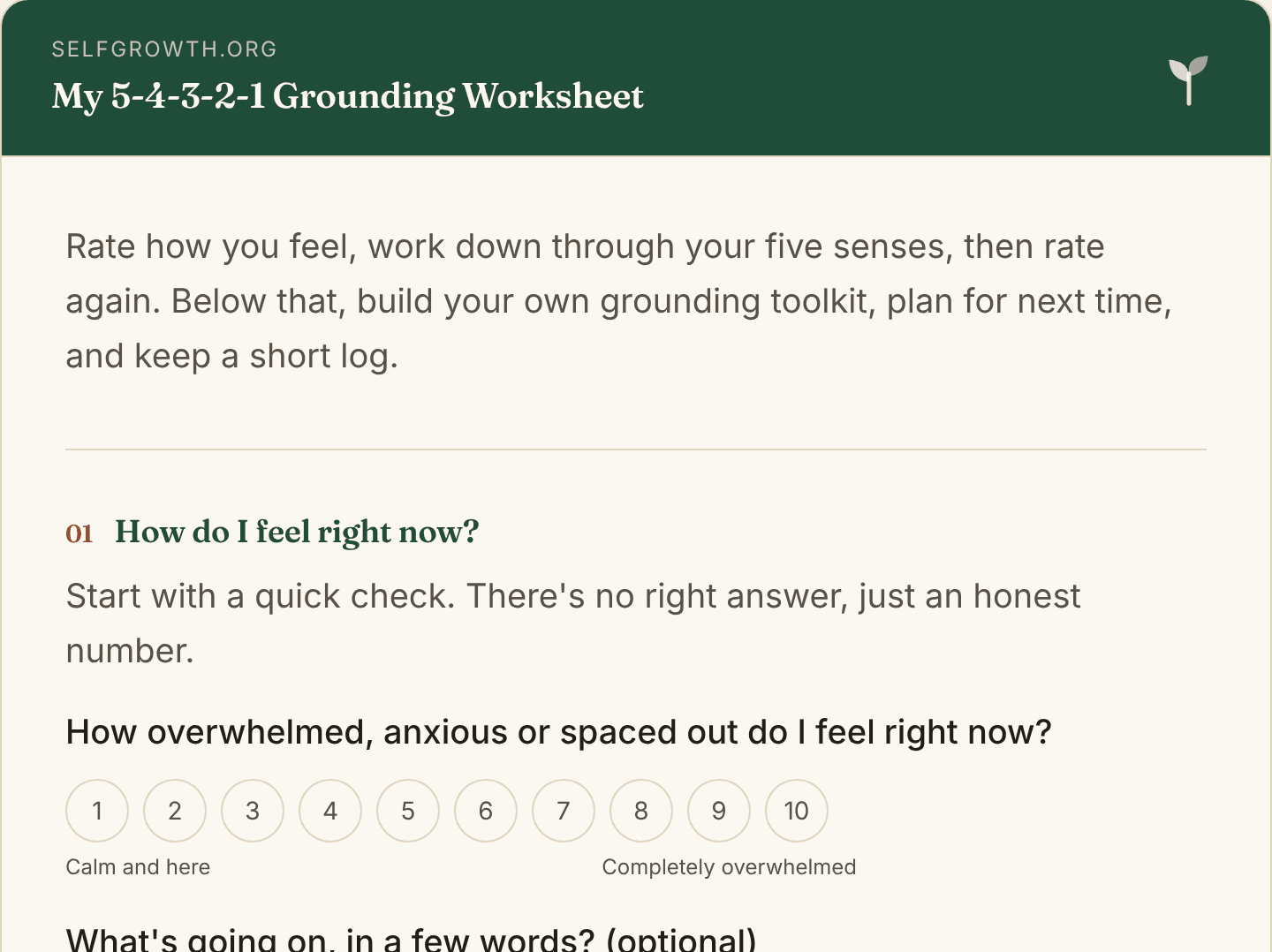
5-4-3-2-1 Grounding Worksheet
A free, printable 5-4-3-2-1 grounding worksheet: rate how you feel, work through your five senses, re-rate, then build your own toolkit and plan for next time.
Open worksheetNew worksheets, straight to your inbox
An occasional new worksheet or tool, sent only when there's something genuinely worth your time. No spam, no pressure, unsubscribe any time.