
Guide
How to stop overthinking
Updated 11 October 2026 · 11 min read
To stop overthinking, don't try to force the thoughts out. Notice the loop and name it, then give your mind somewhere else to go: a set worry time, one small action on what you can control, your senses, a page to write on, a walk or a conversation. With practice, the loop often loosens its grip.
By the Self Growth team · drawn from research on rumination and worry, and acceptance and commitment therapy · how we make these
It's late, you're tired, and your mind is still going over the same thing. What you said in that meeting. What the message really meant. What might go wrong next week. You'd love to switch it off, and the harder you try, the louder it gets.
Overthinking isn't a flaw in your character. It's a habit of the mind, and habits can change. This guide explains what overthinking is, why it's so sticky, and eight practical ways to step out of the loop. The free worksheets below give you somewhere to put the thoughts, so they don't have to live in your head.
What is overthinking?
Overthinking is thinking about the same thing over and over without getting anywhere. It tends to come in two flavours. Rumination looks backwards: replaying a conversation, a mistake or a loss, asking why it happened and what it says about you. Worry looks forwards: running through everything that could go wrong, and how you'd cope if it did.
Both have the same shape. The thoughts go round in a circle, they rarely produce anything new, and you usually come out feeling worse than when you went in. Thinking things through is useful because it moves you forward, and overthinking is when the thinking has stopped helping but hasn't stopped.
Thinking things through moves forward. Overthinking goes round in circles.
Signs of overthinking
You might recognise some of these:
- You replay conversations afterwards, wondering what you should have said.
- You read a short message again and again, looking for hidden meaning.
- You lie awake running through what could go wrong tomorrow.
- Small decisions, like what to order or what to reply, take far longer than they need to.
- You keep asking 'why am I like this?' or 'what if?', and the answers never settle it.
- You seek reassurance from friends, feel better for a moment, then start again.
- You feel tired, tense or low after a long stretch in your own head.
- You find it hard to be present, because part of you is always somewhere else.
None of these on their own means anything is wrong. Everyone overthinks sometimes. It's worth paying attention when the loop takes up a lot of your day, keeps you from sleep, or leaves you feeling worse most of the time.
Why do I overthink?
Overthinking feels like problem-solving. That's what makes it so convincing. If you go over it one more time, surely you'll finally understand, or be ready for whatever comes. Your mind is trying to protect you. The trouble is that going round in circles rarely delivers the answer it promises.
Psychologist Susan Nolen-Hoeksema spent much of her career studying rumination. In a 2008 review with Blair Wisco and Sonja Lyubomirsky, she set out what the research shows. Rumination makes low mood worse. It makes thinking more negative. And it gets in the way of solving problems, which is the very thing it seems to be doing. Most of this research is about depression, so treat it as a guide rather than a rule for everyone.
Some things make overthinking more likely: stress, tiredness, uncertainty, a decision that matters, or a habit of being hard on yourself. If a harsh inner voice drives a lot of your looping, the guide to quieting your inner critic may help alongside this one.
Reflection vs rumination: when thinking helps
Looking inward isn't the problem in itself. Psychologists Paul Trapnell and Jennifer Campbell (1999) found that looking inward is really two different habits, not one. Reflection is curious and open. Rumination is anxious and stuck. They can look alike from the outside, but they feel very different from the inside.
- Reflection asks 'what happened, and what can I learn?' Rumination asks 'why does this always happen to me?'
- Reflection moves towards a next step. Rumination comes back to where it started.
- Reflection usually leaves you calmer or clearer. Rumination usually leaves you heavier.
If you'd like to keep the useful kind of thinking, the self-reflection worksheet gives it a clear structure and an end point.
How to stop overthinking, step by step
You won't need all eight of these every time. Try a couple, notice which ones work for you, and keep those close.
- 1Notice and name it. When you catch yourself going round again, say it plainly: 'I'm overthinking.' Naming the loop gives you a moment of distance from it.
- 2Set a worry time. Pick a short, set slot each day, in the same place, for worrying on purpose. When a worry turns up outside that time, jot it down and tell yourself you'll come back to it later.
- 3Turn it into a problem, or let it go. Ask: is there something I can actually do about this? If yes, choose one small next step and when you'll take it. If not, it belongs in the pile of things outside your control, and more thinking won't change that.
- 4Get out of your head and into your senses. Look around and name five things you can see, four you can feel and three you can hear, the start of the 5-4-3-2-1 exercise. Your attention can't fully be in two places at once.
- 5Notice the thought without arguing with it. Put 'I'm having the thought that' in front of it: 'I'm having the thought that I've messed everything up.' The thought can stay, but it starts to sound like a thought rather than a fact.
- 6Write it down. Empty everything onto paper, without editing. Once it's on the page, you can see it, sort it, and stop holding it all at once.
- 7Move your body. Go for a walk, stretch, tidy a room. Doing something physical gives your mind something else to follow.
- 8Talk to someone. Say it out loud to a person you trust. Aim to be heard, not to collect endless reassurance. Often a worry sounds smaller once it's outside your head.
Step 2 comes from early research on worry by Thomas Borkovec and colleagues (1983). Their idea was that worry can happen anywhere, so it becomes linked to everything. They asked people who saw themselves as worriers to keep worrying to one set time and place each day. In two experiments, four weeks of these instructions led to less daily worry than no treatment. It's an old and modest finding, so treat worry time as something to try, not a guaranteed fix.
Step 5 is a plain-words version of cognitive defusion, an idea from acceptance and commitment therapy (ACT, a talking therapy about making room for hard thoughts and feelings while you act on what matters). Steven Hayes and colleagues (2013) give the example of saying 'I am having the thought that I will never be successful' instead of just believing it. You aren't trying to make the thought go away, only to see it for what it is.
Step 3 is easier with a page in front of you. The circle of control worksheet helps you sort what's yours to act on from what you can let be. For step 4, the guide to grounding techniques has more ways back to the present, and for step 6, the guide to starting a journal can turn the habit into something regular.
Open the Circle of Control WorksheetMindfulness for overthinking
Mindfulness, in plain terms, means noticing what's happening right now, including your thoughts, without getting swept along by them. It doesn't mean emptying your mind. You'll still have thoughts. The skill is seeing them come and go, like cars passing outside, instead of climbing into every one.
A simple way to start: sit for two or three minutes and pay attention to your breath. When your mind wanders, which it will, notice where it went ('planning', 'worrying', 'replaying'), and gently come back. Each time you come back is the practice, not a failure. The 5-4-3-2-1 grounding worksheet is another way in, using your senses rather than your breath.
Common mistakes when trying to stop overthinking
- Trying to stop the thoughts by force. Telling yourself 'don't think about it' tends to keep it close.
- Waiting until you feel certain. Overthinking often hopes for a certainty that never comes. Good enough is usually enough to act on.
- Seeking reassurance over and over. It brings relief for a moment, then the doubt comes back, and the loop gets stronger.
- Treating every thought as important. A thought turning up again doesn't make it true, or urgent.
- Being hard on yourself for overthinking. Criticising the habit just gives you something new to go over.
Trying to push thoughts out by force has a well-known study behind it. In 1987, Daniel Wegner and colleagues asked people to talk through their thoughts for five minutes while trying not to think of a white bear. They couldn't do it. Afterwards, when asked to think about the bear, they thought about it more than people who'd been asked to think about it from the start. In a second experiment, having one specific thing to think about instead made that later rebound less likely. That's why the steps above give your mind somewhere to go, rather than just telling it to stop.
If your overthinking is mostly about the past, the letting go of the past worksheet can help you put an old replay down. Nolen-Hoeksema's 2008 review also notes dozens of experiments where a pleasant distraction lifted low mood, so it helps to have something absorbing ready to turn to.
When to get more support
This guide is for everyday overthinking. It isn't therapy, and sometimes the loop is part of something bigger that deserves proper help. It's worth talking to a GP if:
- You worry most days, about lots of different things, and can't seem to stop, especially if it's been going on for months. This can be a sign of generalised anxiety disorder (GAD).
- You have unwanted thoughts or images that feel disturbing, and you feel driven to check, repeat or seek reassurance to make them go away. This can be a sign of obsessive-compulsive disorder (OCD).
- Your thinking keeps returning to how bad things are, and you've felt low, empty or lost interest in things for weeks. This can be a sign of depression.
- Overthinking is stopping you sleeping, working or seeing people.
These are real conditions, and talking therapies such as CBT can help. A GP can talk it through with you and point you to the right support. If you ever have thoughts of harming yourself, please reach out straight away: in the UK, call Samaritans on 116 123; in the US, call or text 988; elsewhere, findahelpline.com lists free, confidential lines. You deserve real support, not just a page to read.
How we put this together
This guide is written in plain language and draws on the sources listed below. Where the research is thin or mixed, we say so. It's an educational self-reflection resource, not therapy or medical advice, see our editorial standards.
If you want to go deeper
- Nolen-Hoeksema, S., Wisco, B. E. & Lyubomirsky, S. (2008). Rethinking rumination. Perspectives on Psychological Science, 3(5), 400-424.
- Trapnell, P. D. & Campbell, J. D. (1999). Private self-consciousness and the five-factor model of personality: Distinguishing rumination from reflection. Journal of Personality and Social Psychology, 76(2), 284-304.
- Borkovec, T. D., Wilkinson, L., Folensbee, R. & Lerman, C. (1983). Stimulus control applications to the treatment of worry. Behaviour Research and Therapy, 21(3), 247-251.
- Wegner, D. M., Schneider, D. J., Carter, S. R. & White, T. L. (1987). Paradoxical effects of thought suppression. Journal of Personality and Social Psychology, 53(1), 5-13.
- Hayes, S. C., Levin, M. E., Plumb-Vilardaga, J., Villatte, J. L. & Pistorello, J. (2013). Acceptance and commitment therapy and contextual behavioral science: Examining the progress of a distinctive model of behavioral and cognitive therapy. Behavior Therapy, 44(2), 180-198.
Your questions, answered
- How do I stop overthinking everything?
- Start by noticing when it happens and naming it ('I'm overthinking'). Then give your mind something specific to do instead: one small action on what you can control, a set worry time later in the day, a few minutes paying attention to your senses, or writing it all down. Trying to force the thoughts away tends to backfire.
- What are the signs of overthinking?
- Common signs include replaying conversations, reading too much into messages, lying awake running through what could go wrong, struggling with small decisions, asking 'what if?' over and over, seeking reassurance that never quite lasts, and feeling tired or low after long stretches in your own head.
- Why do I overthink?
- Overthinking feels like problem-solving, so the mind keeps doing it in the hope of finding an answer or being ready for the worst. Stress, tiredness, uncertainty, big decisions and a harsh inner critic all make it more likely. Research on rumination suggests that going round in circles actually makes problems harder to solve, not easier.
- Is overthinking a mental illness?
- No. Overthinking on its own is a common habit, not a diagnosis. But constant worry, intrusive thoughts with an urge to check or repeat, or looping thoughts alongside low mood can be part of anxiety, OCD or depression. If it's taking over your days or your sleep, talk to a GP.
- Does mindfulness help with overthinking?
- It can help you relate to your thoughts differently. Mindfulness isn't about emptying your mind. It's about noticing thoughts come and go without following every one. Start small, with two or three minutes of noticing your breath or your senses, and gently coming back each time your mind wanders.
- How do I stop overthinking at night?
- Earlier in the evening, write down whatever's on your mind and one next step for anything you can act on, so it's on paper rather than in your head. If thoughts start up in bed, notice them, remind yourself they'll keep until tomorrow's worry time, and turn your attention to your breath or the feel of the bed.
- Is this free, and is it therapy?
- It's free, with no payment and no email needed, and the worksheets can be filled in online or printed. This guide and the worksheets are self-help tools, not therapy. If overthinking is part of anxiety, OCD or depression, a GP can point you to proper help. If you ever have thoughts of harming yourself, contact a crisis line straight away.
Worksheets to do the work
Free to fill in online or print. No email needed.
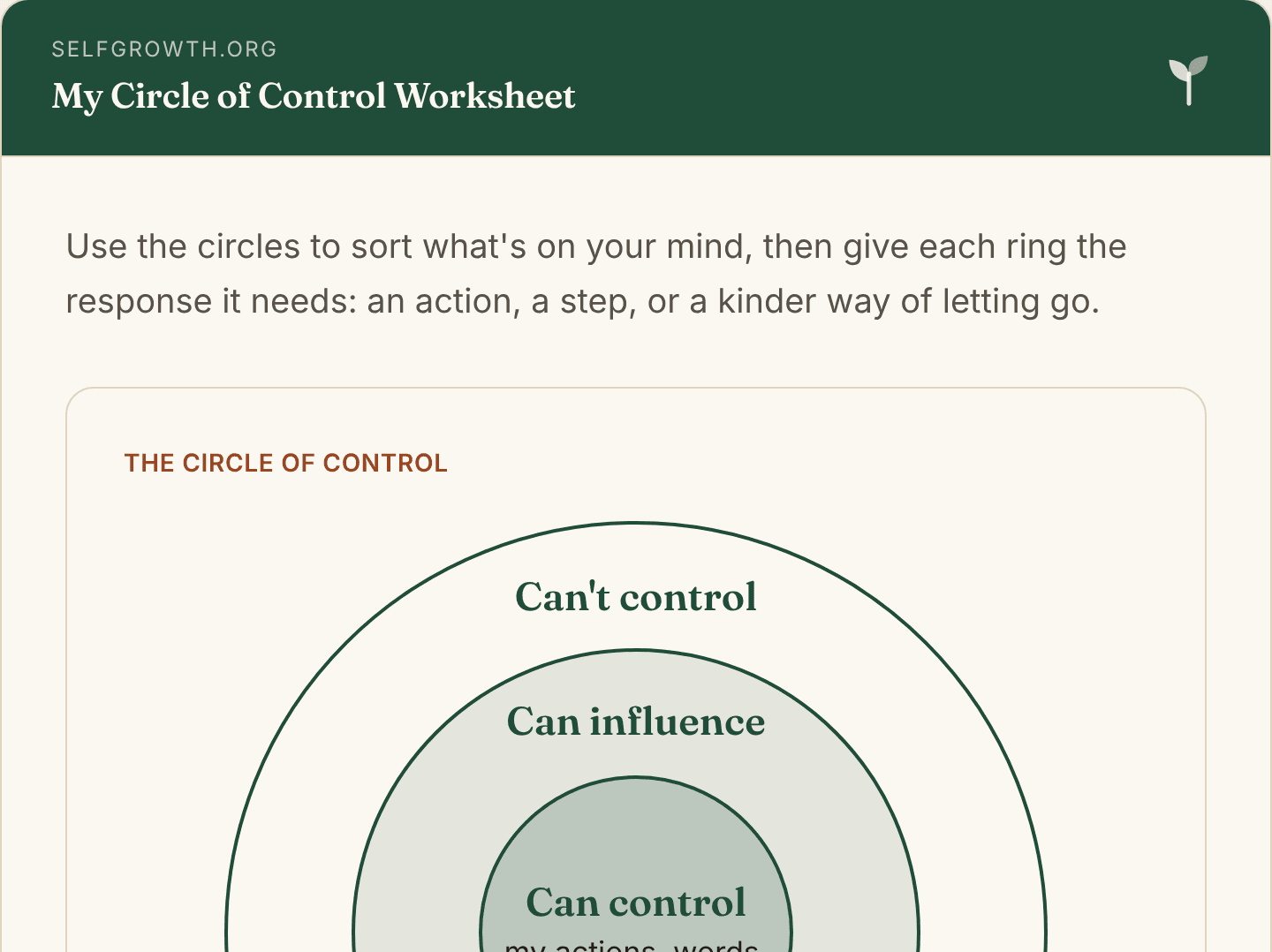
Circle of Control Worksheet
A free circle of control worksheet: sort your worries into what you can control, influence and can't control, then choose one step for each. Free PDF.
Open worksheet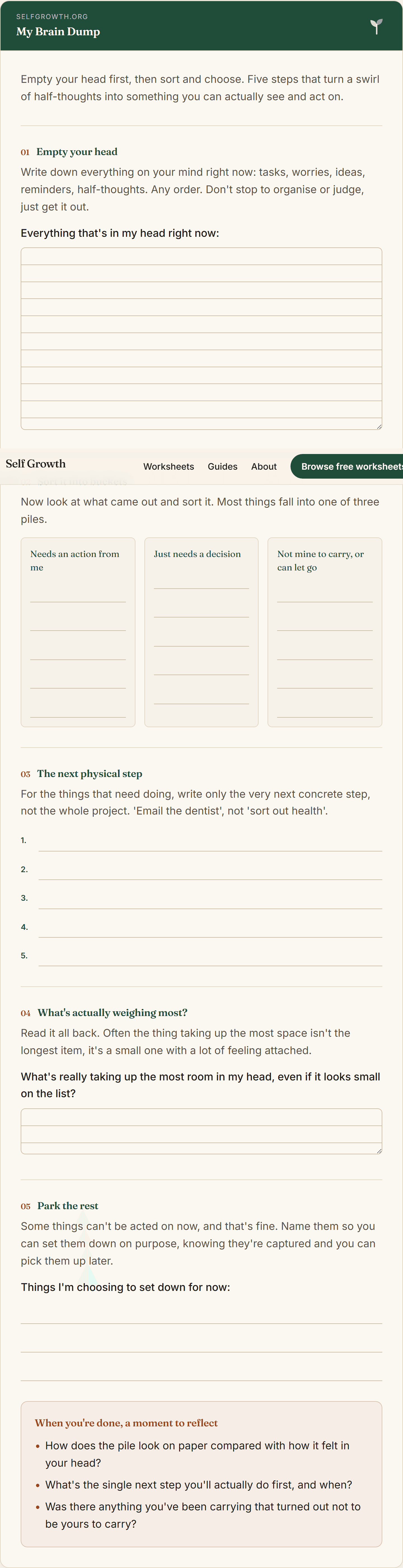
Brain Dump Template
A free, printable brain dump template to empty a cluttered mind onto the page, sort it into what needs action and what to let go, and find the next clear step.
Open worksheet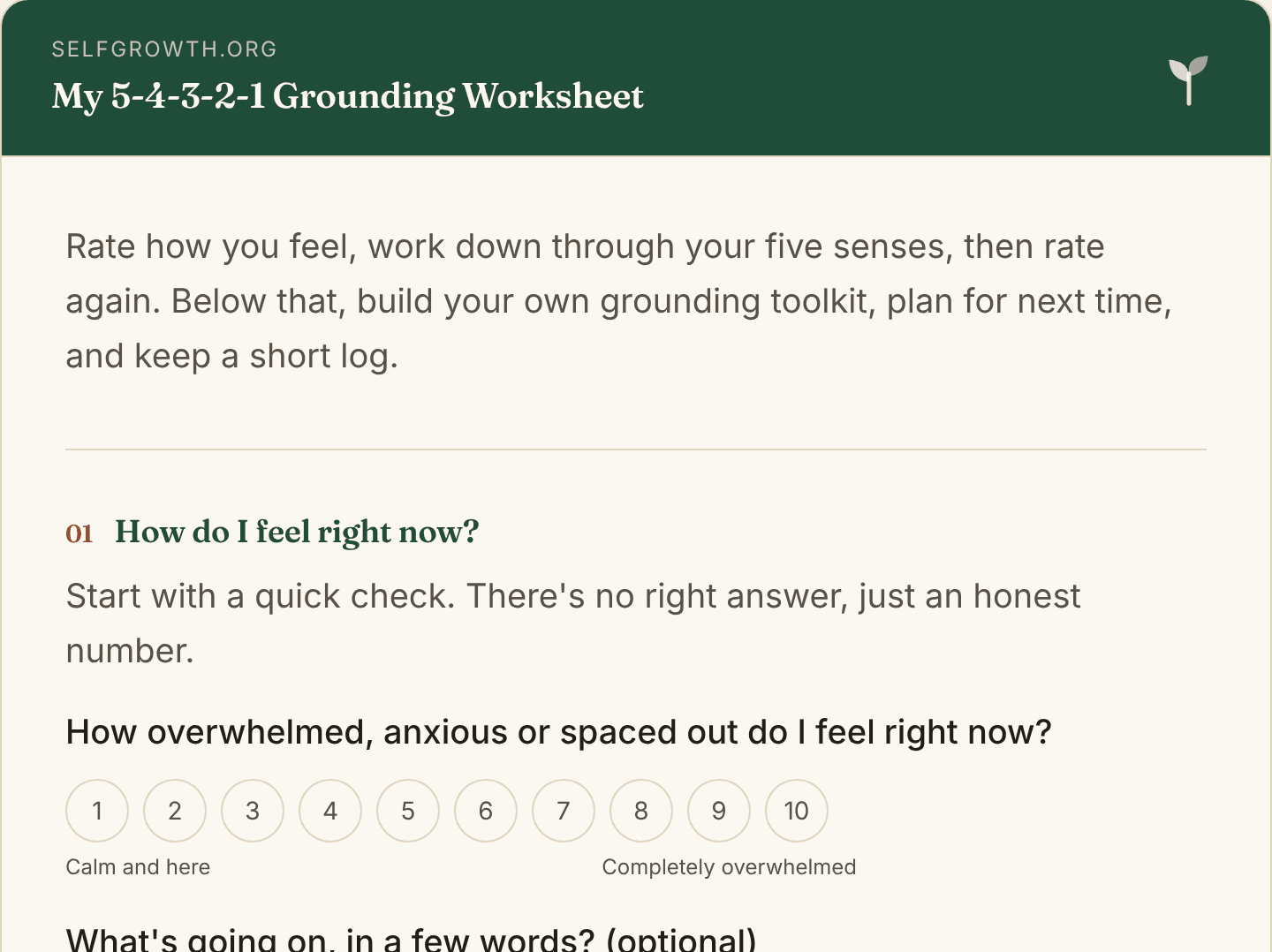
5-4-3-2-1 Grounding Worksheet
A free, printable 5-4-3-2-1 grounding worksheet: rate how you feel, work through your five senses, re-rate, then build your own toolkit and plan for next time.
Open worksheet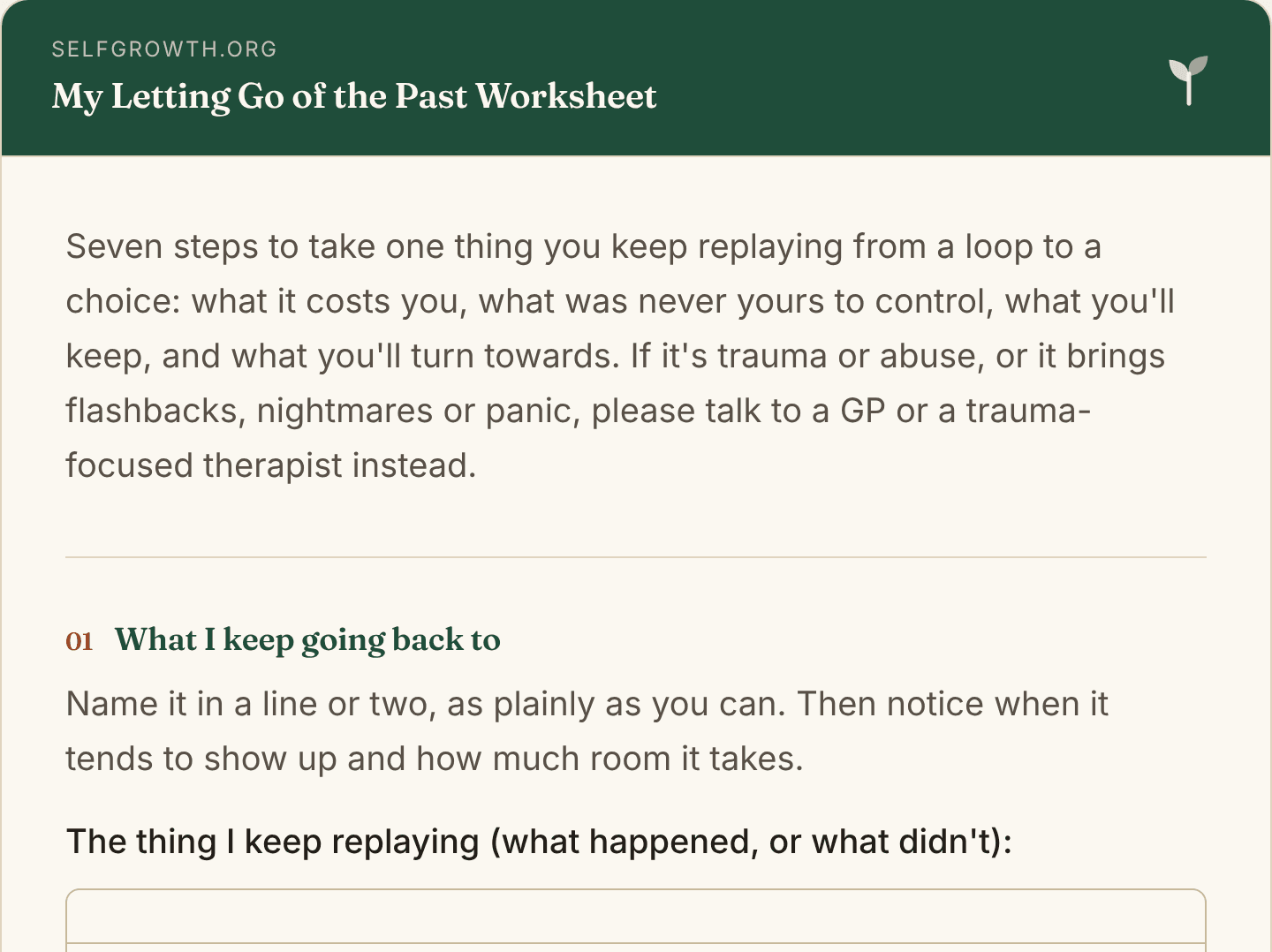
Letting Go of the Past Worksheet
A free printable letting go worksheet: see what replaying the past costs you, sort what was in your control, write an unsent letter, plan for when it returns.
Open worksheetRelated guides
New worksheets, straight to your inbox
An occasional new worksheet or tool, sent only when there's something genuinely worth your time. No spam, no pressure, unsubscribe any time.