
Anxious moments
5-4-3-2-1 grounding worksheet: a free, printable way to come back to the present
Updated 11 October 2026 · 5 min read · Free to print
The 5-4-3-2-1 grounding technique brings you back to the present through your senses: name five things you can see, four you can feel, three you can hear, two you can smell and one you can taste. This free, printable worksheet adds a before and after rating, your own grounding toolkit and a plan for next time.
By the Self Growth team · drawn from trauma-focused therapy and DBT skills · how we make these
Fill it in here (it saves in this browser, but not in a private window), print it, or download the PDF. Free, no sign-up.
When anxiety spikes, your thoughts race, or you feel strangely far away from everything, it's hard to think your way back. The 5-4-3-2-1 technique doesn't ask you to think. It asks you to notice: what you can see, feel, hear, smell and taste, right now, wherever you are.
This worksheet walks you through it in writing. You rate how you feel at the start, work down through your senses one at a time, and rate again at the end, so you can see whether it helped. Then you build a small toolkit of other grounding techniques that suit you, and an if-then plan for the next time a hard moment hits.
It's a tool for getting through a moment, not therapy, and it won't fix what's underneath the feeling. If it only takes the edge off, that still counts.
How to use this worksheet
- 1Use it in the moment if you can, or straight afterwards while you still remember how it felt.
- 2Go slowly. Be specific: 'a blue mug with a chip in the handle' grounds you more than 'a mug'.
- 3If you can't find a smell or a taste, move to find one, name one you like, or write one good thing about yourself instead.
- 4Fill in the toolkit and the plan on a calmer day, and keep the page somewhere you'll find it.
The worksheet
selfgrowth.org
My 5-4-3-2-1 Grounding Worksheet
Rate how you feel, work down through your five senses, then rate again. Below that, build your own grounding toolkit, plan for next time, and keep a short log.
01How do I feel right now?
Start with a quick check. There's no right answer, just an honest number.
How overwhelmed, anxious or spaced out do I feel right now?
What's going on, in a few words? (optional)
025-4-3-2-1: work through your senses
Take your time with each one. Look, listen and feel around you, and write down exactly what you notice.
5 things I can see
Pick out small details: colours, shapes, light, things you'd normally miss.
- 1.
- 2.
- 3.
- 4.
- 5.
4 things I can feel
Your feet on the floor, your clothes on your skin, the chair behind you, the air on your face.
- 1.
- 2.
- 3.
- 4.
3 things I can hear
Near and far: a hum, traffic, voices, your own breathing.
- 1.
- 2.
- 3.
2 things I can smell
If nothing stands out, move to find a smell, or name two smells you like.
- 1.
- 2.
1 thing I can taste (or 1 good thing about myself)
- 1.
03How do I feel now?
Re-rate it. It doesn't need to drop to zero. A few points lower is a real win.
How overwhelmed, anxious or spaced out do I feel now?
What helped most, or what got in the way?
04My grounding toolkit
5-4-3-2-1 is one technique of many. Tick the ones that work for you, or that you'd like to try, so you have a few to choose from.
Other things that bring me back to the present:
05A plan for next time
Decide now, while you're calmer, what you'll do when it happens again. Write it as 'If I notice..., then I will...'.
Entry 1
Entry 2
Entry 3
Someone I can reach out to if grounding isn't enough:
06When I used it
A short log helps you see what works for you. Note each time you tried a grounding technique, and how you felt before and after (1 to 10).
Entry 1
Entry 2
Entry 3
Entry 4
Entry 5
When you're done, a moment to reflect
- What tends to happen just before you start to feel overwhelmed or spaced out?
- Which sense brings you back to the present most quickly: sight, touch, sound, smell or taste?
- Where are you most likely to need grounding, and which technique could you do there without anyone noticing?
- What would you say to a friend who was struggling in the same moment?
- Once you're steadier, is there something underneath the feeling that's worth looking at, or talking to someone about?
Does the 5-4-3-2-1 technique actually work?
Grounding is a familiar skill in trauma-focused therapy. Psychologist Lisa Najavits gives grounding a whole topic in Seeking Safety, her treatment manual for people living with both trauma and substance use. She describes it as a way to step back from emotional pain. Dialectical behaviour therapy (DBT, a skills-based talking therapy developed by Marsha Linehan) teaches similar body-based skills, such as cold water and paced breathing, for getting through intense moments. The grounding toolkit on this worksheet draws on both.
Honestly, the evidence for this exact exercise is thin. The 5-4-3-2-1 exercise itself has no clear originator, and we couldn't find good studies testing it on its own. Slow breathing has more behind it. A 2018 systematic review (a study that gathers all the research on a question) by Andrea Zaccaro and colleagues looked at 15 studies of slow breathing in healthy people. It linked slow breathing with more relaxation and comfort, and less anxiety and anger. That's why a longer out-breath is in the toolkit.
The before and after ratings and the log are there so you can judge for yourself what helps you. Your own experience is the best guide to which techniques belong in your toolkit.
These are educational self-reflection tools, not therapy. See our editorial standards.
If you want to go deeper
- Najavits, L. M. (2002). Seeking Safety: A Treatment Manual for PTSD and Substance Abuse. Guilford Press.
- Linehan, M. M. (2015). DBT Skills Training Manual (2nd ed.). Guilford Press.
- Zaccaro, A., Piarulli, A., Laurino, M., Garbella, E., Menicucci, D., Neri, B. & Gemignani, A. (2018). How breath-control can change your life: A systematic review on psycho-physiological correlates of slow breathing. Frontiers in Human Neuroscience, 12, 353.
Your questions, answered
- What is the 5-4-3-2-1 grounding technique?
- It's a simple grounding exercise that brings your attention back to the present through your senses. You name five things you can see, four you can feel, three you can hear, two you can smell and one you can taste. Focusing on something concrete and close can turn the volume down on racing thoughts or overwhelming feelings.
- How do you do the 54321 grounding exercise?
- Look around and name five things you can see, in detail. Then four things you can feel, like your feet on the floor. Then three things you can hear, two you can smell and one you can taste. Go slowly, out loud or in your head. Step 2 of this worksheet takes you through it in writing, with a rating before and after.
- What if I can't smell or taste anything?
- That's fine. Coming up blank happens. You can move to find a smell (a hand cream, a cup of tea, soap), name a smell or taste you like, or swap the last step for one good thing about yourself. The point is to keep your attention on something real and present, not to get every number right.
- Does 5-4-3-2-1 work for anxiety and panic attacks?
- It can help take the edge off an anxious moment, and it's often taught for that, but there's little research on this exercise by itself. Treat it as a practical skill, not a treatment. If you have panic attacks that keep coming back, flashbacks, or feelings of unreality that won't stop, please talk to a GP. Grounding can sit alongside proper support.
- Who created the 5-4-3-2-1 technique?
- Honestly, it isn't clear. The exercise is taught in many slightly different versions, and we couldn't find a reliable source for who first came up with it. What is well documented is grounding more broadly: it has a topic of its own in trauma-focused approaches such as Lisa Najavits's Seeking Safety.
- Is there a 5-4-3-2-1 grounding worksheet PDF?
- Yes. Use the Download PDF button for a clean, print-ready copy, or Print to print straight from the page. It's completely free, with no payment and no email needed. You can also fill it in on screen, and your answers save in your browser.
- Is this worksheet a substitute for therapy?
- No. It's a self-help tool for getting through hard moments, not therapy or medical advice. If anxiety, panic or flashbacks are part of daily life, a GP can point you towards talking therapies that help. If you ever feel unsafe or have thoughts of harming yourself, call Samaritans on 116 123 (UK), 988 (US), or find a line at findahelpline.com.
Keep going, related worksheets
Progressive Muscle Relaxation Script
A free progressive muscle relaxation script in plain English: tense and release 13 muscle groups from feet to face, with a before-and-after check and 7-day log.
Open worksheet
Body Scan Script
A free body scan meditation script in plain English: move your attention slowly from toes to head, noticing without changing, with reflection prompts and a log.
Open worksheet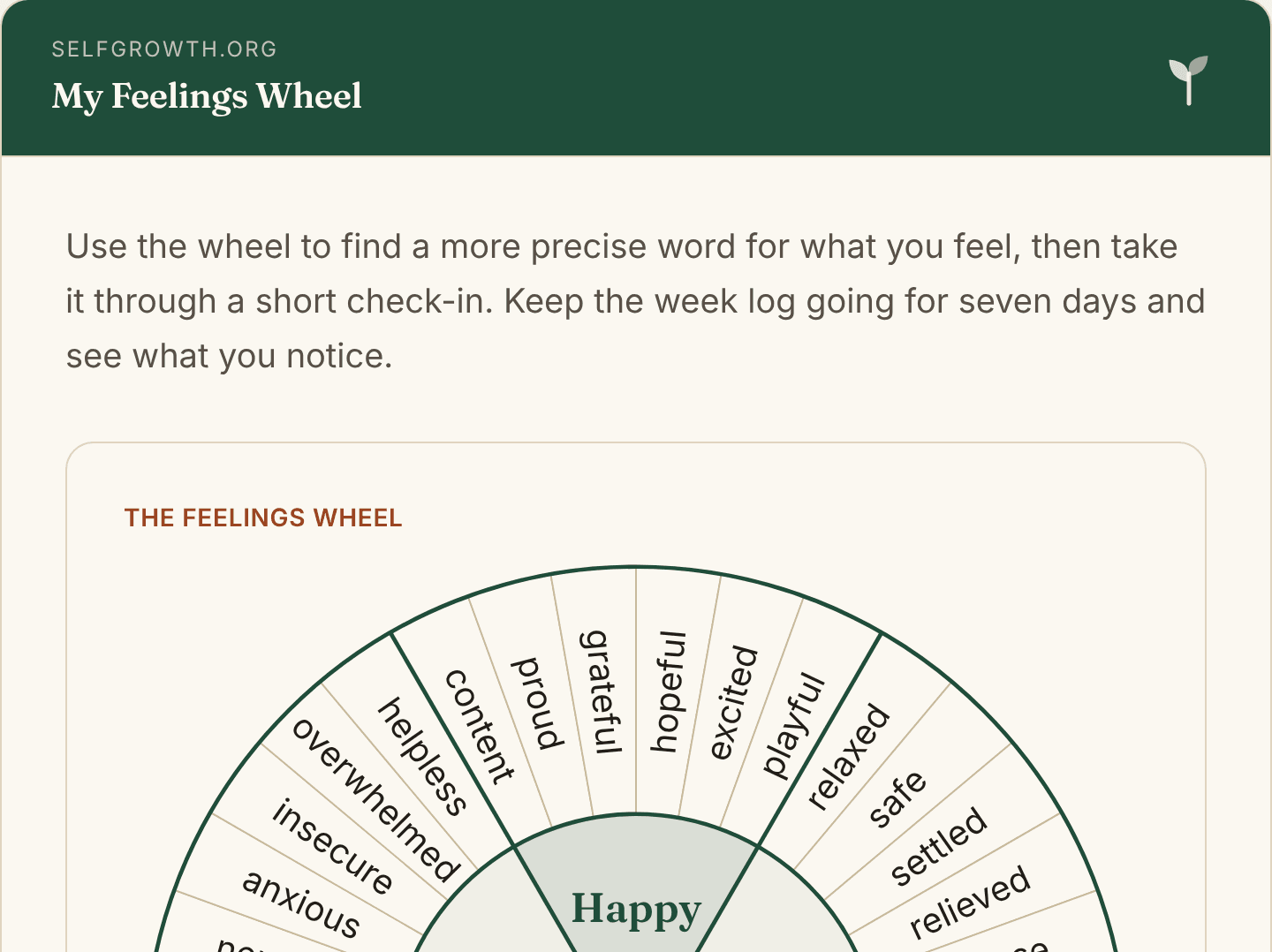
Feelings Wheel
A free printable feelings wheel (emotion wheel) PDF: six core feelings and 36 more precise words, with a daily check-in and a week log to name what you feel.
Open worksheetNew worksheets, straight to your inbox
An occasional new worksheet or tool, sent only when there's something genuinely worth your time. No spam, no pressure, unsubscribe any time.