
Relaxation
Body scan script: a free, printable mindfulness body scan
Updated 11 October 2026 · 7 min read · Free to print
A body scan is a mindfulness practice where you move your attention slowly through your body, from your toes to the top of your head, noticing whatever is there without trying to change it. This free script guides you through a 15 to 20 minute version, with short reflection questions and a 7-day practice log.
By the Self Growth team · drawn from Jon Kabat-Zinn's mindfulness-based stress reduction · how we make these
Fill it in here (it saves in this browser, but not in a private window), print it, or download the PDF. Free, no sign-up.
For much of the day, your attention is probably somewhere ahead of you: the next task, the next message, the conversation you're replaying. Your body comes along, but you only really notice it when something hurts. A body scan turns that around for a few minutes. You rest your attention on one part of your body at a time and simply notice what's there.
You're not trying to relax, fix anything or feel a particular way. You might notice warmth, tingling, pressure, tightness, an itch, or nothing much at all, and all of those count. Your mind will wander, probably many times. Noticing that it has wandered and gently bringing it back is the practice, not a sign you're doing it wrong.
The full script is printed in the sheet below, in parts, so you can read it from the page or the printout, or record yourself reading it slowly. It's a self-guided mindfulness exercise, not therapy, and it isn't a treatment for trauma, anxiety or depression.
How to use this worksheet
- 1Lie on your back on a bed, mat or the floor, or sit in a chair with your feet on the ground. Choose whatever lets you be comfortable and still awake.
- 2Read one part of the script, then close your eyes (or lower your gaze) and do it. Spend roughly a minute or two on each area. There's no need to rush.
- 3Notice each area as it is, without trying to change it. If there's nothing to feel, notice that. If an area is painful, you can rest your attention there lightly, or move on.
- 4When your mind wanders, which it will, notice where it went and gently bring it back to the part of the body you'd reached. You don't need to start again.
- 5If focusing on your body brings up distress or difficult memories, stop. Open your eyes, look around the room, and feel your feet on the floor. You can always come back to it another day, or not at all.
The worksheet
selfgrowth.org
My Body Scan Script
A complete toes-to-head body scan in four parts, with a short note after each and a week-long practice log. If it brings up distress or difficult memories, stop, open your eyes and ground yourself in the room around you.
01Getting settled
Lie down or sit comfortably. Let your eyes close, or rest your gaze softly on the floor in front of you. Notice the places where your body is touching the bed, floor or chair, and let them take your weight. Feel your breath moving in and out, without changing it. Remind yourself that for the next few minutes there's nothing to achieve. You're just going to notice.
How busy does my mind feel right now?
02Part 1: feet and legs
Bring your attention down to the toes of your left foot. Notice whatever is there: warmth or coolness, the touch of a sock, tingling, or nothing at all. Let your attention spread to the sole of the foot, the heel and the top of the foot, then the ankle. Move slowly up through the lower leg, the knee and the thigh. Then let the left leg go from your attention and do the same with the right: toes, foot, ankle, lower leg, knee, thigh. If your mind has wandered, that's fine. Notice where it went, and come back to wherever you were.
What did I notice in my feet and legs?
03Part 2: hips, back, belly and chest
Bring your attention to your hips and pelvis, and the places where they meet the surface under you. Move up into your lower back, noticing any tightness or ease, without trying to change it. Then your upper back and shoulder blades. Now bring your attention round to your belly. Notice it rising and falling with each breath. Move up to your chest, and notice the breath there too. If you feel your heartbeat, notice that. If you don't, that's fine.
What did I notice in my middle and chest?
04Part 3: hands, arms and shoulders
Bring your attention to the fingertips of both hands. Notice each finger if you can, then the palms and the backs of the hands. Move slowly up through your wrists, forearms, elbows and upper arms. Then rest your attention on your shoulders. Shoulders often hold tension. If yours feel tight, just notice the tightness, as if you're curious about it. If they soften as you notice them, let them. If they don't, that's fine too.
What did I notice in my hands, arms and shoulders?
05Part 4: neck, face, head and whole body
Move your attention to your neck and throat. Then your jaw, noticing whether your teeth are touching. Your mouth and lips, your cheeks and nose, and the air moving in and out. Your eyes and the small muscles around them. Your forehead, the sides and back of your head, and the top of your head. Now widen your attention to take in your whole body at once, lying or sitting here, breathing. Stay with that for a few breaths. When you're ready, wiggle your fingers and toes, open your eyes, and take your time before you get up.
What did I notice in my face and head, and in my body as a whole?
06Afterwards
There's no right result. A body scan where your mind wandered constantly still counts.
How busy does my mind feel now?
Where did my mind tend to wander? (plans, worries, memories, sounds)
Where did I notice tension, and where did I notice ease?
Anything that surprised me, or that I want to try differently next time:
07My 7-day practice log
Mindfulness tends to build with practice. Try a body scan once a day for a week if you can, at a time you're unlikely to be interrupted. Short or imperfect sessions still count.
Entry 1
Entry 2
Entry 3
Entry 4
Entry 5
Entry 6
Entry 7
When you're done, a moment to reflect
- Which part of your body was easiest to feel, and which was hardest?
- What does your mind tend to wander towards when you give it a quiet moment?
- What changes when you notice a feeling in your body without trying to fix it?
Does a body scan actually work?
The body scan as it's widely taught today comes from Jon Kabat-Zinn's mindfulness-based stress reduction (MBSR), an eight-week course he started in 1979 at a stress clinic in Massachusetts. He describes the practice in his book Full Catastrophe Living (1990), which gives it a chapter of its own. The version taught in MBSR is longer than this one.
On the evidence: a 2015 meta-analysis (a study that pools the results of many studies) by Bassam Khoury and colleagues looked at 29 studies of MBSR with 2,668 healthy adults. It found MBSR moderately effective overall. The effects were large on stress, moderate on anxiety, depression, distress and quality of life, and small on burnout. The studies varied a lot, and the authors call for more research on which parts of MBSR matter most.
That research tested the whole programme, which includes several practices besides the body scan. So it can't tell you how much the body scan alone does. The script here is our own plain-English version, not Kabat-Zinn's wording. It's a gentle everyday practice, not a treatment.
These are educational self-reflection tools, not therapy. See our editorial standards.
If you want to go deeper
- Kabat-Zinn, J. (1990). Full Catastrophe Living: Using the Wisdom of Your Body and Mind to Face Stress, Pain, and Illness. Delacorte Press (revised edition 2013).
- Khoury, B., Sharma, M., Rush, S. E. & Fournier, C. (2015). Mindfulness-based stress reduction for healthy individuals: A meta-analysis. Journal of Psychosomatic Research, 78(6), 519-528.
Your questions, answered
- What is a body scan meditation?
- It's a mindfulness practice where you move your attention slowly through your body, one area at a time, noticing sensations such as warmth, pressure, tingling or tightness without trying to change them. When your mind wanders, you notice and gently come back. It's one of the core practices in Jon Kabat-Zinn's mindfulness-based stress reduction (MBSR) programme.
- How do you do a body scan?
- Lie down or sit comfortably and close your eyes if that feels okay. Start at your toes and move your attention slowly up through your feet, legs, hips, back, belly, chest, hands, arms, shoulders, neck, face and head, spending a minute or so on each area. Finish by noticing your whole body at once. The script on this page walks you through it in four parts.
- Is a body scan the same as relaxation?
- Not quite. In a body scan you're not trying to relax, just to notice what's there, including tension or discomfort. You may feel calmer afterwards, but that's a side effect, not the goal. If you want an exercise that actively releases tension, try progressive muscle relaxation, where you tense and then let go of each muscle group.
- What if I fall asleep or my mind keeps wandering?
- Both are normal. A wandering mind is part of the practice: each time you notice and come back, that's the exercise working. If you keep falling asleep and you'd rather not, try sitting up, keeping your eyes slightly open, or doing it earlier in the day. If you're using it to help you wind down at night, drifting off may be fine.
- Can a body scan bring up difficult feelings?
- Yes, sometimes. Paying close attention to your body can bring up distress, and for some people it can stir up memories of trauma. If that happens, stop. Open your eyes, look around and name what you can see, and feel your feet on the floor. The grounding techniques guide and the 5-4-3-2-1 grounding worksheet on this site can help. If it keeps happening, or you get flashbacks, talk to a GP or a qualified professional.
- Is there a body scan script PDF?
- Yes. Use the Download PDF button for a clean, print-ready copy with the full script and log, or Print to print straight from the page. It's free, with no payment and no email needed. You can also fill it in on screen, and your answers save in your browser.
- Is this the same as therapy?
- No. It's an educational self-help exercise, not therapy or medical advice. If you're struggling with stress, anxiety, low mood or memories of trauma, please talk to a GP or a qualified mental health professional. If you're in crisis, contact a helpline: Samaritans on 116 123 (UK), 988 (US), or find one near you at findahelpline.com.
Keep going, related worksheets
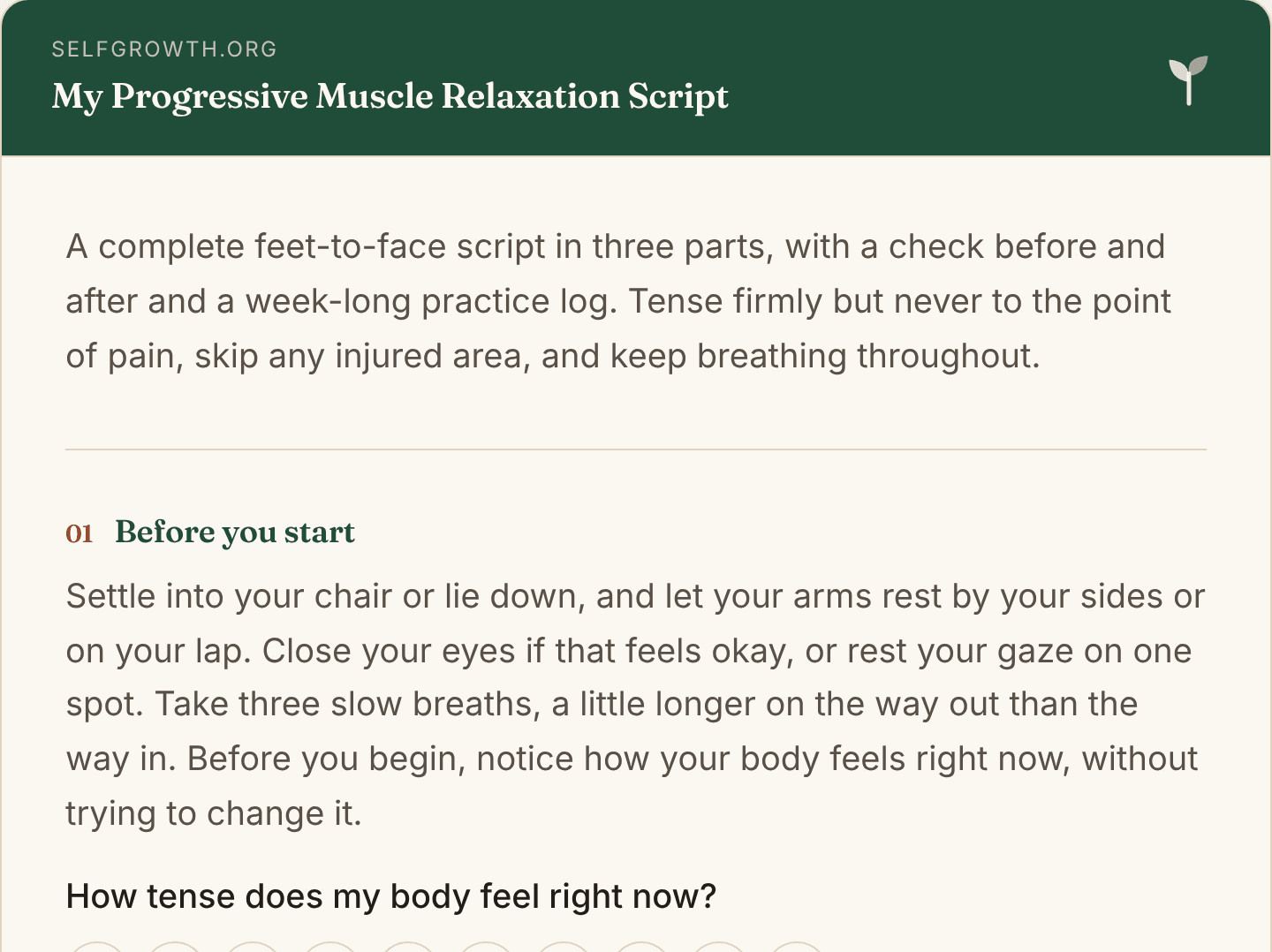
Progressive Muscle Relaxation Script
A free progressive muscle relaxation script in plain English: tense and release 13 muscle groups from feet to face, with a before-and-after check and 7-day log.
Open worksheet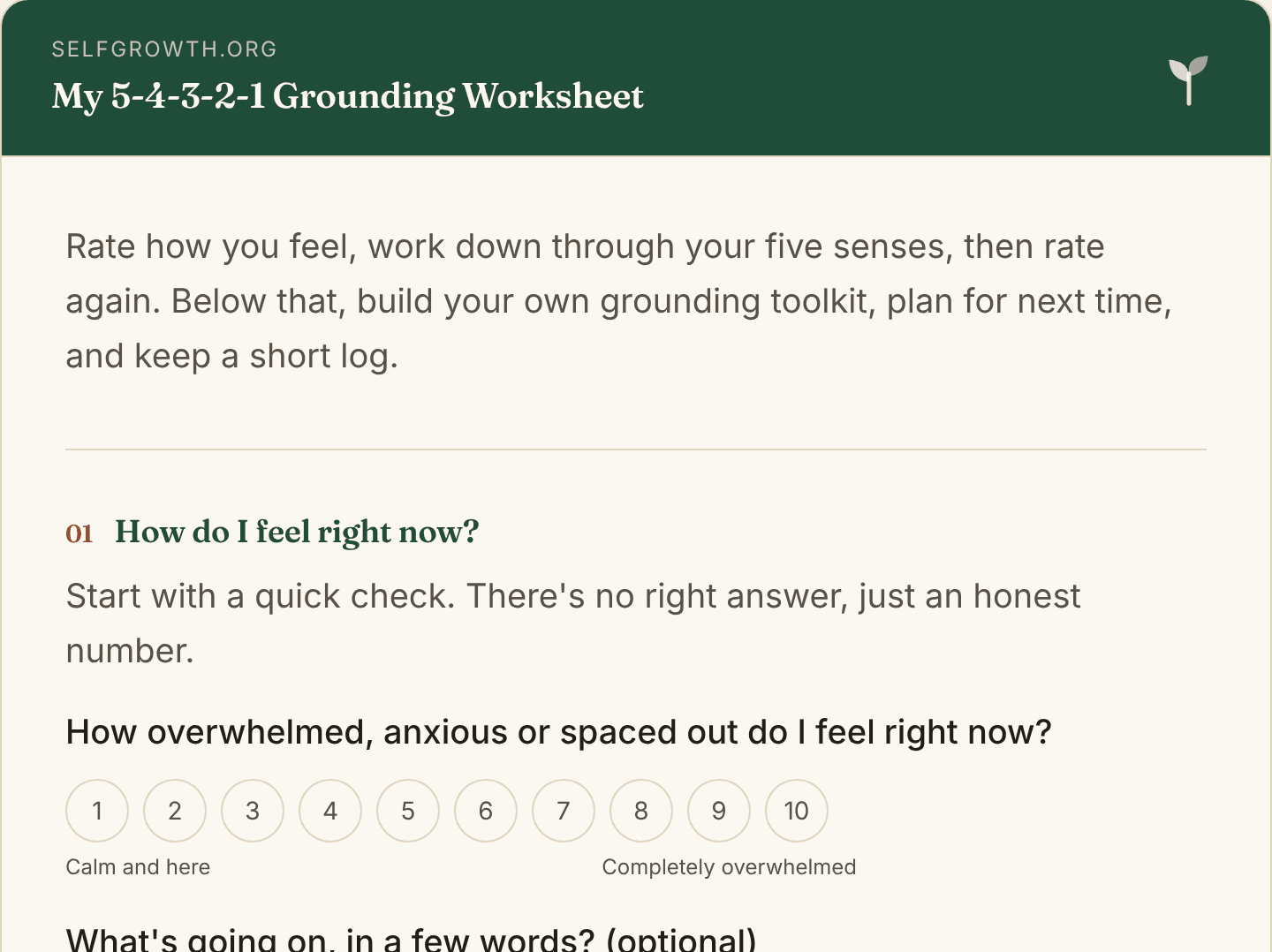
5-4-3-2-1 Grounding Worksheet
A free, printable 5-4-3-2-1 grounding worksheet: rate how you feel, work through your five senses, re-rate, then build your own toolkit and plan for next time.
Open worksheet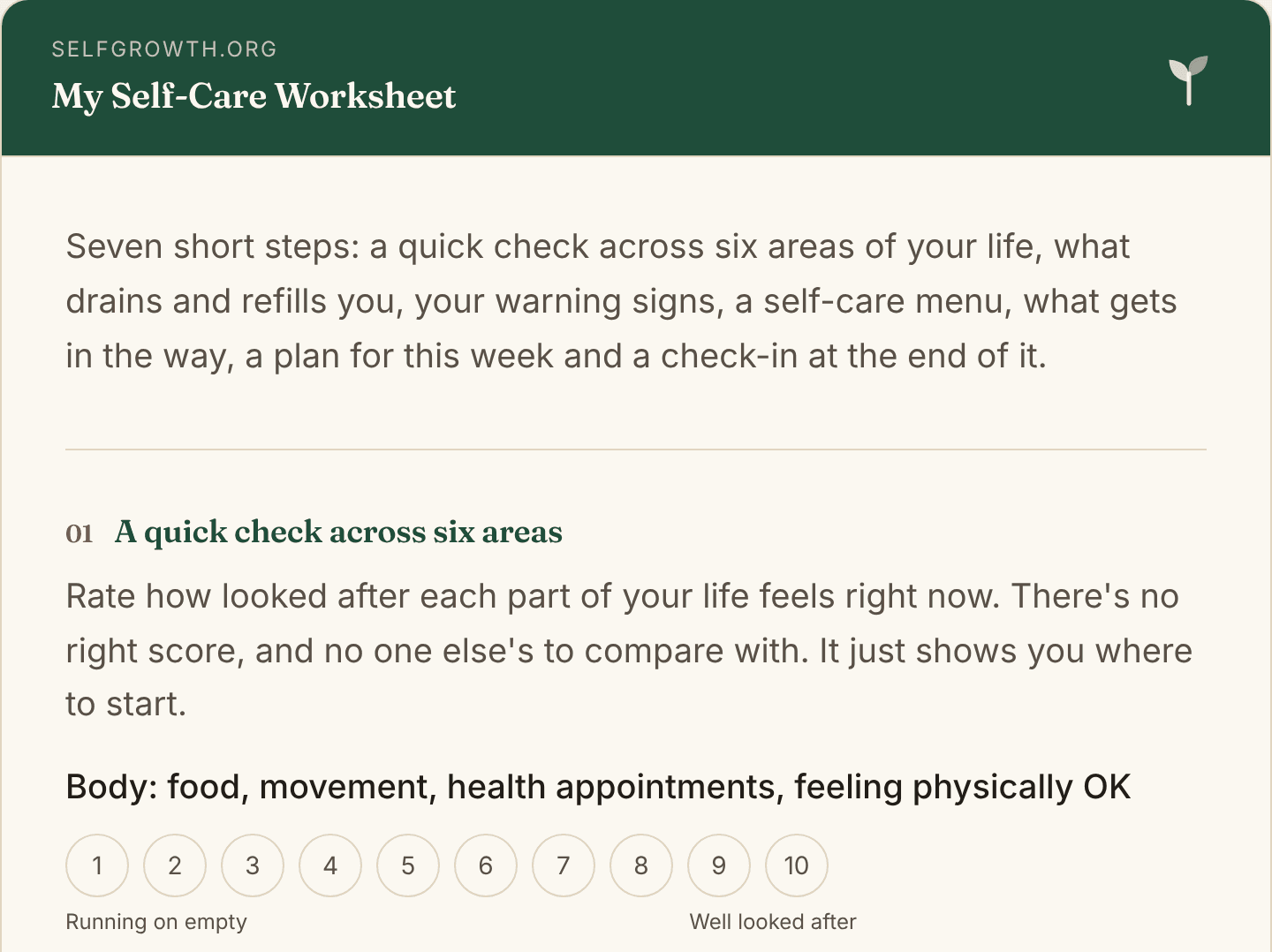
Self-Care Worksheet
A free, printable self-care worksheet for adults: check six areas of your life, see what drains and refills you, and make a self-care plan that costs nothing.
Open worksheetNew worksheets, straight to your inbox
An occasional new worksheet or tool, sent only when there's something genuinely worth your time. No spam, no pressure, unsubscribe any time.