
Guide
Grounding techniques: 10 ways to come back to the present
Updated 11 October 2026 · 10 min read
Grounding techniques bring your attention back to the present through your senses and body when you feel overwhelmed, anxious or spaced out. Try 5-4-3-2-1: name five things you see, four you can feel, three you hear, two you smell and one you taste. Feet on the floor, cold water and a longer out-breath help too.
By the Self Growth team · drawn from trauma-focused therapy and DBT skills · how we make these
Sometimes your mind runs away from you. A worry spirals, a memory pulls you back into something painful, or you feel strangely far away, as if you're watching your own life through glass. In those moments, thinking your way out rarely works. Grounding works the other way round: it uses what you can see, hear, touch, smell and taste to bring you back to here and now.
This guide walks you through ten grounding techniques you can do anywhere, which to try when, the common mistakes, and what the evidence honestly says. It isn't therapy, and it won't fix what's underneath the feeling. It's a way to get your feet back under you, so you can think clearly again.
What are grounding techniques?
Grounding techniques are simple ways to shift your attention away from overwhelming thoughts, feelings or memories and onto the present moment. You do it by noticing something concrete: the floor under your feet, the sounds in the room, the cold of a glass of water in your hand. Your mind can only hold so much at once, and giving it something real and close to focus on can turn the volume down on everything else.
Grounding doesn't solve the problem. It gets you steady enough to face it.
Grounding is a familiar part of trauma-focused therapy. In Seeking Safety, a treatment manual for people living with both trauma and substance use, psychologist Lisa Najavits gives a whole topic to grounding, which she frames as detaching from emotional pain. Similar body-based skills appear in dialectical behaviour therapy (DBT, a skills-based talking therapy developed by Marsha Linehan) for getting through intense moments without making them worse.
One thing grounding is not: 'earthing', the idea of walking barefoot on the ground to absorb the earth's electrical charge. That's a separate idea with health claims we can't stand behind. Here, grounding just means coming back to the present.
Signs you might need to ground yourself
You don't need a reason or a diagnosis to use grounding. It can help any time you notice something like this:
- Your thoughts are racing, or looping on the same worry.
- Your heart is pounding, your breathing is fast or shallow, or your chest feels tight.
- You feel spaced out, numb or unreal, as if you're not quite in your body.
- A memory feels so vivid it's as if it's happening again.
- You're about to snap, cry or shut down and you don't want to.
- You can't concentrate on what's in front of you.
These feelings can come from many places: a stressful day, a reminder of something painful, an argument, too little sleep, too much caffeine, or no obvious cause at all. Grounding doesn't ask you to work out the cause first. You can do that later, when you're steadier. If you're not sure what you're feeling, the list of emotions can help you name it.
When grounding helps, and its limits
Grounding is a short-term tool. It's for the moment itself: the spiral before a meeting, the wave of panic on the bus, the flashback that catches you off guard. It can take the edge off and buy you a few minutes of clear head.
It also has real limits. Grounding doesn't treat anxiety, panic disorder or PTSD. It won't change the situation that's upsetting you, and it doesn't always work, especially the first few times. If you're using it several times a day just to get by, that's a sign you deserve more support, not a sign you're doing it wrong.
10 grounding techniques to try
Try a few of these when you're calm first, so they feel familiar when you need them. You only need one that works for you.
- 1Use 5-4-3-2-1. Name five things you can see, four you can feel, three you can hear, two you can smell and one you can taste. Say them out loud or in your head, and be specific: not 'a chair' but 'a grey chair with a scratch on the arm'.
- 2Put your feet on the floor. Press both feet down and notice the floor pushing back. Feel your heels, the soles of your feet, your toes. If you're sitting, notice the chair holding your weight too.
- 3Breathe out for longer than you breathe in. Breathe in gently through your nose for a count of four, then out slowly for a count of six. Repeat for a minute or two. Don't force big breaths; slow and steady is the point.
- 4Change the temperature. Run cold water over your hands or wrists, splash your face, or hold something cold like an ice cube or a cold drink. Notice exactly how the cold feels.
- 5Hold something with a texture. Keep a small object in your pocket or bag, such as a smooth stone, a keyring or a piece of fabric. Turn it over in your hands and describe it to yourself: its weight, its edges, how warm or cool it is.
- 6Name things by category. Pick a category and list as many as you can: animals, football teams, cities, foods, songs. It keeps your thinking mind busy with something neutral.
- 7Describe the room like a reporter. Describe where you are in plain detail, as if to someone who can't see it: the colour of the walls, what's on the table, where the light is coming from.
- 8Tell yourself where and when you are. Say your name, the day and date, where you are and what you're doing. If it's true, add: 'That was then. This is now. Right now, I'm okay.'
- 9Push against something solid. Press your palms together hard for a few seconds, or push against a wall, then let go. Notice the difference between the tension and the release.
- 10Use a strong taste or smell. Suck a mint, bite into a lemon slice, smell coffee, soap or a scented hand cream. Strong, sharp sensations are hard to ignore.
A note on cold water. Very cold water on your face can make your heart rate drop quickly. Check with your doctor before using very cold water if you have a heart condition or a low resting heart rate, another medical condition, an allergy to cold or an eating disorder, or if you take medicine that lowers your heart rate (such as a beta-blocker). Cold water on your hands is a gentler place to start, and if you feel faint or dizzy, stop.
How to do the 5-4-3-2-1 grounding technique
5-4-3-2-1 is one of the most familiar grounding exercises, because it needs nothing but you and wherever you happen to be. Its origin isn't clear, and it's taught in many slightly different versions, so don't worry about getting it 'right'. Here's the version on the worksheet below.
- 5 things you can see. Look around slowly. Pick out small details you'd normally miss.
- 4 things you can feel. Your clothes on your skin, your back against the chair, the air on your face, your hands in your lap.
- 3 things you can hear. Near and far: a fridge humming, traffic outside, your own breathing.
- 2 things you can smell. If nothing stands out, move to find a smell, or name two smells you like.
- 1 thing you can taste. Or, if you prefer, one good thing about yourself.
Go slowly. The point isn't to finish quickly, it's to really notice each thing. If your mind wanders back to the worry halfway through, that's normal. Just pick up where you left off. The free worksheet takes you through it in writing, with a before and after check, so you can see whether it helped.
Open the 5-4-3-2-1 Grounding WorksheetWhich grounding technique to try when
Different moments call for different tools. These are starting points, not rules. Notice what actually works for you, and keep that.
- Racing, anxious thoughts: 5-4-3-2-1, naming things by category, or describing the room. They give your mind a job to do.
- A pounding heart or fast breathing: a longer out-breath, feet on the floor, or cold water on your hands.
- Feeling numb, spaced out or unreal: strong sensations work well here. Cold water, a sharp taste or smell, pushing against a wall.
- A memory that feels like it's happening now: tell yourself where and when you are, and look for things in the room that show it's today.
- In public, where you'd rather nobody noticed: feet on the floor, a textured object in your pocket, or counting things of one colour.
- At night, when you can't settle: a slow out-breath, or a gentle body-based exercise like the body scan script or the progressive muscle relaxation script.
If your mind tends to loop on the same worry rather than flood with feeling, how to stop overthinking goes into that pattern in more depth.
Common grounding mistakes
- Waiting until you're at your worst to try it for the first time. Practise when you're calm, so it's familiar when you need it.
- Rushing. Racing through 5-4-3-2-1 keeps you in a hurry. Slow down and really notice each thing.
- Expecting the feeling to vanish. A drop from a 9 to a 6 is a real win. Grounding takes the edge off; it doesn't flip a switch.
- Forcing deep breaths. Gulping air can make you feel more light-headed. Keep the in-breath gentle and let the out-breath be the long one.
- Using it to avoid everything. Grounding is for getting through a moment, not for never thinking about what's hard. Come back to the cause later, when you're steadier, perhaps with a brain dump or with someone you trust.
- Judging yourself when it doesn't work. Some techniques will suit you better than others. Try another one, and be as kind to yourself as you'd be to a friend.
Do grounding techniques actually work?
Honestly, the research on grounding techniques themselves is limited. Grounding is widely taught in trauma-focused therapy and DBT-style skills groups, and it makes sense on its face, but we couldn't find good studies testing the 5-4-3-2-1 exercise on its own. So it's best treated as a practical skill worth trying, not a proven treatment.
Slow breathing, such as breathing out for longer than you breathe in, has more research behind it. A 2018 systematic review (a study that gathers and assesses all the research on a question) by Andrea Zaccaro and colleagues looked at 15 studies of slow breathing in healthy people. Slow breathing here meant fewer than 10 breaths a minute. The studies linked it with feeling more relaxed and comfortable. They also linked it with less anxiety and anger, and with feeling less wound up.
Those were studies of healthy people, not people with anxiety disorders. So the honest summary is: slowing your breathing looks likely to help you feel calmer in the moment, and the other techniques are reasonable to try, but none of them replaces proper support if anxiety, panic or flashbacks are part of your daily life.
When to get more support
Grounding is a tool for hard moments, not a substitute for care. Please talk to a GP or family doctor if you have panic attacks that keep coming back, flashbacks or nightmares about something that happened to you, feelings of being detached or unreal that won't stop, or anxiety that's getting in the way of work, sleep or relationships. You're not the only one, and there are talking therapies that help. A GP can point you towards them.
If you feel unsafe, or you're having thoughts of harming yourself, please reach out now. In the UK, call Samaritans free on 116 123, any time. In the US, call or text 988. Elsewhere, findahelpline.com lists free, confidential lines in your country. If you're in immediate danger, call your local emergency number. You deserve real support, not just a page to read.
How we put this together
This guide is written in plain language. Research on grounding techniques themselves is limited, so it draws on how grounding is taught in trauma-focused therapy and DBT skills, and on a systematic review of slow breathing. Where the evidence runs out, we say so. It's an educational self-reflection resource, not therapy or medical advice, see our editorial standards.
If you want to go deeper
- Najavits, L. M. (2002). Seeking Safety: A Treatment Manual for PTSD and Substance Abuse. Guilford Press. Includes the topic 'Detaching from Emotional Pain (Grounding)'.
- Linehan, M. M. (2015). DBT Skills Training Manual (2nd ed.). Guilford Press. Source of the TIPP distress tolerance skills, including temperature and paced breathing.
- Zaccaro, A., Piarulli, A., Laurino, M., Garbella, E., Menicucci, D., Neri, B. & Gemignani, A. (2018). How breath-control can change your life: A systematic review on psycho-physiological correlates of slow breathing. Frontiers in Human Neuroscience, 12, 353.
Your questions, answered
- What are grounding techniques?
- Grounding techniques are quick ways to bring your attention back to the present when you feel overwhelmed, anxious or spaced out. You focus on something concrete through your senses or body: what you can see and hear, your feet on the floor, cold water on your hands, a slow out-breath. They're used in trauma-focused therapy and DBT-style skills, and you can do them anywhere.
- What is the 5-4-3-2-1 grounding technique?
- It's a grounding exercise that walks you through your senses. Name five things you can see, four you can feel, three you can hear, two you can smell and one you can taste. Go slowly and be specific. If taste doesn't work for you, name one good thing about yourself instead. The free 5-4-3-2-1 worksheet takes you through it in writing.
- What is a good grounding exercise for anxiety?
- For racing, anxious thoughts, 5-4-3-2-1 or naming things by category gives your mind something neutral to do. For a pounding heart, try breathing out for longer than you breathe in, or pressing your feet into the floor. Try a few when you're calm, then keep the one that works best for you. Grounding takes the edge off; it doesn't treat an anxiety disorder.
- How do I ground myself during a panic attack?
- Plant your feet on the floor, breathe out slowly for longer than you breathe in, and name what you can see around you. Remind yourself the feeling will pass. If panic attacks keep coming back, or you're not sure whether it's a panic attack or something physical, please see a GP or doctor. If you have chest pain or trouble breathing, call your local emergency number.
- Do grounding techniques actually work?
- The research on grounding techniques themselves is limited, so treat them as a practical skill rather than a proven treatment. Slow breathing has more evidence: a 2018 systematic review of 15 studies in healthy people linked it with feeling more relaxed and less anxious. Grounding is widely taught in trauma-focused therapy because it can help you get through a hard moment.
- Is grounding the same as earthing?
- No. Earthing is the idea of walking barefoot or using special mats to connect with the earth's electrical charge, and it comes with health claims we can't back. Grounding techniques, in the sense used here, simply mean bringing your attention back to the present through your senses and body.
- Is this free, and is it therapy?
- It's free, with no payment and no email needed, and the worksheet can be filled in online or printed. This guide is a self-help tool, not therapy or medical advice. If you have recurring panic attacks, flashbacks or feelings of unreality that won't stop, please talk to a GP. If you ever feel unsafe, contact a crisis line straight away.
Worksheets to do the work
Free to fill in online or print. No email needed.
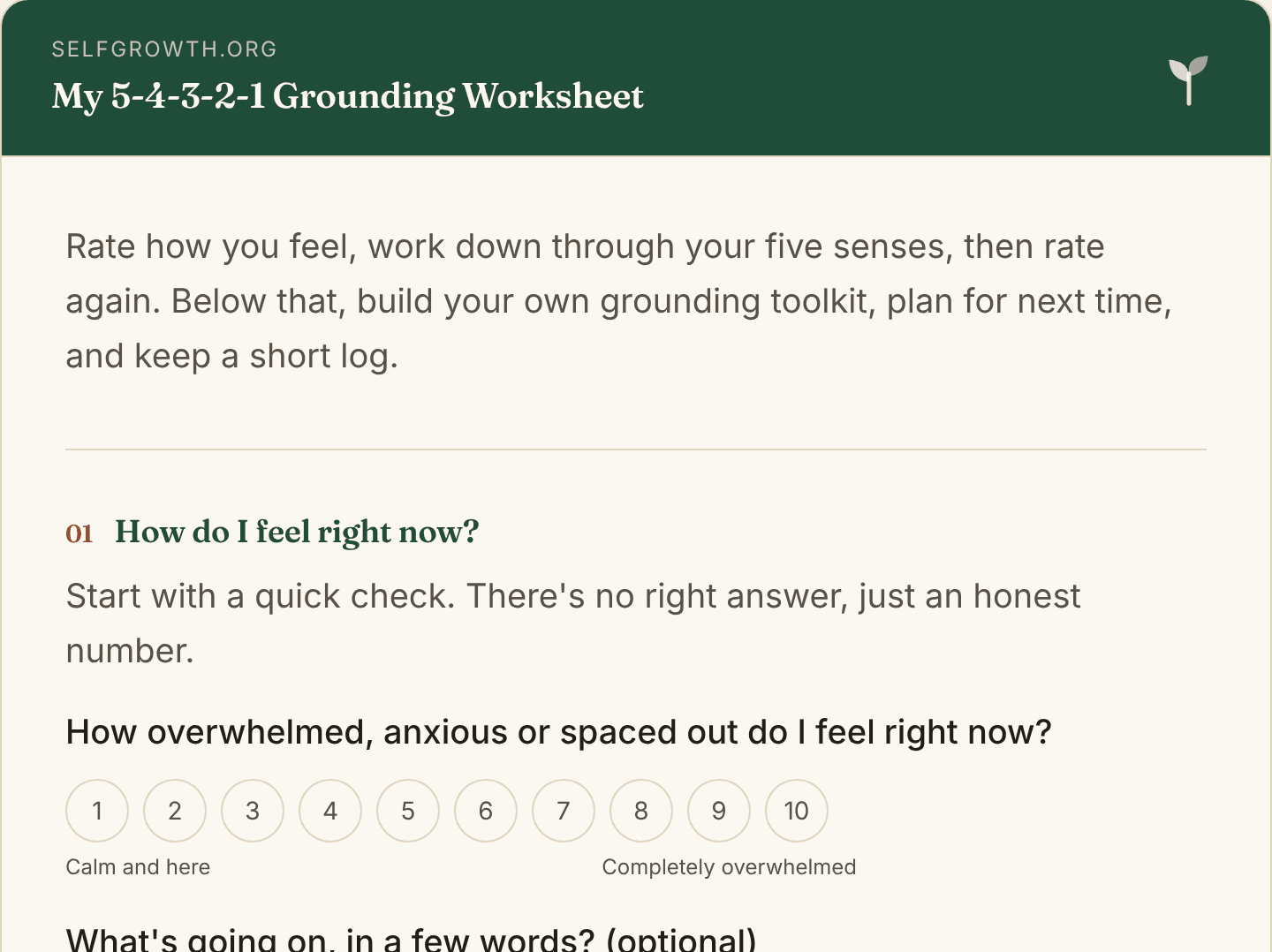
5-4-3-2-1 Grounding Worksheet
A free, printable 5-4-3-2-1 grounding worksheet: rate how you feel, work through your five senses, re-rate, then build your own toolkit and plan for next time.
Open worksheet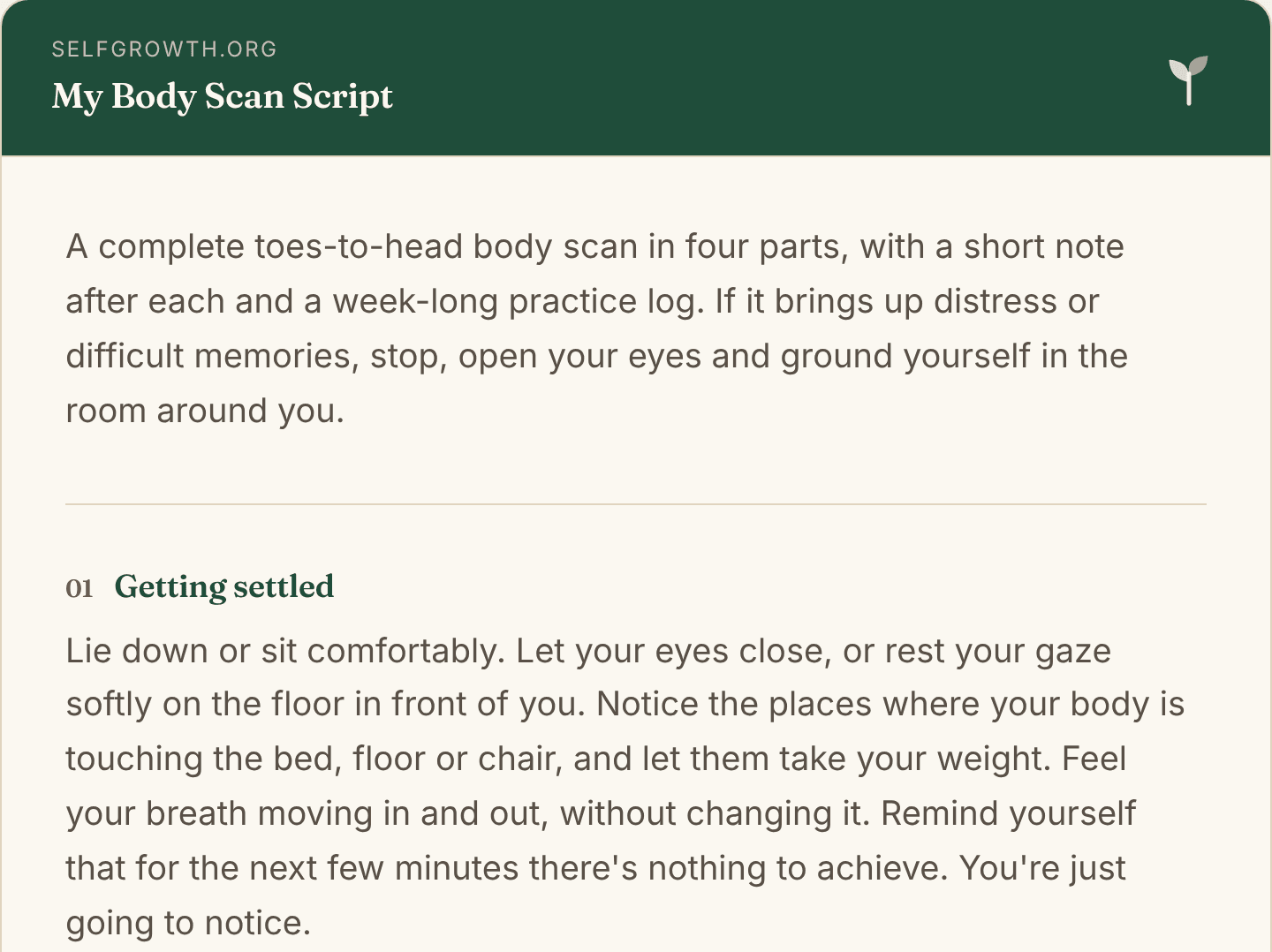
Body Scan Script
A free body scan meditation script in plain English: move your attention slowly from toes to head, noticing without changing, with reflection prompts and a log.
Open worksheet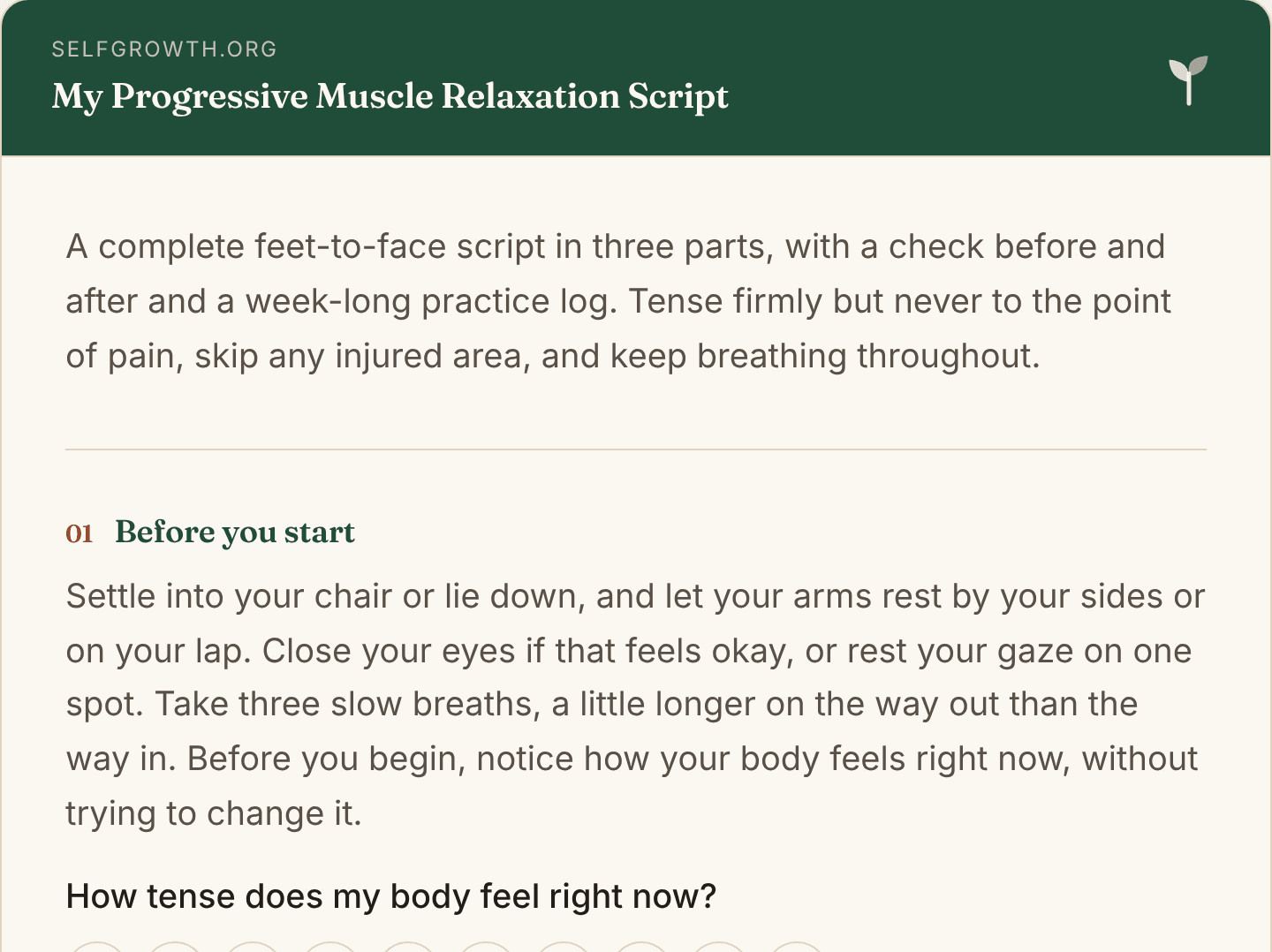
Progressive Muscle Relaxation Script
A free progressive muscle relaxation script in plain English: tense and release 13 muscle groups from feet to face, with a before-and-after check and 7-day log.
Open worksheetRelated guides
New worksheets, straight to your inbox
An occasional new worksheet or tool, sent only when there's something genuinely worth your time. No spam, no pressure, unsubscribe any time.