
Guide
List of emotions: feelings words to help you name what you feel
Updated 11 October 2026 · 10 min read
A list of emotions is a set of feeling words, grouped so you can find the one that fits. This list groups them under happy, calm, sad, hurt, angry and scared, plus flat feelings and mixed ones like shame, guilt and envy. Start with the closest group, then look for the word that makes you think, 'yes, that's it'.
By the Self Growth team · drawn from emotion research on affect labelling and emotion differentiation · how we make these
When someone asks how you are, the words that come out are often 'fine', 'okay', 'stressed' or 'bad'. They're not wrong, they're just blurry. 'Bad' could mean lonely, ashamed, worn out or quietly furious, and each of those points to something different you might need.
This page is a list of emotion words to choose from. It's grouped by broad feeling, so you don't have to read every word. Find the group that's closest to how you feel, then read down until one word fits better than the rest. Some words come with a short meaning, where two feelings are easy to mix up.
There's no right or wrong feeling here, and no word you're not allowed to use. The aim isn't to feel better straight away. It's to see more clearly what's going on, so you can decide what to do next.
How many emotions are there?
There's no single agreed number. Different researchers group emotions in different ways. Psychologist Robert Plutchik, for example, described eight basic emotions, including joy, trust, fear and surprise, arranged in a circle. Other models use more or fewer. Everyday English has a great many feeling words, many of them shades of the same few broad feelings.
For everyday use, it helps to start broad and then get more precise. This list uses six broad groups (happy, calm, sad, hurt, angry and scared), the same six as our feelings wheel, and adds two more: flat or numb feelings, and mixed or complex ones. Under each group you'll find more precise words to choose from.
Happy feelings
Words for when something feels good, light or worth having.
- Content: quietly satisfied with how things are.
- Cheerful: in a bright, easy mood.
- Joyful: a fuller, warmer kind of happy.
- Delighted: very pleased by something that happened.
- Excited: looking forward to something, with energy.
- Proud: pleased about something you or someone close to you did.
- Grateful: thankful for something or someone.
- Hopeful: expecting that things can get better.
- Optimistic: generally expecting good things.
- Playful: light-hearted and up for fun.
- Amused: finding something funny.
- Confident: trusting yourself to handle something.
- Inspired: moved to do or make something.
- Loved: cared for and wanted.
- Affectionate: feeling warmth towards someone.
- Connected: close to someone, or part of something.
- Enthusiastic: keen and eager.
- Satisfied: pleased that something went the way you wanted.
Calm feelings
Words for when things feel steady, safe or settled.
- Relaxed: your body and mind have eased off.
- Peaceful: still and untroubled.
- At ease: comfortable, with nothing pulling at you.
- Safe: free from threat, able to let your guard down.
- Secure: sure of where you stand.
- Settled: things have found their place.
- Relieved: a worry or pressure has lifted.
- Comfortable: at home in the moment or with someone.
- Grounded: steady and in touch with what's around you.
- Centred: balanced, not pulled in different directions.
- Rested: recovered after sleep or a break.
- Patient: able to wait without strain.
- Accepting: letting something be as it is.
- Unhurried: not rushing, with time to spare.
- Serene: deeply calm.
Sad feelings
Words for when something feels heavy, missing or lost.
- Down: a little low, without a clear reason.
- Low: sad, with less energy than usual.
- Disappointed: something didn't turn out the way you hoped.
- Lonely: wanting connection that isn't there right now.
- Homesick: missing a place or the people in it.
- Grieving: sad about a loss, of a person, a relationship, a hope or a way of life.
- Heartbroken: deeply hurt by a loss, often of love.
- Regretful: wishing you'd done something differently.
- Empty: hollow, as if something has gone.
- Tearful: close to crying.
- Gloomy: everything looks a bit grey.
- Melancholy: a quiet, lingering sadness.
- Miserable: very unhappy.
- Discouraged: losing heart after setbacks.
- Hopeless: unable to see things getting better. If this stays, please talk to someone (see the support section below).
- Despairing: hopeless and overwhelmed together.
Hurt feelings
Words for when someone else's words or actions have stung. Hurt often sits underneath anger, so it's worth checking here if you feel angry.
- Rejected: turned away or not chosen.
- Left out: not included when others were.
- Let down: someone didn't do what you counted on.
- Betrayed: someone you trusted broke that trust.
- Abandoned: left on your own when you needed someone.
- Dismissed: your feelings or views were brushed aside.
- Misunderstood: someone got the wrong idea about you.
- Unappreciated: what you do goes unnoticed or unthanked.
- Taken for granted: your effort is expected, not valued.
- Used: someone took from you without caring about you.
- Criticised: judged or found fault with.
- Humiliated: made to feel small in front of others.
- Invisible: as if no one sees you.
- Wounded: deeply hurt, in a way that lingers.
Angry feelings
Words for when something feels wrong, unfair or in your way. Anger runs from a small itch to a strong surge, so the precise word tells you a lot.
- Irritated: mildly bothered.
- Annoyed: bothered enough to notice it.
- Grumpy: in a short-tempered mood.
- Impatient: wanting something to hurry up.
- Frustrated: blocked from something you want or are trying to do.
- Fed up: had enough of something that keeps happening.
- Exasperated: worn out by repeated frustration.
- Defensive: ready to protect yourself from criticism.
- Resentful: holding on to anger about being treated unfairly.
- Bitter: resentment that has hardened over time.
- Indignant: angry at something that seems unjust.
- Provoked: pushed into anger by someone's words or actions.
- Hostile: feeling against someone, ready for a fight.
- Furious: very angry.
- Outraged: shocked and angry at something seriously wrong.
Scared feelings
Words for when something feels uncertain, threatening or too much.
- Uneasy: a vague sense that something isn't right.
- Worried: thinking about what might go wrong.
- Nervous: jittery before something, often with butterflies.
- Apprehensive: uneasy about something coming up.
- Tense: braced, with tight muscles.
- On edge: jumpy and alert.
- Anxious: worried and keyed up, often in your body as well as your head.
- Insecure: unsure of yourself or your place.
- Vulnerable: exposed, easy to hurt.
- Threatened: something or someone feels like a danger to you.
- Dread: a heavy fear of something ahead.
- Overwhelmed: more than you can cope with right now.
- Helpless: unable to change what's happening.
- Panicky: fear rising fast, hard to think straight.
- Terrified: very frightened.
Flat or numb feelings
Not every feeling is loud. Sometimes the honest word is about having very little feeling at all, or being too tired to feel much.
- Tired: low on energy.
- Drained: used up, often by people or effort.
- Exhausted: completely worn out.
- Burnt out: worn down by long-term stress, often at work or in caring for someone.
- Bored: nothing is holding your interest.
- Restless: unable to settle.
- Distracted: your attention keeps sliding away.
- Foggy: hard to think clearly.
- Flat: emotions feel turned down.
- Listless: no energy or enthusiasm for anything.
- Apathetic: you can't bring yourself to care.
- Detached: cut off from what's happening, or from yourself.
- Numb: very little feeling at all.
Numb or flat can be a sign of being worn out, but if it lasts for weeks, or comes with losing interest in things you used to enjoy, it's worth talking to a GP.
Mixed and complex feelings
Some feelings are blends, or are about how you see yourself. These are often the hardest to name, and the most useful to get right.
- Guilt: feeling bad about something you did, or didn't do.
- Shame: feeling bad about who you are, not just what you did. Guilt says 'I did something bad'; shame says 'I am bad'.
- Embarrassment: an awkward, exposed feeling after a mistake others saw.
- Self-conscious: very aware of how others might see you.
- Envy: wanting what someone else has.
- Jealousy: fearing you'll lose someone or something to another person.
- Nostalgia: a warm, wistful longing for the past.
- Bittersweet: happy and sad at once, like the end of something good.
- Longing: a strong wish for something or someone you don't have.
- Ambivalent: pulled two ways about the same thing.
- Conflicted: two feelings or wishes that don't fit together.
- Confused: not sure what you feel, or why.
- Surprised: caught off guard, pleasantly or not.
- Awe: wonder at something much bigger than you.
- Overwhelm: so many feelings, or demands, at once that it's hard to pick any of them out.
- Relief mixed with sadness: glad something is over, and sad that it is.
Mixed feelings are normal. You can be proud of someone and envious of them, or relieved a hard time is over and grieving it. Writing down all of them, instead of picking one, is often more honest.
How to identify your emotions, step by step
You don't need to get it perfect. A minute is enough, and a 'roughly right' word is better than none.
- 1Pause. Stop what you're doing for a moment and take one slow breath.
- 2Notice your body. Check for a tight chest, a clenched jaw, a heavy head, a fluttery stomach or restless legs.
- 3Pick the broad group. Ask which is closest: happy, calm, sad, hurt, angry, scared, flat or mixed.
- 4Find the precise word. Read down that group and choose the word that fits best, or use your own.
- 5Check for more than one. Ask what else is there, and whether one feeling is sitting on top of another, like anger over hurt.
- 6Name what happened. Note what happened just before, or what has been on your mind.
- 7Ask what you need. Rest, company, space, to say something, or one small thing you can do.
If you'd like to do this on paper, the free feelings wheel below puts six broad feelings and more precise words on one printable sheet, with a daily check-in and a week log so you can spot patterns.
Open the Feelings WheelWhy naming your feelings helps
There's some good reason to think finding the word helps, with honest limits.
In a small brain-scanning study, Matthew Lieberman and colleagues (2007) showed adults photos of faces with strong expressions. When people picked a word for the emotion on a face, activity in the amygdala (a part of the brain involved in emotional reactions) went down. It went down less when they did other tasks, like matching faces. Researchers call this 'affect labelling'. The study was about labelling other people's faces in a scanner, not your own feelings, so it's a hint rather than proof.
A 2015 review by Todd Kashdan, Lisa Feldman Barrett and Patrick McKnight looked at 'emotion differentiation', the skill of telling one unpleasant feeling from another. People who describe their feelings in finer detail tend to cope better under intense stress. They're also less likely to turn to things like binge drinking or aggression. Much of this shows a link, not cause and effect. The authors describe the evidence that the skill can be trained as preliminary.
So a list like this won't fix anything on its own. What it can do is give you more words to reach for, which is the skill that research is pointing at.
What's the difference between a feeling and a thought?
It's easy to mix the two up, because everyday language does. 'I feel like they don't care about me' is really a thought, a guess about someone else. The feeling underneath might be hurt, lonely or rejected.
- A feeling can usually be named in a word or two: sad, angry, relieved, ashamed.
- A thought is a sentence about the world, other people or yourself: 'I'm going to fail', 'she's ignoring me'.
- A useful check: if you can put 'that' after 'I feel', it's probably a thought. 'I feel that I'm useless' is a thought; the feeling might be ashamed or hopeless.
- Thoughts can be weighed up and questioned. Feelings don't need to be argued with, only noticed and understood.
Separating the two helps. Once you know the feeling, you can be kinder to it. Once you can see the thought, you can ask whether it's fair. If a harsh thought keeps coming back, the negative self-talk worksheet helps you answer it.
Why it can be hard to name your feelings
If you look at a list like this and nothing seems to fit, you're not doing it wrong. Some reasons it can be hard:
- You grew up in a home where feelings weren't talked about, or certain ones (often anger or sadness) weren't allowed.
- You're used to being busy, so feelings only show up as tiredness or tension.
- You notice feelings mainly in your body: a headache, a knot in your stomach, a racing heart.
- You're under a lot of stress, and everything blurs into 'stressed'.
- One feeling covers another, like anger covering hurt, or cheerfulness covering worry.
You might find it hard to name and describe your feelings across most of your life, not just on bad days. Psychologists call this 'alexithymia'. It isn't a diagnosis in itself, and it can be worked on, often with a therapist. Starting small, with one broad word a day, is a fine way in. Journaling can help too: the guide on how to start journaling has simple ways to begin.
When feelings feel overwhelming: getting more support
This list and the worksheet are self-reflection tools, not therapy. Naming a feeling can make it clearer, but it doesn't always make it smaller, and some feelings are too heavy to carry on your own.
If a feeling is very strong, won't lift, or is getting in the way of sleep, work or relationships, please talk to a GP or family doctor, or a qualified mental health professional. They can help you find talking therapies or other support. If you've felt low, hopeless or numb for more than a couple of weeks, that's a good reason to book an appointment.
If you're in crisis or thinking about harming yourself, please reach out now. In the UK and Ireland, call Samaritans on 116 123. In the US, call or text 988. Anywhere else, find a helpline in your country at findahelpline.com. If you're in immediate danger, call your local emergency number. You deserve real support, not just a list of words.
How we put this together
The word list is our own, in plain UK English, grouped to match our feelings wheel. The meanings are short everyday definitions, not clinical ones. The research section draws on two studies of naming emotions, described with their limits. It's an educational self-reflection resource, not therapy or medical advice, see our editorial standards.
If you want to go deeper
- Lieberman, M. D., Eisenberger, N. I., Crockett, M. J., Tom, S. M., Pfeifer, J. H. & Way, B. M. (2007). Putting feelings into words: Affect labeling disrupts amygdala activity in response to affective stimuli. Psychological Science, 18(5), 421-428.
- Kashdan, T. B., Barrett, L. F. & McKnight, P. E. (2015). Unpacking emotion differentiation: Transforming unpleasant experience by perceiving distinctions in negativity. Current Directions in Psychological Science, 24(1), 10-16.
- Plutchik, R. (2001). The nature of emotions. American Scientist, 89(4), 344-350.
Your questions, answered
- What is a list of emotions?
- A list of emotions is a set of feeling words, usually grouped by broad feeling, so you can find the word that fits what you're going through. The list on this page groups words under happy, calm, sad, hurt, angry, scared, flat or numb, and mixed feelings, with short meanings where two words are easy to confuse.
- What are the basic emotions?
- There's no single agreed list. Psychologist Robert Plutchik described eight basic emotions, including joy, sadness, anger, fear, trust and surprise. Other researchers use different sets. For everyday use, six broad feelings (happy, calm, sad, hurt, angry and scared) are a practical place to start, then you can look for a more precise word inside each one.
- How do I identify my emotions?
- Pause, notice what's happening in your body, then pick the broad group that's closest: happy, calm, sad, hurt, angry, scared, flat or mixed. Read down that group and choose the word that fits best. Check whether there's more than one feeling, note what happened just before, and ask what you might need. A minute is enough.
- What is the difference between feelings and emotions?
- In everyday speech the two words are used interchangeably, and this page does the same. Some writers use 'emotion' for the body's quick reaction and 'feeling' for how you experience it, but there's no single agreed definition. For naming what's going on inside you, the difference matters much less than finding the word that fits.
- Why can't I tell what I'm feeling?
- There are often understandable reasons. You might have grown up without words for feelings, notice them mostly as tension or tiredness, or be so stressed that everything blurs together. Start small with one broad word a day. If it's hard across most of your life, a therapist can help you build the skill.
- Is there a printable list of emotions?
- The free feelings wheel worksheet puts six broad feelings and 36 more precise words on one printable sheet, with a daily check-in and a week log. It's free, with no payment and no email needed. You can download the PDF, print it, or fill it in on screen.
- Is naming my feelings a substitute for therapy?
- No. This is an educational self-reflection guide, not therapy or medical advice. If a feeling is very strong or won't lift, please talk to a GP or a qualified mental health professional. If you're in crisis, call Samaritans on 116 123 (UK and Ireland), call or text 988 (US), or find a helpline at findahelpline.com.
Worksheets to do the work
Free to fill in online or print. No email needed.
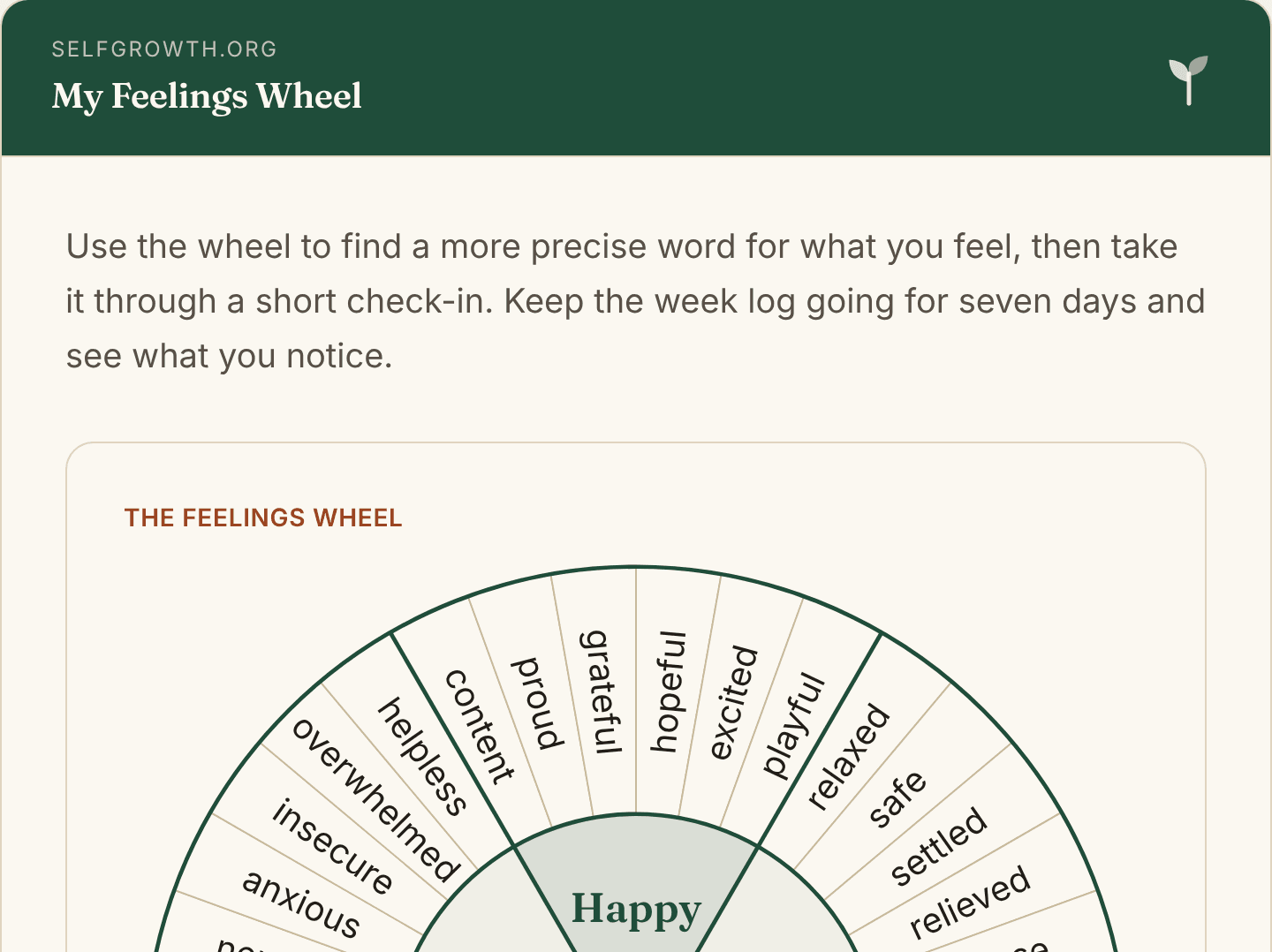
Feelings Wheel
A free printable feelings wheel (emotion wheel) PDF: six core feelings and 36 more precise words, with a daily check-in and a week log to name what you feel.
Open worksheet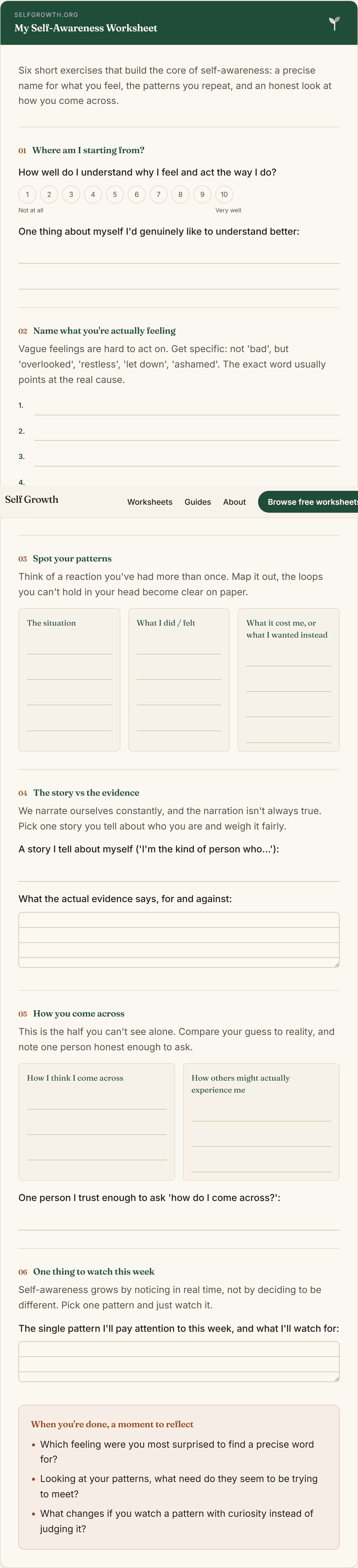
Self-Awareness Worksheet
A free, printable self-awareness worksheet with guided exercises to name your feelings, spot your patterns, and see how you come across, so you understand yourself better.
Open worksheet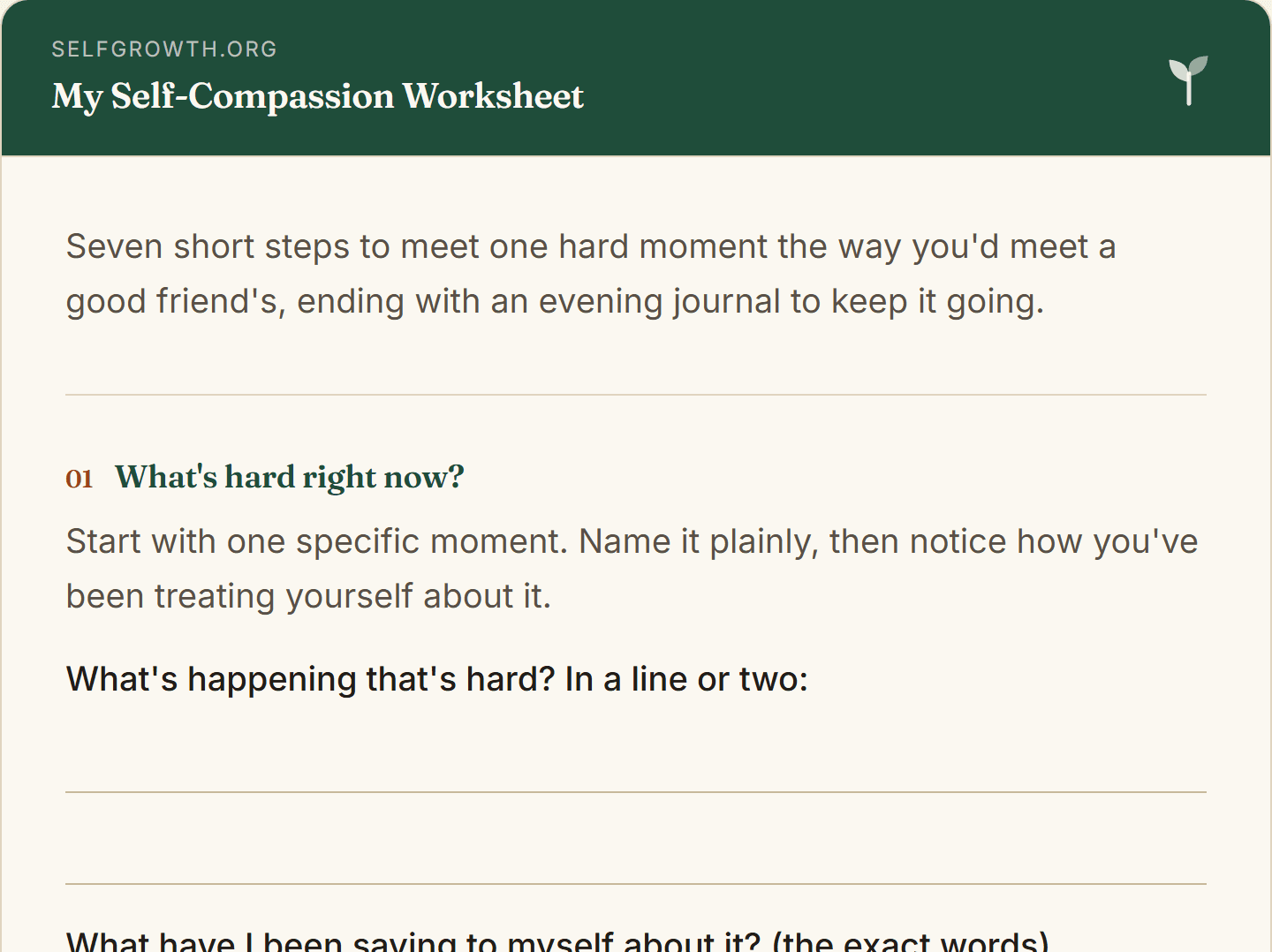
Self-Compassion Worksheet
A free, printable self-compassion worksheet: the self-compassion break, the friend test, a kind letter and journal prompts, based on Kristin Neff's research.
Open worksheet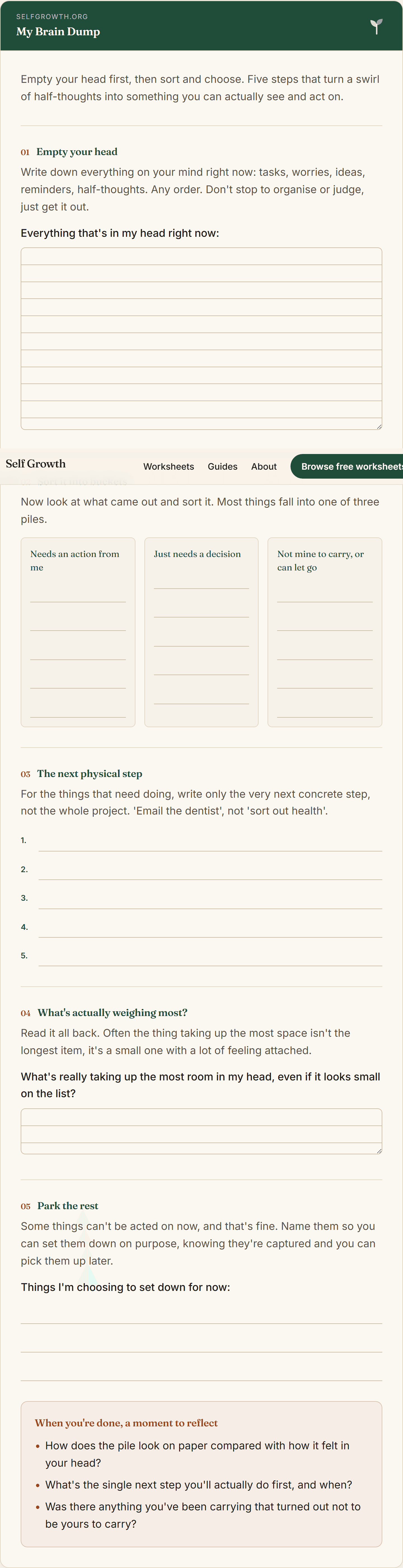
Brain Dump Template
A free, printable brain dump template to empty a cluttered mind onto the page, sort it into what needs action and what to let go, and find the next clear step.
Open worksheetRelated guides
New worksheets, straight to your inbox
An occasional new worksheet or tool, sent only when there's something genuinely worth your time. No spam, no pressure, unsubscribe any time.