
Guide
How to start journaling
Updated 11 October 2026 · 11 min read
To start journaling, pick a few quiet minutes you already have and answer one small question instead of facing a blank page. Write honestly, not well, because nobody else needs to read it. There's no proven schedule, so choose one you'll keep. Carry on if it leaves you clearer, and change approach if it keeps you stuck.
By the Self Growth team · drawn from expressive-writing research and reflective journaling · how we make these
Starting a journal sounds simple until you sit down with the pen. The page is blank, your mind goes quiet, and whatever you write feels either too boring or too much. That's not a sign you're bad at it. It's what a blank page does to almost anyone.
This guide is for the very start: what journaling actually is, a few plain steps to begin, the different kinds of journal and which one fits what you want, and what to write on the nights you've got nothing. You'll also see what the research really shows, which is a real but modest benefit, and why writing can sometimes feel worse before it feels better.
What is journaling?
Journaling is writing down your thoughts, feelings and experiences, for yourself, on a regular-ish basis. That's all. It can be a few lines about your day, an answer to one question, a list of what's on your mind, or a page about something you can't stop thinking about. You don't need a special notebook, a method or any talent for writing.
It helps to know what journaling isn't, too:
- It isn't a diary you have to keep up every day. Gaps are normal.
- It isn't writing for an audience. Spelling, grammar and making sense don't matter.
- It isn't positive thinking. You can write about bad days honestly.
- It isn't therapy. It can help you think more clearly, but it can't replace support from another person when you need it.
You're not trying to write well. You're trying to write honestly.
How to start journaling, step by step
Keep the first few tries small. The aim is a habit you'll come back to, not a perfect first entry.
- 1Choose where you'll write. A cheap notebook, a notes app or a printed prompt sheet all work. Pick whatever you'll actually reach for.
- 2Attach it to a time you already have, such as with your morning coffee, on the bus, or the last few minutes before bed.
- 3Start short. Five to ten minutes is enough at first. You can always write more if it's flowing.
- 4Write the date at the top. It costs nothing and makes old entries far more useful when you look back.
- 5Answer one question rather than facing a blank page. 'What's on my mind right now?' or 'What was the best and hardest part of today?' is plenty.
- 6Write without editing. Don't cross out, don't polish, don't worry about whether it's interesting.
- 7Finish with one line about what you noticed or what you might do next, so the entry doesn't just stop mid-worry.
- 8Every few weeks, re-read a handful of old entries. This is where patterns start to show.
If you'd like the questions done for you, a prompt sheet is the easiest way in. The self-discovery prompts are a good general starting point.
Open the Self-Discovery Journal PromptsTypes of journaling, and which prompts fit
There's no official list of journal types, and you can mix them freely. But knowing roughly what you want from it makes the first page easier. Here are some common kinds, with the free prompt page that fits each one:
- Getting to know yourself: questions about your values, what fills and drains you, and the stories you tell about yourself. Try the self-discovery journal prompts.
- Gratitude journaling: writing down a few specific good things and why they mattered. Use the gratitude journal prompts, and the gratitude journal guide for how often and what to write.
- Growth or reflective journaling: tracking how you're changing over time, from habits and setbacks to a look back at the end of a month. The self-growth journal prompts are built for this.
- Shadow work journaling: writing about the parts of yourself you usually keep hidden, starting gently. Read what shadow work is first, then use the shadow work journal prompts, which go from gentle to deep.
- Free writing or a brain dump: getting everything out of your head and onto the page, with no structure. The brain dump template gives you somewhere to put it.
- A feelings journal: naming what you feel, as precisely as you can. The feelings wheel and the list of emotions help when 'fine' or 'stressed' is all that comes.
- Expressive writing: writing honestly about a difficult or important experience, often for a few sessions in a row. This is the kind most research has tested. Go gently with it, for the reasons in the section on whether journaling helps.
Not sure which one you want? Start with the self-discovery prompts. If you find yourself drawn to what's going well, try gratitude next. If you keep circling the same reactions and patterns, shadow work may be where you're headed.
What to write in a journal when you don't know what to write
The blank page is often the hardest part of journaling. A question gives your mind something to grab. Here are ten starter prompts for the days nothing comes. Pick one, not all of them:
- What's taking up the most space in my head right now?
- What was the best part of today, and the hardest?
- How am I actually feeling, in one honest word? Where do I feel it in my body?
- What am I looking forward to, even slightly?
- What's something I keep putting off, and what's in the way?
- What did I do today that I'd like to do more of?
- Who did I think about today, and why?
- What would I say to a friend who'd had my day?
- What's one thing I'm worried about, and what part of it can I do something about?
- What do I want tomorrow to feel like, and what's one small thing that would help?
If even that's too much, write 'I don't know what to write' and keep going for two minutes. Or just list what you did today. Plain facts count, and they often lead somewhere.
Common beginner mistakes
If you've tried journaling before and it didn't stick, one of these may be why. None of them means journaling isn't for you.
- Aiming too big. Promising yourself a page a day, every day, makes the first missed day feel like failure. Start smaller than you think you need to.
- Waiting for the right notebook or the right mood. The habit matters more than the stationery, and you don't need to feel inspired to write three lines.
- Writing for an imagined reader. If you're editing yourself in case someone sees it, you'll stop writing the honest bits. See the FAQ below on privacy.
- Only venting. Getting it out can help, but writing the same complaint every night can turn into going round in circles. Now and then, end with what you could do next.
- Diving into the deepest stuff first. Starting with your hardest memory can leave you overwhelmed. Build up to it, or leave it for a conversation with someone you trust.
- Never re-reading. Old entries are where you notice how your thinking has shifted. Glance back every few weeks.
Does journaling help? The benefits, honestly
It can, but the evidence is more modest than many posts about journaling suggest. Most of the research isn't on everyday journaling at all. It's on expressive writing, which means writing honestly about difficult or important experiences.
The method was first tested by the psychologist James Pennebaker and Sandra Beall in a study published in 1986. 46 students wrote for 15 minutes a night, on four evenings in a row. Those who wrote about both the facts and the feelings of a traumatic event felt worse straight afterwards. Their blood pressure and negative mood were higher after writing. But over the next six months, they made fewer visits to the health centre. The authors called the findings preliminary.
Since then the method has been tested many times. In 2006, Joanne Frattaroli published a meta-analysis (a study that pools many studies) of 146 randomised trials. She found a real benefit on average. It was small.
So here's a fair summary. Writing honestly about your life may help a little, for some people, some of the time. Those trials didn't test diary entries or prompt journals, so the benefits often claimed for journaling (less stress, better sleep, clearer thinking) are plausible rather than proven. The most useful test is your own: after a few weeks, do you finish a session feeling a bit clearer, or not?
It's also worth knowing that journaling can feel worse before it feels better, as the 1986 study found. A heavy feeling after writing about something hard isn't automatically a bad sign. But it shouldn't become the pattern. Signs journaling isn't helping you:
- You're writing the same worry over and over, without getting anywhere new. That's rumination, and the page can feed it.
- You feel worse after most sessions, not just the occasional hard one.
- You dread sitting down to write, or it's become one more thing to fail at.
- Writing brings up memories that don't settle afterwards.
If that's you, switch to lighter or more practical prompts, take a break, or talk it through with someone instead. That's not giving up. It's using the right tool.
When to get more support
A journal is a self-reflection tool, not therapy. It's good for thinking things through, but it can't listen back, and some things are too heavy to carry on paper alone. If low mood, anxiety, grief or painful memories aren't lifting, or journaling keeps pulling you somewhere dark, that's a reason to talk to someone, not to write harder.
A GP or family doctor is a good first step and can point you towards talking therapies. If you ever have thoughts of harming yourself, please reach out now: call or text 988 in the US, call Samaritans on 116 123 in the UK and Ireland, or find a free helpline where you live at findahelpline.com. You deserve real support, not just a notebook.
How we put this together
This guide is written in plain language. Most journaling research is on expressive writing rather than everyday journals or prompts, so we describe what those studies found and say where the evidence runs out. The steps, journal types and starter prompts are practical suggestions, not tested methods. It's an educational self-reflection resource, not therapy or medical advice, see our editorial standards.
If you want to go deeper
- Pennebaker, J. W. & Beall, S. K. (1986). Confronting a traumatic event: Toward an understanding of inhibition and disease. Journal of Abnormal Psychology, 95(3), 274-281.
- Frattaroli, J. (2006). Experimental disclosure and its moderators: A meta-analysis. Psychological Bulletin, 132(6), 823-865.
Your questions, answered
- How do I start journaling for the first time?
- Pick a few quiet minutes you already have, like with your morning coffee or before bed. Write the date, then answer one simple question, such as 'What's on my mind right now?' Write for five to ten minutes without editing. Don't worry about doing it every day. If a blank page stops you, use a free prompt sheet so you always have a question ready.
- What should I write in my journal?
- Anything that's true for you today: what happened, how you feel about it, what's worrying you, what went well, or what you want next. If nothing comes, answer one prompt, such as 'What was the best and hardest part of today?', or just list what you did. Plain facts are a fine start and often lead to something more.
- What are the benefits of journaling?
- The research is mostly on expressive writing, meaning writing honestly about hard or important experiences. A 2006 meta-analysis of 146 trials found a real but small average benefit. Everyday journaling hasn't been tested as thoroughly, so benefits like clearer thinking or less stress are plausible rather than proven. Notice how you feel after a few weeks and judge it on that.
- Is it better to journal on paper or in an app?
- There's no clear evidence either way, so use whichever you'll actually keep up. Paper is slower and away from your phone's distractions, and it's easy to keep private by tucking it away. An app or notes file is always with you, searchable and can be locked with a passcode. You can also mix them: a printed prompt sheet for longer sessions, your phone for quick notes.
- How long should I journal for?
- There's no proven ideal. Five to ten minutes is a sensible start, and 15 to 20 minutes is plenty for a longer session. The first expressive-writing study used 15 minutes a night for four nights. A short entry you actually write is worth more than a long one you keep putting off.
- Is it better to journal in the morning or at night?
- Honestly, nobody knows. We haven't found good research comparing the two. Mornings can suit planning and setting an intention for the day. Evenings can suit looking back, because the day has happened. If writing at night leaves your mind racing, try earlier. Pick the time you already have a few quiet minutes, so the habit hangs on something you do anyway.
- What if someone reads my journal?
- Worrying about this can stop you writing honestly, so it's worth sorting out. Keep a paper journal somewhere private, use a passcode on an app, or write sensitive things on loose paper and throw them away afterwards. If you live with someone who controls or hurts you, keep anything sensitive where they can't find it, and contact a domestic abuse service: in the UK, 0808 2000 247; in the US, 1-800-799-7233.
- Is journaling free here, and is it therapy?
- Yes, it's free. Every prompt page on this site can be filled in on screen or printed, with no payment and no email needed. Journaling is a self-reflection habit, not therapy or medical advice. If low mood or anxiety won't lift, a GP or a therapist can help. In a crisis, call or text 988 in the US, call Samaritans on 116 123 in the UK and Ireland, or find a helpline at findahelpline.com.
Worksheets to do the work
Free to fill in online or print. No email needed.
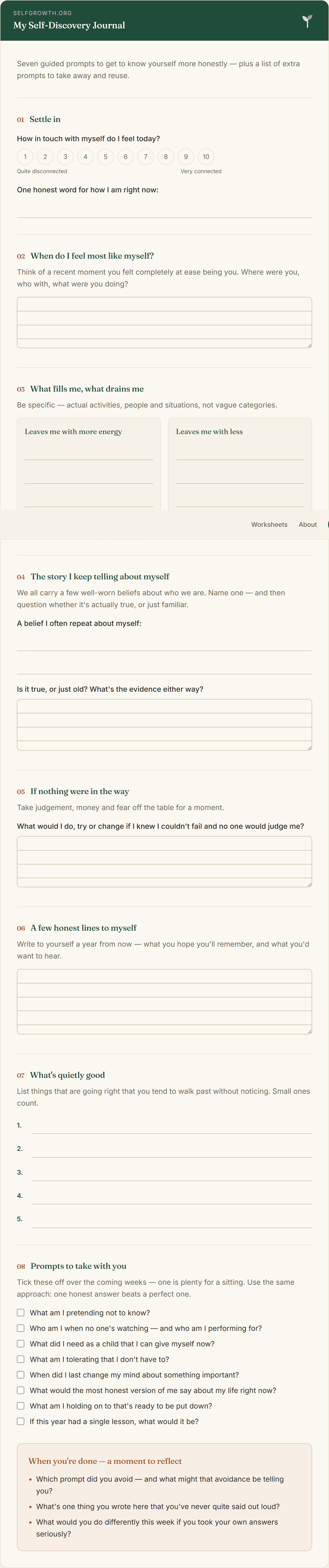
Self-Discovery Journal Prompts
Free, printable self-discovery journal prompts, guided questions with space to write, to explore your values, patterns and what you really want.
Open worksheet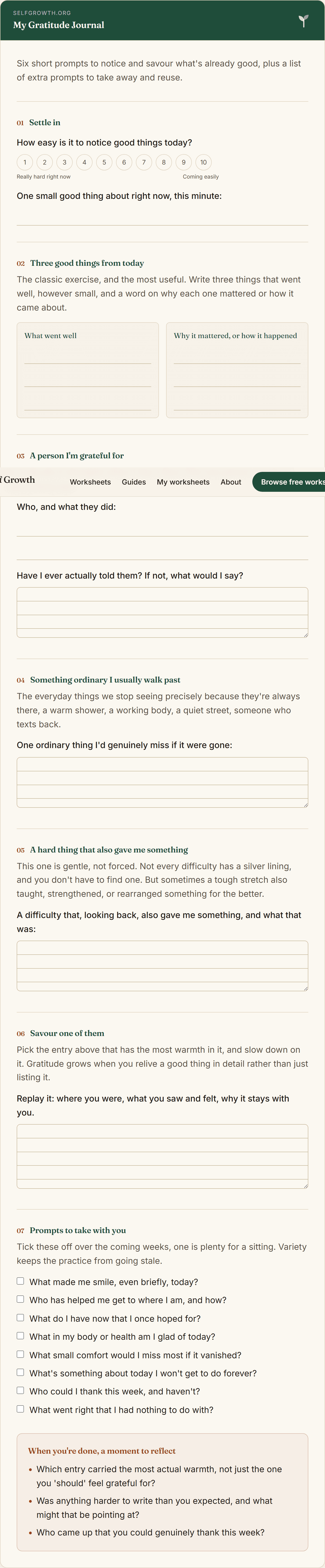
Gratitude Journal Prompts
Free, printable gratitude journal prompts: guided questions with space to write, plus a take-away list, to help you notice and savour what's already good.
Open worksheet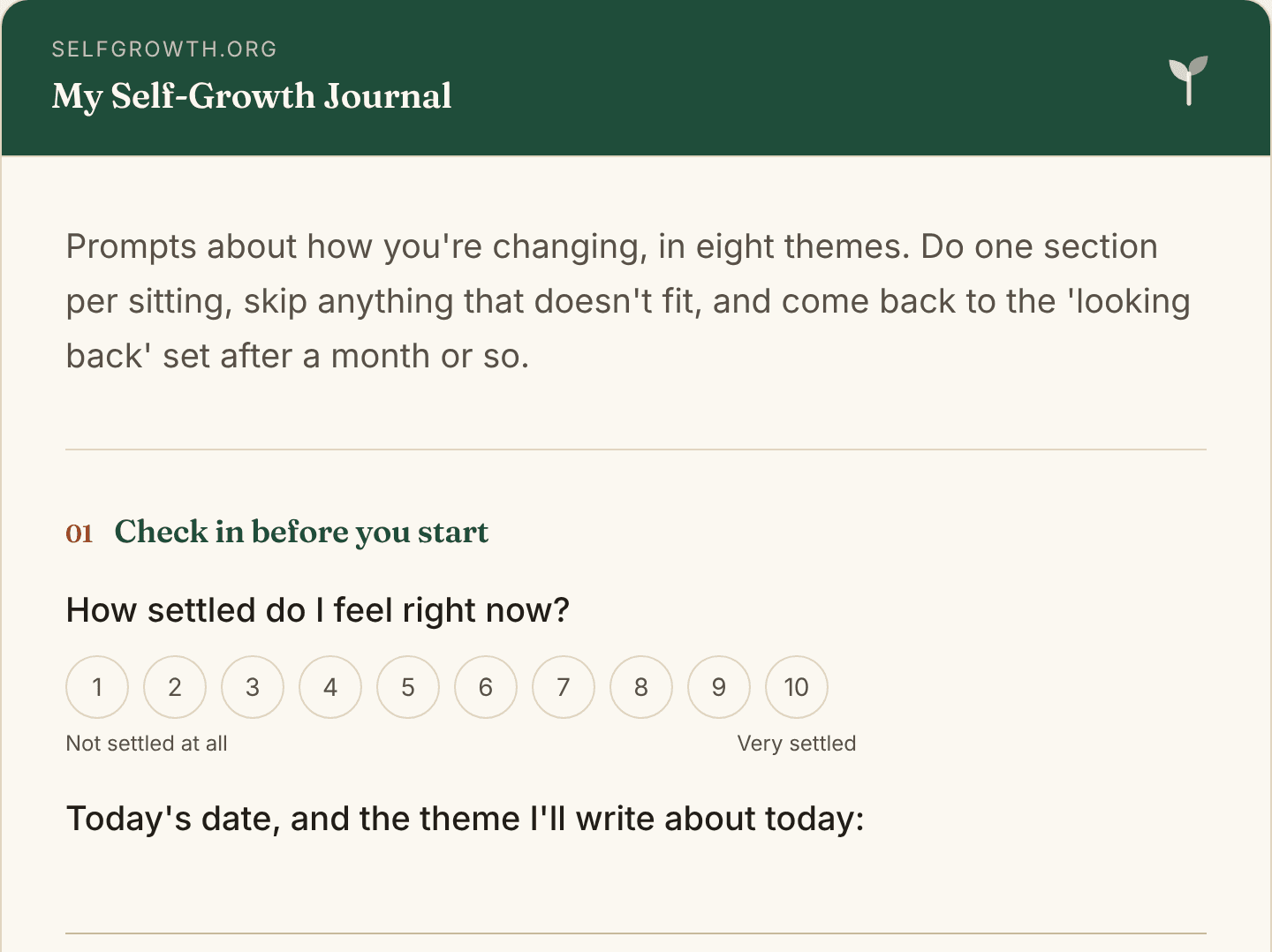
Self-Growth Journal Prompts
58 free, printable journal prompts for self growth, in themes from habits and setbacks to values and a look back, with honest tips on how often to write.
Open worksheet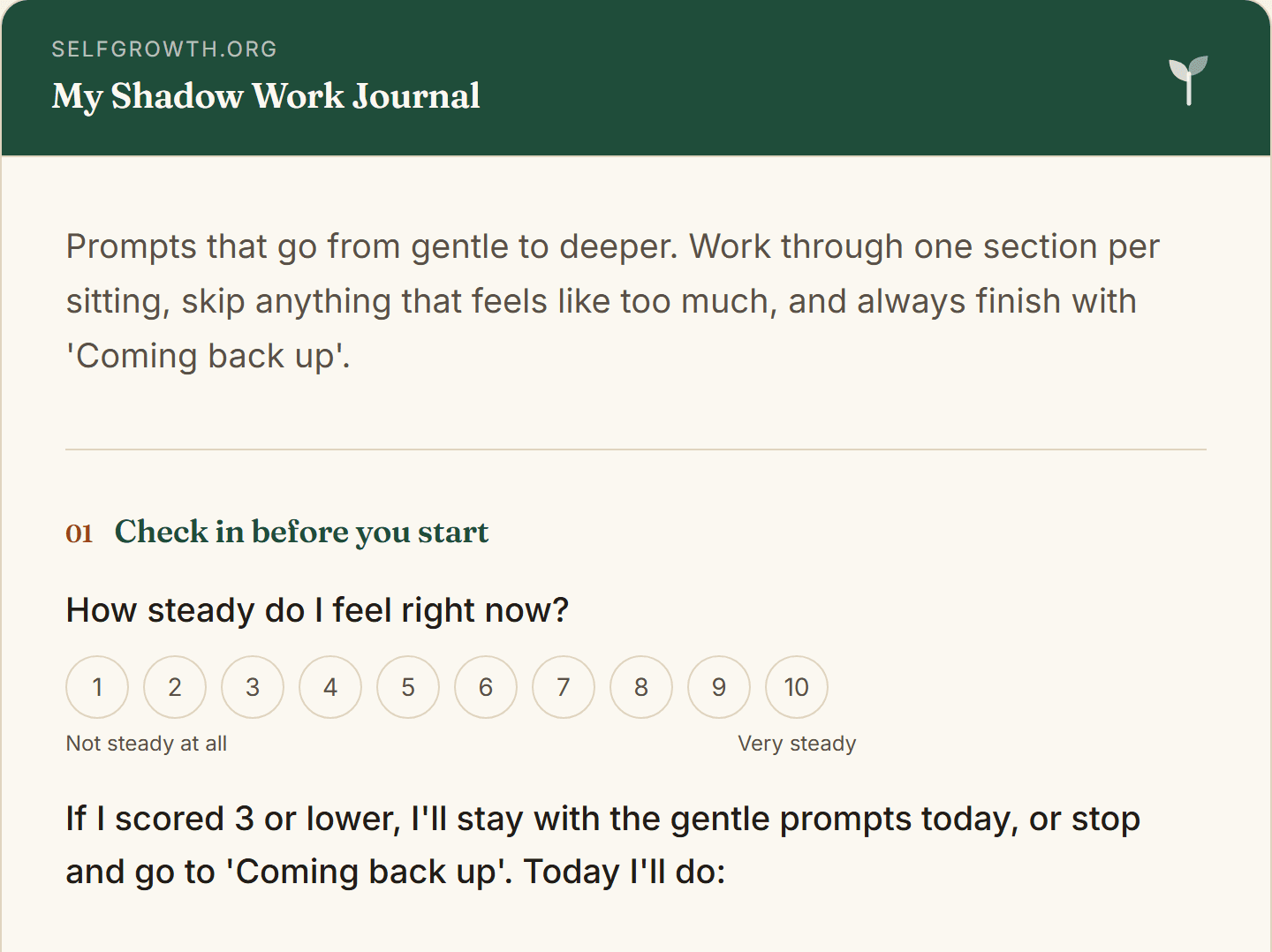
Shadow Work Journal Prompts
Free, printable shadow work journal prompts: 30+ questions that go from gentle to deep, with pacing tips and a plan for when it gets heavy.
Open worksheetRelated guides
New worksheets, straight to your inbox
An occasional new worksheet or tool, sent only when there's something genuinely worth your time. No spam, no pressure, unsubscribe any time.