
Journaling
Journal prompts for self growth: 58 free, printable questions about how you're changing
Updated 11 October 2026 · 8 min read · Free to print
Journal prompts for self growth are questions that help you write about how you're changing: where you are now, what you're learning, what you're outgrowing and how your values show up day to day. This free, printable set has 58 prompts grouped by theme, most with space to write, plus honest advice on how often to journal.
By the Self Growth team · drawn from expressive-writing research & reflective journaling · how we make these
Fill it in here (it saves in this browser, but not in a private window), print it, or download the PDF. Free, no sign-up.
Growth is hard to see while you're in it. Most weeks feel the same from the inside, so it's easy to decide nothing is changing, or to only notice the bits that went wrong. A growth journal gives you a record. When you write down what you're learning, what you're letting go of and how you handled a hard week, you can look back later and see the shape of it.
These prompts are about change over time, not about working out who you are. (If that's what you're after, the self-discovery journal prompts are the better fit.) Here the questions follow the places growth actually happens: your habits, your relationships, your setbacks, and the gap between the values you hold and what you did on Tuesday. The last set is for looking back over a month or a year.
Writing things down can help, but the evidence is more modest than journaling posts often suggest. Most of the research is on expressive writing, which means writing honestly about difficult or important experiences. A 2006 meta-analysis (a study that pools many studies) by Joanne Frattaroli looked at 146 trials. It found a real benefit on average, but a small one. So treat these prompts as a way to think more clearly about your life, not as a fix.
How to use this worksheet
- 1Pick one section, or even one prompt, per sitting. 10 to 20 minutes is plenty. You don't need to go in order, except that the 'looking back' set works best after a few weeks of entries.
- 2There's no proven best schedule. Write as often as you'll actually keep up: some people like a few minutes most days, others a longer session at the end of each week or month. Missing a week isn't failing.
- 3Be specific. 'I'm getting better at saying no' is a start. 'On Thursday I told my manager I couldn't take the extra project' is something you can learn from.
- 4If writing turns into going over the same worry again and again, or you finish feeling worse each time, stop. Switch to a practical prompt (what's one small thing I can do?), take a break from journaling for a while, or talk it through with someone instead.
- 5Date each entry and keep them. Re-reading old pages is where you'll notice how far you've come.
The worksheet
selfgrowth.org
My Self-Growth Journal
Prompts about how you're changing, in eight themes. Do one section per sitting, skip anything that doesn't fit, and come back to the 'looking back' set after a month or so.
01Check in before you start
How settled do I feel right now?
Today's date, and the theme I'll write about today:
02If journaling starts to make you spiral
Journaling should leave you a little clearer, not stuck in a loop. If you notice you're writing the same worry over and over, feeling worse after each session, or the prompts bring up something heavy that doesn't settle, stop and talk to someone. These prompts are for self-reflection, not therapy. A GP or family doctor, or a therapist, can help with what a journal can't. If you have any thoughts of harming yourself, please reach out now: call or text 988 in the US, call Samaritans on 116 123 in the UK and Ireland, or find a free helpline at findahelpline.com.
If this gets heavy, the person I'll talk to is:
Something that helps me reset (a walk, music, a shower, a call):
03Where I am right now
A snapshot of today, so you have something to compare with later. Write it plainly, without dressing it up or running it down.
If I had to describe this stage of my life in one sentence, what would it be?
What's going better than it was a year ago?
What's taking up most of my energy at the moment, and is that what I'd choose?
Which part of my life feels most stuck, and what does stuck feel like there?
What am I quietly proud of that nobody else has noticed?
What do I want to be different by this time next year, in one area only?
04What I'm learning
Growth is mostly learning, and not only the classroom kind. Think about skills, but also things you've understood about yourself or other people.
What have I learned recently that changed how I see something?
What am I getting better at, even slowly? How can I tell?
What's a mistake from the last month that taught me something useful?
Who have I learned from lately, and what exactly did they show me?
What's something I used to be sure about that I'm less sure about now?
What do I want to learn next, and what's one small way to start this week?
05What I'm outgrowing
Growing usually means leaving something behind: a habit, a belief, a role, sometimes a way of being with people. You don't have to act on any of this yet. Just notice it.
What used to fit me that feels a bit too small now?
Which old story about myself ('I'm just not the kind of person who...') is starting to feel untrue?
What am I still doing mainly because I've always done it?
What would I stop doing if I didn't worry about what people would think?
What am I scared to let go of, and what's the fear really about?
What have I already outgrown, and how did I know it was time?
06Habits and the small daily stuff
Most change happens in ordinary days. Look at what you actually do, not what you plan to do.
Which daily habit is helping me most right now?
Which habit is quietly working against what I want? When does it usually show up?
What did I do this week that the version of me from a year ago wouldn't have?
When I drop a good habit, what's usually going on (tired, busy, low, bored)?
What's the smallest version of a habit I want, small enough that I'd still do it on a bad day?
How do I treat myself when I slip, and how would I like to?
07Relationships and how I show up
You grow in relation to other people as much as on your own. Think about specific people and moments, not relationships in general.
Who brings out the version of me I like most? What's different around them?
When did I last handle a hard conversation better than I would have before?
What pattern keeps showing up in my relationships, and what's my part in it?
Where am I saying yes when I mean no?
Who do I want to be more present with, and what gets in the way?
What do I need from people that I'm still finding hard to ask for?
08Setbacks and hard stretches
Pick a recent setback that's small or medium, not the hardest thing that's ever happened to you. If a prompt pulls you somewhere painful, skip it.
What didn't go the way I hoped recently? Just the facts first.
What was in my control, and what wasn't?
What did I tell myself about it at the time, and is that fair?
What would I say to a friend who'd had the same setback?
What helped me get through the last hard stretch I had?
Is there one thing I'd do differently next time? (It's fine if the answer is no.)
09Values in action
It's easy to say what matters to you. These prompts look at the gap between your values and your week, without beating yourself up about it.
Name two or three things that matter most to me. Where did I act on one of them this week?
When did I act against something I care about, and what pulled me there?
If someone watched how I spent my time this week, what would they guess I value?
Which decision coming up would be easier if I let my values decide?
What's one small thing I could do tomorrow that fits who I want to be?
Have my values changed in the last few years? Which one has grown, or faded?
10Looking back over a month or a year
Save these for the end of a month, a birthday or the end of a year. Re-read a few old entries first if you have them.
What's different about me now compared with the start of this stretch?
What am I most glad I did, tried or said?
What did I worry about that turned out fine, or never happened?
What was the hardest part, and what did it teach me?
Who helped me along the way, and have I told them?
What do I want to carry into the next month or year, and what do I want to leave behind?
If this stretch were a chapter, what would I call it?
11More prompts for another day
Tick one off each time you use it. One prompt is plenty for a sitting.
When you're done, a moment to reflect
- Which prompt was the easiest to skip, and is there something in that?
- Reading back what you wrote today, what's one thing you'd want to remember in six months?
- Is there one small, concrete step your answers point to this week?
Does journaling actually help you grow?
The research behind journaling mostly comes from expressive writing, a method the psychologist James Pennebaker began testing in the 1980s. In his first study with Sandra Beall, published in 1986, 46 students wrote for 15 minutes a night on four evenings in a row. Those who wrote about both the facts and the feelings of a traumatic event felt worse straight afterwards. But they made fewer visits to the health centre over the next six months. The authors called the findings preliminary.
Since then the method has been tested many times. Joanne Frattaroli's 2006 meta-analysis pooled 146 randomised trials and found a positive average effect. It was small. Those trials were about writing through difficult or meaningful experiences, not about growth prompts, so we treat them as support for the habit of writing honestly, not as proof that this worksheet will change your life.
The themes here (where you are now, learning, outgrowing, habits, relationships, setbacks, values and looking back) are our own choice. They follow the everyday places where change tends to show up. The advice to stop if writing turns into rumination (going over the same worry again and again) is there because writing about hard things can make you feel worse in the short term.
These are educational self-reflection tools, not therapy. See our editorial standards.
If you want to go deeper
- Pennebaker, J. W. & Beall, S. K. (1986). Confronting a traumatic event: Toward an understanding of inhibition and disease. Journal of Abnormal Psychology, 95(3), 274-281.
- Frattaroli, J. (2006). Experimental disclosure and its moderators: A meta-analysis. Psychological Bulletin, 132(6), 823-865.
Your questions, answered
- What are good journal prompts for self growth?
- Good self-growth prompts ask about change, not just how your day went. For example: What's going better than it was a year ago? What am I outgrowing? Which habit is quietly working against what I want? What did a recent setback teach me? Where did I act on my values this week? What do I want to carry into next year? Specific questions like these are easier to answer honestly than a blank page.
- How do I start a self-growth journal?
- Pick a notebook, or print these prompts, and set aside 10 to 20 minutes somewhere quiet. Write today's date and a short snapshot of where you are now, so you have something to compare with later. Then answer one prompt without editing. Keep the entries, because re-reading them after a month or so is where you start to see your own growth.
- How often should I journal for personal growth?
- There's no proven best schedule, so choose one you'll actually keep. A few minutes most days works for some people, while others prefer one longer session a week or a review at the end of each month. A short entry you actually write is worth more than a long one you keep putting off. If journaling starts to feel like a chore or leaves you feeling worse, cut back or take a break.
- Does journaling actually help with self growth?
- It may help a little. Most research is on expressive writing, meaning writing honestly about difficult or important experiences. A 2006 meta-analysis of 146 trials by Joanne Frattaroli found a real but small average benefit. Those studies didn't test growth prompts like these, so the best way to think of a growth journal is as a tool for reflection, not a proven treatment.
- Can journaling make you feel worse?
- Sometimes, at least for a while. In James Pennebaker and Sandra Beall's 1986 study, students who wrote about the facts and feelings of a traumatic event had higher blood pressure and more negative moods straight after writing, even though they visited the health centre less in the next six months. Common signs it isn't helping: going over the same worry again and again, or feeling worse after every session. If that happens, stop and talk to someone.
- How are these different from self-discovery journal prompts?
- Self-discovery prompts help you understand who you are: your values, your patterns and what you really want. These self-growth prompts are about how you're changing over time: what you're learning and outgrowing, your habits, relationships and setbacks, and a look back over a month or a year. If you're not sure what self-growth means for you, the guide What is self-growth? on this site is a good place to start.
- Is there a free self-growth journal PDF, and is it a substitute for therapy?
- Yes, it's free. Use the Download PDF button for a printable copy, or fill it in on screen, with no payment and no email needed. It's an educational self-reflection tool, not therapy or medical advice. If low mood, anxiety or painful memories don't settle, please talk to a GP or a therapist. In a crisis, call or text 988 in the US, call Samaritans on 116 123 in the UK and Ireland, or find a helpline at findahelpline.com.
Keep going, related worksheets
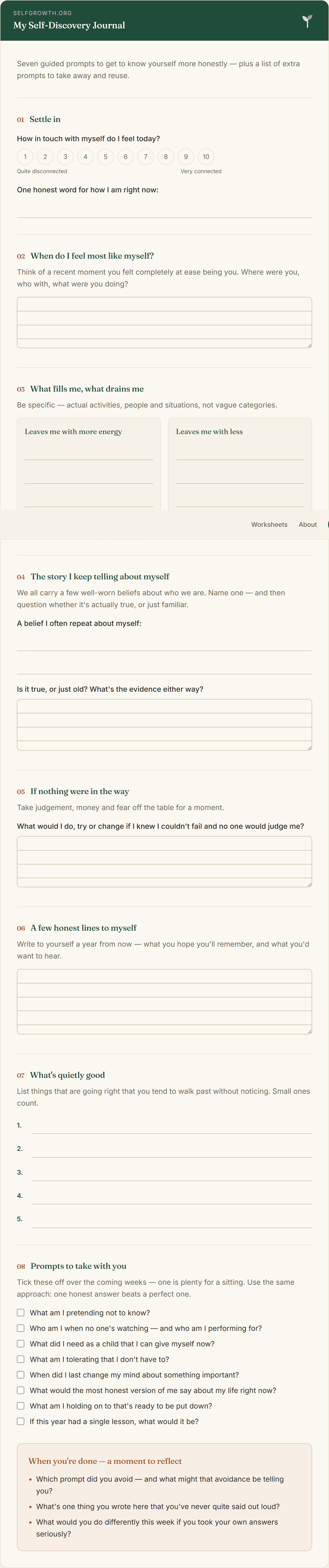
Self-Discovery Journal Prompts
Free, printable self-discovery journal prompts, guided questions with space to write, to explore your values, patterns and what you really want.
Open worksheet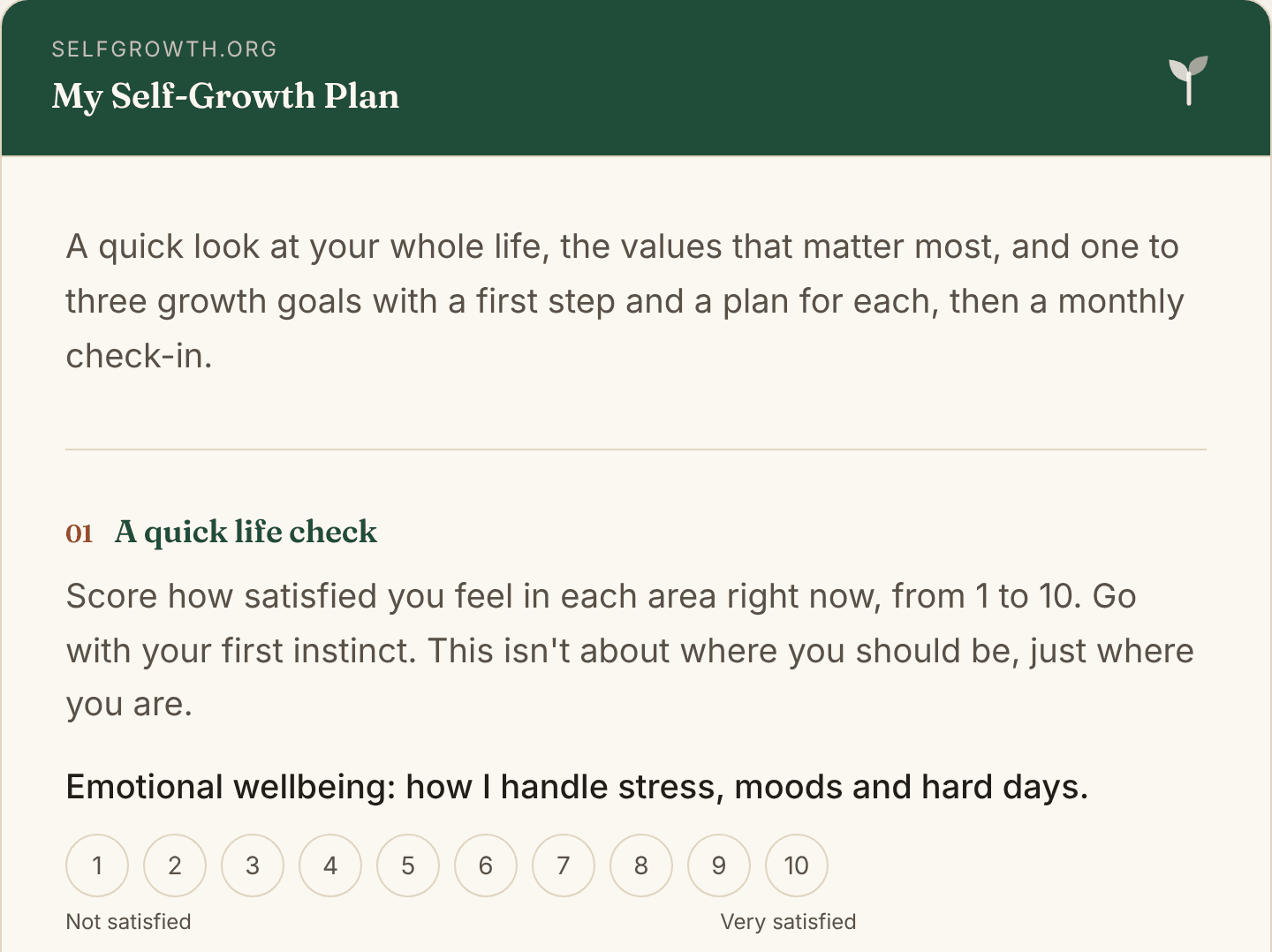
Self-Growth Plan
A free, printable self-growth plan template: check in on six areas of life, pick three values, choose one to three goals, plan a first step and review monthly.
Open worksheet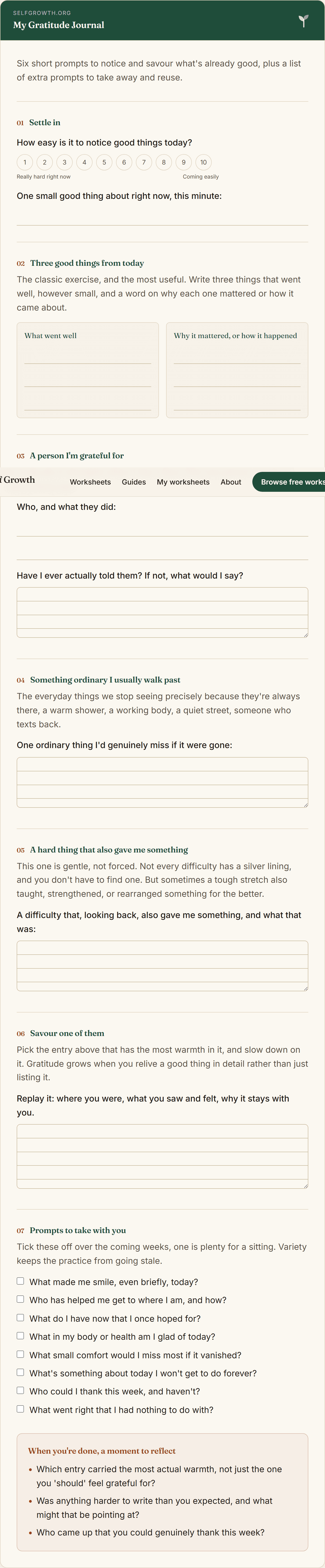
Gratitude Journal Prompts
Free, printable gratitude journal prompts: guided questions with space to write, plus a take-away list, to help you notice and savour what's already good.
Open worksheetNew worksheets, straight to your inbox
An occasional new worksheet or tool, sent only when there's something genuinely worth your time. No spam, no pressure, unsubscribe any time.