
Gratitude
Gratitude Journal Prompts: A Free, Printable Worksheet to Notice What's Good
Updated June 27, 2026 · 6 min read · Free to print
Gratitude journal prompts are short, specific questions that help you notice and write down what's good in your life, instead of staring at a blank page. This free, printable worksheet gives you a guided set, from the classic three good things to a person you're grateful for and an ordinary thing you usually walk past, plus a list of extra prompts to keep.
By the Self Growth team · drawn from positive psychology and gratitude research · how we make these
A clean, print-ready PDF, properly formatted, free, no email needed.
Most of us are wired to notice what's wrong far more readily than what's right; it kept our ancestors alive, but it makes for a heavy day-to-day. A gratitude journal is a small, deliberate counterweight. By writing down a few good things on purpose, you give your attention some practice at finding them, so over time the good stuff gets a little easier to see.
The trap with gratitude journaling is vagueness. 'I'm grateful for my family' written every night quickly becomes wallpaper. The prompts here push you toward the specific and the felt: not just what you're grateful for, but the particular moment, the person, the small ordinary thing you'd normally walk straight past.
There's real research behind this. Studies on counting blessings and the 'three good things' exercise have linked a regular gratitude practice to better mood and sleep. You don't need to feel grateful to start, and you don't need to write much. You just need to look, honestly, and put a few true things on the page.
- 1
You notice one good thing
Small and specific: a kind text, the first coffee, sun on the wall.
- 2
You pause and let it land
A few seconds of actually feeling it, not just ticking it off.
- 3
You write it down
Naming it on paper makes it concrete and easier to recall later.
- 4
Attention slowly re-tunes
Your brain gets a little better at scanning for what's going right.
- 5
The next good thing is easier to spot
So tomorrow's noticing takes less effort than today's.
Each round makes the next one easier, that's the spiral
How to use this worksheet
- 1Give yourself 10–15 quiet minutes. Print it, or type straight onto the page.
- 2Be specific, not sweeping. 'The way the rain sounded this morning' beats 'I'm grateful for nature'.
- 3Don't fake it. On a flat day, one small true thing is worth more than five forced ones.
- 4Keep what you write and come back to it. Re-reading old entries on a low day is half the point.
The worksheet
selfgrowth.org
My Gratitude Journal
Six short prompts to notice and savour what's already good, plus a list of extra prompts to take away and reuse.
01Settle in
How easy is it to notice good things today?
One small good thing about right now, this minute:
02Three good things from today
The classic exercise, and the most useful. Write three things that went well, however small, and a word on why each one mattered or how it came about.
What went well
Why it mattered, or how it happened
03A person I'm grateful for
Gratitude is strongest when it has a face. Pick one person, recent or from long ago.
Who, and what they did:
Have I ever actually told them? If not, what would I say?
04Something ordinary I usually walk past
The everyday things we stop seeing precisely because they're always there, a warm shower, a working body, a quiet street, someone who texts back.
One ordinary thing I'd genuinely miss if it were gone:
05A hard thing that also gave me something
This one is gentle, not forced. Not every difficulty has a silver lining, and you don't have to find one. But sometimes a tough stretch also taught, strengthened, or rearranged something for the better.
A difficulty that, looking back, also gave me something, and what that was:
06Savour one of them
Pick the entry above that has the most warmth in it, and slow down on it. Gratitude grows when you relive a good thing in detail rather than just listing it.
Replay it: where you were, what you saw and felt, why it stays with you.
07Prompts to take with you
Tick these off over the coming weeks, one is plenty for a sitting. Variety keeps the practice from going stale.
When you're done, a moment to reflect
- Which entry carried the most actual warmth, not just the one you 'should' feel grateful for?
- Was anything harder to write than you expected, and what might that be pointing at?
- Who came up that you could genuinely thank this week?
Why these prompts, and where the idea comes from
The exercises here come out of positive psychology, the branch of research that studies what helps people function well rather than only what goes wrong. Robert Emmons and Michael McCullough's well-known 'counting blessings' studies found that people who regularly wrote down things they were grateful for reported better mood and wellbeing than those who logged hassles or neutral events. Martin Seligman's 'three good things' exercise, the model for the second prompt here, has held up similarly.
We've deliberately pushed the prompts toward the specific and the savoured, because vague, repetitive gratitude ('grateful for my family' every night) tends to lose its effect, while detail and genuine reliving keep it alive. This is an educational wellbeing tool, not therapy; gratitude practice complements real support but doesn't replace it when low mood or anxiety won't lift.
These are educational self-reflection tools, not therapy, see our editorial standards.
If you want to go deeper
- Robert A. Emmons — Thanks! How Practicing Gratitude Can Make You Happier (Houghton Mifflin, 2007).
- Emmons, R. A. & McCullough, M. E. (2003). Counting blessings versus burdens. Journal of Personality and Social Psychology.
- Martin E. P. Seligman — Flourish (2011), which sets out the 'three good things' exercise.
Questions people ask
- What are gratitude journal prompts?
- They're short, specific questions that give your gratitude practice a direction, instead of a blank page and the vague instruction to 'be grateful'. A good prompt points you at one answerable thing (a person, a small win, an ordinary comfort), which makes it far easier to write something true rather than something generic.
- What should I write in a gratitude journal?
- Specifics, not categories. Rather than 'my family', write the particular moment: the way someone laughed, a message that arrived at the right time, the first warm day. Mix it up, what went well today, a person you're grateful for, an everyday thing you usually overlook, even a hard stretch that gave you something. This worksheet walks you through each of those.
- How often should I journal gratitude?
- Whatever you'll actually keep up. A few minutes two or three times a week is plenty, and some research suggests that journaling less often but more deeply can beat a rushed daily list that turns into autopilot. Consistency and honesty matter more than frequency.
- Does keeping a gratitude journal actually work?
- There's good evidence it helps for many people. Studies on 'counting blessings' and the 'three good things' exercise have linked a regular gratitude practice to improvements in mood, wellbeing and sleep. It isn't a cure-all and it isn't therapy, but as a low-cost habit it has a genuinely solid track record.
- What if I don't feel grateful?
- That's normal, and you don't need to feel it to start. Gratitude journaling is more about training attention than manufacturing a feeling, so on a flat day, one small true thing ('the coffee was good') is the whole job. Forcing big, fake gratitude tends to backfire; honest and small works better.
- Is this worksheet free, and is it a substitute for therapy?
- It's completely free to fill in online or print, no payment and no email needed. It's an educational self-reflection tool, not therapy or medical advice. Gratitude practice sits well alongside other support, but if low mood or anxiety lingers, please talk to a qualified professional or a local support line.
Keep going, related worksheets
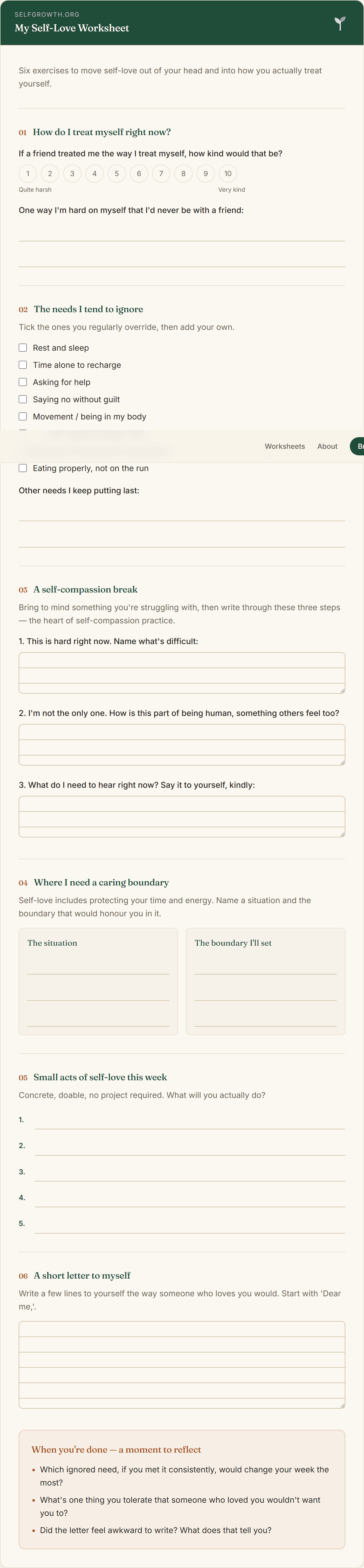
Self-Love Worksheet
A free, printable self-love worksheet that turns self-love from a vague idea into specific actions, meeting your needs, setting boundaries, and treating yourself with care.
Open worksheet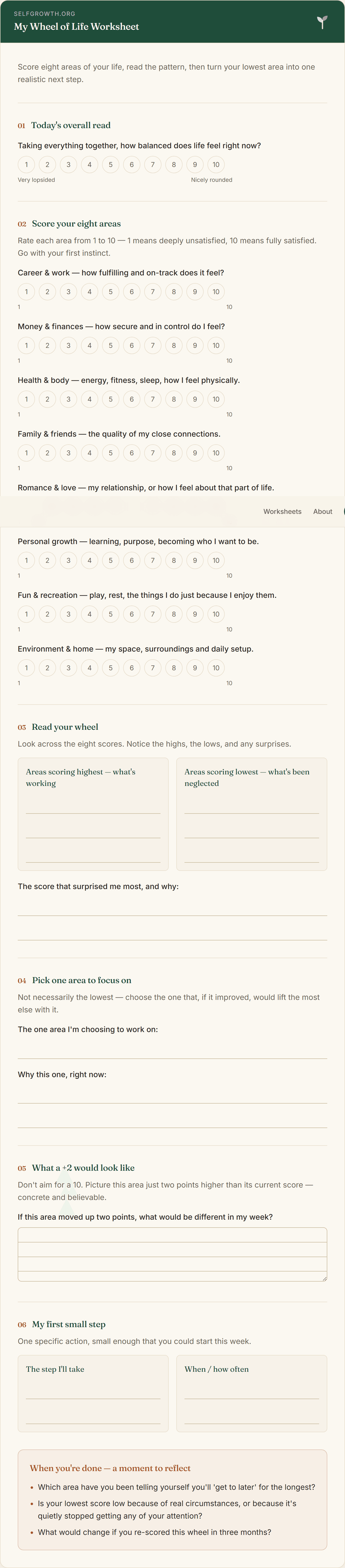
Wheel of Life Worksheet
A free, printable Wheel of Life worksheet. Score eight areas of your life out of ten, see where you're out of balance, and pick one to work on next.
Open worksheet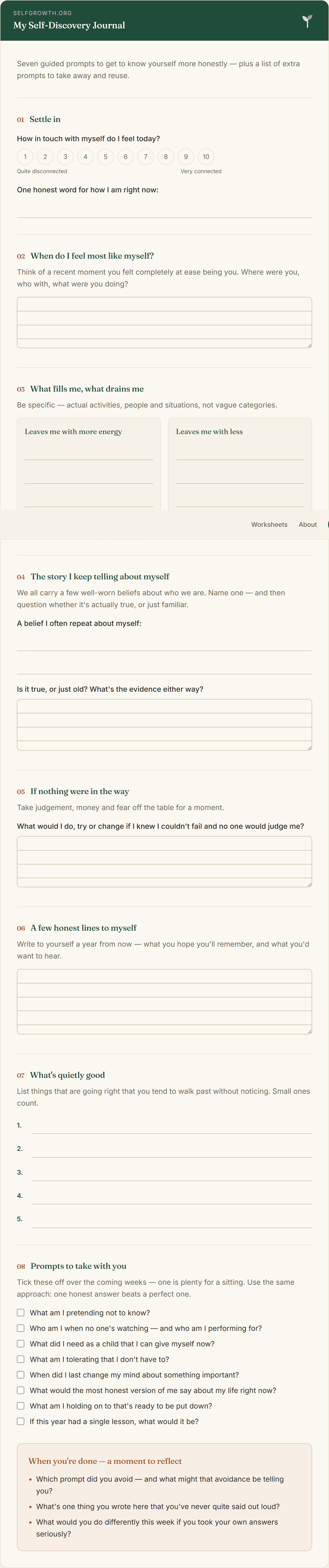
Self-Discovery Journal Prompts
Free, printable self-discovery journal prompts, guided questions with space to write, to explore your values, patterns and what you really want.
Open worksheetNew worksheets, straight to your inbox
An occasional new worksheet or tool, sent only when there's something genuinely worth your time. No spam, no pressure, unsubscribe any time.