
Guide
How to start a gratitude journal
Updated June 27, 2026 · 8 min read
To start a gratitude journal, keep it small and specific: a few times a week, write down two or three particular good things from your day and a word on why each mattered. Specifics beat categories ('the way the rain sounded' beats 'nature'), honesty beats forcing it, and consistency beats length. A prompt or worksheet helps far more than a blank page.
By the Self Growth team · drawn from positive psychology and gratitude research · how we make these
A gratitude journal is one of the simplest, best-evidenced wellbeing habits there is, and also one of the easiest to do badly. Done well, it gently re-tunes your attention toward what's going right. Done on autopilot, it becomes 'grateful for my family' copied out every night until it means nothing.
This guide covers the difference: what a gratitude journal actually is, what to write so it keeps working, how often to do it, whether the research really holds up, and the common mistakes that drain the practice of its point. There's a free printable prompts worksheet at the end so you're not starting from a blank page.
What a gratitude journal actually is
A gratitude journal is simply a place where you regularly write down things you're grateful for. That's the whole mechanism. It isn't positive thinking, and it isn't pretending hard things aren't hard. It's a deliberate habit of noticing and recording the good that's already there, which most of us are surprisingly bad at, because our attention is built to scan for threats and problems first.
The point isn't the notebook; it's the noticing. Writing it down just makes the noticing concrete and gives you something to look back on. Over time, the act of regularly hunting for good things trains your attention to spot them more readily, even on the days you don't write.
What to write in a gratitude journal
The single biggest factor in whether a gratitude journal works is specificity. Vague, repeated entries lose their effect fast. Specific, felt ones keep it alive. Aim for the particular moment rather than the broad category:
- Not 'my friends', but 'the way Sam checked in without being asked'.
- Not 'my health', but 'that I could walk to the shop in the sun this morning'.
- Not 'my home', but 'how quiet the house was at 6am with a coffee'.
- A person, named, and what they actually did.
- An ordinary thing you usually walk straight past, a hot shower, a working phone, a text that landed at the right moment.
- Occasionally, a hard stretch that, looking back, also gave you something, gently, and only if it's true.
Variety matters too. Rotating between people, small wins, ordinary comforts and the occasional reframed difficulty stops the practice from flattening into a daily checklist.
How to start, step by step
You don't need a special notebook or a perfect routine. You need a small, repeatable habit you'll actually keep.
- 1Pick a time you already have, the last few minutes before bed, or with your morning coffee. Attaching it to an existing habit makes it stick.
- 2Start with the 'three good things' exercise: write three things that went well today and, for each, a word on why it mattered or how it came about.
- 3Be specific and brief. One true, particular sentence beats a paragraph of general gratitude.
- 4Aim for a few times a week, not a perfect daily streak. Missing a day isn't failure; quietly skipping the guilt and picking it back up is the skill.
- 5Now and then, slow down on one entry and really relive it. Savouring a good thing in detail is where a lot of the benefit lives.
- 6Re-read old entries on a low day. This is half the reason to write them down at all.
The free worksheet below turns these steps into something you can fill in straight away, with guided prompts and a take-away list so you always have a next question ready.
Open the Gratitude Journal PromptsWhy it works
Gratitude isn't about pretending things are fine. It's about not missing the good that's actually there.
A gratitude journal works less by manufacturing a warm feeling and more by training where your attention goes. Each time you deliberately look for something good, pause to feel it, and write it down, you make the next round of noticing a little easier, a small upward spiral.
- 1
You notice one good thing
Small and specific: a kind text, the first coffee, sun on the wall.
- 2
You pause and let it land
A few seconds of actually feeling it, not just ticking it off.
- 3
You write it down
Naming it on paper makes it concrete and easier to recall later.
- 4
Attention slowly re-tunes
Your brain gets a little better at scanning for what's going right.
- 5
The next good thing is easier to spot
So tomorrow's noticing takes less effort than today's.
Each round makes the next one easier, that's the spiral
The research backs the basic effect. Emmons and McCullough's 'counting blessings' studies found people who regularly recorded things they were grateful for reported better mood and wellbeing than those who logged hassles. Seligman's 'three good things' exercise has shown similar results. It's not a miracle cure, and it won't fix circumstances that genuinely need to change, but as a low-cost habit it earns its place.
Common mistakes that drain the practice
Most people who say gratitude journaling 'didn't work' fell into one of these. They're all easy to fix:
- Staying vague. The same broad entries every night stop registering. Get specific.
- Going daily until it's a chore. A rushed nightly list on autopilot does little; a slower practice a few times a week often does more.
- Forcing it. Manufacturing big, fake gratitude on a hard day backfires. One small true thing is the whole job.
- Only listing, never savouring. The benefit deepens when you occasionally relive a good thing in detail, not just log it.
- Treating it as a fix for everything. Gratitude sits alongside dealing with real problems; it isn't a substitute for changing what genuinely needs to change.
Where to go next
Pick what fits where you are. Each links to a free worksheet you can fill in online or print.
To start practising straight away, use the gratitude journal prompts worksheet, it walks you through the three good things, a person you're grateful for, and more.
Open the Gratitude Journal PromptsIf you want a broader journaling habit beyond gratitude, the self-discovery journal prompts open up values, patterns and what you actually want.
Open the Self-Discovery Journal PromptsAnd if being kinder to yourself is the harder part, the self-love worksheet works on treating yourself with the fairness you'd offer a friend.
Open the Self-Love WorksheetWhen gratitude isn't enough
Gratitude journaling is a wellbeing habit, not a treatment. If you're carrying low mood, anxiety or grief that won't lift, being told to 'count your blessings' can feel hollow or even dismissive, and that's a fair reaction. It doesn't mean gratitude is useless; it means it isn't the whole answer.
If things feel persistently heavy, a GP is a good first step and can point you toward talking therapies. These guides and worksheets are educational self-reflection tools, not therapy, and you deserve real support, not just a page to fill in.
How we put this together
This guide is written in plain language from established, evidence-based ideas, not personal opinion. It's an educational self-reflection resource, not therapy or medical advice, see our editorial standards.
If you want to go deeper
- Robert A. Emmons — Thanks! How Practicing Gratitude Can Make You Happier (Houghton Mifflin, 2007).
- Emmons, R. A. & McCullough, M. E. (2003). Counting blessings versus burdens. Journal of Personality and Social Psychology.
- Martin E. P. Seligman — Flourish (2011), which sets out the 'three good things' exercise.
Questions people ask
- How do I start a gratitude journal?
- Keep it small and specific. Attach it to a habit you already have (bedtime, morning coffee), and start with the 'three good things' exercise: write three particular things that went well today and a word on why each mattered. Aim for a few times a week rather than a perfect daily streak, and use a prompt or worksheet so you're never staring at a blank page.
- What should I write in a gratitude journal?
- Specifics, not categories. Instead of 'my family', write the actual moment, the way someone laughed, a message that arrived at the right time, the first warm day of spring. Rotate between people you're grateful for, small wins, ordinary comforts you usually overlook, and occasionally a hard stretch that gave you something. Variety and detail keep it from going stale.
- How often should I write in a gratitude journal?
- Whatever you'll actually keep up, but you don't need to do it daily. Some research suggests journaling a few times a week, more slowly, can work better than a rushed nightly list that becomes autopilot. Consistency over time matters more than frequency or length.
- Does a gratitude journal really work?
- For many people, yes. Studies on 'counting blessings' (Emmons and McCullough) and the 'three good things' exercise (Seligman) have linked a regular gratitude practice to better mood, wellbeing and sleep. It's not a cure-all and won't fix circumstances that genuinely need changing, but as a low-cost habit the evidence is genuinely good.
- What if I don't feel grateful, or it feels fake?
- That's common and not a problem. Gratitude journaling is more about training attention than forcing a feeling, so on a flat day one small true thing is enough. Manufacturing big, fake gratitude tends to backfire; honest and small beats forced and grand. If gratitude consistently feels hollow because of low mood, that's worth taking seriously and talking to someone about.
Worksheets to do the work
Free to fill in online or print. No email needed.
Self-Love Worksheet
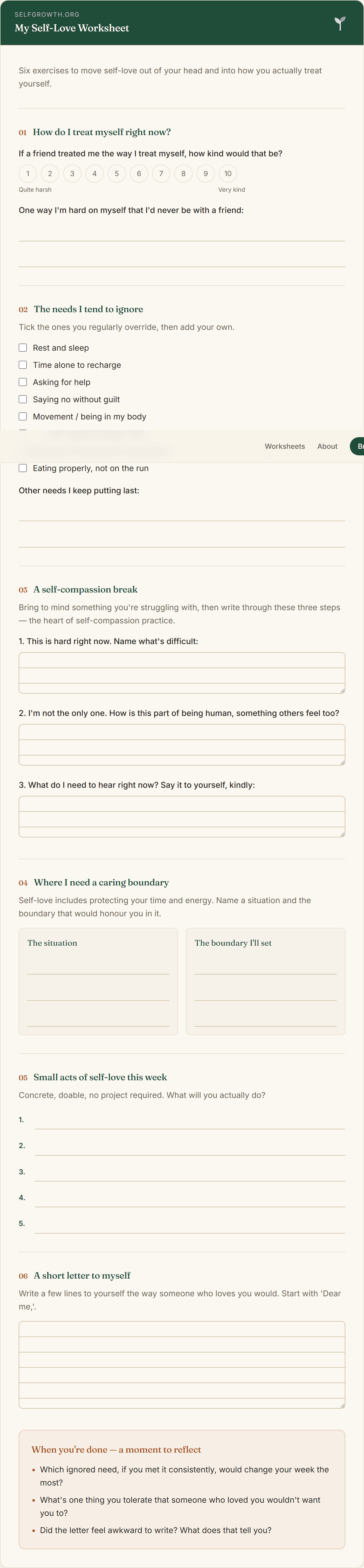
A free, printable self-love worksheet that turns self-love from a vague idea into specific actions, meeting your needs, setting boundaries, and treating yourself with care.
Open worksheet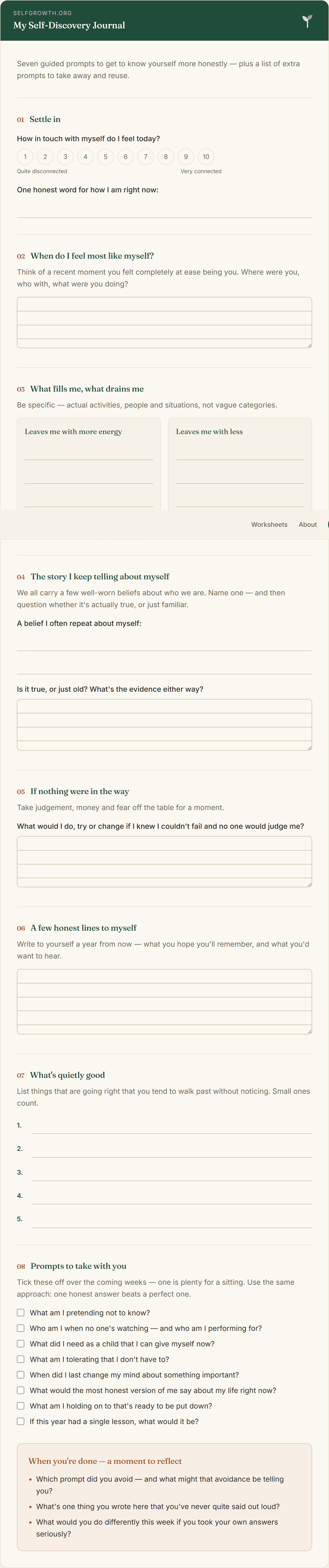
Self-Discovery Journal Prompts
Free, printable self-discovery journal prompts, guided questions with space to write, to explore your values, patterns and what you really want.
Open worksheet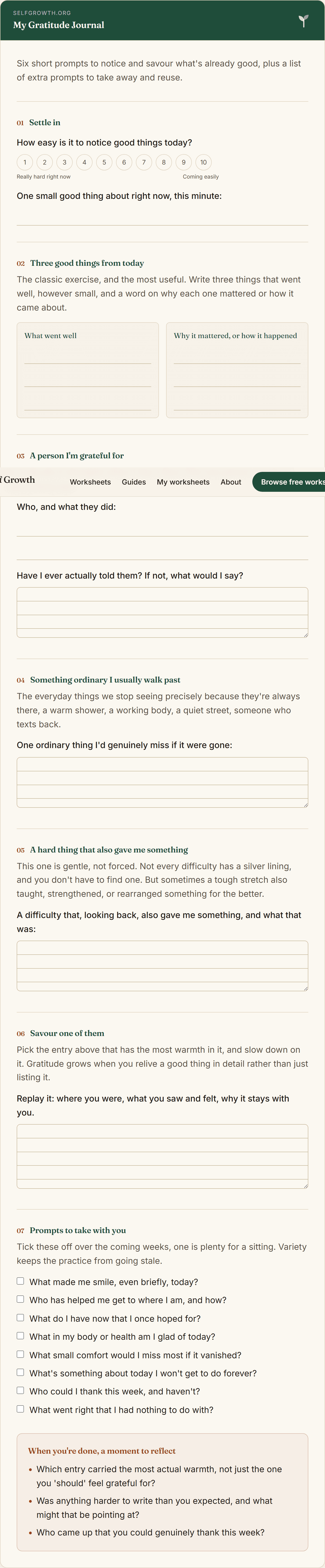
Gratitude Journal Prompts
Free, printable gratitude journal prompts: guided questions with space to write, plus a take-away list, to help you notice and savour what's already good.
Open worksheetNew worksheets, straight to your inbox
An occasional new worksheet or tool, sent only when there's something genuinely worth your time. No spam, no pressure, unsubscribe any time.