
Goal-setting
Self-growth plan: a free, printable template for your whole life
Updated 11 October 2026 · 6 min read · Free to print
A self-growth plan is one page that pulls your growth together. You check in on six areas of life, name three values that matter most, and choose one to three goals. For each goal you plan a small first step, an if-then plan and what might get in the way, then review it all monthly.
By the Self Growth team · drawn from goal-setting theory and self-determination research · how we make these
Fill it in here (it saves in this browser, but not in a private window), print it, or download the PDF. Free, no sign-up.
It's easy to want to grow in ten directions at once, and end up moving in none. A self-growth plan helps you step back, look at your whole life for a few minutes, and choose the handful of changes that would make the biggest difference to you right now.
This template keeps it to roughly a page. You start with a quick check on six areas of life and the values you care about most. Then you choose one to three growth goals, and for each one you plan a first small step, the moment you'll do it, and what you'll do when life gets in the way. It finishes with a monthly check-in, so the plan stays alive instead of sitting in a drawer.
If one goal needs a deeper plan of its own, the goal-setting worksheet takes a single goal much further. This page is for seeing the whole picture and keeping a few things moving.
How to use this worksheet
- 1Give yourself 20 to 30 quiet minutes. Fill it in on screen or print it.
- 2Go with your gut on the scores. They're for you, not a test, and there's no right number.
- 3Choose fewer goals than you think. One to three is plenty, and one is fine.
- 4Put the monthly check-in date in your calendar before you close the page, then come back to the last section each month.
The worksheet
selfgrowth.org
My Self-Growth Plan
A quick look at your whole life, the values that matter most, and one to three growth goals with a first step and a plan for each, then a monthly check-in.
01A quick life check
Score how satisfied you feel in each area right now, from 1 to 10. Go with your first instinct. This isn't about where you should be, just where you are.
Emotional wellbeing: how I handle stress, moods and hard days.
Relationships: family, friends, partner, feeling close to people.
Health and body: sleep, movement, energy, looking after myself.
Mind and learning: curiosity, new skills, reading, learning new things.
Work and money: how my work and finances feel day to day.
Values and meaning: living in a way that feels true to me.
The one or two areas that most want my attention, and why:
02What matters most to me
Pick three values that feel most like you. If you're stuck, some common ones are kindness, honesty, family, friendship, learning, health, courage, creativity, freedom, security, fairness and fun.
My three values right now:
- 1.
- 2.
- 3.
Where in my life do I feel furthest from one of these at the moment?
03My growth goals
Choose one to three. Write each as something you do, not something you are: 'pause before I reply when I'm annoyed', not 'be calmer'. Link it to an area and a value above.
Entry 1
Entry 2
Entry 3
04First steps and when I'll take them
For each goal, pick a first step so small it would be odd not to do it. Then tie it to a moment you'll really meet: 'When [this happens], I will [the step].'
Entry 1
Entry 2
Entry 3
05What might get in the way
Be honest about the thing most likely to stop you: tiredness, a busy week, self-doubt, other people's plans. Then decide now what you'll do when it shows up.
Entry 1
Entry 2
Entry 3
Who or what could help me keep going (a person, a reminder, a place):
06Monthly check-in
Once a month, come back here for ten minutes. Monthly isn't magic, it's just a pace most people can keep. Look at each goal kindly: missing days is normal, and a smaller step is often the fix.
Entry 1
Entry 2
Entry 3
How kindly have I treated myself about my progress this month?
My next check-in date:
07Is this plan still mine?
Run through these at each check-in. If a goal fails most of them, it's fine to change it or let it go.
When you're done, a moment to reflect
- If this time next year one thing about how you live had changed, what would you most want it to be?
- Which of your goals came from you, and which came from what you think you're supposed to want?
- What has helped you keep going with a change before, and could you use it again?
- What would a gentle version of this plan look like on a hard week?
Why these steps, and where they come from
The life check and the values step come first because a goal that grows out of what you care about tends to last. Kennon Sheldon and Andrew Elliot's research on 'self-concordant' goals, meaning goals that fit your own interests and values, found that people put more sustained effort into them, reached them more often and got more wellbeing from reaching them. The six areas are our own simple grouping, not an official list.
Writing each goal as something you do comes from goal-setting theory. Edwin Locke and Gary Latham's 2002 review of 35 years of research found that specific goals usually beat a vague 'do your best'. Most of that work is about tasks and work rather than personal growth, so we lean on the general lesson rather than any exact claim.
The if-then plans come from Peter Gollwitzer's work on implementation intentions: deciding in advance 'when this happens, I'll do that' lets the moment prompt the action instead of willpower. The monthly check-in draws on a 2016 review led by Benjamin Harkin, which pooled 138 experiments and found that monitoring progress helped people reach their goals, especially when they recorded it. No study sets the ideal interval; monthly is our suggestion.
This is an educational tool for everyday growth, not therapy. If something heavier is in the way, please reach for real support too.
These are educational self-reflection tools, not therapy. See our editorial standards.
If you want to go deeper
- Sheldon, K. M. & Elliot, A. J. (1999). Goal striving, need satisfaction, and longitudinal well-being: The self-concordance model. Journal of Personality and Social Psychology, 76(3), 482-497.
- Locke, E. A. & Latham, G. P. (2002). Building a practically useful theory of goal setting and task motivation: A 35-year odyssey. American Psychologist, 57(9), 705-717.
- Gollwitzer, P. M. (1999). Implementation intentions: Strong effects of simple plans. American Psychologist, 54(7), 493-503.
- Harkin, B. et al. (2016). Does monitoring goal progress promote goal attainment? A meta-analysis of the experimental evidence. Psychological Bulletin, 142(2), 198-229.
Your questions, answered
- What is a self-growth plan?
- A self-growth plan, sometimes called a personal growth or self-development plan, is a short written plan for how you want to grow. This one has you check in on six areas of life, name three values, choose one to three goals, and plan a first step, an if-then plan and what might get in the way for each. A monthly check-in keeps it going.
- How do I write a personal growth plan?
- Keep it short. Start by noticing which areas of life feel thin, then name what you care about most. Choose one to three goals that connect the two, and write each as something you can do. For each, plan a tiny first step, when you'll do it, and what you'll do if something gets in the way. Then pick a date to review it.
- What should be in a self-development plan template?
- A useful template covers where you are now, what matters to you, a small number of goals, a first step and a when-and-where plan for each, the likely obstacles, and a regular review. Long templates with dozens of boxes tend to get abandoned, so this one aims for roughly a page you'll actually use.
- How is this different from the goal-setting worksheet?
- This plan looks at your whole life and keeps a few goals moving at once, with a light plan for each and a monthly check-in. The goal-setting worksheet takes a single goal much deeper, making it measurable, contrasting the outcome with the obstacle and planning repeatable actions. You might start with this plan, then use the goal-setting worksheet for the goal that needs the most work.
- How often should I review my self-growth plan?
- There's no proven ideal interval. We suggest once a month because it's frequent enough to notice what's working and rare enough not to become a chore. Research does suggest that keeping track of your progress, especially writing it down, can help you reach your goals. Pick a rhythm you'll keep.
- Is this self-growth plan template free?
- Yes. It's completely free, with no payment and no email needed. You can fill it in on screen, where your answers save in your browser, or use the Download PDF or Print button for a clean paper copy.
- Is this a substitute for therapy?
- No. It's an educational self-reflection tool for everyday growth, not therapy or medical advice. If low mood, anxiety or burnout is what's really in the way, please talk to a GP or a qualified professional. If you're struggling right now, findahelpline.com lists free helplines, Samaritans are on 116 123 in the UK, and 988 in the US.
Keep going, related worksheets

Goal-Setting Worksheet
A free, printable goal-setting worksheet that turns a vague wish into a specific goal, a when-and-where plan, and a first step you'll actually take this week.
Open worksheet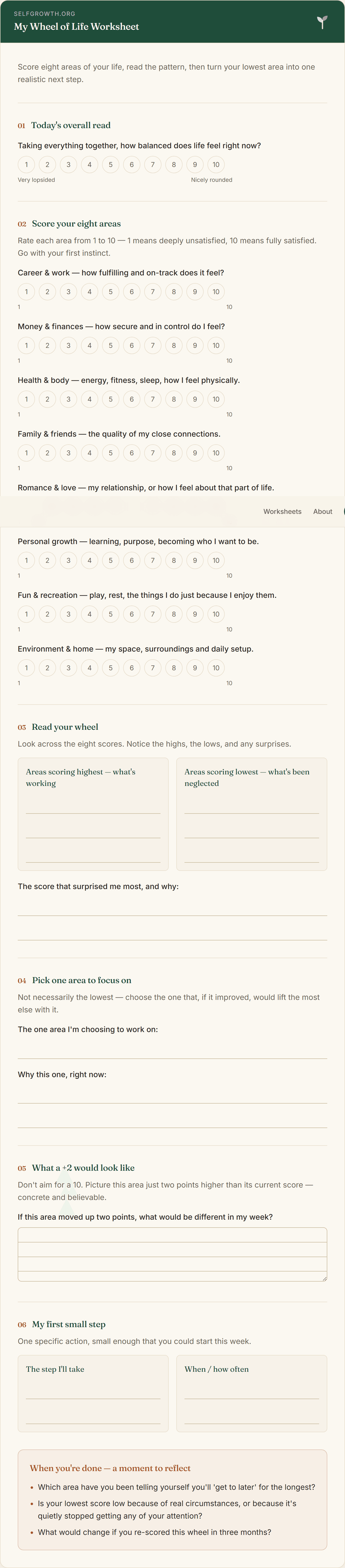
Wheel of Life Worksheet
A free, printable Wheel of Life worksheet. Score eight areas of your life out of ten, see where you're out of balance, and pick one to work on next.
Open worksheet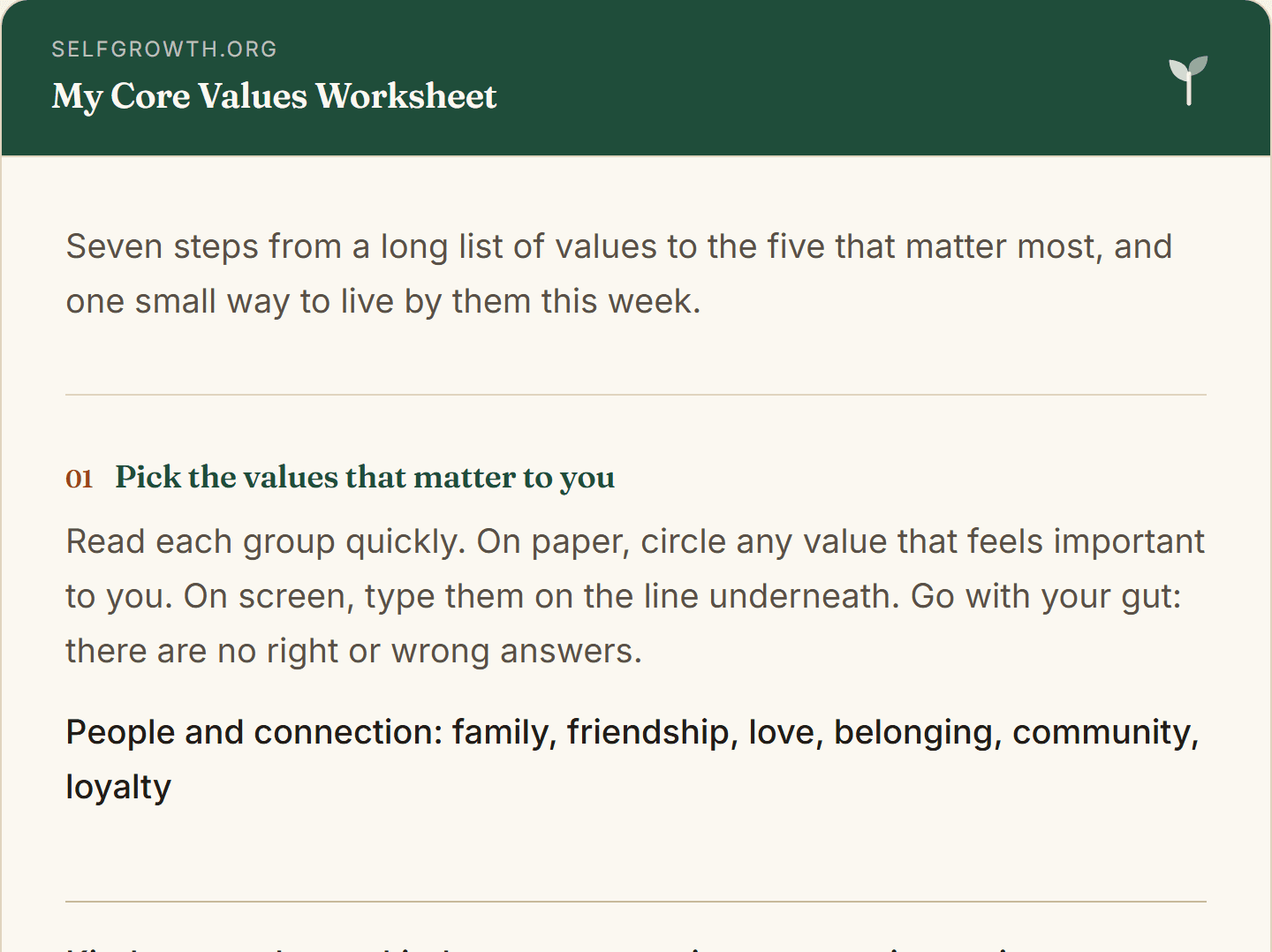
Core Values Worksheet
A free, printable core values worksheet: pick values from a list, narrow them to your top five, put them in your own words and plan one step to live by them.
Open worksheetNew worksheets, straight to your inbox
An occasional new worksheet or tool, sent only when there's something genuinely worth your time. No spam, no pressure, unsubscribe any time.