
Guide
Self-growth goals: examples, and how to set yours
Updated 11 October 2026 · 10 min read
Self-growth goals are changes you want to make in how you live and treat yourself, not just in your circumstances: handling stress more calmly, being a better listener, sleeping more, learning something new. Choose one to three that truly matter to you, give each a small first step and an if-then plan, then check in each month.
By the Self Growth team · drawn from goal-setting theory and self-determination research · how we make these
When you search for self-growth goals, you're usually looking for two things: some examples to get your thinking going, and a way to pick the right ones without ending up with a list of twenty good intentions you'll forget by Friday.
This guide gives you both. Below are concrete examples grouped by area of life, a simple way to choose the few that matter, and a short method for turning one into a plan you can start this week. None of them are about becoming a different person. They're about becoming a bit more like the person you already want to be.
What are self-growth goals?
A self-growth goal (you'll also see 'personal growth goal' or 'self-development goal') is about changing something in you: a habit, a skill, a way of reacting, a way of treating yourself or other people. Compare 'get a new job' with 'speak up in meetings when I have an idea'. The first is about your situation. The second is about you, and it's mostly in your hands.
Good self-growth goals tend to be small, specific and kind. They grow out of what you care about rather than what you think you're supposed to fix. If you'd like the bigger picture of what self-growth means, the guide to what self-growth is is a good companion to this one.
Examples of self-growth goals, by area of life
Use these as prompts, not prescriptions. Read through, notice which ones make you think 'yes, that', and change the wording until it sounds like you. Each one is written as something you can actually do.
Emotional growth goals:
- Pause and name what I'm feeling before I react, at least once a day.
- Speak to myself after a mistake the way I'd speak to a friend.
- Take a ten-minute walk when I notice stress building, instead of pushing through.
- Write down three things that went okay each evening, for a month.
- Let myself rest without having to earn it first.
Relationship goals:
- Listen to the end of what someone's saying before I answer.
- Message one friend I've lost touch with each week.
- Say no to one thing a week I'd usually agree to out of guilt.
- Tell the people I love what I appreciate about them, out loud.
- Bring up small issues early and calmly, before they turn into resentment.
Health and body goals:
- Go to bed at the same time on weeknights.
- Move my body in a way I enjoy, three times a week.
- Put my phone in another room for the first half hour of the day.
- Eat one proper lunch away from my desk each working day.
- Book the check-up I've been putting off.
Mind and learning goals:
- Read for fifteen minutes before bed instead of scrolling.
- Learn the basics of one new skill this season, such as cooking, a language or an instrument.
- Get curious about one view I disagree with, and read the best case for it.
- Keep a short journal so I notice my own patterns.
- Try one thing I'm not good at yet, and let myself be a beginner.
Work and money goals:
- Ask for feedback on one piece of work a month.
- Stop checking work messages after a set time in the evening.
- Spend an hour a week on a skill that would help my next step.
- Look at my spending once a week, without judging myself for it.
- Share an idea in a meeting, even if it isn't fully formed.
Values and meaning goals:
- Work out my top three values, and check one decision a week against them.
- Give a little time each month to something I care about beyond myself.
- Spend ten quiet minutes a week asking what's going well and what isn't.
- Make one choice this month that's more honest to who I am, even if it's uncomfortable.
- Notice where my time goes, and move an hour towards what matters most.
Notice what these have in common. None of them is 'become confident' or 'be happier'. Those are lovely directions, but you can't do them on a Tuesday. Each example above is something you could start this week.
How to choose the self-growth goals that matter to you
The hardest part isn't finding goals. It's choosing a few and letting the rest wait. One to three is plenty. Each goal needs a share of your attention and energy, and spread across ten, none of them gets enough.
- Start with where life feels thin. A quick wheel of life shows you, at a glance, which areas feel full and which feel neglected. The lowest score is often a good place to look first, though not always the place to start.
- Check it against what you care about. A goal that grows out of your values is easier to keep going with. The core values worksheet helps you name your top few.
- Ask whose goal it is. If the honest reason is 'I feel I should' or 'someone else wants me to', it may not be yours yet.
- Pick at least one that feels good to do. Growth doesn't all have to be fixing. Learning, play and connection count too.
That third point has real research behind it. Kennon Sheldon and Andrew Elliot studied what they call 'self-concordant' goals, meaning goals that fit your own interests and values. In their 1999 studies, people pursuing those goals put in more sustained effort, reached them more often, and got more wellbeing from reaching them. A goal that's truly yours isn't just nicer. It's more likely to happen.
Choose the goal you'd still want if nobody else ever knew about it.
How to turn a self-growth goal into a plan
A self-growth plan doesn't need to be long. For each goal, you need a reason, a first step, a cue for when you'll do it, and a plan for what's likely to get in the way. Here's the whole thing in six steps.
- 1Write the goal as something you do, not something you are. Swap 'be calmer' for 'take three slow breaths before I reply when I'm annoyed'.
- 2Write down why it matters to you, in a sentence. Name the value underneath it if you can.
- 3Choose the smallest first step you could take in the next few days, so small it would be odd not to do it.
- 4Make an if-then plan: 'When [a moment you'll really meet], I will [the step].' For example, 'When I sit down with my morning tea, I'll write two lines in my journal.'
- 5Name the thing most likely to get in the way, and plan for it too: 'If I miss the morning, then I'll do it before bed.'
- 6Put a check-in in your calendar. Once a month is a good place to start. Look at what went well, what got in the way, and what you'll change.
Step 4 has some of the strongest evidence. Psychologist Peter Gollwitzer calls these 'implementation intentions'. In a 1999 paper in American Psychologist, he set out how deciding in advance 'when this happens, I'll do that' lets the moment itself prompt the action, so you don't have to rely on remembering or feeling motivated. Later research has backed this up: a 2006 review by Gollwitzer and Paschal Sheeran pooled 94 studies and found a medium-to-large effect of if-then plans on reaching goals, though most of these studies test specific behaviours rather than broad personal growth.
Step 1 draws on goal-setting theory. Edwin Locke and Gary Latham's 2002 review of 35 years of research found that specific, challenging goals usually lead to better results than a vague 'do your best'. Most of that research is about tasks and work, not personal growth, so treat it as a useful guide rather than a promise. The general lesson still carries over: a goal you can picture yourself doing is easier to start than one you can only wish for.
Step 6 matters more than it looks. A 2016 review led by Benjamin Harkin pooled 138 experiments and found that people who monitored their progress were more likely to reach their goals, especially when they wrote their progress down. There's no magic interval for checking in. Monthly is simply a pace you can probably keep without it becoming another chore.
Open the Self-Growth PlanA worked example
Say your wheel of life shows relationships feel thin, and one of your values is connection. Your goal: 'Stay in touch with the friends who matter to me.' That's still a bit fuzzy, so you make it something you do: 'Message one friend each Sunday.'
Your why: 'I miss feeling close to people, and I don't want friendships to fade by accident.' Your first step: send one message this Sunday. Your if-then plan: 'When I sit down after Sunday lunch, I'll message one friend.' Your obstacle: you'll be tired and tell yourself next week. Your plan for it: 'If I don't feel like writing much, then I'll just send a quick hello.' At your monthly check-in you notice you managed three Sundays out of four. That's not a failure. That's three conversations that wouldn't have happened.
Signs a self-growth goal is the wrong one
Sometimes a goal stalls because the plan needs tweaking. Sometimes it stalls because it was never the right goal. These are signs it might be the second:
- You dread it every time, and the dread doesn't ease after the first few weeks.
- The honest reason is about what other people will think, not what you want.
- It's really a way of being harder on yourself, such as a goal built around fixing something you're ashamed of.
- You keep making it bigger whenever you fall short, instead of smaller.
- Reaching it wouldn't change anything you care about.
- It's crowding out rest, sleep or the people you love.
Letting go of a goal that isn't yours isn't giving up. It's making room for one that is. You can also keep the direction and change the goal: 'run a marathon' might become 'enjoy moving my body again'. If your goals keep turning into a stick to beat yourself with, the guide to self-compassion may help more than a new plan.
When to get more support
Self-growth goals are for everyday change. They're not a treatment for low mood, anxiety, burnout or anything heavier, and this guide isn't therapy. If you keep setting goals and stalling, and underneath it is a flatness or worry that won't lift, the problem may not be the goal at all. More goals can start to feel like more ways to fail.
A GP or family doctor is a good first step and can point you towards talking therapies. If you're struggling right now, you can find a free helpline in your country at findahelpline.com. In the UK, Samaritans are on 116 123, day or night. In the US, you can call or text 988. You deserve real support, not just a better plan.
How we put this together
This guide is written in plain language. The example goals are our own. The planning steps draw on research into goal-setting, if-then planning, goals that fit your values, and tracking progress. Most of that research tests specific behaviours, not personal growth as a whole, so where the evidence runs out, we say so. It's an educational self-reflection resource, not therapy or medical advice, see our editorial standards.
If you want to go deeper
- Gollwitzer, P. M. (1999). Implementation intentions: Strong effects of simple plans. American Psychologist, 54(7), 493-503.
- Gollwitzer, P. M. & Sheeran, P. (2006). Implementation intentions and goal achievement: A meta-analysis of effects and processes. Advances in Experimental Social Psychology, 38, 69-119.
- Locke, E. A. & Latham, G. P. (2002). Building a practically useful theory of goal setting and task motivation: A 35-year odyssey. American Psychologist, 57(9), 705-717.
- Sheldon, K. M. & Elliot, A. J. (1999). Goal striving, need satisfaction, and longitudinal well-being: The self-concordance model. Journal of Personality and Social Psychology, 76(3), 482-497.
- Harkin, B. et al. (2016). Does monitoring goal progress promote goal attainment? A meta-analysis of the experimental evidence. Psychological Bulletin, 142(2), 198-229.
Your questions, answered
- What are some examples of self-growth goals?
- Everyday examples include naming your feelings before you react, speaking to yourself kindly after a mistake, listening to the end before you answer, messaging one friend a week, going to bed at a regular time, reading before bed instead of scrolling, asking for feedback at work, and checking one decision a week against your values. Each is small and specific enough to start this week.
- What are the main areas of personal growth?
- There's no official list, but you may find it useful to think about emotional wellbeing, relationships, health and body, mind and learning, work and money, and values and meaning. A wheel of life lets you score areas like these quickly, so you can see which feel full and which could use some attention.
- How many self-growth goals should I have?
- One to three is plenty. Every goal needs attention, a plan and a bit of your energy each week, and spreading that across many goals usually means none of them moves. Start with one or two that genuinely matter, and add another once the first is part of your routine.
- How do I write a self-growth plan?
- Keep it to a page. Check in briefly on each area of your life, name your top few values, then choose one to three goals. For each, write why it matters, a small first step, an if-then plan for when you'll do it, and what's likely to get in the way. Finish with a date for a monthly check-in. The free self-growth plan worksheet walks you through it.
- What's the difference between a self-growth goal and a normal goal?
- A normal goal is often about an outcome or your circumstances, such as a new job, a house or a number on a scale. A self-growth goal is about you: a habit, a skill, a way of reacting or treating people. The two often overlap, but a self-growth goal is usually more within your control, which makes it easier to act on today.
- What if I keep failing at my goals?
- First, check the size: most stalled goals are too big or too vague, so make the next step smaller. Then check whose goal it is, because goals you've absorbed from other people are harder to keep. Missing a day isn't failure. If you keep stalling and feel flat or anxious most of the time, that's worth talking to a GP about.
- Is this free, and is it therapy?
- It's free, with no payment and no email needed, and the worksheet can be filled in online or printed. This guide is a self-reflection tool, not therapy or medical advice. If things feel heavy, a GP, a therapist or a helpline can help. Samaritans are on 116 123 in the UK, and 988 in the US.
Worksheets to do the work
Free to fill in online or print. No email needed.
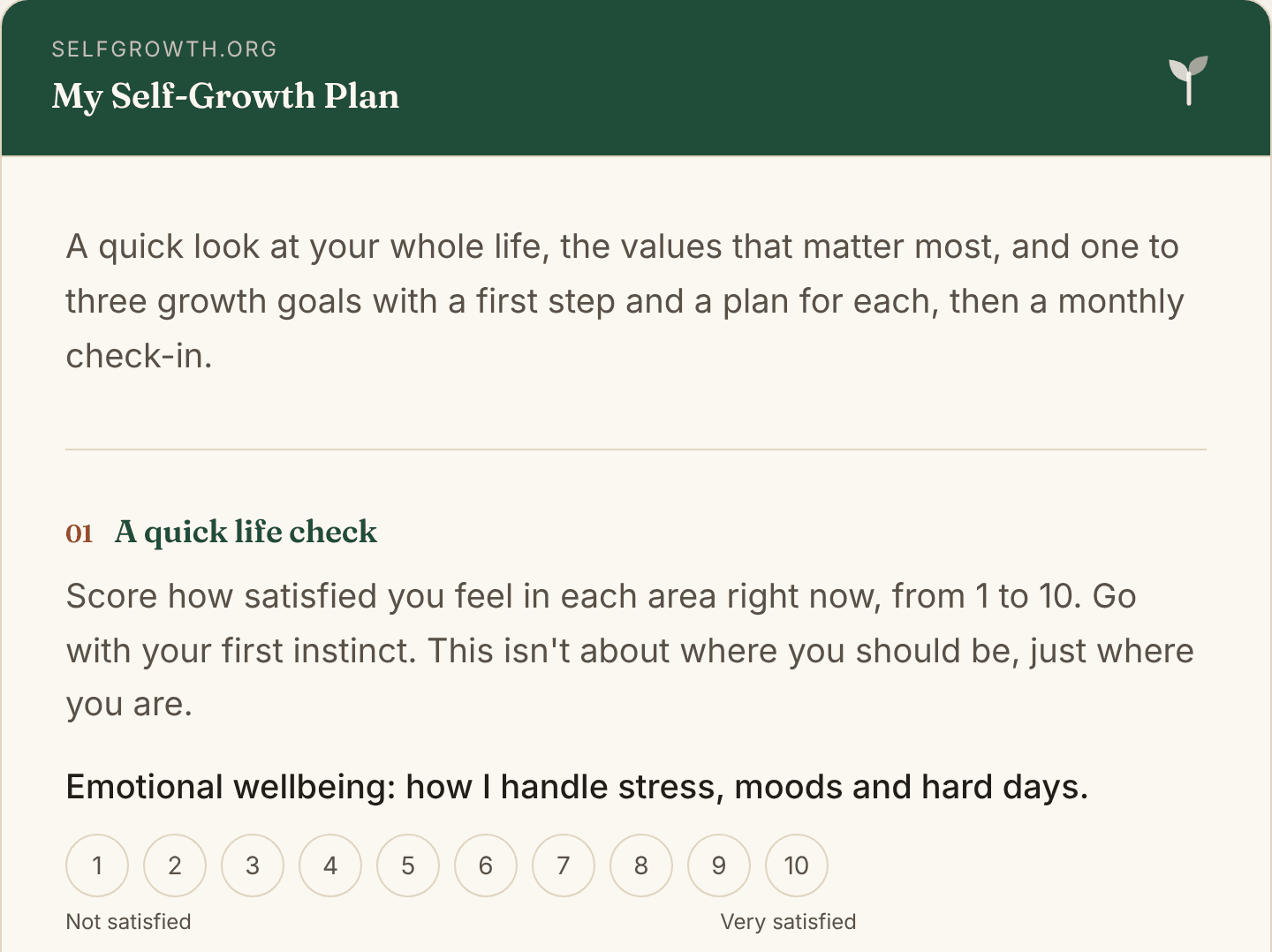
Self-Growth Plan
A free, printable self-growth plan template: check in on six areas of life, pick three values, choose one to three goals, plan a first step and review monthly.
Open worksheet
Goal-Setting Worksheet
A free, printable goal-setting worksheet that turns a vague wish into a specific goal, a when-and-where plan, and a first step you'll actually take this week.
Open worksheet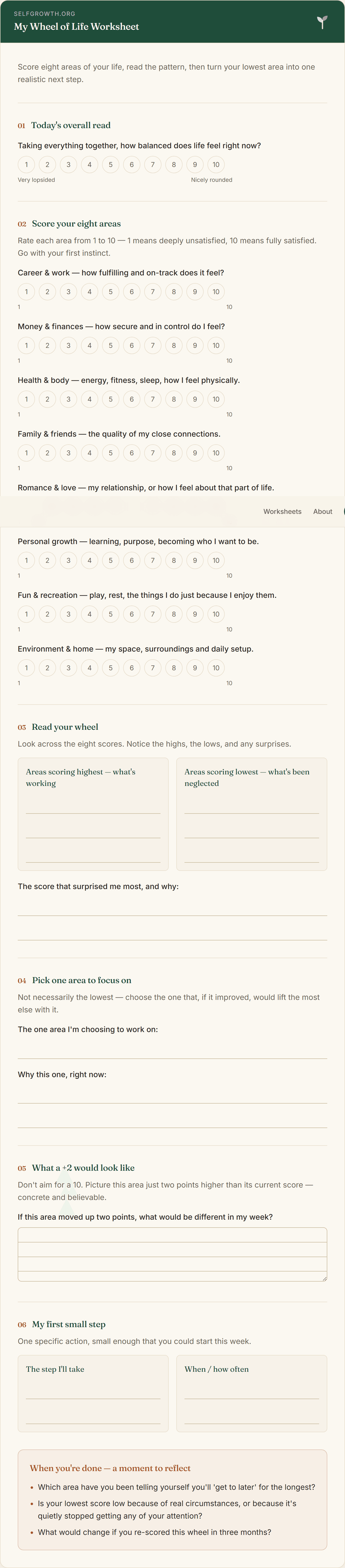
Wheel of Life Worksheet
A free, printable Wheel of Life worksheet. Score eight areas of your life out of ten, see where you're out of balance, and pick one to work on next.
Open worksheet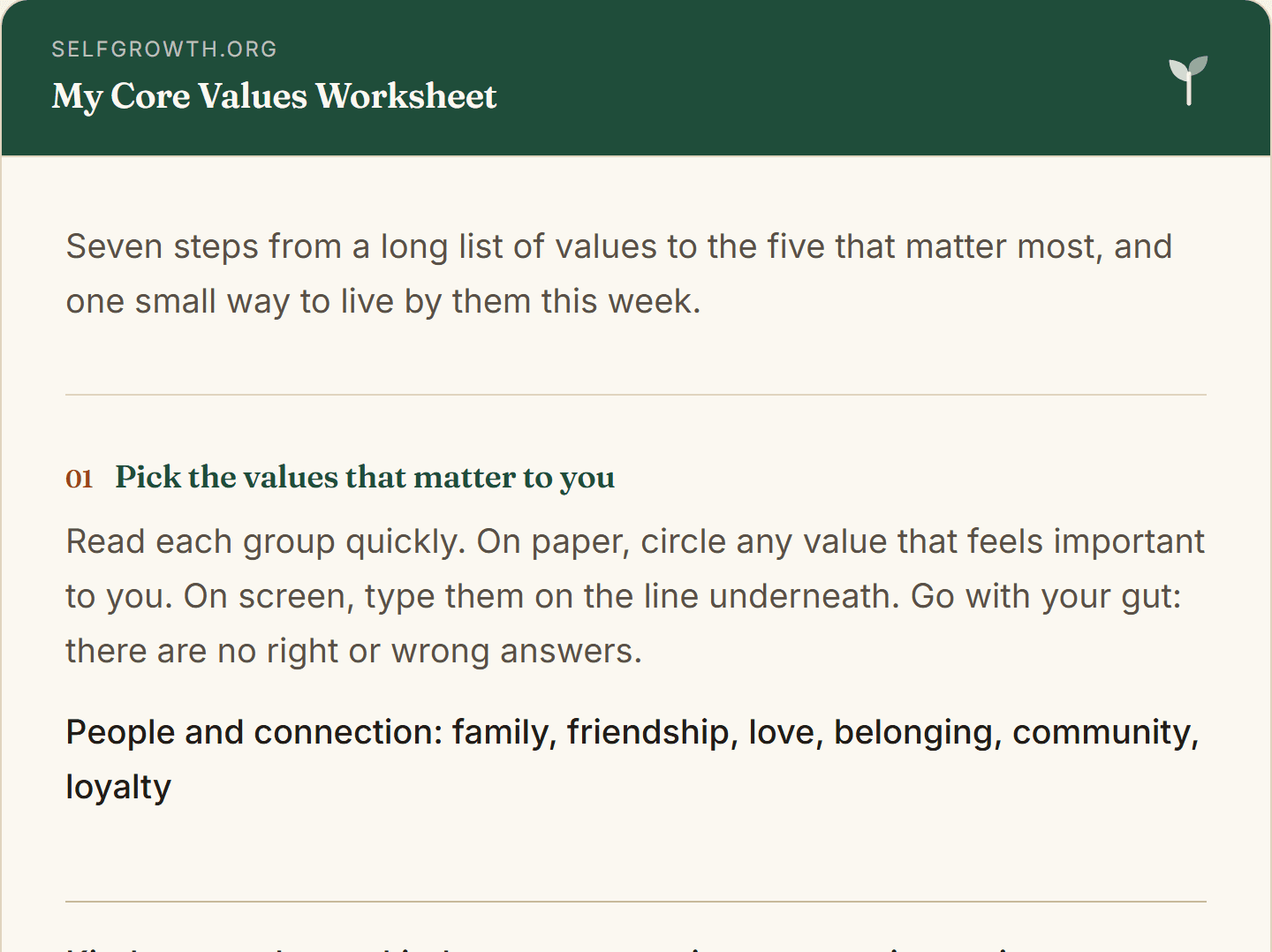
Core Values Worksheet
A free, printable core values worksheet: pick values from a list, narrow them to your top five, put them in your own words and plan one step to live by them.
Open worksheetRelated guides
New worksheets, straight to your inbox
An occasional new worksheet or tool, sent only when there's something genuinely worth your time. No spam, no pressure, unsubscribe any time.