
Values
Core Values Worksheet: A Free, Printable Way to Find What Matters to You
Updated October 4, 2026 · 6 min read · Free to print
A core values worksheet helps you work out what matters most to you. This one gives you a values list to pick from, narrows it to your top five, puts each in your own words, shows the gap between what matters and how you live, and ends with one small step. It's free to fill in or print.
By the Self Growth team · drawn from acceptance and commitment therapy and values research · how we make these
Print it, or save the PDF and fill it in by hand. Free, no email needed.
Your values are the kind of person you want to be: how you want to treat people, what you want to stand for, what you'd find hardest to give up. Most of us carry them around without ever writing them down, which is why it's so easy to drift from them without noticing.
This worksheet starts with a plain list of values to pick from, so you're not facing a blank page. Then it helps you sort and narrow them to five, write what each means to you, and check how closely you're living by them. It ends with one small step for this week, and a way to use your values when a choice is hard.
There are no right or wrong values, and nothing here is a test. Go with your gut, and leave out anything you only think you should care about.
A value
Being a good friend
A direction you keep heading in. You never finish it, you just keep living it.
- A goalCall Jo on Sunday
- A goalRemember her birthday
- A goalHelp with the move
Goals get ticked off. The value keeps going, like heading west: you never arrive
How to use this worksheet
- 1Allow about 20 to 30 minutes, somewhere you won't be interrupted.
- 2Pick quickly at first. You'll narrow things down later, so there's no need to be careful in the first two steps.
- 3Write for yourself, not for how it would sound to anyone else. No one has to read this.
- 4Come back to it in a few months, or after a big change. Which values lead can shift as your life does.
The worksheet
selfgrowth.org
My Core Values Worksheet
Seven steps from a long list of values to the five that matter most, and one small way to live by them this week.
01Pick the values that matter to you
Read each group quickly. On paper, circle any value that feels important to you. On screen, type them on the line underneath. Go with your gut: there are no right or wrong answers.
People and connection: family, friendship, love, belonging, community, loyalty
Kindness and care: kindness, compassion, generosity, patience, forgiveness, helping others
Honesty and character: honesty, integrity, fairness, responsibility, respect, courage
Growth and learning: learning, curiosity, growth, wisdom, challenge, doing things well
02Keep going: four more groups
Same again. Then add any values of your own that matter to you and aren't on the list.
Freedom and creativity: independence, freedom, adventure, spontaneity, creativity, authenticity
Security and achievement: security, stability, order, hard work, achievement, ambition
Health and enjoyment: health, fun, humour, rest, nature, beauty
Meaning and the wider world: faith, purpose, tradition, gratitude, justice, making a difference
My own values, not on the list:
03Sort them, then choose your top five
Write each value you picked in a column: very important (the ones you'd find hardest to give up), or important but less so. Then choose five from the first column.
Very important to me
Important to me
My top five, each as something I do: not just 'honesty', but 'saying what I really think, kindly'.
My value
What it means to me
As something I do
04How closely am I living by them?
Give each of your five two scores from 0 to 10: how important it is to you, and how well you've lived by it this past month. Be honest, not harsh. The biggest gaps show you where to start.
My value
How important
0 to 10
How well I've lived it
0 to 10
What gets in the way most often?
05Why my top value matters to me
Pick the one value that matters most to you right now. Write a few lines about why it matters, and a time it showed up in your life. There's no need to make it sound good.
My top value:
Why it matters to me, and a time it showed up:
06One small step this week
Pick a value with a big gap, and one small, specific thing you'll do this week to live it a little more. Small counts. 'Be a better friend' becomes 'text Jo on Thursday to ask how the interview went'.
The value I'll act on:
What I'll do, and when and where:
Acting on a value can feel uncomfortable. What might get in the way, and what will I do if it does?
07When two values pull against each other
Sometimes a choice sets two of your values against each other, like ambition and family. That's normal. Use this when you're facing a decision.
A choice I'm facing:
Option A
Which of my values it honours, and which it costs
Option B
Which of my values it honours, and which it costs
Which option moves me towards the person I want to be, right now?
When you're done, a moment to reflect
- When did you last feel proud of how you acted, not of what you achieved? Which value were you living?
- What makes you angry on someone else's behalf? Which value is being stepped on?
- Did you pick any value because you felt you should, rather than because it's truly yours?
- Who do you admire, and for which qualities?
- If you lived a little more by your top value, what would someone close to you notice first?
Why these steps, and where they come from
The spine of this worksheet is values work from acceptance and commitment therapy (ACT), where getting clear on what you want to stand for, and then taking small steps towards it, are two of the core processes. Russ Harris, a doctor and therapist who trains others in ACT, describes values as how you want to behave on an ongoing basis, not what you want to get or achieve. The 0 to 10 scores in step 4 are adapted from a rating form in his free ACT worksheets, which goes with a values sheet he adapted from Kelly Wilson's Valued Living Questionnaire. Step 6 is what ACT calls committed action.
Steps 1 to 3 borrow the idea behind the Personal Values Card Sort, from Miller and colleagues at the University of New Mexico: sort values into piles by how important they are to you. The list itself is our own, written in plain English. Step 7 draws on Shalom Schwartz's research on values, which describes how some values tend to pull against each other, such as personal success and looking after others.
Step 5 is the kind of writing used in research on self-affirmation, where people write about a value that matters to them. Some studies have found it helps people cope with stress and threat, but a large, careful repeat of one school study found no effect. So treat it as worth a few minutes, not a cure. These are educational self-reflection tools, written to be done alone or alongside therapy, not a replacement for it.
These are educational self-reflection tools, not therapy, see our editorial standards.
If you want to go deeper
- Harris, R. The complete set of client handouts and worksheets from his ACT books (2018), actmindfully.com.au, including the values worksheet and rating form adapted from Kelly Wilson's Valued Living Questionnaire.
- Harris, R. (2006). Embracing your demons: an overview of acceptance and commitment therapy. Psychotherapy in Australia, 12(4).
- Miller, W. R., C'de Baca, J., Matthews, D. B. & Wilbourne, P. L. (2001). Personal Values Card Sort. University of New Mexico.
- Schwartz, S. H. (2012). An overview of the Schwartz theory of basic values. Online Readings in Psychology and Culture, 2(1).
- Cohen, G. L. & Sherman, D. K. (2014). The psychology of change: Self-affirmation and social psychological intervention. Annual Review of Psychology, 65, 333-371.
- Hanselman, P., Rozek, C. S., Grigg, J. & Borman, G. D. (2017). New evidence on self-affirmation effects and theorized sources of heterogeneity from large-scale replications. Journal of Educational Psychology, 109(3), 405-424.
Your questions, answered
- What is a core values worksheet?
- It's a structured page that helps you work out what matters most to you, and then live by it. This one gives you a values list to pick from, helps you sort and narrow it to your top five, puts each in your own words, and checks how closely you're living by them. It ends with one small step for this week and a way to use your values when a choice is hard.
- How do I use a values list?
- Read it quickly and pick out anything that feels important, going with your gut. Then sort your picks into 'very important' and 'important', and narrow the first group down to five. The words are only labels, so the step that matters most is writing what each value means to you, as something you do.
- How is this different from the 'Who am I?' worksheet?
- The 'Who am I?' worksheet explores your identity: who you are underneath the roles you play. This one goes deep on values. It gives you a list to choose from, helps you rank them, shows the gap between what matters to you and how you're living, and ends with an action. They work well together.
- What are good questions to help me find my values?
- Try: 'When did I feel proud of how I acted, not of what I achieved?', 'What makes me angry on someone else's behalf?', 'Who do I admire, and for which qualities?' and 'What would I keep doing even if nobody ever saw it?'. Then look for the value underneath each answer and check it against the list in steps 1 and 2.
- Is there a core values worksheet PDF?
- Yes. Use the Download PDF button for a clean, print-ready copy, or Print to print straight from the page. It's completely free, with no payment and no email needed. You can also fill it in on screen, and your answers save in your browser.
- Is this worksheet a substitute for therapy?
- No. It's an educational self-reflection tool, not therapy or medical advice. Thinking about your values can stir up hard feelings, especially if your life feels a long way from what matters to you. If you feel stuck, hopeless or overwhelmed, or ever have thoughts of harming yourself, please reach out to a GP or family doctor, a qualified mental health professional or a crisis line.
Keep going, related worksheets
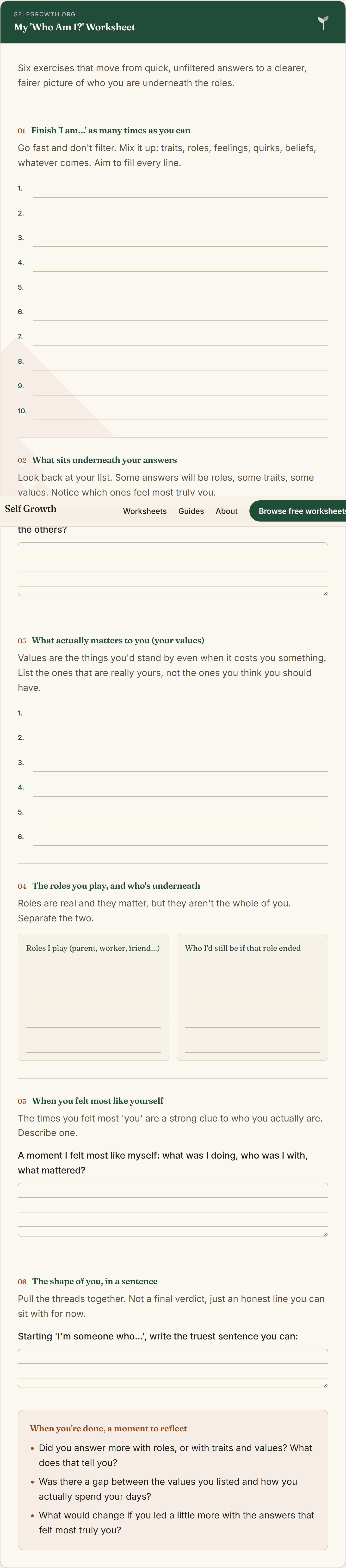
Who Am I? Worksheet
A free, printable 'Who am I?' worksheet to explore your identity, values and the person underneath your roles, with the classic twenty-statements exercise and guided prompts.
Open worksheet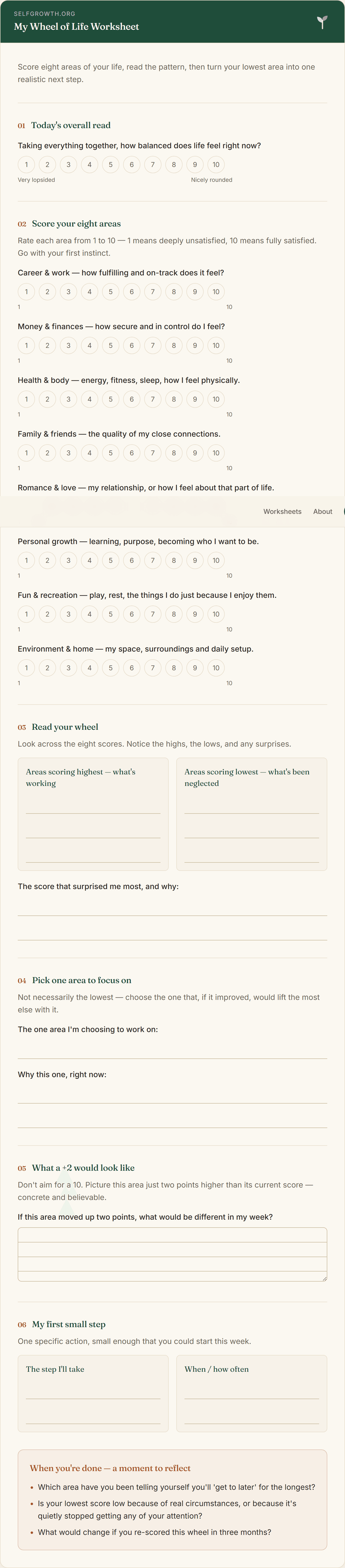
Wheel of Life Worksheet
A free, printable Wheel of Life worksheet. Score eight areas of your life out of ten, see where you're out of balance, and pick one to work on next.
Open worksheet
Goal-Setting Worksheet
A free, printable goal-setting worksheet that turns a vague wish into a specific goal, a when-and-where plan, and a first step you'll actually take this week.
Open worksheetNew worksheets, straight to your inbox
An occasional new worksheet or tool, sent only when there's something genuinely worth your time. No spam, no pressure, unsubscribe any time.